Bangladesh Air Force

No. You shouldn't comment without sufficient knowledge. BD has JL-8 and Yak-130 (1x squadron each) around 30 advanced trainer.

And 2x squadron of German grove T120 as basic trainer.

That's more than enough to prepare enough pilots for 1/2x squadron of advanced MRCA like Typhoon or J10CE.

In fact we have too many trainers compared to actual modern combat aircrafts.

Also, cost isn't the driving factor in capability acquisition. It is about satisfying the requirements first. We need to acquire something that would ensure qualitative edge over Myanmar AF. I.e. new gen Typhoon.
The concept of a training regimen involves streamlining, like an inverted pyramid, but BD has the opposite—a mix of multiple squadrons similar to what NAF has and QEAF had, which led them to outsource pilots. No BAF pilot will be able to fly a J-10CE or Typhoon in the next five years, though they might manage to fly a Jeff after one to two years of training. Cost plays a big role in these decisions; training for the Typhoon alone would cost $20–25 million per jet or more, as BAF is ill-equipped and undertrained. Logistics and support would add another $80–100 million per jet, making it roughly $130 million before even purchasing the aircraft. A better training program could help cut these costs significantly over the next five to ten years.
Just because BAF has one squadron of this and one squadron of that doesn’t make it the best in training—in fact, quite the opposite. With PAF, at least BAF will have a fighting chance over the next two decades. Acquiring capability and acquiring technical prowess are two different things—just ask the Indians. And as for the first part, your information comes from Wikipedia’s equipment sections, whereas my work is actually quoted in those areas, so I think I know what I’m talking about.
Yeah, that's why I am saying we should allocate resources to complete the development. A basic trainer isn't exactly rocket science.
Developing a basic trainer isn’t just about building the aircraft; it also involves creating extensive paperwork, which takes significant time and effort. That’s why it can be more practical to adopt the most commonly used trainer in the region. Take Turkey, for example—they have the R&D capability to develop one, but they’ve chosen not to waste time on it and instead focus their efforts elsewhere.
 
The concept of a training regimen involves streamlining, like an inverted pyramid, but BD has the opposite—a mix of multiple squadrons similar to what NAF has and QEAF had, which led them to outsource pilots. No BAF pilot will be able to fly a J-10CE or Typhoon in the next five years,

This type of outlandish claim would have some credibility if comes from someone who knows in and outs of BAF current organisation and institutions. (Then a credible assessment can be made on where BAF stands w.r.t to inducting and utilising new platforms and capabilities.) Which you don't.

though they might manage to fly a Jeff after one to two years of training. Cost plays a big role in these decisions; training for the Typhoon alone would cost $20–25 million per jet or more, as BAF is ill-equipped and undertrained. Logistics and support would add another $80–100 million per jet, making it roughly $130 million before even purchasing the aircraft. A better training program could help cut these costs significantly over the next five to ten years.
Just because BAF has one squadron of this and one squadron of that doesn’t make it the best in training—in fact, quite the opposite. With PAF, at least BAF will have a fighting chance over the next two decades. Acquiring capability and acquiring technical prowess are two different things—just ask the Indians. And as for the first part, your information comes from Wikipedia’s equipment sections,

Fighting chance against what?

There is no fighting chance against India with a dozen or 16x JF17.

Effective deterrence strategy against India require intergated assymetric warfighting CONOP that primarily depends on advanced long range IADS network for BAF, GMLRS + TBM, UAVs of all types, EW and C4ISR, short and medium range AD for army, and AIP Submarines for Navy. (Secondarily perhaps stealth aircrafts for BAF in the future when economy allows.)

Anything short of this (across all three services) won't provide a conventional fighting chance against an adversary like India. So that's not the concern here.

It's about our primary threat Myanmar. That's why it make more sense to get Typhoon as it is something out of their reach.

Any potential deal would include training and logistics. That's why budget estimated for 1 squadron of typhoon (12x jets) is around $2.5/2.9 billions. Leonardo already has a working relation with BAF. I can see both parties working out training and logistical matters just fine with that amount of investment.


whereas my work is actually quoted in those areas,

Sure mate.
 
Last edited:


BDMilitary
@BDMILITARY

🇧🇩 🇵🇰✈️ Bangali Pilots of the Pakistan Air Force (PAF)
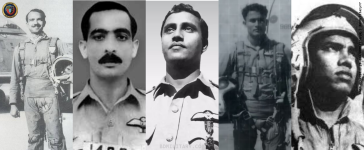
Their Skill, Sacrifice & Legacy built today's modern day Pakistan Air Force and Bangladesh Air Force.

1) Air Commodore Muhammad Mahmood Alam (MM Alam)

Born in Calcutta (British India), MM Alam became the most famous fighter ace of the PAF. During the 1965 Indo-Pak War, he was credited with shooting down five enemy aircraft in under one minute, a record often cited in air combat history. Awarded Sitara-e-Jurat.

2) Squadron Leader Sarfaraz Ahmed Rafiqui

Born in Rajshahi (now Bangladesh), Rafiqui was one of the bravest PAF fighter pilots of the 1965 war. He continued attacking enemy airfields despite heavy odds and was martyred in action. Honoured with Hilal-e-Jurat and Sitara-e-Jurat.

3) Group Captain Saiful Azam


A highly skilled Bengali fighter pilot, decorated with Sitara-e-Jurat for the 1965 war. Later flew combat missions in the Middle East on deputation and eventually joined the Bangladesh Air Force, serving the nation after independence.

4) Flight Lieutenant Waleed Ehsanul Karim

One of the youngest Bengali fighter pilots in the PAF, flying F-86 Sabres during the 1960s. Known for strong academic and flying performance at the PAF Academy, representing the technical excellence of Bengali air warriors.

5) Flight Lieutenant Matiur Rahman

A Bengali PAF pilot who attempted to defect with his aircraft in 1971 to join the Bangladesh Liberation War. He was killed during the attempt and was posthumously awarded Bir Sreshtho, the highest gallantry award of Bangladesh.

1767814477938.png
 
To view this content we will need your consent to set third party cookies.
For more detailed information, see our cookies page.
 
Bangladesh Air Force Shenyang FT-6 Ex Pakistan Air Force 10840, November 1998.

Zaroor ul Haq air base Chittagong

View attachment 166700
I read somewhere that during 1990s, after some great natural disaster in Bangladesh, Pakistan gifted some fighter aircraft to Bangladesh.

Is there any information on this, like quantity, serial numbers and their current status?
 
I read somewhere that during 1990s, after some great natural disaster in Bangladesh, Pakistan gifted some fighter aircraft to Bangladesh.

Is there any information on this, like quantity, serial numbers and their current status?
yes Pak gifted refurbished f6 to bd in 1980s
 
To view this content we will need your consent to set third party cookies.
For more detailed information, see our cookies page.
 
Super mushshak shouldn't be bought. We need to allocate the resources to develop the BBT-2 trainer fully.

View attachment 170308

It provides a good domestic solution for basic training.

JF-17 doesn't make much sense either.

Either Typhoon trench 4 or J10CE. Preferably Typhoon as Myanmar can't get it. (+ it has qualitative edge on anything Myanmar can get from Russia or China barring J-35.)

Only thing that makes sense to buy from Pakistan is Fatah-2 TBM. A good number of them. Preferably ToT with local production. Also collaboration on UAVs and loitering ammunition.

And of course training and exchanges with PA and PAF.
I agree on the mushaks. Nothing that we cannot make ourself at home besides the amount of basic trainer purchases we have done the last decade is enough atleast given the size of current force. BBT 2 should be matured into production instead but to be profitable BAF needs to expand production facilities and I think its time BAF consider setting up a defence company and IPO it to raise funds. Private investment can guarantee BAF innovation in the future. As for jf17... I disagree. It can easily be the workhorse of the fleet and maintenance crews should be familiar with its basic servicing related to engine atleast since migs use it too.

EFT should be a very specialised fleet which shouldn't be expanded... jf17 can be the work horse and j10s can assist or lead depending on operational needs

Rn I see Pakistanis claiming eft that BAF wants to purchase are existing European tranche 2s but I haven't heard any confirmation on that
 
To view this content we will need your consent to set third party cookies.
For more detailed information, see our cookies page.
 

Pakistan, Bangladesh reaffirm defence ties during high-level military meetings​


Bangladesh air chief meets CDF Munir, naval chief; discusses defence cooperation, regional security

Web Desk
January 08, 2026


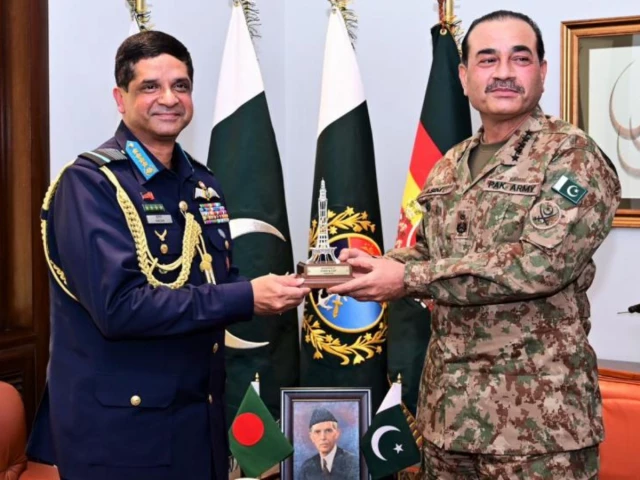
chief of defence forces field marshal syed asim munir calls on bangladesh air force chief air chief marshal hasan mahmood khan at the general headquarters in rawalpindi photo ispr


Chief of Defence Forces Field Marshal Syed Asim Munir calls on Bangladesh Air Force Chief Air Chief Marshal Hasan Mahmood Khan at the General Headquarters in Rawalpindi. Photo: ISPR

Pakistan and Bangladesh on Thursday reaffirmed the importance of strengthening professional collaboration and defence ties between their armed forces during a meeting between Chief of Defence Forces Field Marshal Syed Asim Munir and Bangladesh Air Force Chief Air Chief Marshal Hasan Mahmood Khan, the military’s media wing said.

According to a statement issued by the Inter-Services Public Relations (ISPR), the Bangladeshi air chief called on Field Marshal Munir at the General Headquarters (GHQ) in Rawalpindi.

“During the meeting, matters of mutual interest, regional security dynamics and avenues for enhancing bilateral defence and military cooperation were discussed,” the ISPR said, adding that both sides “underscored the importance of strengthening professional collaboration, training exchanges and defence ties between the armed forces of Pakistan and Bangladesh”.
 

Users who are viewing this thread

Back
Top