Tesla Vehicles Megathread

France
To view this content we will need your consent to set third party cookies.
For more detailed information, see our cookies page.

itworks.png

FSD Europe first impressions: MIND BLOWN!​

 
To view this content we will need your consent to set third party cookies.
For more detailed information, see our cookies page.

Tesla Full Self-Driving Did Something I Would’ve Missed​

 
Tesla didn’t lose to BYD because of cheap cars. It lost to better economics

Updated on: January 07, 2026 7:49 AM
Sam Bourgi
搜狗截图20260108171740.jpg
China’s BYD has taken the global crown in electric vehicles from Tesla, but the headline sales figures only hint at what’s really going on.

A closer look at the numbers reveals two very different businesses — and a growing long-term challenge for Tesla.

As InvestorsObserver reported, BYD sold roughly 2.2 million battery electric vehicles last year, comfortably surpassing Tesla’s 1.7 million and making it the world’s largest pure-play EV maker.

Those top-line figures, however, don’t tell the full story.

Despite selling cars at roughly half Tesla’s average selling price, BYD earns about the same gross profit per vehicle. That distinction matters far more than revenue or unit sales in a capital-intensive industry like automobiles.

Over time, it’s profit per unit, not price, that determines strategic power.

In other words, BYD isn’t winning by flooding the market with cheap cars and thin margins. It’s winning by building vehicles far more efficiently.

That efficiency creates a serious problem for Tesla. If BYD generates Tesla-like gross profit on much lower-priced vehicles, it has far more room to cut prices, expand into new segments, or absorb industry downturns without damaging its financial position.

In a price war, BYD can attack Tesla’s core price bands without sacrificing profitability, while Tesla has far less margin for error.

The dynamic was recently highlighted by entrepreneur and venture capitalist Glenn Luk, who co-founded Healthcare.com.

“That means BYD has double the gross profit to reinvest back into R&D, capex, marketing, and distribution,” Luk wrote, “and this is before accounting for the four-to-five-times difference in nominal per-employee costs.”

The implication is clear. BYD’s cost structure gives it excess cash flow that can be reinvested not just to defend the low end of the market, but to build and scale higher-end sub-brands, without ever needing to charge Tesla-level prices.

That’s the real reason BYD’s rise matters. It’s not just outselling Tesla today — it’s building a financial and operational advantage that compounds over time.

BYD’s competitive position strengthens​

BYD’s explosive growth has come with one notable absence: the United States. Even without operating in one of the world’s largest auto market, the Chinese automaker has still managed to surpass Tesla on the global stage.

BYD isn’t subject to a literal ban in the United States. However, a combination of steep import tariffs, regulatory hurdles, and vehicle certification requirements has effectively made the U.S. passenger car market commercially unviable for the company.

In 2024, BYD said it had no plans to enter the U.S. market, choosing instead to prioritize expansion across other regions, including Europe, Latin America, and parts of Asia.

Tesla, by contrast, has struggled to gain momentum in BYD’s home market of China. Tesla’s China sales totaled 531,855 vehicles in the first 11 months of 2025, putting the company on pace to fall well short of its full-year 2024 deliveries of 657,105 in the country.

 
Tesla didn’t lose to BYD because of cheap cars. It lost to better economics

Updated on: January 07, 2026 7:49 AM
Sam Bourgi
View attachment 170781
China’s BYD has taken the global crown in electric vehicles from Tesla, but the headline sales figures only hint at what’s really going on.

A closer look at the numbers reveals two very different businesses — and a growing long-term challenge for Tesla.

As InvestorsObserver reported, BYD sold roughly 2.2 million battery electric vehicles last year, comfortably surpassing Tesla’s 1.7 million and making it the world’s largest pure-play EV maker.

Those top-line figures, however, don’t tell the full story.

Despite selling cars at roughly half Tesla’s average selling price, BYD earns about the same gross profit per vehicle. That distinction matters far more than revenue or unit sales in a capital-intensive industry like automobiles.

Over time, it’s profit per unit, not price, that determines strategic power.

In other words, BYD isn’t winning by flooding the market with cheap cars and thin margins. It’s winning by building vehicles far more efficiently.

That efficiency creates a serious problem for Tesla. If BYD generates Tesla-like gross profit on much lower-priced vehicles, it has far more room to cut prices, expand into new segments, or absorb industry downturns without damaging its financial position.

In a price war, BYD can attack Tesla’s core price bands without sacrificing profitability, while Tesla has far less margin for error.

The dynamic was recently highlighted by entrepreneur and venture capitalist Glenn Luk, who co-founded Healthcare.com.

“That means BYD has double the gross profit to reinvest back into R&D, capex, marketing, and distribution,” Luk wrote, “and this is before accounting for the four-to-five-times difference in nominal per-employee costs.”

The implication is clear. BYD’s cost structure gives it excess cash flow that can be reinvested not just to defend the low end of the market, but to build and scale higher-end sub-brands, without ever needing to charge Tesla-level prices.

That’s the real reason BYD’s rise matters. It’s not just outselling Tesla today — it’s building a financial and operational advantage that compounds over time.

BYD’s competitive position strengthens​

BYD’s explosive growth has come with one notable absence: the United States. Even without operating in one of the world’s largest auto market, the Chinese automaker has still managed to surpass Tesla on the global stage.

BYD isn’t subject to a literal ban in the United States. However, a combination of steep import tariffs, regulatory hurdles, and vehicle certification requirements has effectively made the U.S. passenger car market commercially unviable for the company.

In 2024, BYD said it had no plans to enter the U.S. market, choosing instead to prioritize expansion across other regions, including Europe, Latin America, and parts of Asia.

Tesla, by contrast, has struggled to gain momentum in BYD’s home market of China. Tesla’s China sales totaled 531,855 vehicles in the first 11 months of 2025, putting the company on pace to fall well short of its full-year 2024 deliveries of 657,105 in the country.


um the picture isnt exactly all rosy for BYD

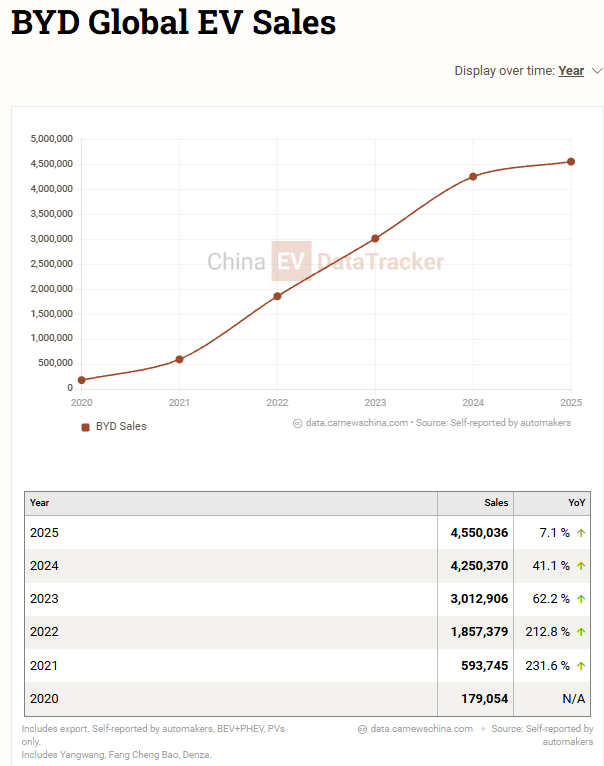
BYD sold 4.6 million cars in 2025, but outlook for 2026 weakens​


BYD sold 414,784 passenger vehicles globally in December, down 18.6% from the same month last year and down 12.7% from November. This is the fourth month of consecutive year-over-year decline. Overseas sales reached record-breaking 133,172 vehicles in December, up 133% from last year.

In December, BYD sold 190,712 battery electric vehicles (BEVs), down 8.2% from the same month last year (YoY). It is the first YoY decline in 2025 and only the third YoY decline in all-electric vehicle sales in the previous five years (the second was in February 2024 due to CNY, and the third in July 2024, otherwise there was only YoY growth since 2021).

BYD also sold 224,072 plug-in hybrid vehicles (PHEVs), down 25.7% year over year. This is the ninth consecutive month of PHEV sales decline, which started in April.

BYD ceased ICE-only vehicle sales in April 2022, focusing only on BEVs and PHEVs.
Note: We track passenger vehicle sales only; together with commercial vehicles and buses, sales are a bit higher – 420,398 units in December and 4,602,436 in 2025.

image-1.png


Editor’s comment​

Nothing grows forever, and BYD just learned that. BYD’s initial annual target was 5.5 million, with some speculation that it could reach 6.5 million at the beginning of the year. This was corrected to 4.6 million targets in September, which BYD somehow reached.

But 2026 is gonna be even more challenging for the largest Chinese NEV maker. The domestic sales are falling (BYD brand was 35% down in China in November, and it is expected that it will be down over 10% in 2025) as the Chinese government now scrutinizes their primary weapon of massive discounts, and dozens of other EV makers have proved to provide fair enough budget EVs (Geely and Leapmotor are celebrating). Folks in Shenzhen know that their 2026 performance will heavily depend on overseas markets and whether they will be able to continue winning hearts (and wallets) of buyers outside China. We will keep an eye on that.
 
um the picture isnt exactly all rosy for BYD

BYD sold 4.6 million cars in 2025, but outlook for 2026 weakens​


BYD sold 414,784 passenger vehicles globally in December, down 18.6% from the same month last year and down 12.7% from November. This is the fourth month of consecutive year-over-year decline. Overseas sales reached record-breaking 133,172 vehicles in December, up 133% from last year.

In December, BYD sold 190,712 battery electric vehicles (BEVs), down 8.2% from the same month last year (YoY). It is the first YoY decline in 2025 and only the third YoY decline in all-electric vehicle sales in the previous five years (the second was in February 2024 due to CNY, and the third in July 2024, otherwise there was only YoY growth since 2021).

BYD also sold 224,072 plug-in hybrid vehicles (PHEVs), down 25.7% year over year. This is the ninth consecutive month of PHEV sales decline, which started in April.

BYD ceased ICE-only vehicle sales in April 2022, focusing only on BEVs and PHEVs.
Note: We track passenger vehicle sales only; together with commercial vehicles and buses, sales are a bit higher – 420,398 units in December and 4,602,436 in 2025.

image-1.png


Editor’s comment​

Nothing grows forever, and BYD just learned that. BYD’s initial annual target was 5.5 million, with some speculation that it could reach 6.5 million at the beginning of the year. This was corrected to 4.6 million targets in September, which BYD somehow reached.

But 2026 is gonna be even more challenging for the largest Chinese NEV maker. The domestic sales are falling (BYD brand was 35% down in China in November, and it is expected that it will be down over 10% in 2025) as the Chinese government now scrutinizes their primary weapon of massive discounts, and dozens of other EV makers have proved to provide fair enough budget EVs (Geely and Leapmotor are celebrating). Folks in Shenzhen know that their 2026 performance will heavily depend on overseas markets and whether they will be able to continue winning hearts (and wallets) of buyers outside China. We will keep an eye on that.
Same for Tesla, EV competition is fierce, but all driven by Chinese brands.
 
um the picture isnt exactly all rosy for BYD

BYD sold 4.6 million cars in 2025, but outlook for 2026 weakens​


BYD sold 414,784 passenger vehicles globally in December, down 18.6% from the same month last year and down 12.7% from November. This is the fourth month of consecutive year-over-year decline. Overseas sales reached record-breaking 133,172 vehicles in December, up 133% from last year.

In December, BYD sold 190,712 battery electric vehicles (BEVs), down 8.2% from the same month last year (YoY). It is the first YoY decline in 2025 and only the third YoY decline in all-electric vehicle sales in the previous five years (the second was in February 2024 due to CNY, and the third in July 2024, otherwise there was only YoY growth since 2021).

BYD also sold 224,072 plug-in hybrid vehicles (PHEVs), down 25.7% year over year. This is the ninth consecutive month of PHEV sales decline, which started in April.

BYD ceased ICE-only vehicle sales in April 2022, focusing only on BEVs and PHEVs.
Note: We track passenger vehicle sales only; together with commercial vehicles and buses, sales are a bit higher – 420,398 units in December and 4,602,436 in 2025.

image-1.png


Editor’s comment​

Nothing grows forever, and BYD just learned that. BYD’s initial annual target was 5.5 million, with some speculation that it could reach 6.5 million at the beginning of the year. This was corrected to 4.6 million targets in September, which BYD somehow reached.

But 2026 is gonna be even more challenging for the largest Chinese NEV maker. The domestic sales are falling (BYD brand was 35% down in China in November, and it is expected that it will be down over 10% in 2025) as the Chinese government now scrutinizes their primary weapon of massive discounts, and dozens of other EV makers have proved to provide fair enough budget EVs (Geely and Leapmotor are celebrating). Folks in Shenzhen know that their 2026 performance will heavily depend on overseas markets and whether they will be able to continue winning hearts (and wallets) of buyers outside China. We will keep an eye on that.
And BYD is not the only EV maker China has

China’s NEV retail sales rise 17.6% in 2025, Chinese brand NEV exports jump 139%: report
By GT staff reporters
Published: Jan 09, 2026 07:38 PM

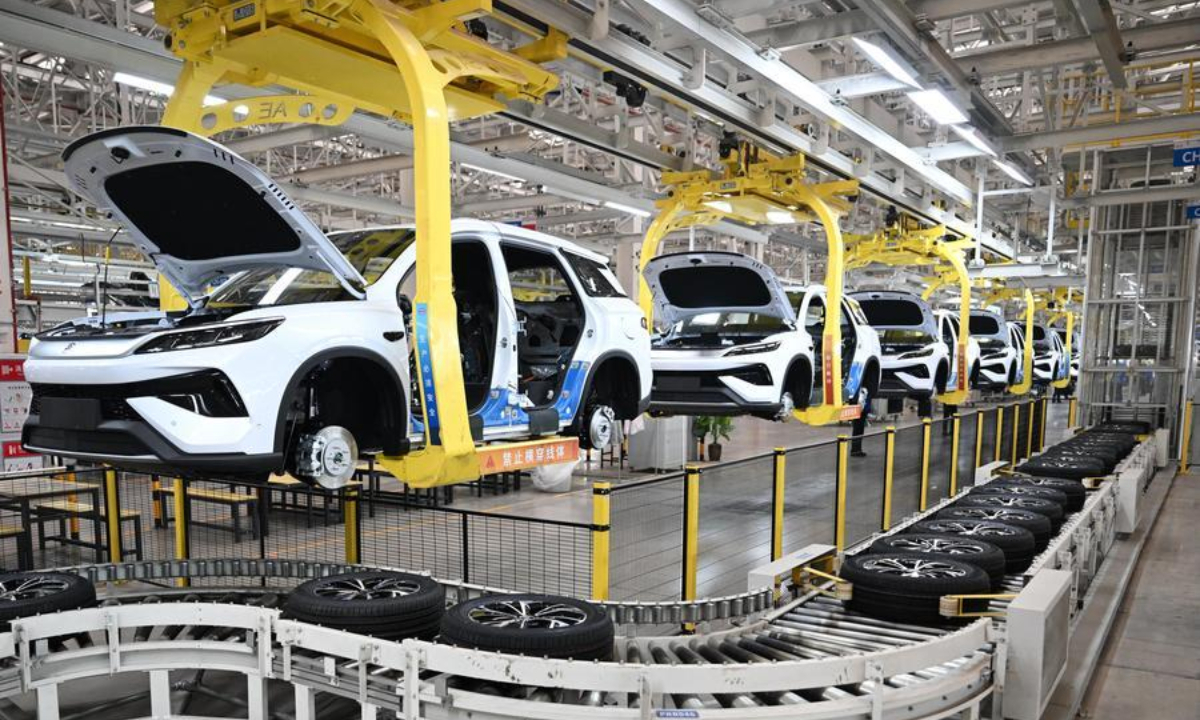
This photo taken on Nov. 3, 2025 shows a new energy vehicle (NEV) assembly line of BYD, China's leading NEV manufacturer, at the plant of BYD in Zhengzhou, central China's Henan Province.  (Xinhua/Li Jianan)

This photo taken on Nov. 3, 2025 shows a new energy vehicle (NEV) assembly line of BYD, China's leading NEV manufacturer, at the plant of BYD in Zhengzhou, central China's Henan Province. (Xinhua/Li Jianan)


China's new-energy vehicle retail sales totaled around 12.81 million units in 2025, up 17.6 percent year-on-year, data from the China Passenger Car Association (CPCA) showed on Friday, following robust growth in earlier wholesale figures.

Notably, exports of Chinese-brand new-energy vehicles reached 2.04 million units, surging 139 percent year-on-year, with new-energy models accounting for 49.5 percent of total exports by domestic brands, said CPCA.

China's passenger car exports are shifting from simply selling vehicles to exporting entire industrial chains, marking a transition from rapid volume expansion to a higher-quality phase of growth, the association said.

Experts said the resilience of China's new-energy vehicle market mainly stems from strong trade-in and scrap-page incentives, which have unlocked replacement demand, alongside intensifying competition and falling prices that are accelerating the shift from fuel-powered cars to electric models.

New-energy vehicles emerged as the standout segment in the association's latest domestic passenger car market analysis. In December, retail sales of new-energy passenger vehicles reached 1.337 million units, up 2.6 percent year-on-year and 1.2 percent month-on-month.

New-energy vehicles accounted for 59.1 percent of total domestic passenger car retail sales in December, an increase of 9.6 percentage points from a year earlier. Among Chinese-brand passenger vehicles, the penetration rate of new-energy models climbed to 80.9 percent during the month, according to CPCA.

On the wholesale side, new-energy vehicle penetration stood at 56.0 percent in December, up 6.6 percentage points from December 2024, the association said.

The performance was underpinned by solid momentum among the nation's new-energy passenger vehicle makers in December, as BYD reinforced its leadership with both battery electric and plug-in hybrid models, CPCA said.

Strong performances by leading new-energy vehicle makers helped lift the broader new-energy vehicle market.

BYD overtook Tesla in full-year battery-electric vehicle sales for the first time to become the world's largest seller, the Xinhua News Agency reported on Saturday.

BYD sold about 4.6 million new-energy vehicles in 2025, including roughly 2.26 million battery-electric vehicles, Xinhua said, citing data that also showed Tesla delivered about 1.63 million vehicles worldwide during the year.

China-based carmaker Geely Auto reported full-year sales of more than 3.02 million vehicles in 2025, exceeding its annual target, financial media outlet 36Kr reported on Sunday.

CPCA noted that national vehicle scrap-page renewal programs and local trade-in incentives effectively supported auto consumption in 2025. While passenger car retail growth softened to a 5 percent contraction in the fourth quarter, the association said some consumers adopted a wait-and-see stance toward year-end purchases, a shift that has also helped build momentum for the passenger car market in early 2026.

China's new-energy vehicle exports are showing higher-quality growth, with shipments increasingly directed toward the Middle East as well as developed markets, notably Western Europe and parts of Asia, CPCA noted.

The auto industry has strong linkages across the economy, driving demand in sectors such as steel, rubber, plastics and electronics, and generating a significant multiplier effect for local economies, making it a key pillar of the manufacturing system, Zhang Xiang, secretary-general of the International Intelligent Vehicle Engineering Association, told the Global Times on Friday.

As China's vehicle output and export volumes continue to expand, Chinese brands are gaining a larger share of the global market, with overseas consumers showing growing acceptance, placing the industry in a phase of rapid ascent, according to Zhang.


“A License to Print Money”: Tesla Stock (NASDAQ:TSLA) Notches Up as Lithium Refinery Goes Live​


To view this content we will need your consent to set third party cookies.
For more detailed information, see our cookies page.
 
Not surprised the legacy automakers would dig their heels in.

i'm telling you car makers are not talking AI and FSD seriously..and they should

they are about to hook grok up to the cameras so it can see what you can see.

To view this content we will need your consent to set third party cookies.
For more detailed information, see our cookies page.

Here's a conversation with Grok while driving a 2026 Tesla Model S.​

 
Tesla breakthrough could allow the latest versions of FSD to run on older chips.

Tesla’s Secret Patent Could Save Millions of Older HW3 Cars​


One of the biggest concerns among longtime Tesla owners has always been hardware obsolescence. Buy a vehicle marketed as “Full Self-Driving capable,” and a few years later, a new computer arrives that seems to leave your car behind. A newly published Tesla patent suggests the company may have found a way to extend the life of older Hardware 3 (HW3/AI3) vehicles — without swapping out a single chip.

Earlier this week, Tesla published patent US20260017503A1, titled Bit-Augmented Arithmetic Convolution, first spotted and broken down by longtime industry watcher @tslaming. The core idea is surprisingly simple: allow modern, high-precision AI models to run on older, lower-precision hardware using clever math and software techniques instead of requiring brand-new silicon.

As @tslaming explains, Tesla has effectively patented a “mixed-precision bridge” that lets inexpensive 8-bit hardware perform tasks typically reserved for power-hungry 32-bit systems. This approach allows advanced neural networks — the kind used for Full Self-Driving and Tesla’s Optimus robot — to maintain high spatial and temporal accuracy without melting circuits or draining range.

In practical terms, Tesla splits higher-precision numbers into smaller chunks that HW3 can handle. A 16-bit value becomes two 8-bit parts, processed separately by the existing neural network accelerator and then recombined. The result is behavior closer to a 16-bit or even 32-bit system, achieved entirely through software and math tricks rather than new hardware.

Why does this matter? Tesla introduced HW3 back in 2019, when most AI workloads were designed around simple 8-bit math. Today’s Full Self-Driving models increasingly benefit from higher precision, especially for long-context memory — like remembering a stop sign that’s been out of view for 30 seconds — and stable object tracking. Traditionally, automakers would either downgrade the software or force owners into costly hardware upgrades.

This patent points to a third path. Tesla could run newer, more capable FSD models across AI3, AI4, and future AI5 systems, simply scaling efficiency rather than functionality. That’s especially relevant as Tesla has already confirmed a “FSD v14 Lite” release for HW3 cars later this year, and this breakthrough could help squeeze even more capability out of aging hardware.

There are trade-offs, including slightly higher latency and power usage, and camera limitations still apply. But the upside is significant: millions of Teslas could continue receiving FSD updates instead of aging out — buying owners more time before an upgrade becomes unavoidable.
 

“A License to Print Money”: Tesla Stock (NASDAQ:TSLA) Notches Up as Lithium Refinery Goes Live​


To view this content we will need your consent to set third party cookies.
For more detailed information, see our cookies page.

To view this content we will need your consent to set third party cookies.
For more detailed information, see our cookies page.


To view this content we will need your consent to set third party cookies.
For more detailed information, see our cookies page.

Game-Changer: Tesla Brings First North American Lithium Refinery Online!​

 
To view this content we will need your consent to set third party cookies.
For more detailed information, see our cookies page.


Tesla launches robotaxi rides without a human chaperone in Austin​


@F-22Raptor
@AZ_HighCountry
@Davey Crockett
@Get Ya Wig Split

To view this content we will need your consent to set third party cookies.
For more detailed information, see our cookies page.


Many..many..many..many years in the making gentlemen

2016
To view this content we will need your consent to set third party cookies.
For more detailed information, see our cookies page.
 
Last edited:
To view this content we will need your consent to set third party cookies.
For more detailed information, see our cookies page.


Tesla launches robotaxi rides without a human chaperone in Austin​


@F-22Raptor
@AZ_HighCountry
@Davey Crockett
@Get Ya Wig Split

Many..many..many..many years in the making gentlemen

2016
To view this content we will need your consent to set third party cookies.
For more detailed information, see our cookies page.

Looking forward to the first lost robotaxi to come up to NE Oklahoma with about an hour charge left.

Last summer had to break the news to a lady driving a Tesla, running low, the nearest charging station may be up in Independence, Kansas.

But if she can't get there, be very nice to a cattle rancher who may let her charge at a ranch along the way.
 
Looking forward to the first lost robotaxi to come up to NE Oklahoma with about an hour charge left.

Last summer had to break the news to a lady driving a Tesla, running low, the nearest charging station may be up in Independence, Kansas.

But if she can't get there, be very nice to a cattle rancher who may let her charge at a ranch along the way.

Won’t happen unless a traffic jam or somebody jacking up the A/C or heating. The car is smart enough to calculate the power needed to get to and back from somewhere. If it can’t it will just decline the ride.
 
Won’t happen unless a traffic jam or somebody jacking up the A/C or heating. The car is smart enough to calculate the power needed to get to and back from somewhere. If it can’t it will just decline the ride.

Unless a woman overrides it and ends up at my truck stop with a low battery in Oklahoma?
 

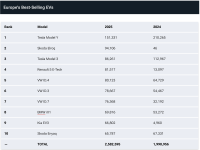
It’s no secret that Tesla had a tough run in Europe last year. After several years of outpacing legacy automakers in EV sales, 2025 brought a sharp reversal that few would have seen coming just a couple of years ago. The brand that once led the electric car race is now falling behind a familiar rival with a very different backstory.

Volkswagen sold more battery-electric vehicles in Europe than Tesla last year. Yes, VW, the same manufacturer that was mired in the diesel emissions scandal just as Tesla was gearing up for the Model 3, has now overtaken the American brand on its home turf.

topsellingevs.png


🤔 for the top 10:

Tesla: 151,331+ 86,261 = 237,592
VW: 80,123+78,667+76,368=235,158
 

Users who are viewing this thread

Latest Posts

Back
Top