
Navigation
Install the app
How to install the app on iOS
Follow along with the video below to see how to install our site as a web app on your home screen.
Note: This feature may not be available in some browsers.
More options
Style variation
You are using an out of date browser. It may not display this or other websites correctly.
You should upgrade or use an alternative browser.
You should upgrade or use an alternative browser.
US Economy - News, Updates and Discussion
- Thread starter Get Ya Wig Split
- Start date
More options
Who Replied?

kambhakt
Registered Member

But but...
The killer of Afghan Muslim babies comes back to try to troll me.
K2RULEZ
Elite Member
The killer of Afghan Muslim babies comes back to try to troll me.
When did I kill Afghan Muslim babies?
Shame on you and your country India.
U.S.-India trade deal stalled because Modi didn’t call Trump, Lutnick says
India has disputed Commerce Secretary Howard Lutnick’s account of the trade negotiations. Analysts say New Delhi is unused to Trump’s mercurial dealmaking style.


retaxis
Trusted Member


modi: Saar can i see you now before you redeem?When did I kill Afghan Muslim babies?
Shame on you and your country India.
U.S.-India trade deal stalled because Modi didn’t call Trump, Lutnick says
India has disputed Commerce Secretary Howard Lutnick’s account of the trade negotiations. Analysts say New Delhi is unused to Trump’s mercurial dealmaking style.

Hamartia Antidote
Elite Member


At Least Half of the $2 Trillion in Billionaire Wealth Have Left California | NextBigFuture.com
The total wealth that has left California is now $1 trillion.
 www.nextbigfuture.com
At Least Half of the $2 Trillion in Billionaire Wealth Have Left California
California had $2 trillion of billionaire wealth just a few weeks ago. Now, 50% of that wealth has left – taking their income tax revenue, sales tax revenue, real estate tax revenue and all their staffs (and their salaries and income taxes) with them.
In other words, by starting this ill conceived attempt at an asset tax, the California budget deficit will explode. And we still don’t know if the tax will even make the ballot. If the measures passes, it could be held up with lawsuit challenges.
California billionaires were reliable tax payers – 13.3% every year.
Unless this ballot initiative is pulled, we will not stop the billionaire exodus. With no rich people left in California, the middle class will have to foot the bill.
The “2026 Billionaire Tax Act” is a voter initiative backed by the Service Employees International Union–United Healthcare Workers West (SEIU-UHW) that aims to appear on California’s November 2026 ballot, provided it gathers around 875,000 signatures. It would impose a one-time 5% excise tax on the net worth (including all forms of personal property and wealth, tangible or intangible) of applicable individuals and trusts exceeding $1 billion.
Key details
It targets California residents (full- or part-year) as of January 1, 2026, with retroactive effect if passed. The January 1, 2025, backdating language was dropped to try and get something defensible and passable. There will be legal challenges.
Key Potential Lawsuits and Challenges
– Retroactivity and Due Process Violations (U.S. and California Constitutions)
The Act’s tax obligation is tied to residency on January 1, 2026—nearly 11 months before potential voter approval in November 2026. Challengers argue this creates a “harsh and oppressive” retroactive tax, violating the Due Process Clause (5th and 14th Amendments). Precedents like Carlton allow modest retroactivity for rational purposes
– Dormant Commerce Clause Violations
The tax applies to worldwide assets, potentially taxing wealth generated outside California without fair apportionment. Under the Complete Auto test, taxes must have substantial nexus, be fairly apportioned, non-discriminatory, and related to state services. Challengers (via attorney Alex Spiro’s letter to Gov. Newsom) claim it fails apportionment and burdens interstate commerce, especially for nonresidents or those with global holdings.
– Takings Clause and Equal Protection Violations (5th and 14th Amendments)
Critics like Spiro label it an “uncompensated confiscation of property” (Takings Clause) and discriminatory, concentrating burden on a tiny group (~200-250 billionaires) to solve general revenue issues, violating equal protection (citing Armour v. City of Indianapolis, 2012).
Counter proposals — Budget Stability Act of 2026
Raises the voter approval threshold to a two-thirds supermajority for passage of any statewide initiative that creates a one-time tax (directly targeting measures like the billionaire tax).
Exemptions are directly held real estate, pensions, and retirement accounts are excluded. However, real estate owned through businesses would be taxable.
Payment Structure. Due in 2027, but taxpayers can opt to spread payments over five years (with a small deferral fee/interest charge). Legal challenges may block passage and if passed could limit what goes into effect and will take years to resolve lawsuits.
Revenue Projection
Expected to raise approximately $100 billion over five years (or about $20 billion annually) from roughly 200 affected billionaires, primarily to offset federal cuts to healthcare (Medi-Cal), education, and food assistance programs. For example, someone with $20 billion in taxable net worth would owe $1 billion, while higher-net-worth individuals like Larry Page (estimated $258 billion) could face over $12 billion.
Broader Implications
Critics, including Palihapitiya, describe it as an “asset seizure” and warn that the fine print could enable future expansions to non-billionaires (taxing cars, homes, or jewelry). Supporters frame it as a fair, one-time contribution from those who have benefited most from California’s economy to address inequality and budget shortfalls, estimated at $19 billion annually for Medi-Cal alone under potential federal changes.
Legal and Economic Context
California’s Legislative Analyst’s Office estimates it could generate tens of billions in one-time revenue but lead to long-term annual losses of hundreds of millions in state income taxes if billionaires relocate.
The initiative is opposed by Governor Gavin Newsom and many tech leaders, who argue it could be blocked via lawsuit under provisions allowing the state to halt measures that impede governance
California’s top marginal rate is 13.3% on ordinary income and capital gains (treated as income). Billionaires often realize massive gains from stock sales, IPOs, or venture exits. If the $1 trillion in exited wealth previously generated even a conservative 5% annual return (e.g., via investments), that’s $50 billion in potential income/cap gains subject to tax—yielding about $6.65 billion annually in state revenue at the top rate. More realistically, with variable realizations (tech founders cashing out stakes), losses could exceed $10-20 billion per year statewide from reduced high-earner contributions.
Billionaires employ large staffs (household, security, administrative) and fund ventures that create jobs. A single billionaire’s operations might support hundreds of roles with salaries totaling tens of millions annually. At scale, the $1 trillion exodus could displace thousands of high-paying jobs (in tech, VC firms), leading to $5-10 billion in lost annual wage income statewide.

Beijingwalker
VIP Member
2026 Debt-to-GDP Surge: Economic Risks and Reforms for US, Japan
In 2026, soaring debt-to-GDP ratios signal economic vulnerabilities, risking defaults, stagnation, and reduced fiscal space in nations like the US (124.3%) and Japan (250%). High ratios crowd out investments and fuel inflation, but targeted reforms and growth policies offer pathways to stability. Vigilant monitoring is essential for sustainable prosperity.Written by Maya Perez
Monday, January 12, 2026
The Debt Shadow: Why Economies Tremble Under Mounting Debt-to-GDP Burdens in 2026
In an era where national debts soar to unprecedented heights, the debt-to-GDP ratio emerges as a critical barometer of economic health. This metric, which compares a country’s public debt to its gross domestic product, offers a snapshot of fiscal sustainability. As we navigate 2026, with global uncertainties amplifying, understanding why this ratio matters has never been more urgent. Economists and policymakers alike scrutinize it to gauge whether a nation can manage its borrowings without stifling growth or inviting crises.The ratio’s significance lies in its ability to signal potential vulnerabilities. A high debt-to-GDP figure suggests that a country might struggle to repay debts if economic output falters, potentially leading to higher interest rates, reduced investor confidence, and even sovereign defaults. For instance, historical precedents like Greece’s debt crisis in the early 2010s illustrate how ratios exceeding 100% can spiral into austerity measures and prolonged recessions. In today’s context, with inflation cooling but trade tensions rising, this metric helps forecast resilience against shocks.
Beyond immediate risks, the debt-to-GDP ratio influences long-term policy decisions. Governments with elevated ratios often face constrained fiscal space, limiting their ability to invest in infrastructure, education, or healthcare. This can perpetuate cycles of low growth, as seen in Japan, where a ratio hovering around 250% has coincided with decades of stagnation despite aggressive monetary policies. As 2026 unfolds, nations must balance debt accumulation with productivity-enhancing reforms to avoid such traps.
Rising Ratios and Global Pressures
Current data paints a concerning picture for major economies. The United States, for example, recorded a government debt-to-GDP ratio of 124.3% in 2024, according to Trading Economics. Projections suggest this could climb further amid ongoing fiscal deficits and interest payments surpassing $1 trillion annually. Posts on X highlight public alarm, with users warning that breaching 130% could trigger a “danger line,” potentially leading to fiscal dominance where monetary policy bows to debt management needs.
Emerging markets are not immune. India’s shift to targeting debt-to-GDP as its primary fiscal anchor starting in 2026-27 introduces flexibility but also challenges, as noted in a recent article from Livemint. Dwindling tax collections and slower nominal GDP growth could pressure this ratio, complicating efforts to maintain it below 60% for the central government and 20% for states. Analysts emphasize that revenue enhancement and expenditure efficiency will be key to navigating these hurdles.
On a global scale, Deloitte’s insights into the 2026 economic outlook reveal a dichotomy: advanced economies slowing under policy strains, while select emerging markets thrive through reforms. The report from Deloitte Insights underscores how high debt levels in developed nations could exacerbate slowdowns, particularly if interest rates remain elevated. This divergence highlights the ratio’s role in comparative economic analysis, influencing investment flows and currency stability.
Economic Impacts: Growth, Inflation, and Stability
The economic repercussions of a swelling debt-to-GDP ratio extend to growth trajectories. High debt burdens can crowd out private investment, as governments compete for capital, driving up borrowing costs. In the U.S., where the national debt nears $38 trillion, Treasury Secretary Janet Yellen has warned of approaching a “red line,” as reported by Fortune. This could usher in an era of fiscal dominance, where central banks prioritize debt sustainability over inflation control, potentially fueling price instability.
Inflation dynamics are intricately linked. While moderate debt can stimulate demand, excessive levels risk hyperinflation if monetized through money printing. The Guardian’s analysis of the 2026 global outlook predicts cooling inflation but flags risks from AI-driven growth uncertainties and trade policies, as detailed in their five charts feature. For countries like the Philippines, the World Bank notes that current debt-to-GDP levels are enviable, yet rebuilding fiscal buffers remains essential to weather future shocks, per BusinessWorld Online.
Stability concerns amplify in interconnected markets. A rising ratio can erode currency values, as investors demand higher yields to offset default risks. Historical data from the International Monetary Fund, accessible via their datamapper, shows patterns where ratios above 90% correlate with slower growth in advanced economies. In 2026, with geopolitical headwinds persisting, nations like India project 7.4% GDP growth despite challenges, as stated by RBI Governor Shaktikanta Das in Business Standard.
Policy Responses and Future Trajectories
Addressing high debt-to-GDP ratios demands multifaceted strategies. Fiscal consolidation, through spending cuts or tax hikes, is a common approach, though politically fraught. The U.S. Treasury’s Fiscal Data guide explains how the national debt functions and its impacts, available at U.S. Treasury Fiscal Data. Experts advocate for growth-oriented policies to expand the denominator—GDP—rather than solely reducing debt.
Innovation and technology play pivotal roles. AI investments, projected to add 1.6% to U.S. GDP in 2026 according to sentiment on X, could offset debt pressures by boosting productivity. However, as Wall Street Mav’s posts indicate, with debt potentially reaching $40 trillion by late 2026, interest payments could consume 40% of government revenue at 5% rates, underscoring the urgency for reforms.
International comparisons provide valuable lessons. A comprehensive overview from World Population Review ranks countries by their ratios, revealing stark contrasts. For instance, while Japan’s high ratio coexists with low interest rates due to domestic savings, others like Italy face borrowing premiums. In 2026, as per CNBC TV18’s report on India’s fiscal targets, slower GDP growth might cause slight slippage in debt metrics, prompting recalibrations for FY27–FY31, found at CNBC TV18.
Investor Sentiment and Market Reactions
Market participants closely monitor debt-to-GDP trends for investment cues. Elevated ratios often lead to bond yield spikes, as seen in recent U.S. Treasury auctions. Posts on X from users like Sheri Unfiltered emphasize the peril of approaching 130%, with crisis thresholds around 150%, potentially within 3–5 years at current paces. This sentiment fuels demand for alternatives like Bitcoin and gold, as noted in The Coin Republic’s updates.
For industry insiders, the ratio informs risk assessments. In sectors like finance and manufacturing, high national debt can translate to tighter credit conditions and reduced corporate borrowing. The Economic Advisory Council to the Prime Minister of India stresses fiscal deficit control and debt sustainability in the 2026 budget, as covered by Asianet Newsable, aligning with broader growth roadmaps.
Geopolitical factors compound these dynamics. Trade barriers and conflicts could inflate deficits, pushing ratios higher. Financer.com’s guide to the U.S. ratio in 2026 projects ongoing increases, with implications for economic stability, detailed at Financer. As one X post from $10 TRILLION warns, even with tariff revenues, U.S. debt-to-GDP might rise to 135% by 2035, exceeding World War II peaks.
Pathways to Mitigation and Optimism
Mitigation strategies include debt restructuring and international aid, though these are last resorts. Proactive measures, such as enhancing tax bases and promoting exports, can stabilize ratios. In the Philippines, the World Bank’s positive outlook encourages fiscal prudence without alarm, reinforcing that manageable debt supports development.
Optimism persists amid challenges. India’s resilient economy, projected at 7.4% growth, demonstrates how targeted policies can counter global headwinds. X discussions, like those from Jim Welsh, forecast okay GDP in the first half of 2026, buoyed by government deficits, AI spending, and tax benefits, potentially adding 0.7% to growth.
Ultimately, the debt-to-GDP ratio serves as a compass for navigating fiscal waters. By heeding its warnings, policymakers can foster sustainable growth, ensuring economies thrive rather than buckle under debt’s weight. As 2026 progresses, vigilant monitoring and adaptive strategies will be paramount to averting potential pitfalls.
Beijingwalker
VIP Member
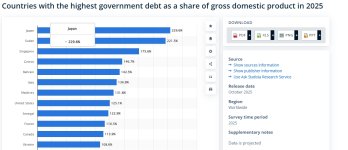
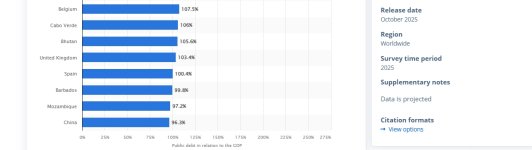

Highest debt-to-GDP ratio by country 2025| Statista
In 2025, Japan had the highest public debt level in relation to its gross domestic product, at almost 230 percent.
 www.statista.com


F-22Raptor
Elite Member
Real gross domestic product (GDP) increased at an annual rate of 4.4 percent in the third quarter of 2025 (July, August, and September), according to the updated estimate released by the U.S. Bureau of Economic Analysis. In the second quarter, real GDP increased 3.8 percent.
 www.bea.gov
Q3 GDP has been revised upward to 4.4% growth.
Gross Domestic Product, 3rd Quarter 2025 (Updated Estimate), GDP by Industry, and Corporate Profits (Revised) | U.S. Bureau of Economic Analysis (BEA)
Real gross domestic product (GDP) increased at an annual rate of 4.4 percent in the third quarter of 2025 (July, August, and September), according to the updated estimate released by the U.S. Bureau of Economic Analysis. In the second quarter, real GDP increased 3.8 percent.Due to the recent...
Q3 GDP has been revised upward to 4.4% growth.


AZ_HighCountry
INT'L MOD
I'll believe this when I see it.
j_hungary
Professional
I am still waiting on
1.) Groceries Price goes down
2.) Inflation Curbed
3.) Foreign Investment into America
4.) My $2000 tax return
5.) 36 trillion national debt paid off.
I will probably add this to my list of things I am waiting on.
Last edited:

VCheng
THINK TANK: CONSULTANT
I am still waiting on
1.) Groceries Price goes down
2.) Inflation Curbed
3.) Foreign Investment into America
4.) My $2000 tax return
5.) 36 trillion national debt paid off.
I will probably add this to my list of things I am waiting on.
Whatever gave you the idea that you would get any of those things?!

j_hungary
Professional
Well, the President of the United States said so, and I believe it.......Whatever gave you the idea that you would get any of those things?!
VCheng
THINK TANK: CONSULTANT
Well, the President of the United States said so, and I believe it.......
LOL. He can say with a straight face he never said any of those things.
Users who are viewing this thread
Total: 1 (members: 0, guests: 1)
Pakistan Defence Latest

Country Watch Latest
-

-
 Bangladesh Keen To Join Saudi-Pak-Turkey Defence Alliance, Says PM's Top Aide (11 Viewers)
- Latest: Bengal71
-

-
-

Latest Posts
-
-
Bangladesh Keen To Join Saudi-Pak-Turkey Defence Alliance, Says PM's Top Aide (11 Viewers)
- Latest: Bengal71
-
 Tesla's Optimus Robots to Enter Mass Production in 2025, Aims for 100,000 by 2026 (4 Viewers)
- Latest: Hamartia Antidote
-
-
 BREAKING : Cargo plane overshoots runway at Miami International Airport (12 Viewers)
- Latest: Ali_Baba