Turkish UAV/UCAV Projects

The comparison is a tailless air platform launching BVR missiles vs one that isn't tailless. The RCS advantage is clearly with the tailless delta wing.

Not neccesarily. Anka -3 has stuff sticking out of its airframe. Again, it's an experimental aircraft.
 
has stuff sticking out of its airframe.

Its a prototype for testing... The production variant obviously will not have such matters. lol, are you just arguing for the sake of arguing?
 
Its a prototype for testing... The production variant obviously will not have such matters.

1 -- Full of composite material to reduce its RCS
2 -- Internal weapon bays to reduce its RCS
3 -- RAM paint to reduce its RCS
4 -- The exhaust will be inside the body to reduce its RCS
5 -- The infrared trace will be reduced by mixing the cold air with the hot air of the engine

6 -- The V-shaped ANKA-III does not have horizontal and vertical stabilisation to reduce RCS


---------------------------------------------------------
---------------------------------------------------------

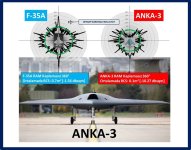
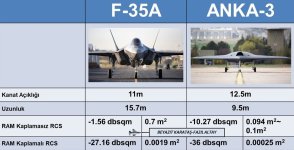
According to Defense analyst and radar technology expert Fazıl Altay

Geometrically, ANKA-3 is more stealthy than the F-35
The F-35A cannot detect the ANKA-3 from a distance more than 29 km on its own Radar

Without RAM ( approximately )
F-35A : 0,7 m2
ANKA-3 : 0,1 m2
1768263697419.jpeg
1768264924162.jpeg
 
ANKA-3 can perform air-to-ground missions carried out by the F-35
( autonomously, safely and economically )


What can the PATRIOT Air Defense System do against the ANKA-3 ?
According to Defense analyst and radar technology expert Fazıl Altay

▪️The PATRIOT uses C-band for target detection.
▪️Its performance at 120km is 1.5 m² RCS. The ANKA-3's C-band RCS is 0.002 m²
▪️In this case, the Patriot radar can only detect the ANKA-3 when it is at 23-25 km

and GAME OVER

ANKA-3 will carry munitions/missiles in internal weapon bays
-- 100+ km TOLUN-IIR guided munition ( IIR seeker )
-- 150+ km KUZGUN-TJ modular strike Missile ( IIR or RF seeker )
-- 150+ km CAKIR Cruise Missile ( IIR+RF hybrid seeker )
-- 275 km SOM-J Cruise Missile ( IIR seeker )


Therefore, since ANKA-3 will never approach the Radar within 23-25 km, PATRIOT can not fire at ANKA-3, but ANKA-3 can fire Missiles from 100-150 km away to hit the Patriot Radar
 
Its a prototype for testing... The production variant obviously will not have such matters. lol, are you just arguing for the sake of arguing?

Anka 3 with AESA and BVR kills anything Greece can deploy against it in BVR, even the F-35. That RCS is going to be incredibly small with no vertical stabilizers and without a cockpit. The only worry is stability in flight with a tailless design and close range combat and speed.

Your original argument was fundamentally flawed. This isn't about RCS only. Anka-3 simply does not have enough electricity to power sensors and avionics at scale that F35 does. Not even close. And It won't be supporting F35 like processing.

When I pointed that out, you claimed powerplant doesn't matter I'm BVR. And switched your argument to -Anka-3 won't even turn on its own AESA and it will be a node among many in a networked architecture and will just be the launching platform with fire control data coming from somewhere else.

Now that is a bit different argument than ANKA-3 taking on F35 with its AESA and BVR, isn't it.
 
Last edited:
Who says that ANKA-3 does not have enough electricity to power its AESA Radar ?


GROK Says


The ANKA-3 appears to have sufficient electrical power to operate the MURAD AESA Radar

The MURAD AESA Radar (especially the versions optimized for airborne platforms) has a highly manageable power consumption: The system operates on 28V DC and the maximum power consumption is approximately 350W (some sources state this value including the cooling system)

This is a remarkably low value for modern AESA radars; for example, some Fighter AESA Radars consume in the kW range, while the MURAD Radar is optimized with highly energy-efficient GaN technology


The F-35's detection range for the ANKA-3 is estimated to be around 25-40 km (some analyses mention figures like 28-34 km).

--------------------------------------------------------------
--------------------------------------------------------------

Thanks to its turbofan Engine, it provides sufficient electricity generation through its alternator/generator system. Similar jet-powered unmanned Platforms (such as KIZILELMA) operate the same Radar family without problems, and ANKA-3's electrical/cooling infrastructure is designed to be compatible with this integration

ANKA-3 has the electrical power and infrastructure to operate the MURAD AESA, integration is already planned and ongoing
 
GROK says

In a network-centric warfare environment (integrated with systems like E-7T AWACS, SIPER ), ANKA-3 poses a very serious threat. Thanks to MURAD AESA Radar, it can detect the F-35 from a greater distance and engage it with Gökdoğan/Gökhan; the fact that the F-35's radar detects ANKA-3 later provides an advantage

Türkiye's combination of unmanned aerial Vehicles, domestically produced AESA Radars, and long-range BVR Missiles is shifting the balance of power


----------------------------------------------------------
----------------------------------------------------------


7 ANKA-3 can match with 1 F-35 ?

GROK says

7 ANKA-3s have a very high chance of winning against a single F-35 — in fact, in most scenarios, the probability of winning is high (according to known data and analysis for early 2026). But this is not a one-on-one "dogfight"; modern BVR air combat is determined by network-centricity, sensor fusion, and numerical advantage

Note : Turkiye can produce 7 ANKA-3 in price of 1 F-35
 
Why would 7 ANKA-3s have an advantage against 1 F-35 ?


Single F-35 (AN/APG-81 + sensors)
7 ANKA-3s (MURAD AESA + Gökdoğan/Gökhan)

Who has the advantage? & Why? Radar Detection Range
Detects ANKA-3 at ~25-40 km (flying wing RCS estimates ~0.01 m², some analyses 28-34 km)

ANKA-3 group (7x) → Sees first, detects F-35 from much further away.
Numerical Superiority


Stealth Comparison
Very low RCS (best 5th generation)
Very low RCS (flying wing, some analyses claim it's even less visible than the F-35 from the front)
Close, but the ANKA-3 group balances with low RCS + numbers.


Sensor Fusion & EW
Superior (DAS 360° IR, EOTS, pilot awareness)
MURAD + EOTS/IR, but unmanned → less pilot load, swarm coordination
F-35 individually superior, but crushes 7 ANKA-3 swarms in the network (with E-7T AWACS, KORAL EW, ASOJ-23A , SIPER ground SAM support )

Missile Range & Number
AIM-120D ~180 km, but limited internal payload
Gökdoğan 100+ km (active radar), Gökhan ramjet → long range + numerous
Salvo fire from 7 platforms would overwhelm the F-35 (even the F-35's ECM manages a limited number of targets)

1 platform, limited missiles (generally 4-6 AIM-120D internally)
7 platforms → 28 Gökdoğan (100+ km) / Gökhan (ramjet, 200+ km potential) missiles


---------------------------------------------------------------
---------------------------------------------------------------

7 ANKA-3s vs 1 F-35 → The ANKA-3 group wins (highly likely)
Thanks to MURAD Radar, most of the group can detect F-35s from 80+ km away. Simultaneous salvo of 20+ missiles → The F-35's DIRCM/EW is saturated, at least a few missiles hit.

ANKA-3s take positions with swarm coordination (AI-supported loyal wingman), some becoming decoys while others engage. Even if the F-35 escapes, it is constantly tracked (low RCS advantage is reduced).
 
Murad AESA has 1152 TR Module which has consume 20w per module.

20x1152=23040W means 23 kW ,350W is way too small amount
 
The confusion arises from mixing up different types of power in AESA Radars

The Murad AESA radar (specifically variants like MURAD 110-A or MURAD 100-A for platforms such as F-16 Özgür upgrades, ANKA-3, or Kizilelma) is reported in reliable discussions and estimates to have around ~1152 TR modules (Transmit/Receive Modules), often GaN-based for better efficiency and power handling

You're correct that if each TR module consumed or output 20 W, then 1152 × 20 W = 23,040 W ≈ 23 kW. But that would typically refer to peak RF transmit power (or close to it) per module in pulsed operation—not the Radar's total system power draw from the Aircraft's electrical supply.However, the 350 W figure you've seen is almost certainly the radar's total electrical power consumption (input power from the platform, at 28V DC in the localized ECS/cooling system version). This is the power the entire radar system draws during operation, including:
  • The exciter, receiver, processors, beam steering electronics, etc.
  • Inefficiencies and cooling overhead.
This 350 W is not the radiated RF power—it's way too low for that.


----------------------------------------------------------
----------------------------------------------------------

Key distinctions in AESA Radar power:
  • Total system power consumption (input from aircraft): Often in the hundreds of watts to low kW for fighter/UAV nose radars (e.g., the Murad's reported max 350 W fits compact airborne systems with efficient GaN tech)

  • Peak radiated power (transmit power during pulses): Much higher, e.g., estimates for this Murad variant reach ~30 kW peak (from community analyses of photos and GaN module capabilities, assuming ~16-channel grouping or similar per TRM cluster).

  • Average radiated power: Lower still (e.g., ~1 kW or so in some analyses), limited by cooling capacity (airborne radars have strict thermal constraints—no massive liquid cooling like on big ships).


------------------------------------------------------------
------------------------------------------------------------

GaN TR modules are more efficient than older GaAs ones (higher PAE—power added efficiency), so they can deliver higher peak output per module while drawing less overall input power and generating less waste heat. Typical modern GaN airborne TRMs output 10–20 W peak RF per module (or more in clusters), but the radar doesn't run all modules at full power continuously—duty cycles, beam agility, and modes keep average power manageable

The 23 kW figure aligns with plausible peak transmit power for a 1152-element GaN array, while 350 W is the realistic total system draw—not a contradiction, just different metrics. Official ASELSAN pages don't publish exact numbers (classified/sensitive), but this matches patterns in similar radars (e.g., scaled-down APG-83 SABR or others).
 
23kW is the required antenna power at max
350w is the requried radar main board power,

you will need 350W + XXX W to run the radar
 
Can ANKA-3 detect the F-35 with KARAT IRST?


GROK says

Yes, ANKA-3 has the potential to detect the F-35 with KARAT IRST, but the exact distance and conditions remain confidential and depend on many variables ... ( Clouds, rain, humidity significantly reduce IR range )

While the F-35 is very difficult to detect by Radar, its IR (infrared) signature (engine exhaust heat, fuselage heat, friction heat, etc.) remains distinct.
The F-35's IR stealth capabilities are not as advanced as the F-22's (the exhaust nozzle cooling system is more limited)

---------------------------------------------------------
---------------------------------------------------------

Advantage/Disadvantage on the ANKA-3 + KARAT side
Situation on the F-35 side
IR signature
The F-35's engine (F135) gets quite hot → makes detection easier
IR reduction exists but is limited


Range
Modern IRSTs (PIRATE, OLS-35, etc.) can reach 80–150+ km (frontal aspect) → KARAT is expected to be similar or better
F-35 DAS is very powerful but more focused on missile detection

Passive advantage
ANKA-3 detects without emitting Radar → a huge advantage
If the F-35 activates its Radar, it will be found immediately


--------------------------------------------------------
--------------------------------------------------------

Based on theoretical and stated specifications, yes, the ANKA-3 KARAT IRST can detect the F-35, and under suitable conditions (especially if it approaches from behind or the F-35 is flying at high power), it can detect and track it from a fairly good distance, and even provide data for air-to-air Missiles (Gökdoğan, etc.)


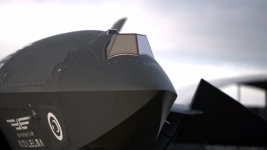
KARAT IRST was integrated into the KIZILELMA
1768301167624.png

KIZILELMA uses same turbofan Engine and KIZIELMA was equipped with MURAD AESA Radar + TOYGUN EOTS + KARAT IRST
 
Your original argument was fundamentally flawed. This isn't about RCS only. Anka-3 simply does not have enough electricity to power sensors and avionics at scale that F35 does. Not even close. And It won't be supporting F35 like processing.

When I pointed that out, you claimed powerplant doesn't matter I'm BVR. And switched your argument to -Anka-3 won't even turn on its own AESA and it will be a node among many in a networked architecture and will just be the launching platform with fire control data coming from somewhere else.

Now that is a bit different argument than ANKA-3 taking on F35 with its AESA and BVR, isn't it.

I didn't switch arguments, you made assumptions when you should have asked for further clarification. The entire premise is based on a networked warfare scenario where the only thing relevant is who takes the first shot and who gets detected first. The assumption here the ANKA 3 is in a network with AWACS and other aircraft, and its going forwards towards the merge, with the other side having their own aircraft and their own assets. The relevance here then is with Forward RCS and what sort of missile is being carried, b/c if its networked warfare, then the AESA matter is irrelevant, the engine matter is irrelevant, its functioning here as a CCA that is a tailless wing with air to air missiles carried internally. nothing else matters, not the engine(its arguable over engine exhaust), not its AESA, as all the guidance is being done by the AWACS via data link.
 
The relevance here then is with Forward RCS and what sort of missile is being carried, b/c if its networked warfare, then the AESA matter is irrelevant, the engine matter is irrelevant, its functioning here as a CCA that is a tailless wing with air to air missiles carried internally. nothing else matters, not the engine(its arguable over engine exhaust), not its AESA, as all the guidance is being done by the AWACS via data link.

Not only AWACS but also other land-naval Platforms such as ALP-300G early warning AESA Radar ( SIPER AD System ), VHF/UHF band passive Radars , CAFRAD and CENK-400N Naval AESA Radars ( TF-2000/ISTIF Warships )

also ASOJ-23A stand off jammer Aircraft to jam or degrade the Radar and sensor performance of the F-35


Greece doesnt have all these capabilities ... They will use only F-35s
NO unmanned stealth Fighter Jet
NO flying-wing stealth UCAV ( tailless )
NO stand off Jammer Aircraft
NO ground based Radar Electronic Warfare System
NO long range Early Warning Radars ( S , L , VHF/UHF band )

-------------------------------------------------------------

In a network-centric warfare environment (integrated with systems like E-7T AEWC , SIPER , TF-2000 , ISTIF , ASOJ-23A , KORAL-200 ) also KARAT IRST ; ANKA-3 poses a very serious threat. it can detect the F-35 from a greater distance and engage it with GOKDOGAN/GOKBORA BVR Missiles or SIPER AD Missile ; the fact that the F-35's radar detects ANKA-3 later provides an advantage

by network-centricity, sensor fusion and numerical advantage

To produce 7 ANKA-3 in price of 1 F-35
 
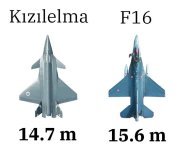
KIZILELMA vs F-16V in BVR Combat


GROK says :
Yes — KIZILELMA can beat F-16V in BVR

In pure 1-vs-1 BVR (Beyond Visual Range) combat, a Turkish Bayraktar Kızılelma has a realistic chance to beat a Greek F-16V Viper — and in many realistic scenarios it could even have the advantage — but it's not a guaranteed win for either side. The outcome depends heavily on tactics, numbers, supporting assets, electronic warfare, missile quality, launch conditions, and pilot (or operator) skill.Here's a breakdown based on known specs and demonstrated capabilities as of early 2026:Key Comparison Table

AspectBayraktar Kızılelma (current / near-term)Greek F-16V (Block 70 Viper)Edge?
Platform typeUnmanned (loyal wingman / autonomous-capable UCAV)Manned fighter— (different strengths)
RadarAselsan MURAD AESA (GaN-based) ≈ 250–300 km detection claimed, 120+ km trackingNorthrop Grumman AN/APG-83 SABR AESA (very mature)Roughly comparable (detection likely similar vs non-stealth targets)
RCS (stealth signature)Low-observable design (smaller + shaping)Conventional (higher RCS than Kızılelma)Kızılelma
Max speedSubsonic now (Mach ~0.9), supersonic variants plannedMach 2+F-16V (kinematics)
Service ceiling~35,000 ft~50,000+ ftF-16V
Main BVR missileGökdoğan (indigenous AMRAAM-class, active radar, 65+ km baseline, 100–180+ km variants possible)AIM-120C/D AMRAAM (D variant up to ~160–180 km in good conditions)Roughly comparable (both solid modern active radar missiles)
Missile carriageExternal (wing stations) → hurts stealth when loadedExternal (but more stations + higher energy launch)F-16V (more flexibility)
Situational awarenessAESA + IRST (KARAT) + EOTS, datalink to AWACS/other assetsAESA + Link-16 + HMD + pods, human pilotF-16V (human + mature NATO integration)
Cost / riskMuch cheaper, zero pilot riskExpensive, pilot at riskKızılelma (attritable)
Demonstrated BVRLive Gökdoğan kill vs jet target drone (2025), simulated F-16 lock at ~48 kmOperational AIM-120 launches (real combat proven)Kızılelma has newer public BVR demos


Who Wins in BVR — Realistic Scenarios
  1. Head-on, neutral merge, single missile exchange (clean config)
    Kızılelma has a meaningful edge
    Lower RCS + good AESA means it can often detect and shoot first (especially if Gökdoğan performs near its advertised range). The F-16V sees the Kızılelma later → missile launch advantage to the drone in many geometries.
  2. With datalink / AWACS support
    Either can dominate
    Both platforms shine when fed offboard targeting. Turkey's growing MUM-T (manned-unmanned teaming) with F-16s + Kızılelma swarms could overwhelm. Greece's mature NATO Link-16 integration is excellent too.
  3. Realistic squadron-level fight
    Kızılelma likely wins through numbers / attrition
    Kızılelma is cheaper and attritable. Turkey can produce/operate many more than Greece can replace F-16Vs. Losing 5–10 Kızılelma hurts less than losing one F-16V + pilot.

Bottom Line (2026 perspective)
Kızılelma is not just a "drone" anymore — it's a legitimate BVR-capable unmanned fighter with AESA + indigenous long-range missile proven in tests. In a pure stealth + first-shot BVR duel, it can beat (or at least strongly threaten) an F-16V more often than people intuitively think, especially head-on or when the drone shoots first.


-------------------------------------------------------------------------------------------------------

In a real Aegean scenario, quantity + integration + risk tolerance would likely favor Turkey's side more than pure 1v1 platform comparison suggests.

So yes — Kızılelma can beat F-16V in BVR, and in many plausible setups it would.

1768369799695.jpeg
 

Users who are viewing this thread

Back
Top