AI models are beginning to solve complex mathematical problems, surprising even the world's leading scientists

Hamartia Antidote

Elite Member
Joined
Nov 17, 2013
Messages
48,160
Reaction score
27,422
Reputation
465.6
Country of Origin
Country of Residence

Over the weekend, Neil Somani, a software engineer and former quantum mathematics researcher, decided to test what a new OpenAI model could do in mathematics. The result was unexpected: he uploaded a problem to the chat and gave the AI 15 minutes to think about it. Neil checked the resulting solution using the Harmonic tool — the proof was flawless and passed formal verification.

“I was interested in determining the baseline: what complex mathematical problems large language models can already handle and what they still can’t,” Somani said. The surprise was that with the use of the latter model, the frontier of AI capabilities began to shift somewhat forward.

ChatGPT's "chain of reasoning" is even more impressive: it confidently operates with such mathematical axioms as Legendre's formula, Bertrand's postulate, and the Star of David theorem, writes TechCrunch.

In the process, the model came across a 2013 Math Overflow post by Harvard professor Noam Elkis solving a similar problem. But the proof that ChatGPT published was not a simple copycat — it was fundamentally different from Elkis's version. What's more, the AI provided a comprehensive answer to a version of the problem by the legendary Pál Erdős, whose vast collection of unsolved problems became a veritable testing ground for AI.

This success is a real challenge for skeptics who do not believe in the possibilities of AI, and such cases are becoming more and more common. Artificial intelligence is everywhere in mathematics today: from the specialized Aristotle model for formal proofs to Deep Research for searching for scientific papers. But it was with the release of GPT 5.2 — which Somani calls significantly smarter than previous versions — that the volume of AI problems solved became so large that it is impossible to ignore. This raises new questions about the ability of LLM to expand the boundaries of human knowledge.

Somány analyzed the Erdős problems, a collection of more than 1,000 conjectures by the Hungarian mathematician that are publicly available. These problems, which vary greatly in subject matter and complexity, have become a tempting target for AI mathematics. While Google Gemini’s AlphaEvolve model showed initial success in November, Somány and his colleagues have recently found that GPT 5.2 is remarkably adept at solving high-level mathematical problems.

Since Christmas, the status of 15 problems on the Erdős website has been changed from "open" to "solved" — and in 11 cases, the notes to the solutions explicitly stated that artificial intelligence models were used in the process.

Renowned mathematician Terence Tao provides more modest statistics on GitHub . He highlights eight examples where AI has made progress on Erdős problems on its own, and six more where neural networks have helped by finding and refining old scientific papers. The time when AI will be able to do mathematics completely without human help is still a long way off, but the role of large models in this field is becoming increasingly important.

On Mastodon, Tao suggested that the scalability of AI systems makes them "better suited for systematic application to the 'long tail' of little-known Erdös problems, many of which actually have simple solutions."

“Thus, many of these simpler Erdős problems are now more likely to be solved solely by AI-based methods than by human or hybrid means,” Tao noted.

Another driving force is the recent shift toward formalization, a labor-intensive process that makes it easier to test and develop mathematical reasoning. Formalization does not necessarily require the use of AI or even computers, but the advent of new automated tools has greatly simplified the task. The open-source “proof assistant” Lean, developed at Microsoft Research in 2013, has become widely used in the field as a means of formalizing proofs, and AI tools such as Harmonic’s Aristotle promise to automate much of this work.

For Harmonic founder Tudor Achim, the sudden surge in Erdös problems is less important than the fact that the world’s top mathematicians are starting to take these tools seriously. “I’m more concerned about the fact that math and computer science professors are using [AI tools],” Achim said. “These people care about their reputation, so when they say they use Aristotle or ChatGPT, that’s the real evidence.”
 

XAI Grok 4.20 and OpenAI 5.2 Are Solving Significant Previously Unsolved Math Proofs​


mathproblem.png

A Mathematician with early access to XAI Grok 4.20, found a new Bellman function for one of the problems he had been working on with my student N. Alpay. Not an Erdős problem, but original research. Demonstrates AI generating novel math objects (Bellman functions for optimal control) quickly, linking to isoperimetric profiles and Takagi function (RH-related). It advances understanding of square function instabilities without changing the world immediately, but highlights AI’s role in “small steps” toward deeper insights in stochastic processes and analysis.

There have also been solving of decades old open significant math problems solved by OpenAI GPT 5.2.

Paul Erdős, the prolific Hungarian mathematician, posed over 1,000 open problems across fields like combinatorics, number theory, and graph theory. Many remain unsolved, with some offering cash prizes. Recently, large language models (LLMs) like OpenAI’s GPT-5.2 (released in late 2025) have made headlines for contributing to solutions, often autonomously or with minimal human guidance. These are tracked on the erdosproblems.com site, maintained by mathematician Thomas Bloom, and verified by experts like Terence Tao (Fields Medalist).

Overall, since Christmas 2025, 15 Erdős problems have been marked solved with 11 crediting AI involvement. Tao’s analysis is that there are 8 cases of meaningful autonomous AI progress, 6 where AI built on prior research.


AI doesn’t just generate initial proofs — it excels at iteratively refining them. For instance, in the process of turning raw AI-generated arguments into full research papers, tools like GPT can
– automatically rewrite sections for better clarity.
– Adjust phrasing, variable choices, or logical flow.
– Incorporate historical context, literature references, and natural-language explanations.
– Produce multiple drafts quickly, reducing the “feel of a generic AI-produced document” to something approaching acceptable research-paper quality.

In one specific example Tao referenced (around the autonomous solve of Erdős #728), the collaboration led to a new writeup of the proof that he judged as within ballpark of an acceptable standard for a research paper, with room for improvement but far beyond initial raw output.

Tao describes this as shifting proof-writing toward a search problem at scale. AI can generate thousands of mini-lemmas, variations, or exposition styles, then use checkers (like Lean) to validate and cull the weak ones, while humans focus on high-level direction. He calls this “vibe-coding” or rapid iteration — complementary to human strengths. There is useful vibe-math proofing. Enabling more possibilities to be considered more rapidly. A good human mathematician can have math research enhanced and sped up.

Why This Matters

Speed and Scalability — Traditional paper-writing involves months/years of manual revisions. AI compresses this to days or hours for drafts, allowing mathematicians to mass-produce high-quality expositions at scale. Tao has noted this could lead to more and more mass-produced mathematics, but in a positive sense. It will free experts for deeper insights.

From Assistant to Co-Author — Earlier AI was mostly for lookup, coding, or basic formalization. Now, with models like GPT-5.2, it’s handling smart, context-aware adjustments — guessing intermediate steps, rephrasing for rigor, or even suggesting structural changes — making it a true collaborator.

Broader Trend — This builds on Tao’s long-standing views (from 2023–2025) that AI will act as a co-pilot for math. They will accelerate verification, literature review, and now exposition/editing. He sees 2026-level AI as potentially trustworthy co-authors in many fields.

Tao remains measured. He stresses these are often lowest-hanging fruit (problems amenable to standard techniques), and AI still needs human oversight for creativity and intent. But the iterative refinement capability is a genuine paradigm shift in how math papers get produced.


The Bellman Function Work in Detail

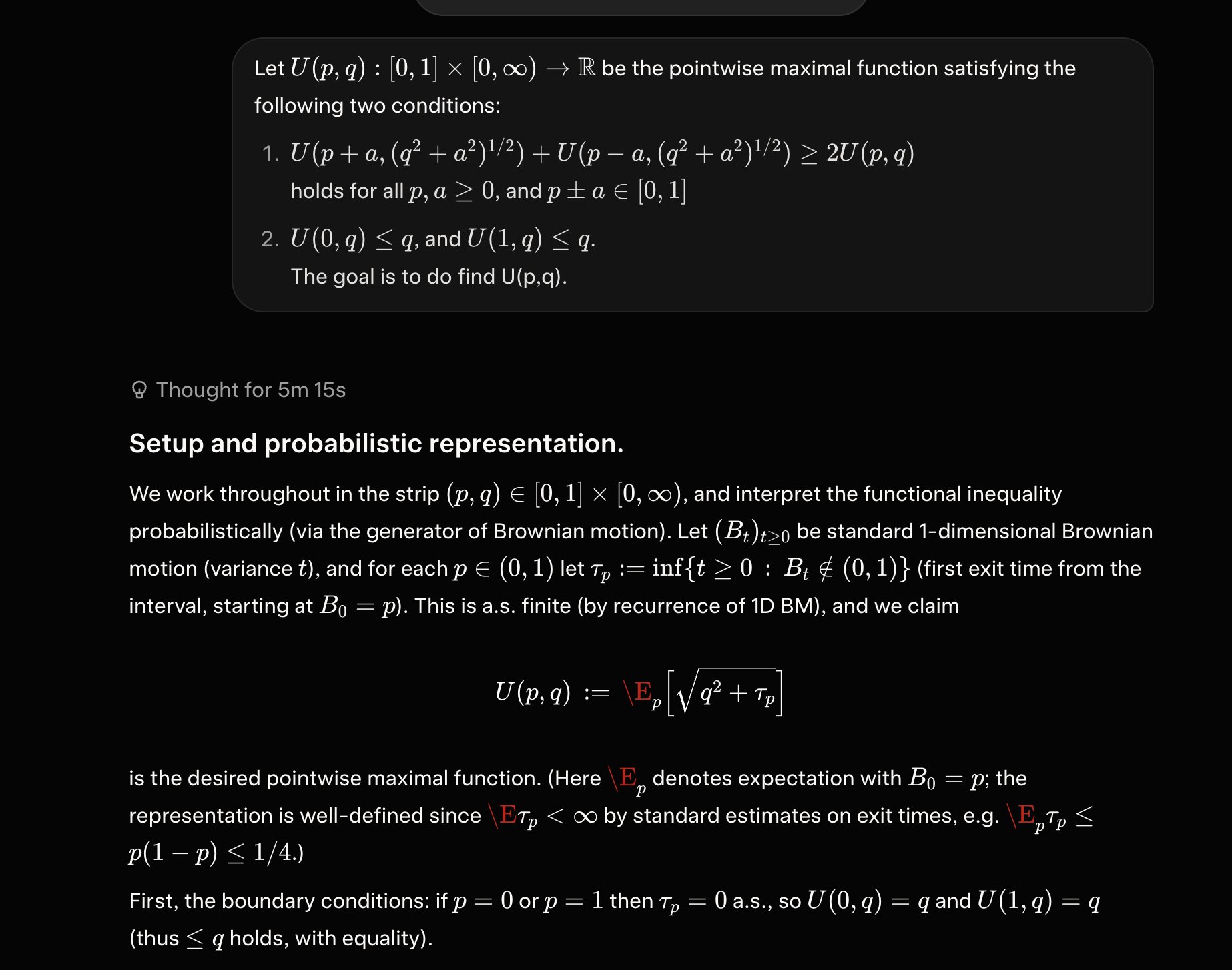
The problem reduces to identifying the pointwise maximal function U(p,q) under two constraints and understanding the behavior of U(p,0).

Their paper proved U(p,0)\geq I(p), where I(p) is the Gaussian isoperimetric profile, I(p) ~ p\sqrt{log(1/p)} as p ~ 0.

After ~5 minutes, Grok 4.20 produced an explicit formula U(p,q) = E \sqrt{q^2+\tau}, where \tau is the exit time of Brownian motion from (0,1) starting at p. This yields U(p,0)=E\sqrt{\tau} ~ p log(1/p) at p ~ 0, a square root improvement in the logarithmic factor.

Any significance of this result? It will not tell you how to change the world tomorrow. Rather, it gives a small step toward understanding what is going on with averages of stochastic analogs of derivatives (quadratic variation) of Boolean functions: how small can they be?

More precisely, this gives a sharp lower bound on the L1 norm of the dyadic square function applied to indicator functions 1_A of sets A \subset [0,1].

A previous tweet about Takagi function, they saw that the sharp lower bound on ||S_1(1_A)||_1 miraculously coincides with Takagi function of |A| which (surprisingly to me) is related to the Riemann hypothesis. Here, they obtain a sharp lower bound on ||S_2(1_A)||_1 given by E \sqrt{\tau}, where Brownian motion starts at |A|. This function belongs to the family of isoperimetric-type profiles, but unlike the fractal Takagi function, it is smooth and does not coincide with the Gaussian isoperimetric profile.


Finally, in harmonic analysis it is known that the square function is not bounded in L^1. The question here was more about curiosity: how exactly does it blow up when tested on Boolean functions 1_A. Previously, the best known lower bound was |A|(1-|A|) (Burkholder—Davis—Gandy). In our paper, we obtained |A| (1-|A|)\sqrt{log(1/(|A|(1-|A|)))}. This new Grok’s Bellman function gives |A| (1-|A|) \log(1/(|A|(1-|A|))) and this bound is actually sharp.

 
non sense, real test of progression is:
1. cancer cure
2. cheap fuel and free electricity

until then, it is only a ponzi scheme

now, ask yourself, would such an AI would ever exist?

just keep being the Negative Nancy and watch the world pass you by
 
non sense, real test of progression is:
1. cancer cure
2. cheap fuel and free electricity

until then, it is only a ponzi scheme

now, ask yourself, would such an AI would ever exist?
you want be a free loader living off others
 
I am not sure about the above math problem, but prediction and probability are the hardest problems to solve. Even Newton couldn't model the stock exchange trend. It also applied to fluid dynamics, policy making, etc.
For cancer treatment, etc, the functions need continuous feedback. It is not like a boundary dependent that, once set, then you are predicting the next step. The number of variables keeps changing in such a model. Like game theory, it is an infinite game.
 
I am not sure about the above math problem, but prediction and probability are the hardest problems to solve. Even Newton couldn't model the stock exchange trend. It also applied to fluid dynamics, policy making, etc.
For cancer treatment, etc, the functions need continuous feedback. It is not like a boundary dependent that, once set, then you are predicting the next step. The number of variables keeps changing in such a model. Like game theory, it is an infinite game.


in other words:

AI still cant produce work like Markov Chain
 
AI still cant produce work like Markov Chain
Just googled that. I think this is still easy to model.
In cancer, the cell can mutate, so the variables change and so forth. Also, we do not know all the variables, unlike in Physics where at least the laws are fixed, even if the intermediate variables are unknown.

For instance, we don't know intermediate reactions, but a rich methane burn will give CO2, H2O and energy. The mass remains conserved. So, it is easy to predict overall but difficult to model each step. In biology, there are no as such fixed laws.
 
Western countries are just using AI to spy on own people.
 
Just googled that. I think this is still easy to model.
In cancer, the cell can mutate, so the variables change and so forth. Also, we do not know all the variables, unlike in Physics where at least the laws are fixed, even if the intermediate variables are unknown.

For instance, we don't know intermediate reactions, but a rich methane burn will give CO2, H2O and energy. The mass remains conserved. So, it is easy to predict overall but difficult to model each step. In biology, there are no as such fixed laws.


not denying AI utility, only pointing out, its incapabilities

can AI summarize all of the Newtonian physics in 10 lines for a 10 year old child?

human can, okay not in 10 lines, but humans can do a decent job!
 
Western countries are just using AI to spy on own people.


spying or tech. is a religion which is a spying tool

dont get me wrong, tech. is a wonderful innovation, like MRI scanners, but it is problematic when clashes with culture
 
i determine indeterminate truth!
btw, AI supposed to make banking betting operation too!
you all are AI fan, criticism too bitter han!
Chatgpt works well for a lot of things. It is still work in progress. People pontificating about AI is like saying internet is garbage in 1995
 

Users who are viewing this thread

Country Watch Latest

Back
Top