Pakistan-India Conflict 2025: News Updates and Discussion

I think indian military is convinced that Bahratis will get high on this modi churan.

Look at the F16s burning wreckages outside hanger. 😂
To view this content we will need your consent to set third party cookies.
For more detailed information, see our cookies page.

A miserable and truly obsessive qom. These societal characteristics make them dangerous but also vulnerable.
 
To view this content we will need your consent to set third party cookies.
For more detailed information, see our cookies page.
 
New video has appeared on Youtube of a wreckage (Possible Mig-29). Download before it gets blocked by India. Location: Ahlan Bala near Jammu. Was uploaded on 7th May morning but someone discovered it now. I guess @flyingorca posted the screenshot of this video in previous pages

To view this content we will need your consent to set third party cookies.
For more detailed information, see our cookies page.


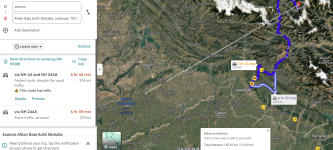
For Reference, It is 180 Km approx away from Infamous Dinga, Gujrat. My guestimate is the shot was taken at the range of 160-170 KM. This MIG-29 didnt know what was coming at it lol. Can someone geo location vis a vis what PAF disclosed where MIG 29 was shot down? And does it match with the video of Indian soldier video showing the wreckage?


To view this content we will need your consent to set third party cookies.
For more detailed information, see our cookies page.


1769174703505.png
 
Last edited:
New video has appeared on Youtube of a wreckage (Possible Mig-29). Download before it gets blocked by India. Location: Ahlan Bala near Jammu. Was uploaded on 7th May morning but someone discovered it now. I guess @flyingorca posted the screenshot of this video in previous pages

To view this content we will need your consent to set third party cookies.
For more detailed information, see our cookies page.


For Reference, It is 180 Km approx away from Infamous Dinga, Gujrat. My guestimate is the shot was taken at the range of 160-170 KM. This MIG-29 didnt know what was coming at it lol. Can someone geo location vis a vis what PAF disclosed where MIG 29 was shot down? And does it match with the video of Indian soldier video showing the wreckage?


To view this content we will need your consent to set third party cookies.
For more detailed information, see our cookies page.


View attachment 174118


the way I see it, PAF showed what a system based on merit and justice can achieve!
(mind you, IAF is one of the tech. savvy and leading Airforce and PAF stands no where in terms of budget!)
an institution which runs on:

1. Bravery and leadership;
2. fairness, justice, merit and proportionate rewards; and
3. Rewards on risk taking (without destroying fairness)
4. zero religious madness!

If whole Pak. start to work like these, we can achieve whole lot within 5 years!
 
New video has appeared on Youtube of a wreckage (Possible Mig-29). Download before it gets blocked by India. Location: Ahlan Bala near Jammu. Was uploaded on 7th May morning but someone discovered it now. I guess @flyingorca posted the screenshot of this video in previous pages

To view this content we will need your consent to set third party cookies.
For more detailed information, see our cookies page.


For Reference, It is 180 Km approx away from Infamous Dinga, Gujrat. My guestimate is the shot was taken at the range of 160-170 KM. This MIG-29 didnt know what was coming at it lol. Can someone geo location vis a vis what PAF disclosed where MIG 29 was shot down? And does it match with the video of Indian soldier video showing the wreckage?


To view this content we will need your consent to set third party cookies.
For more detailed information, see our cookies page.


View attachment 174118

I think this is same Ramban location where Mig29 was shot down
 
Interesting article, an Indian POV from the site War on the Rocks

Deep Learning From Operation Sindoor: Five Takeaways From a Four-Day War​

SAMEER LALWANI, SHAILENDER ARYA, AND DAVID BROSTOFF
January 22, 2026
War on the Rocks
( Note : Surprisingly the article glosses over the issue of whether Pakistan "begged" for a ceasefire)


Extract:
" In the aftermath of the conflict, analysts noted some basic takeaways. India was willing to cross new lines, take on more risk, and — following lessons from Ukraine and the Middle East — conduct air and missile strikes on targets deep inside its adversary’s territory. New Delhi also seemed to underestimate Islamabad’s capabilities and resolve, which reportedly resulted in some loss of assetseven while India asserted it too downed several Pakistani assets. While India may have won the military engagement on points rather than a knock-out, it failed to effectively communicate this to domestic and international audiences, suggesting New Delhi’s need for better strategic communications. Finally, escalation control — while asserted by India — was not self-evident to all parties, leading the United States and others to press for a ceasefire.

As has been argued in these pages, India’s brief but consequential war with Pakistan — known as Operation Sindoor — may turn out to be a crucible for longer-term Indian strategic and operational thinking. In the weeks and months since the war, five distinct lessons have emerged. First, New Delhi believes it can fight a conventional war below the nuclear threshold. Second, it has developed a preference for “non-contact” warfare. Third, the Indian military has identified — and is beginning to remedy — gaps in its capabilities. Fourth, New Delhi has reassessed the nature of the China-Pakistan threat. Finally, India reaffirmed its strategic ties with Russia.

These five lessons are by no means exhaustive, and they may not align with the core takeaways of some observers. Nevertheless, they are relevant for policymakers seeking to understand India’s strategic trajectory in the coming years. As a rising power with one of the largest economies and militaries, India’s lessons from the war and its subsequent actions will shape regional stability and U.S. interests in the Indo-Pacific. Moreover, as Washington deepens its partnership with New Delhi, India’s doctrinal shifts, evolving military capabilities, and power-balancing behavior demand closer attention."
 
One of the authors is retired Indian military fyi

it was sensibly written for a change, hence I think people should read it. They seem to have learnt on their gaps and are acting on lessons learnt. I don't agree with some of their conclusions, of course.
 
it was sensibly written for a change, hence I think people should read it. They seem to have learnt on their gaps and are acting on lessons learnt. I don't agree with some of their conclusions, of course.

Yeah, fair enough, no mention of terrible air combat losses makes it hard to take seriously though.....
 
To view this content we will need your consent to set third party cookies.
For more detailed information, see our cookies page.
 
Interesting article, an Indian POV from the site War on the Rocks

Deep Learning From Operation Sindoor: Five Takeaways From a Four-Day War​

SAMEER LALWANI, SHAILENDER ARYA, AND DAVID BROSTOFF
January 22, 2026
War on the Rocks
( Note : Surprisingly the article glosses over the issue of whether Pakistan "begged" for a ceasefire)


Extract:
" In the aftermath of the conflict, analysts noted some basic takeaways. India was willing to cross new lines, take on more risk, and — following lessons from Ukraine and the Middle East — conduct air and missile strikes on targets deep inside its adversary’s territory. New Delhi also seemed to underestimate Islamabad’s capabilities and resolve, which reportedly resulted in some loss of assetseven while India asserted it too downed several Pakistani assets. While India may have won the military engagement on points rather than a knock-out, it failed to effectively communicate this to domestic and international audiences, suggesting New Delhi’s need for better strategic communications. Finally, escalation control — while asserted by India — was not self-evident to all parties, leading the United States and others to press for a ceasefire.

As has been argued in these pages, India’s brief but consequential war with Pakistan — known as Operation Sindoor — may turn out to be a crucible for longer-term Indian strategic and operational thinking. In the weeks and months since the war, five distinct lessons have emerged. First, New Delhi believes it can fight a conventional war below the nuclear threshold. Second, it has developed a preference for “non-contact” warfare. Third, the Indian military has identified — and is beginning to remedy — gaps in its capabilities. Fourth, New Delhi has reassessed the nature of the China-Pakistan threat. Finally, India reaffirmed its strategic ties with Russia.

These five lessons are by no means exhaustive, and they may not align with the core takeaways of some observers. Nevertheless, they are relevant for policymakers seeking to understand India’s strategic trajectory in the coming years. As a rising power with one of the largest economies and militaries, India’s lessons from the war and its subsequent actions will shape regional stability and U.S. interests in the Indo-Pacific. Moreover, as Washington deepens its partnership with New Delhi, India’s doctrinal shifts, evolving military capabilities, and power-balancing behavior demand closer attention."
Indians would be dump fks if they think they can fight a conventional war with pak, destruction of refineries and some important industrial zones around Delhi would cause more damage to indian economy than whatever they can do to pak in terms of conventional engagement, dumb fks always learn the wrong lessons
 
To view this content we will need your consent to set third party cookies.
For more detailed information, see our cookies page.


Western media still trying their best to save some Indian pride (and confidence in their weapns systems)
 

Users who are viewing this thread

Pakistan Defence Latest

Back
Top