
Fatman17
Moderator

RUSSIA'S INTENSE AIR AND MISSILE DEFENCE OPERATION IN UKRAINE WAR
- Aviation Features
- Russia's intense air and missile defence operation in Ukraine War
By Alexander Mladenov 27th July 2023
FEATURE
Alexander Mladenov examines Russia’s air and missile defence operations in its protracted and hotly contested war with Ukraine
Russia’s expansive multi-service GBAD (ground based air defence) network, supporting the invasion of Ukraine and incorporating a wide variety of capable assets supplied by the Russian Land Forces (RuLF), Airborne Troops (RuAT), Navy (RuN) and Aerospace Forces (RuASF), has been facing multiple operational challenges. Among the principal ones is countering the enemy tactical jet and combat helicopter attack operations, conducted as a rule at low and ultra-low level and often without crossing the highly contested front lines.
Ukrainian Air Force (UkAF) jets are also being involved in regular suppression of enemy air defence (SEAD) operations, unleashing US-supplied anti-radiation missiles on the known surface-to-air missile (SAM) positions as part of co-ordinated attacks on high-value targets, staged together with long-range rockets and artillery.
Another principal challenge for Russian GBAD calls for shooting down in an effective manner Ukraine’s Soviet-era Tochka and Tochka-U (SS-21 Scarab) short-range ballistic missiles (SRBMs) as well as the antiquated Tupolev Tu-141/143 jet-powered recce drones repurposed as surrogate cruise missiles.
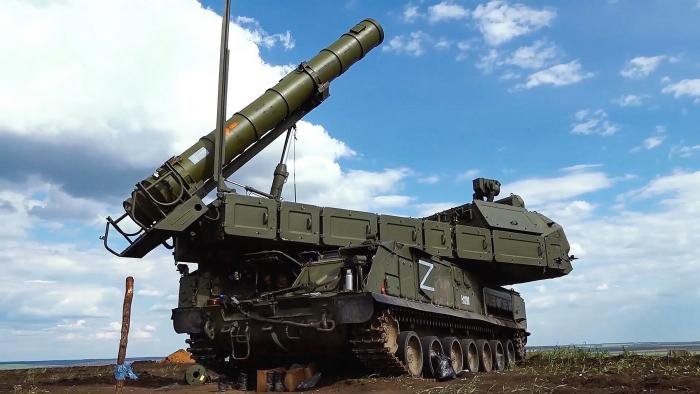
The Turkish-made TB2 Bayraktar reconnaissance/strike drones, operated by the Ukrainians in significant numbers from the outset of war, were also included in the list of the priority targets since the very beginning. In fact, the TB2s have fared quite well in the strike role in the initial and very chaotic days of the Russian invasion, delivering guided bombs with high accuracy on the invader’s armoured columns. The Bayraktars have even managed to destroy at least two Buk-M1-2/M2 (SA-17 Grizzly) radar-equipped launchers and two transporter-launcher vehicles, fully loaded with missiles, with the hits causing spectacular secondary explosions of their missiles.
It is noteworthy that the bombed SA-17 launchers, engaged near the city of Malin northwest of Kyiv and shown in combat video footage released by the Ukrainian MoD (taken by TB2’s own EO/IR sensor package), still had their missiles in stowed position, lacking any readies to fight, apparently due to the non-existent command-and-control system to warn on air attacks and protect the advancing troops at the time.

Later on, when the Russian GBAD eventually managed to establish well-functioning command and control facilities on most axes of advance of the troops on the ground deep into Ukrainian territory, the long and medium-range SAMs began showing their teeth. They shot down TB2s – at least seven examples were reported gunned down in March and April 2022 (based on visual proof), and nine more followed between May 2022 and late April 2023. A proportion of the shot-down TB2s were claimed by the RuASF’s fighter aviation branch and RuN warships above the Black Sea during the Snake Island battles in May-June 2022.
Finally, 15 months of full-blown war have shown that the Russian GBAD is still facing more than serious issues with the reliability and functionality of its identification friend or foe (IFF) system. During this time, its SAM systems have managed to gun down not fewer than five friendly aircraft, this figure including two Su-34s, one Su-35S and two Ka-52s. It has also been hinted that the four RuASF aircraft shot down on May 13 this year (one Su-34, one Su-35S and two Mi-8MTPR-1 electronic warfare helicopters), were also victims of friendly fire, but this “remarkable achievement” is yet to be confirmed by reliable sources.
Multi-service GBAD network
The GBAD assets deployed in the near-rear areas of the Russian troops in the occupied territories, drawn from all four military districts, are represented by RuLF’s Buk-M1-2/2 and Buk-M3 (SA-27) systems, augmented by Pantsir-S1s (SA-22 Greyhound), supplied by the RuASF. The list of the frontline GBAD systems includes RuLF Tor-M1s, Tor-M2Us and Tor-2MDs (SA-15 Gauntlet), complemented by Osa-AKM (SA-8 Gecko), supplied by both the RuLF and RuN plus numerous Strela-10M4 (SA-13 Gopher) systems, belonging to the RuLF and RuAT branches. The low altitude air defence was also strengthened with RuLF Tunguska (SA-19 Grison) SAM/AAA systems and ZSU-23-4 Shilka self-propelled anti-aircraft artillery pieces.
In addition, the rear and near-rear areas in the Donetsk and Luhansk regions (commonly known as Donbas) were covered from the very beginning by the S-300V1 and S-300V4 long-range systems, deployed by the RuLF and RuASF respectively, well-suited to engaging air targets deep in Ukrainian airspace. All the major urban and industrial centres and important military facilities in the occupied territories (including Crimea) and on Russian territory in the border areas were also placed under the protective umbrella of the RuASF’s SAM troops assets such as the Pantsir-S1, S-300PM-2 Favorit (SA-20 Gargoyle), S-400 Triumph (SA-21 Growler) and the newest medium-range system, the S-350 Vityaz.
The known S-300V1/V4 positions were established in the Kharkiv region (S-300V1) in the northern part of Ukraine and Svatove in Donbas (S-300V4) in the eastern area. In turn, a brand-new S-350 system was noticed deployed to protect Taganrog airfield in Russia, on the Sea of Azov coast, used by RuASF tactical combat jets and helicopters for regular raids against the Ukrainian positions in the Donbas region.

To improve the command-and-control abilities (most likely based on the unsatisfactory results from countering Ukrainian drone and rocket threats), in late February 2023 the GBAD systems of the RuLF, operating into Ukraine, were transferred under control of the RuASF.
HIMARS harassment
Since June-July 2022, all the medium and long-range Russian SAM systems deployed into the occupied territories have been facing the rather serious challenge to counter the Ukrainian regular long-range precise rocket strikes, delivered by the US-supplied Guided Multiple Launch Rocket Systems (GMLRS) munitions. These high-speed 227mm M31 rockets, using GPS guidance, fired by the M142 High Mobility Artillery Rocket Systems (HIMRAS) on truck chassis and the M270 Multiple-Launch Rocket Systems (MLRS) on tracked chassis, have proved a significant game-changer in the war in Ukraine.Boasting a range of up to 42nm, the highly accurate M31 rockets, provided with 200lb warheads, rapidly became a deadly effective weapon for pounding Russian ammunition and fuel depots, military headquarters, bridges, barracks and concentration of artillery, military vehicles and manpower in the near-rear areas. When unleashed in salvoes (sometimes combined with firings of unguided rockets from legacy Soviet-era systems to saturate the enemy air defences), the M31s have managed on multiple occasions to penetrate the defensive umbrella of the advanced Russian SAMs, which proved only capable of shooting down a proportion of the rockets flying towards the defended objects.

Russian SAM crews operating the Buk-M3 system tended to comment that the M31 rockets were extremely difficult targets to intercept (at least in the beginning) due to the combination of a very small radar cross section and very high speed (exceeding Mach 2.5 in the terminal phase of flight, diving towards the designated target), enabling a short window of opportunity for an effective engagement, up to ten seconds long. In such conditions, the Buk-M3, advertised as the most capable system to counter the M31, can unleash its missiles at about 12nm range, with hits achieved at 7-8nm.
M142 HIMARS systems have also been used occasionally for the Russian GBAD suppression purposes, targeting mainly the long-range early-warning radars, with at least two Podlet-K systems reported knocked out in 2022. One of these took hits at a position in the village of Lazurne, on the Black Sea coast, to the south of the city of Kherson, and the other was reported destroyed next Chornobaivka Airport, also near Kherson.





 At least 6 major Russian refineries are on fire after being hit by Ukrainian drones this evening.


