Russia-Ukraine War - News, Discussions & Updates

Status
Not open for further replies.

RUSSIA'S INTENSE AIR AND MISSILE DEFENCE OPERATION IN UKRAINE WAR​

  1. Aviation Features
  2. Russia's intense air and missile defence operation in Ukraine War


By Alexander Mladenov 27th July 2023
FEATURE

Alexander Mladenov examines Russia’s air and missile defence operations in its protracted and hotly contested war with Ukraine
Russia’s expansive multi-service GBAD (ground based air defence) network, supporting the invasion of Ukraine and incorporating a wide variety of capable assets supplied by the Russian Land Forces (RuLF), Airborne Troops (RuAT), Navy (RuN) and Aerospace Forces (RuASF), has been facing multiple operational challenges. Among the principal ones is countering the enemy tactical jet and combat helicopter attack operations, conducted as a rule at low and ultra-low level and often without crossing the highly contested front lines.
Ukrainian Air Force (UkAF) jets are also being involved in regular suppression of enemy air defence (SEAD) operations, unleashing US-supplied anti-radiation missiles on the known surface-to-air missile (SAM) positions as part of co-ordinated attacks on high-value targets, staged together with long-range rockets and artillery.
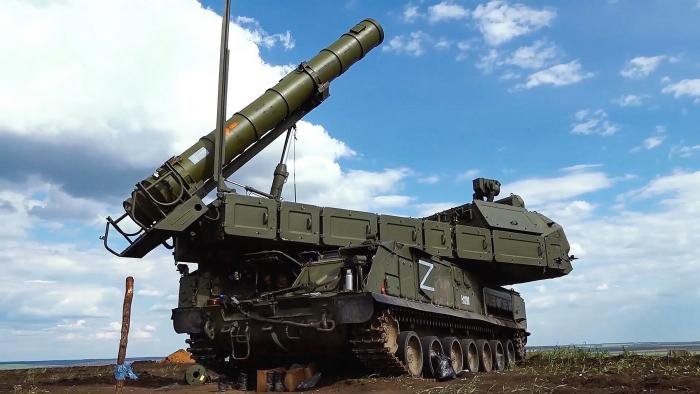
The Buk-M3 (SA-27), using highly mobile eight-round TELARs, is considered to be the most modern medium-range Russian GBAD system fielded for front-line use and protection of the rear areas, seeing active use to counter large-calibre rockets and short-range ballistic missiles, which can be engaged at ranges of up to 12nm
The Buk-M3 (SA-27), using highly mobile eight-round TELARs, is considered to be the most modern medium-range Russian GBAD system fielded for front-line use and protection of the rear areas, seeing active use to counter large-calibre rockets and short-range ballistic missiles, which can be engaged at ranges of up to 12nm Russian MoD
Another principal challenge for Russian GBAD calls for shooting down in an effective manner Ukraine’s Soviet-era Tochka and Tochka-U (SS-21 Scarab) short-range ballistic missiles (SRBMs) as well as the antiquated Tupolev Tu-141/143 jet-powered recce drones repurposed as surrogate cruise missiles.
The Turkish-made TB2 Bayraktar reconnaissance/strike drones, operated by the Ukrainians in significant numbers from the outset of war, were also included in the list of the priority targets since the very beginning. In fact, the TB2s have fared quite well in the strike role in the initial and very chaotic days of the Russian invasion, delivering guided bombs with high accuracy on the invader’s armoured columns. The Bayraktars have even managed to destroy at least two Buk-M1-2/M2 (SA-17 Grizzly) radar-equipped launchers and two transporter-launcher vehicles, fully loaded with missiles, with the hits causing spectacular secondary explosions of their missiles.
It is noteworthy that the bombed SA-17 launchers, engaged near the city of Malin northwest of Kyiv and shown in combat video footage released by the Ukrainian MoD (taken by TB2’s own EO/IR sensor package), still had their missiles in stowed position, lacking any readies to fight, apparently due to the non-existent command-and-control system to warn on air attacks and protect the advancing troops at the time.
The Buk-M3 SAM system, fielded in service with the RuLF in 2017, is advertised as the most effective battlefield system used in the war in Ukraine, highly automated and well-suited to counter large-calibre rockets such as the US-supplied M31 for the HIMARS and MARS systems
The Buk-M3 SAM system, fielded in service with the RuLF in 2017, is advertised as the most effective battlefield system used in the war in Ukraine, highly automated and well-suited to counter large-calibre rockets such as the US-supplied M31 for the HIMARS and MARS systems Russian MoD
Later on, when the Russian GBAD eventually managed to establish well-functioning command and control facilities on most axes of advance of the troops on the ground deep into Ukrainian territory, the long and medium-range SAMs began showing their teeth. They shot down TB2s – at least seven examples were reported gunned down in March and April 2022 (based on visual proof), and nine more followed between May 2022 and late April 2023. A proportion of the shot-down TB2s were claimed by the RuASF’s fighter aviation branch and RuN warships above the Black Sea during the Snake Island battles in May-June 2022.
Finally, 15 months of full-blown war have shown that the Russian GBAD is still facing more than serious issues with the reliability and functionality of its identification friend or foe (IFF) system. During this time, its SAM systems have managed to gun down not fewer than five friendly aircraft, this figure including two Su-34s, one Su-35S and two Ka-52s. It has also been hinted that the four RuASF aircraft shot down on May 13 this year (one Su-34, one Su-35S and two Mi-8MTPR-1 electronic warfare helicopters), were also victims of friendly fire, but this “remarkable achievement” is yet to be confirmed by reliable sources.

Multi-service GBAD network​

The GBAD assets deployed in the near-rear areas of the Russian troops in the occupied territories, drawn from all four military districts, are represented by RuLF’s Buk-M1-2/2 and Buk-M3 (SA-27) systems, augmented by Pantsir-S1s (SA-22 Greyhound), supplied by the RuASF. The list of the frontline GBAD systems includes RuLF Tor-M1s, Tor-M2Us and Tor-2MDs (SA-15 Gauntlet), complemented by Osa-AKM (SA-8 Gecko), supplied by both the RuLF and RuN plus numerous Strela-10M4 (SA-13 Gopher) systems, belonging to the RuLF and RuAT branches. The low altitude air defence was also strengthened with RuLF Tunguska (SA-19 Grison) SAM/AAA systems and ZSU-23-4 Shilka self-propelled anti-aircraft artillery pieces.
Remains of a Ukrainian-designed and built A1SM Fury (Furiya) affordable reconnaissance drone, shot down by the Russian air defences on the frontline
Remains of a Ukrainian-designed and built A1SM Fury (Furiya) affordable reconnaissance drone, shot down by the Russian air defences on the frontline via Russian internet
In addition, the rear and near-rear areas in the Donetsk and Luhansk regions (commonly known as Donbas) were covered from the very beginning by the S-300V1 and S-300V4 long-range systems, deployed by the RuLF and RuASF respectively, well-suited to engaging air targets deep in Ukrainian airspace. All the major urban and industrial centres and important military facilities in the occupied territories (including Crimea) and on Russian territory in the border areas were also placed under the protective umbrella of the RuASF’s SAM troops assets such as the Pantsir-S1, S-300PM-2 Favorit (SA-20 Gargoyle), S-400 Triumph (SA-21 Growler) and the newest medium-range system, the S-350 Vityaz.
The known S-300V1/V4 positions were established in the Kharkiv region (S-300V1) in the northern part of Ukraine and Svatove in Donbas (S-300V4) in the eastern area. In turn, a brand-new S-350 system was noticed deployed to protect Taganrog airfield in Russia, on the Sea of Azov coast, used by RuASF tactical combat jets and helicopters for regular raids against the Ukrainian positions in the Donbas region.
A RuASF Pantsir-S1 (SA-22) mobile SAM/AAA system on firing position protecting a helicopter forward operating site. These highly mobile systems are used for air defence of important infrastructure objects in the near-rear and deep-rear areas, and were also fielded in common manner for airfield protection
A RuASF Pantsir-S1 (SA-22) mobile SAM/AAA system on firing position protecting a helicopter forward operating site. These highly mobile systems are used for air defence of important infrastructure objects in the near-rear and deep-rear areas, and were also fielded in common manner for airfield protection Russian MoD
To improve the command-and-control abilities (most likely based on the unsatisfactory results from countering Ukrainian drone and rocket threats), in late February 2023 the GBAD systems of the RuLF, operating into Ukraine, were transferred under control of the RuASF.

HIMARS harassment​

Since June-July 2022, all the medium and long-range Russian SAM systems deployed into the occupied territories have been facing the rather serious challenge to counter the Ukrainian regular long-range precise rocket strikes, delivered by the US-supplied Guided Multiple Launch Rocket Systems (GMLRS) munitions. These high-speed 227mm M31 rockets, using GPS guidance, fired by the M142 High Mobility Artillery Rocket Systems (HIMRAS) on truck chassis and the M270 Multiple-Launch Rocket Systems (MLRS) on tracked chassis, have proved a significant game-changer in the war in Ukraine.
Boasting a range of up to 42nm, the highly accurate M31 rockets, provided with 200lb warheads, rapidly became a deadly effective weapon for pounding Russian ammunition and fuel depots, military headquarters, bridges, barracks and concentration of artillery, military vehicles and manpower in the near-rear areas. When unleashed in salvoes (sometimes combined with firings of unguided rockets from legacy Soviet-era systems to saturate the enemy air defences), the M31s have managed on multiple occasions to penetrate the defensive umbrella of the advanced Russian SAMs, which proved only capable of shooting down a proportion of the rockets flying towards the defended objects.
The RuLF Nyobii-S early-warning radars are operated in conjunction with mobile SAM systems such as the Buk-M3 on the front-line and in near-rear areas
The RuLF Nyobii-S early-warning radars are operated in conjunction with mobile SAM systems such as the Buk-M3 on the front-line and in near-rear areas Russian MoD
Russian SAM crews operating the Buk-M3 system tended to comment that the M31 rockets were extremely difficult targets to intercept (at least in the beginning) due to the combination of a very small radar cross section and very high speed (exceeding Mach 2.5 in the terminal phase of flight, diving towards the designated target), enabling a short window of opportunity for an effective engagement, up to ten seconds long. In such conditions, the Buk-M3, advertised as the most capable system to counter the M31, can unleash its missiles at about 12nm range, with hits achieved at 7-8nm.
M142 HIMARS systems have also been used occasionally for the Russian GBAD suppression purposes, targeting mainly the long-range early-warning radars, with at least two Podlet-K systems reported knocked out in 2022. One of these took hits at a position in the village of Lazurne, on the Black Sea coast, to the south of the city of Kherson, and the other was reported destroyed next Chornobaivka Airport, also near Kherson.
The S-300V1 (SA-12 Gladiator) is among the premier long-range SAM systems operated by the RuLF at the war theatre in Ukraine. Deployed in the rear areas of the occupied territories in the Donbas region in the east, the Kharkiv region in the northeast and the southern regions of Zaporozhiya and Kherson, the SA-12 has been tasked with countering both aircraft and ballistic missile threats
The S-300V1 (SA-12 Gladiator) is among the premier long-range SAM systems operated by the RuLF at the war theatre in Ukraine. Deployed in the rear areas of the occupied territories in the Donbas region in the east, the Kharkiv region in the northeast and the southern regions of Zaporozhiya and Kherson, the SA-12 has been tasked with countering both aircraft and ballistic missile threats Russian MoD
 
In addition to the HIMARS and MLRS, the Ukrainian military also uses the indigenous Vilkha-M system (firing 300mm guided rockets fitted with a 485lb warhead) boasting up to 60nm range, and the Turkish-supplied TRLG-230 system with up to 38nm range, capable of firing 230mm guided rockets, which are also among the target set of the Russian GBAD systems.
The Tochka and Tochka-U SRBMs fired by the Ukrainian forces frequently in the initial months of the invasion (and on rare occasions in 2023), were also on the list of priority targets for the long and medium-range SAM systems in Donbas and some Russian regions such as Krasonodar, Bryansk and Belgorod. However, there is no confirmed information of the kill ratio achieved, which would assess the real-world effectiveness of this category of anti-missile operations.

Facing the HARM threat​

Since August 2022, the Russian GBAD positions in Donbas and Kherson regions began to be regularly harassed by US-supplied AGM-88 high-speed anti-radiation missiles (HARMs). Launched from UkAF MiG-29 and Su-27 fighters, it is believed that a serious proportion of the HARM strikes have been mounted to grant better chances for the GMLRS guided rockets to penetrate the enemy GBAD umbrella or facilitate strikes by UkAF combat jets. To do this, HARMS are unleashed from low or medium altitude, in a co-ordinated manner, to service Russian SAM and radar positions in well-defended near-rear areas.
This is an ASU-01 Valkyrja recce drone wreckage, gunned down by the Russian forces
This is an ASU-01 Valkyrja recce drone wreckage, gunned down by the Russian forces via Russian internet
The method used to launch HARMs has been hurriedly modified for the MiG-29s and Su-27s, becoming the so-called pre-briefed mode, and it has been deemed to be largely ineffective. The missile is launched at a pre-calculated point reached by the fighter by using GPS navigation, as it is programmed to fly to a pre-planned area with known SAM activity. There is no lock-on of an enemy radar before launch, as it is hoped that lock-on on radar emissions could be achieved in flight. This is a low-effective employment method, which could be useful to apply additional psychological pressure on the SAM crews in the targeted area, disrupting their effective operations to counter other aircraft, missiles or rockets approaching or already inside their engagement zones.
At the beginning of the AGM-88’s daily use, the Russian MoD regularly released news on HARM missiles shot down by its GBAD network, and missile remains were shown on numerous occasions, but at a later stage no such announcements were released.
A well-camouflaged Russian Pantsir-S1 system in the war zone. In addition to combat jets and helicopters, these systems were also used to counter large-calibre rockets and short-range ballistic missiles
A well-camouflaged Russian Pantsir-S1 system in the war zone. In addition to combat jets and helicopters, these systems were also used to counter large-calibre rockets and short-range ballistic missiles Russian MoD
On May 12, 2023, the remains of a US-supplied ADM-160B MALD decoy missile were found after a powerful strike in the city of Luhansk, delivered with British-supplied Storm Shadow stand-off missiles, most likely unleashed by a modified UkAF Su-24M bomber.
Ukraine’s 155mm long-range artillery proved to be another important weapon used to systematically harass Russian SAM systems deployed into the frontline areas. The artillery pieces fire satellite-guided rounds with range of up of 21nm, operating with the invaluable targeting support of fixed-wing intelligence, surveillance and reconnisance (ISR) drones loitering into own or Russian-held airspace or over the front line and looking for targets in their assigned zones of interest.
Footage derived from an Ukrainian TB2 Bayraktar drone delivering devastating strikes on a TELAR and a TEL of Russian Buk-M1-2 SAM system near the city of Malin, northwest of Kiev, on February 28, 2022
Footage derived from an Ukrainian TB2 Bayraktar drone delivering devastating strikes on a TELAR and a TEL of Russian Buk-M1-2 SAM system near the city of Malin, northwest of Kiev, on February 28, 2022 Ukrainian MoD
The drones, utilising GPS navigation and outfitted with high-definition TV sensors, have proved well capable of supplying accurate enough positioning information on the targets, enabling engagement by Ukraine’s land-based long-range artillery in a prompt manner. The 155mm artillery, in particular, managed to successfully supress the Russian SAMs deployed to Snake Island in May-June 2022, which eventually prompted the Russians to abandon the hotly contested island.
Another SAM-busting method, adopted by the Ukrainian troops in the second half of 2022 and intensified in early 2023, calls for searching and destroying Russian SAM systems with affordable loitering munition, such as the US-supplied Switchblade 600 and the indigenously produced RAM II.

Jet-powered recce drones​

The Ukrainian recce jet drone fleet of Tu-141s, a 1970s-vintage design, was repurposed to be used as surrogate cruise missiles. Fitted with a makeshift warhead and flying at low and medium altitude deep into Russian-controlled airspace, these drones were initially easy targets for the Russian GBAD.
The first example was reported shot down by SAM systems while flying in the Crimea airspace during early March 2022, and a stray bomb-laden drone was found in Zagreb, Croatia, after crossing the airspace of Romania and Hungary unopposed on March 10. However, later on, the Ukrainians began equipping their Tu-141 fleet with a new flight control system to enable cruise flight at tree-top level, giving it quite a good chance of penetrating through the air defence belts set up on Russian territory. The wreckage of a modified Tu-141, fitted with an improvised warhead (an OFAB-100-120 fragmentation/high-explosive bomb was used for this purpose), was found on February 6, 2023, near the city of Kaluga, south of Moscow, with the crash most likely caused by hitting a tree after traveling between 220-240nm in Russian airspace.
Buk-M3 has emerged as a pretty capable SAM system, with all-round combat capability against all known categories of air, missile and rocket targets
Buk-M3 has emerged as a pretty capable SAM system, with all-round combat capability against all known categories of air, missile and rocket targets Russian MoD
Remains of another Tu-141, launched from Ukrainian territory, were also found on March 26 this year, in the Tula region south of Moscow, after penetrating the layered GBAD in the border regions of Russia, undetected yet again.
It is still unknown if modified Tu-141s were used to deliver the well-publicised strikes against the RuASF air bases at Engels, Ryazan-Dyagilevo, Shaykovka and Kursk-Khalino in December 2022 – at least a proportion of these attacks were undertaken by small-size, prop-driven, fixed-wing drones, launched by Ukrainian Special Operations Forces (SOF) teams operating on Russian territory.
In addition to countering the drone raids deep into Russian territory (which proved to be largely without results) in 2022 and 2023, the GBAD networks that were established in the border regions of Russia and in occupied Crimea were kept busy dealing with intrusions of slow-speed ‘suicide’ drones – unmanned aerial vehicles also known as loitering munitions – launched from Ukraine or from suitable places on Russian territory almost daily.
A Russian S-300V1 system deployed in Kharkiv region seen unleashing a 9M83 missile with range of up to 38nm
A Russian S-300V1 system deployed in Kharkiv region seen unleashing a 9M83 missile with range of up to 38nm Russian MoD
Initially, these threats were typically represented by the Chinese-made Skyeye 4450 drones, which can be easily purchased from the Alibaba web-based sales service. Fitted with a makeshift warhead (weighing up to 44lb) these affordable UAVs use accurate GPS navigation to fly to their designated target.
There were numerous occasions when such slow-speed explosive-laden drones managed to penetrate through the GBAD coverage at low altitude and deliver accurate hits on their targets. The most well-known was the suicide drone attack on June 21, 2022, against an oil refinery in Novshakhtinsk in Rostov region in southern Russia, causing a large fire. Then, a successful strike in similar manner followed against the headquarters of the Russian Black Sea Fleet in Sevastopol, Crimea on July 31, which yielded major propaganda as the extensive GBAD protecting the city was proved ineffective to provide any countermeasures.
A look inside the Buk-M3 TELAR vehicles, with operators siting at their consoles for detecting, tracking and engaging air targets
A look inside the Buk-M3 TELAR vehicles, with operators siting at their consoles for detecting, tracking and engaging air targets Russian MoD
 
It is also suspected that Chinese-made killer drones were used in the August 19, 2022, attack on Saki airfield (also known as Novofedorivka) in Crimea, which resulted in the explosion of ammunition dumps and destruction or serious damage of up to nine Su-30SM fighter-bombers and Su-24M bombers of the Russian naval air arm. There were numerous reports of Ukrainian slow-speed drones flying over the Black Sea next to Crimea, in the vicinity of Sevastopol, engaged by the Black Sea Fleet air defence last August, also believed to have been Skyeye 4450s.
In 2023, suicide drone raids on Sevastopol continued, but with much lower effectiveness due to Russian GBAD’s improved early warning capabilities and strengthened SAM presence and combat readiness.
The Russian layered GBAD, established on the mainland, also proved ill-suited to counter a daring night raid of a pair of Ukrainian Mi-24 attack helicopters, which set ablaze a fuel depot near Belgorod, flying at ultra-low altitude on April 1, 2022.
Operators of the Tor-2MU SAM system at work inside the armoured TELAR vehicle
Operators of the Tor-2MU SAM system at work inside the armoured TELAR vehicle Russian MoD
The GBAD coverage established in the border areas in the northern, northeastern and southern regions also proved ill-suited to cope with the combat operations of long-range, low and slow-flying suicide drones, used to good effect by the Ukrainians in April and May this year to strike numerous fuel depots, oil refiners and other industrial and military facilities, including important facilities in occupied Crimea, Krasnodar and the Voronezh region.
In February, a Ukrainian-designed UJ-22 Airborn prop-driven drone, fitted with a 44lb warhead, managed to penetrate undetected through the GBAD defensive belts next to the border with Ukraine and deep into Russian territory, and was eventually found crashed in a forest some 54nnm southeast of Moscow. On April 23, there was another explosive-laden UJ-22, discovered in a forest near the city of Noginsk, some 22nm south of Moscow’s city centre. It fell on the ground after running out of fuel, having travelled undetected for more than 250nm in Russian airspace.
Wreckage of a Ukrainian Tu-141 recce drone repurposed as a surrogate cruise missile, found on Russian territory
Wreckage of a Ukrainian Tu-141 recce drone repurposed as a surrogate cruise missile, found on Russian territory via Russian internet

GBAD score revealed​

According to US estimates found in leaked Pentagon documents (such as the Ukraine war intelligence briefings, allegedly uploaded on the internet by Massachusetts Air National Guard Airman First Class Jack Teixeira), revealed for the first time in early March that, as of mid-February 2023, Ukraine’s air power attrition caused by both Russian GBAD and fighters accounted for 60 combat jets and 32 helicopters.
A Russian Buk-M2 TELAR seen here at ready-to-fire position
A Russian Buk-M2 TELAR seen here at ready-to-fire position Russian MoD
According to the author’s research, the majority of UkAF fighter jet losses have been due to RuASF Su-35S and MiG-31BMs, which are also claimed to have gunned down a significant number of helicopters. The rest of the confirmed combat jet losses, including a sizeable proportion of Su-25 attack aircraft shot down by the Russians, are believed to have been achieved against aircraft flying at low and ultra-low altitude, engaged by short-range SAMs and man-portable air defence systems (MANPADS).
There is still little confirmed information on the combat exploits of the sophisticated GBAS systems when pitted against UkAF combat jets and helicopters employed in the ground attack, deep strike and SEAD roles. There is only confirmed information on one or two UkAF Su-25s claimed by Pantsir-S1 SAM/AAA systems in the area between the border of Crimea and the city of Kherson in the first days of war as well as another Su-25 gunned down in the Volnovakha area on March 14 last year, most likely by the OSA-AKM.
Wreckage of an UkAF Su-25 attack aircraft shot down on March 14, 2022, near Volnovakha, most Kiley by a Russian Osa-AKM shot-range SAM system
Wreckage of an UkAF Su-25 attack aircraft shot down on March 14, 2022, near Volnovakha, most Kiley by a Russian Osa-AKM shot-range SAM system via Russian internet

Drone-hunting operations​

At a later stage in 2022, when the Ukrainians began to field in a mass manner mini, small and tactical-class unmanned aircraft systems (UAS) for ISR – such as the Leleka-100, Valkyrja, Fury and FlyEye – the Russian GBAD began actively hunting for these drones operating in frontline areas. Osa-AKM, Tor-M1/M2, Tunguska and Strela-10M are the most used systems for this purpose, complemented by heat-seeking MANPADS (effective only against low-flying drones powered by internal combustion engines).
This is a Russian Podlet-K long-range early warning radar seriously damaged by Ukrainian rocket fire at Chornobaivka Airport near Kherson
This is a Russian Podlet-K long-range early warning radar seriously damaged by Ukrainian rocket fire at Chornobaivka Airport near Kherson via Russian internet
The increasing drone losses in enemy airspace or over the front line (both to SAMs and electronic warfare systems, this being especially true for the Chinese-built small-size commercial-grade multicopters) in some highly contested sectors are said to have prompted Ukrainian forces to restrict the use of their UAS there. Equipped with high-quality TV sensors, these changed the tactics to operate mostly from own airspace, staying outside the reach of the Russian short-range missiles in zones saturated with GBAD systems.
This UJ-22 Airborne drone, outfitted with explosive charge, was found on the ground near the Russian city of Kolomna, some 50nm southeast of Moscow’s city centre
This UJ-22 Airborne drone, outfitted with explosive charge, was found on the ground near the Russian city of Kolomna, some 50nm southeast of Moscow’s city centre via Russian internet
 
It is still difficult to assess the real-world effectiveness of the Russian GBAD when pitted against the omnipresent Ukrainian fixed-wing drones and large-size multicopters, used for ISR and strike missions on a daily basis.
The artillery and rocket fire corrections are among the most effective drone roles exercised by the Ukrainians in this full-blown war. Accurate and timely targeting facilitated by daily use of far-seeing high-definition sensors has enabled Ukrainian artillery to inflict heavy losses on Russian troops, ammunition dumps and military equipment deployed on the front line and in the near-rear areas.
According to Oryx, as of May 15 this year, there was visual proof available to confirm the combat loss of 111 Ukrainian reconnaissance and strike drones claimed destroyed (this figure excluding the small-size camera-equipped multicopters in the Mavic DJI-class). Of these, 56 were reconnaissance drones.
Wreckage of a gunned down TB2 Bayraktar tactical UAS
Wreckage of a gunned down TB2 Bayraktar tactical UAS via Russian internet
However, it is highly likely that the real number of Ukrainian drones lost in action well exceeds 150 as there is no confirmed information on any drone wreckage found on Ukrainian-held territory. In contrast, the Oryx data on the TB2 Bayraktar combat losses is deemed to be more or less accurate, with 18 examples listed as lost; 16 of these reported as having been gunned down in the war (by enemy fire) plus a further two shoot-downs due to friendly fire.

Topics​

Read more about
Thumbnail

Originally published in AirForces Monthly Magazine​

 
You don’t fear death?
Let’s get the fact straight. It’s Putin and Hamas they start the bloodshed.
No I don't.
I don't fear death. But I fear the punishment of almighty.
And you are still very delusional and stubborn.
You are bit even listening your inner voice. The voice of consciousness.
And NO.... It was Isra-hell who started ethnic cleansing and genocide of local Palestinians after occupying their lands in the same of "God's choosen people".
Well, I tried to wake you up. I did my duty. I am not doing it again as I will be blamed of thread derailing.
Live into your own fantasy until the day of judgement when the eye balls will not be visible due to fear.
 
What do you have to gain by sucking up to Israel and Westerners? Is is the trade deals that Vietnam gets?
Ach nonsense
If just the money we can suck up to the chinese. They told us Vietnam will become very rich if we become again part of Chinese imperialism. The fact we deny their offer multiple times says, money is not all we want.
 
FACTS!!!

To view this content we will need your consent to set third party cookies.
For more detailed information, see our cookies page.
 
Ukraine will be free that day. Get the clown ASAP...

To view this content we will need your consent to set third party cookies.
For more detailed information, see our cookies page.
 
To view this content we will need your consent to set third party cookies.
For more detailed information, see our cookies page.
 
To view this content we will need your consent to set third party cookies.
For more detailed information, see our cookies page.


To view this content we will need your consent to set third party cookies.
For more detailed information, see our cookies page.
 
Today is a very busy day in Russia!

▶️ At least 6 major Russian refineries are on fire after being hit by Ukrainian drones this evening.
▶️ Power plants in Leningrad oblast also burst into flames.
▶️ Soldiers and armor from pro-Ukrainian Russian rebel units have entered Russia and are fighting Russian forces in Belgorod.
▶️ A Russian Il-76 military plane crashed in Ivanovo.
 
To view this content we will need your consent to set third party cookies.
For more detailed information, see our cookies page.


An IL-76 crashed
 
2024 is a critical year for Russia. At current loss rates, their tank and IFV stocks will be depleted by 2026. By 2026, the US and Europe combined will be outproducing Russia in shell production. If they can’t make a breakthrough, it will likely never happen.

You said the same thing in 2022 would happen in 2024 :ROFLMAO:
 
Heeeeee Hooooooo, let's goooo!!!

To view this content we will need your consent to set third party cookies.
For more detailed information, see our cookies page.
 
Status
Not open for further replies.

Users who are viewing this thread

Pakistan Defence Latest

Back
Top
