China Science And Technology News

I hope China is the winner, and I hope China becomes the world's largest economy in NOMINAL GDP Terms. I think the world deserves it now.

But as constructive criticism for our Chinese friends, China is still behind USA economically, quite a bit. China still has some way to go. Best of Luck.

It will, and it already is.

After all, most AI scientists are Chinese.

Even in the US, half of them are Chinese.

It's impossible to say that China is not the world leader in AI research and development.
 
China's hard-on for AI is actually much greater than the US but US policy keeps AI industry pumped with resources. While China's gov also pushes AI and adoption, the overall attitude Chinese people have about AI is much more positive than overall western attitude.

Yes the US AI industry is basically Chinese run now with around half the engineers and scientists being Chinese born and educated. Every other group like Russians or Indians and local white Americans are a much smaller proportion.

Chinese people overall also have a bigger hard-on for AI whether thats the accessible generative AI kind or the real AIs.
 

AstraZeneca sets out $15 billion China investment during Starmer visit

Published 01/29/2026, 05:10 AM

LONDON/BEIJING - British pharmaceutical giant AstraZeneca announced Thursday it will invest $15 billion in China through 2030 to expand its research, development and manufacturing capabilities in the world’s second-largest pharmaceutical market.

The investment will focus on enhancing the company’s cell therapy and radioconjugates capabilities across the entire value chain, from drug discovery to manufacturing. AstraZeneca aims to become the first global biopharmaceutical company with end-to-end cell therapy capabilities in China, building on its acquisition of Gracell Biotechnologies earlier this year.

"Today’s landmark investment of $15 billion begins an exciting next chapter for AstraZeneca in China, which has become a critical contributor to scientific innovation, advanced manufacturing, and global public health," said Pascal Soriot, Chief Executive Officer of AstraZeneca, according to the press release.

The company plans to develop its existing manufacturing facilities in Wuxi, Taizhou, Qingdao, and Beijing, which currently supply medicines to China and 70 other markets worldwide. New manufacturing sites will also be established, though specific locations were not disclosed.

AstraZeneca expects to grow its workforce in China beyond 20,000 employees and create thousands of additional jobs across the healthcare ecosystem. The company currently employs over 17,000 people in China, which represents its second-largest market globally.

The announcement coincided with UK Prime Minister Keir Starmer’s visit to China and aims to strengthen healthcare innovation collaboration between the two countries. AstraZeneca is working to establish partnerships between British and Chinese research institutions, including the University of Oxford, University of Glasgow, and King’s College London.
 

World’s First 10G Internet Network, world record set in China​

April 28, 2025


World’s First 10G Internet Network, world record set in China

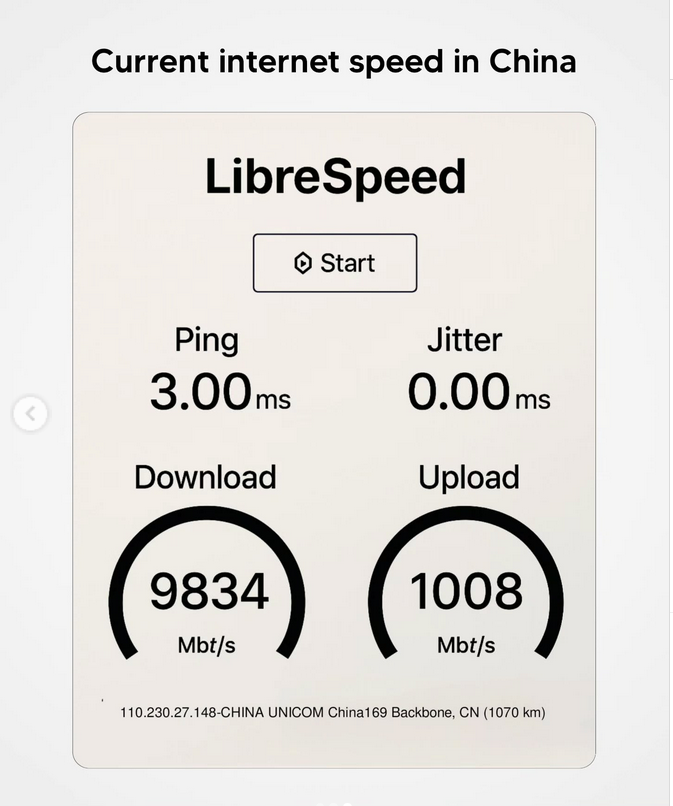
Sunan County, Hebei Province, China--Chinese telecom heavyweight Huawei and state-run operator China Unicom had launched a commercial 10-Gigabit (10G) broadband network in Sunan County, Hebei Province, marking a significant development in next-generation internet infrastructure; real-world tests recorded download speeds of up to 9,834 Megabits per second (Mbps), upload speeds reaching 1,008 Mbps, and latency as low as 3 milliseconds, thus setting the new world record for the World’s First 10G Internet Network, according to the WORLD RECORD ACADEMY.
World’s First 10G Internet Network, world record set in China

"China has launched the world’s first commercial 10-Gigabit (10G) broadband network, marking a significant development in next-generation internet infrastructure. The network went live in Sunan County, Hebei Province, as a joint initiative between state-owned telecom operator China Unicom and technology firm Huawei," The Express Tribune reports.

"According to the companies, the system is based on 50G Passive Optical Network (PON) technology, which dramatically boosts data transmission across existing fibre-optic cables.

"Real-world tests recorded download speeds of up to 9,834 Megabits per second (Mbps), upload speeds reaching 1,008 Mbps, and latency as low as 3 milliseconds. These figures reflect a tenfold improvement over conventional 1G broadband services."
World’s First 10G Internet Network, world record set in China

"The breakthrough, achieved in Sunan County of Hebei province, marks a major leap in internet connectivity, promising lightning-fast speeds that could redefine how people work, play, and communicate online," the News 18 reports.

"The 10G broadband service is the result of a collaboration between Chinese telecom heavyweight Huawei and state-run operator China Unicom. According to a report by The Economic Times, the network is capable of delivering download speeds of up to 9,834 megabits per second (Mbps), essentially 10 gigabits per second (Gbps), while upload speeds can reach 1,008 Mbps. More impressively, latency is reportedly as low as 0.003 seconds, a feature critical for real-time applications.

"This ultra-high-speed service is powered by next-generation 50G passive optical network (PON) technology, which significantly enhances data transmission over existing fibre-optic infrastructure. In simple terms, it’s a major upgrade to current broadband backbones, capable of handling enormous volumes of data with unprecedented efficiency."
World’s First 10G Internet Network, world record set in China

"China has taken a significant step in internet infrastructure by launching what is being described as the world’s first commercially viable 10G broadband network.Developed in collaboration between Huawei and the state-run China Unicom, the new high-speed network is now operational in Xiong’an, a smart megacity located roughly 70 miles southwest of Beijing in Hebei Province," the MSN reports.

"The newly deployed 10G network represents a culmination of advanced engineering and national strategy. It utilizes 50G Passive Optical Network (PON) technology, which significantly enhances data transmission capabilities over traditional fiber-optic systems.

"The implications of this network extend well beyond consumer internet access. In fields like virtual and augmented reality, telemedicine, and remote education, such connectivity can drastically improve functionality and user experience."

To view this content we will need your consent to set third party cookies.
For more detailed information, see our cookies page.


World’s First 10G Internet Network, world record set in China​

April 28, 2025


World’s First 10G Internet Network, world record set in China

Sunan County, Hebei Province, China--Chinese telecom heavyweight Huawei and state-run operator China Unicom had launched a commercial 10-Gigabit (10G) broadband network in Sunan County, Hebei Province, marking a significant development in next-generation internet infrastructure; real-world tests recorded download speeds of up to 9,834 Megabits per second (Mbps), upload speeds reaching 1,008 Mbps, and latency as low as 3 milliseconds, thus setting the new world record for the World’s First 10G Internet Network, according to the WORLD RECORD ACADEMY.
World’s First 10G Internet Network, world record set in China

"China has launched the world’s first commercial 10-Gigabit (10G) broadband network, marking a significant development in next-generation internet infrastructure. The network went live in Sunan County, Hebei Province, as a joint initiative between state-owned telecom operator China Unicom and technology firm Huawei," The Express Tribune reports.

"According to the companies, the system is based on 50G Passive Optical Network (PON) technology, which dramatically boosts data transmission across existing fibre-optic cables.

"Real-world tests recorded download speeds of up to 9,834 Megabits per second (Mbps), upload speeds reaching 1,008 Mbps, and latency as low as 3 milliseconds. These figures reflect a tenfold improvement over conventional 1G broadband services."
World’s First 10G Internet Network, world record set in China

"The breakthrough, achieved in Sunan County of Hebei province, marks a major leap in internet connectivity, promising lightning-fast speeds that could redefine how people work, play, and communicate online," the News 18 reports.

"The 10G broadband service is the result of a collaboration between Chinese telecom heavyweight Huawei and state-run operator China Unicom. According to a report by The Economic Times, the network is capable of delivering download speeds of up to 9,834 megabits per second (Mbps), essentially 10 gigabits per second (Gbps), while upload speeds can reach 1,008 Mbps. More impressively, latency is reportedly as low as 0.003 seconds, a feature critical for real-time applications.

"This ultra-high-speed service is powered by next-generation 50G passive optical network (PON) technology, which significantly enhances data transmission over existing fibre-optic infrastructure. In simple terms, it’s a major upgrade to current broadband backbones, capable of handling enormous volumes of data with unprecedented efficiency."
World’s First 10G Internet Network, world record set in China

"China has taken a significant step in internet infrastructure by launching what is being described as the world’s first commercially viable 10G broadband network.Developed in collaboration between Huawei and the state-run China Unicom, the new high-speed network is now operational in Xiong’an, a smart megacity located roughly 70 miles southwest of Beijing in Hebei Province," the MSN reports.

"The newly deployed 10G network represents a culmination of advanced engineering and national strategy. It utilizes 50G Passive Optical Network (PON) technology, which significantly enhances data transmission capabilities over traditional fiber-optic systems.

"The implications of this network extend well beyond consumer internet access. In fields like virtual and augmented reality, telemedicine, and remote education, such connectivity can drastically improve functionality and user experience."

To view this content we will need your consent to set third party cookies.
For more detailed information, see our cookies page.


Impressive. But most modern applications for consumer use cap out at around 50mbps downstream.

This has service sector and industry applications for sure.
 
Impressive. But most modern applications for consumer use cap out at around 50mbps downstream.

This has service sector and industry applications for sure.
My home internet speed is 1 Gbps.
The service package including home internet, TV service, and three mobile phone lines costs 78 RMB per month.
 
My home internet speed is 1 Gbps.
The service package including home internet, TV service, and three mobile phone lines costs 78 RMB per month.
Perhaps my post wasn't clear most consumer services like streaming, file sharing, virtual machines and gaming only require a max 50mbps downpipe.

@Khansaheeb laughing at my post like a goofball perhaps doesn't understand how IP Stream works.

Honestly for most houses unless you have 10 people all streaming on full HD - you will never cap out 1GBPS bandwidth.

Besides due to how access points, routers and devices work, you will never truly obtain 1gbps downstream speeds u less you are hardwired with a cat6e cable or above.

Most old phones and laptops can obtain max 150/500mbps downstream.

Wifi connections are much slower due to various factors including signal interference, SNR, blah blah.
 
Perhaps my post wasn't clear most consumer services like streaming, file sharing, virtual machines and gaming only require a max 50mbps downpipe.

@Khansaheeb laughing at my post like a goofball perhaps doesn't understand how IP Stream works.

Honestly for most houses unless you have 10 people all streaming on full HD - you will never cap out 1GBPS bandwidth.

Besides due to how access points, routers and devices work, you will never truly obtain 1gbps downstream speeds u less you are hardwired with a cat6e cable or above.

Most old phones and laptops can obtain max 150/500mbps downstream.

Wifi connections are much slower due to various factors including signal interference, SNR, blah blah.
I don't know how you use the internet.

In Chinese households, we frequently use the internet to watch TV, TV series, movies, and other video content. To achieve a 4K viewing experience, sufficient internet bandwidth is essential.

In a typical household, someone might be watching a 4K movie in the living room, someone else might be using their mobile phone, and another person might be playing games on a computer... To support this scenario, a minimum of 500Mbps internet bandwidth is required. Otherwise, video content will only be supported up to 1080P. 50Mbps internet bandwidth is definitely insufficient.

Previously, television programs were transmitted via separate signal channels, not using internet lines. Now, separate television signal channels still exist, but we typically don't use them; the vast majority of young people use internet television.
 
True.

The issue though is upstream from you. All of the existing infrastructure, especially legacy, will have an impact on what you ultimately receive.

In my current house, we have 600Meg and are hardly making a dent in the utilization. We will soon be starting the construction of the new house. The provider is running fiber in the street so I need to make sure to have a fiber handoff at the MPOE when the line is run to the house. From there, I am seriously considering CAT7 or even CAT8 for the drops needed in the house. Everything else will be wireless.
 
True.

The issue though is upstream from you. All of the existing infrastructure, especially legacy, will have an impact on what you ultimately receive.

In my current house, we have 600Meg and are hardly making a dent in the utilization. We will soon be starting the construction of the new house. The provider is running fiber in the street so I need to make sure to have a fiber handoff at the MPOE when the line is run to the house. From there, I am seriously considering CAT7 or even CAT8 for the drops needed in the house. Everything else will be wireless.
Yeh , in the UK we have 100G fiber in my street but only 1GB to my house. Guess they need to upgrade their exchange routers. yeh, i noticed its fiber to box in the street but then they send copper down to the house. As people aren't technical they like big numbers and are happy with that. I have CAT 8 in my house in the UK as I futured proofed my install. But my network card is 1GB will need to upgrade to the 10GB card and ask the provider to upgrade the connection to at least 10GB but they won't because the cheapskates wont spend the money to upgrade their routers. Why we need the huge bandwidth is the large number of game players and video conferences.
 
My home internet speed is 1 Gbps.
The service package including home internet, TV service, and three mobile phone lines costs 78 RMB per month.
78? That’s cheap. Here in Germany I pay 60 euros a month or almost 500 RMB a month for 1Gb fiberglass connection. I am looking to upgrade to 2.5 or 5Gb but the local carrier can’t deliver yet.
 
Chinese scientists build world-first 20GW microwave weapon that can fire 60-second bursts

Ground-based and compact Chinese technology can disrupt or damage Starlink satellites operating in low Earth orbit


1770326274107.png
Stephen Chenin Beijing

Published: 7:00pm, 5 Feb 2026

At the Northwest Institute of Nuclear Technology in Xian, Shaanxi province, sits an unremarkable-looking device called the TPG1000Cs.

It could become Starlink’s worst nightmare.

The TPG1000Cs is the world’s first compact driver for a high-power microwave (HPM) weapon, capable of delivering an extraordinary 20 gigawatts of power for up to one full minute.

Measuring just four metres long (13 feet) and weighing only five tonnes, it is compact enough to be mounted on trucks, warships, aircraft or even satellites.

According to estimates from some Chinese experts, a ground-based microwave weapon with an output over 1GW could severely disrupt or even damage Starlink satellites operating in low Earth orbit.

Until now, similar known systems could only operate continuously for no more than three seconds and were far bulkier.
 

AI Users in China Surpass 602 Million

06/02/2026 SCIENCE
ai-users-in-china-surpass-602-million-5V1HST5Y.jpg


In the fast-evolving landscape of artificial intelligence (AI), China is steadily establishing itself as a dominant force, transforming its digital economy and redefining global tech leadership. With millions of new users embracing generative AI tools and substantial investments fueling startups and research, China’s AI trajectory is reshaping the world’s technological balance. This surge isn’t just about numbers; It’s about a comprehensive ecosystem where government policies, corporate strategies, and grassroots innovations converge to accelerate progress on an unprecedented scale.

As the world’s second-largest economy, China recognizes AI’s potential to revolutionize industries such as finance, healthcare, manufacturing, and public services. The country’s strategic focus on AI development underpins its goal of becoming a global leader in science and technology by 2030. This ambition drives aggressive investments, open-source platform expansions, and talent cultivation efforts, weaving a vibrant fabric of innovation that strives to surpass Western counterparts.

Explosive Growth in Generative AI User Base​

The proliferation of generative AI tools in China demonstrates a significant shift in digital engagement. According to recent reports from the China Internet Network Information Center (CNNIC), approximately 249 million Chinese users interacted with AI-driven content creation tools in 2024. Projections indicate a meteoric rise to around 602 million users by 2025—more than doubling within just a year. This rapid adoption underlines the country’s focus on making AI accessible to a broad demographic, fostering a tech-savvy population eager for novel applications.

What drives this surge? Several factors contribute, including government initiatives promoting AI penetration, increasing smartphone penetration driving mobile AI use, and a booming startup scene developing user-friendly applications. Notably, China’s expansive [internet infrastructure](https://www.stats.gov.cn/english/), reaching over 80% nationwide coverage, ensures AI services are within easy reach of most citizens, empowering an increasingly digital lifestyle.

Expanding Internet Penetration and Its Impact​

Internet user numbers in China already exceed 1.125 billion, with a penetration rate of approximately 80%. This broad base creates fertile ground for AI-driven innovations to spread across various sectors quickly. From online education platforms tailoring content dynamically to AI-enhanced e-commerce sites personalizing shopping experiences, the integration of AI becomes seamless and pervasive. Such widespread access accelerates AI literacy, making China not just a consumer but also a prolific developer of cutting-edge AI models.

China’s Growing Power in the Global AI Ecosystem​

China’s global influence in artificial intelligence continues to expand, especially as the utilization of large language models (LLMs) grows. A recent report from OpenRouter and other tech industry sources reveals that China’s open-source LLMs now account for over 30% of worldwide usage—an incredible feat considering the dominance of Western firms historically. This shift indicates a burgeoning ecosystem of Chinese-developed models trusted both domestically and internationally, challenging the long-held dominance of American giants like OpenAI.

Moreover, Chinese companies are innovating rapidly, developing models optimized for Mandarin and other local languages, which enhance their competitiveness on the global stage. These models are often integrated into products ranging from virtual assistants to enterprise tools, fostering a smarter, more connected society.

Language and Cultural Integration in AI Systems​

Interestingly, Chinese remains the second most used language in AI commands and interactions behind English, reflecting China’s emphasis on culturally tailored AI applications. Developers are increasingly focusing on bilingual, multilingual AI systems that support not only Mandarin but also regional dialects, minority languages, and even traditional Chinese scripts. This cultural integration enriches AI’s applicability across diverse Chinese communities, ensuring relevance and inclusivity.

Economic Impact and Market Valuations​

The economic footprint of AI in China has grown exponentially. The domestic AI industry was valued at around 900 billion yuan in 2024—approximately $127.5 billion—and is projected to surpass 1.2 trillion yuan ($170 billion) by 2025. Leading Chinese tech giants like Alibaba, Baidu, Tencent, and Huawei continue to pour billions of dollars into AI research and development, positioning China as a formidable competitor on the global stage.

These investments translate into practical AI solutions that accelerate productivity and innovation in core sectors. Autonomous vehicles, AI-powered diagnostics, financial analytics, and smart city projects benefit from these technological advancements, ultimately leading to an economic transformation driven by intelligent automation.

Sectoral Adoption and Transformation​

China’s widespread AI adoption extends beyond corporate innovation into fundamental societal functions. The healthcare sector employs AI to personalize treatments and improve diagnostics, reducing costs and improving patient outcomes. In manufacturing, intelligent automation increases efficiency and reduces reliance on manual labor, while the government utilizes AI for better urban planning and public safety management.

Such widespread integration fosters an environment where AI is no longer a futuristic concept but a daily reality shaping lives and industries. These transformations create a ripple effect—improving quality of life, boosting productivity, and elevating China’s strategic position amid a competitive global environment.

Future Prospects and Strategic Pathways​

Looking ahead, China aims to solidify its dominance by investing heavily in advanced AI research, fostering international collaboration, and nurturing local talent. The focus remains on developing indigenous AI technologies that cater to China’s unique linguistic, cultural, and economic needs, reducing dependence on foreign models and platforms. This approach is complemented by government-driven policies that support AI startups, incentivize innovation, and safeguard data security.

Moreover, China’s ambition to lead in quantum computing and neural network models positions it at the forefront of next-generation AI. These investments could output breakthroughs that set new standards globally, propelling China from a user of AI technologies to a pioneer shaping the future landscape of artificial intelligence.


Users who are viewing this thread

Back
Top