India is incomplete without Pakistan: Indian Prime Minister Atal Bihari Vajapayee

Report in the Independent UK


View attachment 175281

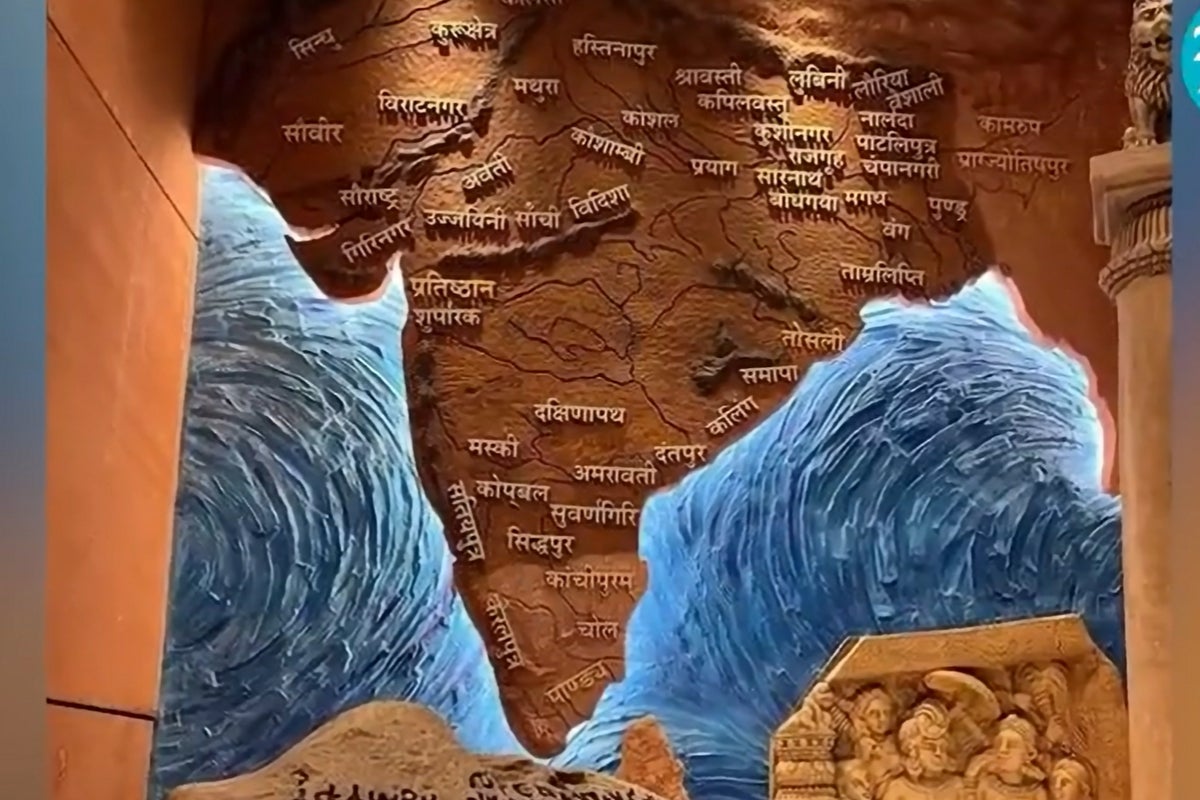
Mural of ‘undivided India’ in India’s new parliament building sparks diplomatic row

Mural in new Indian parliament building denounced for ‘expansionist mindset’ and ‘threat to the freedom’

A mural depicting a map of an ancient “undivided India” in the country’s new parliament has angered neighbours including Bangladesh, Nepal and Pakistan.​

The artwork shows India extending into nearby nations including Afghanistan in the west, the Maldives, Sri Lanka and Bhutan.​

The concept of a ‘Greater India’ – popularly called ‘Akhand Bharat’ in Hindi – is espoused by hardline nationalists.​

Bangladesh ordered its diplomats in Delhi to seek a clarification and explanation of the mural, while there were protests in Nepal.

Prime minister Narendra Modi inaugurated the new parliament buidling, constructed at an estimated cost of Rs 9.7bn (£94.2m), late last month​

India said the mural shows the ancient Mauryan empire and that it represents a time of flourishing “people-oriented” governance, and has “nothing to do with politics”.​

That statement came after a minister in Modi’s government tweeted a photo of the mural. “Resolve is clear – Akhand Bharat,” wrote parliamentary affairs minister Pralhad Joshi​

To view this content we will need your consent to set third party cookies.
For more detailed information, see our cookies page.


Bangladesh’s minister of state for foreign affairs Shahriar Alam said his ministry directed its mission in Delhi to seek “further clarification” on the matter.​

The minister suggested the Bangladesh government has no objection to the mural after Delhi’s clarification, but is seeking an explanation amid pressure from opposition parties.​

“There is widespread anger over the map,” Mr Alam said.​

“There is no reason to express doubts about it. However, for further clarification, we have asked the mission in Delhi to speak to the Indian Ministry of External Affairs to find out what their official explanation is,” he said.​

Bangladesh’s principal opposition party, the Bangladesh Nationalist Party (BNP), had raised the issue of the mural.​

“Displaying Bangladesh as part of the undivided map of any other country is a threat to the country’s independence and sovereignty,” said the BNP’s general secretary Mirza Fakhrul Islam Alamgir on Sunday.​

Pakistan’s foreign ministry spokesperson Mumtaz Baloch also raised concerns over the mural and said Islamabad was “appalled” by Mr Joshi’s comments.​

“The gratuitous assertion of ‘Akhand Bharat’ is a manifestation of a revisionist and expansionist mindset that seeks to subjugate the identity and culture of not only India’s neighbouring countries but also its own religious minorities,” she said.​

The mural also sparked protests in Nepal in the beginning of this month when Mr Modi was on a visit to that country, and criticism from the country’s political leaders.​


View attachment 175285
“A country like India which sees itself as an ancient and established country and as a model of democracy keeps Nepali areas in its map and hangs the map in the parliament, this cannot be considered appropriate,” said Nepal’s former prime minister KP Sharma Oli.

India’s ministry of external affairs (MEA) said in a statement on 2 June that the mural showed a time in Indian history during King Ashoka’s rule.

Ashoka was one of the ancient Mauryan dynasty’s most charismatic rulerswho played a significant role in propagating Buddhism in Asia.

“The mural in question depicts the spread of the Ashokan empire and the idea of a responsible and people-oriented government he adopted and propagated. That’s what the plaque in front of the mural says,” MEA spokesperson Arindam Bagchi said.


This mural and their biggest Hindu temple (during its busiest and that aircraft of theirs would have been my biggest targets during the May conflict.
No! You are wrong, it is United Nations Resolution 80. Go check Chatgpt for yourself as well.
I took that exactly from ChatGPT.....
 
We always blame ourselves.
But we continuously forget to look across the border, they've been fed fantasies and lies as truths, it's really quite pitiful.

Ancient this and ancient that.
This country of "India that is Bharat" that was created in 1947 and still in the process of nation building, the only reason it exists is because America and Europe are afraid of China. If there was no China they would have left it as they found it, in dozens of pieces.

Secular this and Secular that.
There is nothing secular about this country or the people. Not the constitution, not the laws, nor the legal system. and certainly none of their nata sahibs,
Not the Original Gandhi, Not Nehru, Not Indra. All of them were radical Hindus, the only difference being whether they were the soft version of the bare face naked version such as the present lot.

Then you have their glorious wars. It's a frigging joke.
In every single war they have fought with Pakistan, they received continuous supplies, from the Soviets and the Europeans especially the French, plus Israelis.
And, Pakistan was heavily sanctioned by everyone in every single war.
In the very first war soon after independence of Pakistan, Pakistan army did not actually join the war till around 6 months later, lol, its hilarious and surprisingly little known fact. Pakistan had to fight with other means because Pakistan was threatened by the joint command based in Delhi to stay out of the war and still they could not achieve an outright victory.

They're told lies to boost confidence, whilst our lot hide facts, even tell lies because we have to do the national obsession with self loathing Randi Rona.

The only war India fought with a peer adversary was the one with China in 1962, when it was beaten to a pulp, Nehru sending begging letters to everyone asking for help, even to President Ayub, you can find them at the Kennedy library/centre.
America came running, forced Europe to help as well, delivering nearly one billion dollars worth of weapons right to the front lines. Plus America delivered a warning to China via its embassy in Poland (I think) to back off, and it readied its forces in the Philippines to show the seriousness of that warning, which is why China vacated all the captured territory.

So, they haven't done anything particularly new to their syllabus, it's has always been like that, full of lies and fantasies. We're only just finding out because its not easy to control information anymore.
Whole-heartily I agree with you. This is a civilizational war as much as we might not think that way - but the enemy does. He very purposefully puts up a mural of a contiguous South Asia, and brags that he attacked his enemies places of worship to satisfy his loq iq, hateful population. We should have leveled their biggest temple in return - with Hindoo worshipers in there, preferably those temples that are associated with the ruling party. They have shifted to populating social media by spreading anti-Islamic content, and then pushing their degenerate cultures onto Pakistan through social media. A page out of the J+w playbook. I do not understand why there hasn't been a push-back culturally by the State of Pakistan
 
grief of the Hindus

They're not even Hindu (persianized form of Sindhu). It's an identity scam. None of the "Hindu" scriptures call their religion Hinduism or the followers Hindu.

So it's more like "grief of the Ganga dwellers".

Once you fix the terminology ^^ , crying about Karachi and Lahore no longer makes sense does it?
 
Atal Bihari Vajpayee was an RSS member. His legacy of making India complete again lives on through the new generation of RSS members.

"The only solution to the pain of Partition lies in undoing it" :
RSS Chief Mohan Bhagwat


Pakistan condemns RSS chief's Partition remarks, calls it 'delusional thinking, historical revisionism'

Naveed Siddiqui Published November 27, 20211769762599186.png


Pakistan on Saturday strongly condemned the statement of Hindu nationalist group Rashtriya Swayamsevak Sangh (RSS) chief Mohan Bhagwat's statement — in which he said "the only solution to the pain of Partition lies in undoing it" — terming it "delusional thinking and historical revisionism".

According to a report by The Indian Express, the RSS issued a statement on Thursday quoting Bhagwat as saying that the India of 2021 was not the same as the one in 1947 while speaking at a book launch event.

"Partition has happened once, it won't happen again. Those who think that way will face partition themselves," he said.

The RSS chief said if India wanted to contribute to the world, it would need to become "capable", adding, "the only solution to the pain of Partition lies in undoing it."


Reacting to the remarks, the Foreign Office, in its statement issued today, said Pakistan completely rejected the "highly provocative and irresponsible remarks", pointing out that the RSS chief had also indulged in "such delusional thinking and historical revisionism" previously.

"Pakistan has repeatedly highlighted the threat posed to regional peace and stability by the toxic mix of the extremist Hindutva ideology (Hindu Rashtra) and expansionist foreign policy (Akhand Bharat) being pursued by the ruling RSS-BJP dispensation in India."

The FO warned that the "dangerous mindset" was aimed to "completely marginalise and displace" minorities in India, and also posed an existential threat to all South Asian neighbours.

Read: How to dismantle Hindutva

The world was witness to the systematic usurpation of the rights of minorities, especially Muslims, in India and the unabated repression of Kashmiris in occupied Kashmir, the statement noted. In addition, the world had also seen India's reckless misadventures in February 2019 —when Indian aircraft violated the Line of Control, it said.

"Pakistan has consistently opposed India's hegemonic impulses and demonstrated a firm resolve to thwart any aggressive designs. While committed to peace, the people and armed forces of Pakistan are fully capable of defending the sovereignty and territorial integrity of the country," the Foreign Office reiterated.

It advised the Bharatiya Janata Party (BJP) and the RSS to "refrain from making such provocative and irresponsible statements, accept the established realities, and learn to follow the imperatives of peaceful coexistence."

The Partition of British India into two separate states of Pakistan and India, on August 14 and 15, 1947, respectively, was a tumultuous time in history that caused communal riots, mass casualties and a colossal wave of migration.
 
Last edited:
1) Pakistan to vacate all of the occupied territory (including Galgit Baltistan) - when is Pakistan doing this.
India is supposed to vacate all occupied territory at the same time
Also, get back the land given to China.
China has given us 1,000 sq km of land, in exchange we rescinded absurd British-era claims on land neither we nor Hari Singh ever controlled.
Reverse the demographic change.

2) India will vacate, only a small force left to hold elections. If Pakistan does 1, we will pressure Indian on this. We will also repopulate vacated lands with Kashmiri pundits.
Want to talk about demographics?

Remove all Indian settlers from Kashmir, and repopulate Jammu to restore its original indigenous Muslim majority demographics prior to the 1947 Jammu Genocide. Of course, Pandits are always welcome back to Kashmir.

3) Hold plebiscite. India will QB this - rest assured we will follow through the decision of people as we have done over 75 years now.
You arrest Kashmiris for refusing to support your cricket team or not putting your flag on their WhatsApp status for 15 august.

Decision of people my foot.
 
We gave back occupied terrorities and 93K PoW post 1971 - are those actions of a country which is animous to Pak?
Have you ever sobered up from your cow cola overdose, and thought for a second, that maybe the scale of your 'victory' in 1971 was blown out of proportion by your brain dead media? Perhaps you didn't have as much leverage as a state who truly decisively defeats its enemy did?
 

Publicity stunt': Pakistan slams Modi for 'distorting history' in tweets about Partition

We gave back occupied terrorities and 93K PoW post 1971 - are those actions of a country which is animous to Pak?

Was returning prisoners an act of magnanimity?
For your education:
  • Under the Third Geneva Convention of 1949 (Article 118), prisoners of war (POWs) must be released and repatriated without delay after the cessation of active hostilities.This obligation is a fundamental rule of international humanitarian law, ensuring that detention is not used as a punitive measure after conflict ends.
  • There was the Delhi Agreement of August 28, 1973, between India and Pakistan, on the repatriation of 44,000 combatant and non-combatant Pakistani prisoners of war (POWs) AND 49,000 civilian internees following the 1971 war . This pact was assisted by the UN High Commissioner for Refugees (UNHCR) and the International Red Cross, which was primarily concerned with the repatriation of civilian refugees.
  • Repatriation of prisoners of war is the responsibility of all belligerents in any war. Pakistan also released hundreds of Indian military prisoners of war captured on the Western front including some pilots from downed Indian Air Force planes ( many Abhinandans 😂). . Also released were Mukti Bahini, and Bengali ( Bangladeshi) military personnel captured in East Pakistan and flown to West Pakistan.
Releasing prisoners is not a favor or a gracious gesture but a responsibility under International Law. Ukraine and Russia frequently exchange prisoners, and in ALL wars including the Korean War, Vietnam War and the Arab Israeli wars prisoners have been released after the end of hostilities. China returned thousands of Indian Prisoners of War after the 1962 Sino-Indian war and about 110 prisoners after the Galwan border conflict in June 2020.
In fact India delayed the release of the Pakistani prisoners which should have been released in December 1971; just as all prisoners were exchanged between India and Pakistan by November 1965 following the ceasefire after the 1965 September Pakistan-India War. India was about to become an international pariah with potential sanctions from the West by hanging on to prisoners long after the war had ended.
@arjunk
 
Last edited:
Whole-heartily I agree with you. This is a civilizational war as much as we might not think that way - but the enemy does. He very purposefully puts up a mural of a contiguous South Asia, and brags that he attacked his enemies places of worship to satisfy his loq iq, hateful population. We should have leveled their biggest temple in return - with Hindoo worshipers in there, preferably those temples that are associated with the ruling party. They have shifted to populating social media by spreading anti-Islamic content, and then pushing their degenerate cultures onto Pakistan through social media. A page out of the J+w playbook. I do not understand why there hasn't been a push-back culturally by the State of Pakistan

One reason and it is not the one our nation is obsessed with, it's not corruption, corruption isn't even in the top 5.

It's the constant political instability, which has led to a culture of incompetence, which in turn has bred many other shortcomings.

Agree on a constitutional order, stick with it, no self loathing randi rona about constant change and couple of decades later we could see a potential great power.
People forget Pakistan is a massive country and it's still growing, plus it has other attributes on which it could potentially stand taller, but we need political stability.

I am massively proud of what Pakistan has achieved in the previous decades, although most of our idiotic brethren cannot see it, we can achieve a lot more in a politically stable system.


p.s.
I am a strong believer in having good relations with our cousins to the immediate east, so i don't think it is wise to close all doors, but it is high time we start speaking truths about history, the present and the decades old hateful mindset which is a reality in India.
Further east, they're our brothers.
 
Want to talk about demographics?

Remove all Indian settlers from Kashmir, and repopulate Jammu to restore its original indigenous Muslim majority demographics prior to the 1947 Jammu Genocide. Of course, Pandits are always welcome back to Kashmir.

Should’ve thought of all this when Kashmiri Pandits were brutally ethnically cleansed in the 1990s under Pakistan backed terrorism. That episode alone guarantees we’re never going to allow that kind of demographic adventurism to repeat itself.

No region in India has an inherent right to remain forcibly Muslim, Hindu, or anything else. People are free to live, move, and settle anywhere in the country, India isn’t an ethno religious preserve.
As for UN resolutions you didn’t accept them, we didn’t vacate, end of discussion. Arguments frozen in 1948 don’t override realities in 2026.

We’ve already lived through far worse periods when Pakistan was economically better off and India was weaker. That phase is long over. Today, Kashmir is a minor issue in India’s overall trajectory, while for Pakistan it’s a consuming obsession that has helped keep the country economically and institutionally stagnant.
Now ask the obvious question, what’s the worst case scenario for India? A few dozen lives a year, a few billion dollars, maybe an incident once in a while, a plane here and there. In India’s balance sheet, that’s a rounding error. Strategically, it keeps Pakistan permanently tied down militarily, diplomatically, and economically, exactly where we want it to be.
Given that reality, why rush into compromises or any peace processes that only free Pakistan to redirect energy toward growth and leverage? The current situation suits India just fine.
 
Should’ve thought of all this when Kashmiri Pandits were brutally ethnically cleansed in the 1990s under Pakistan backed terrorism. That episode alone guarantees we’re never going to allow that kind of demographic adventurism to repeat itself.😂😂
@arjunk

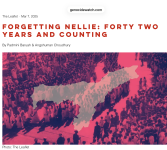
Forgetting Nellie: Forty two years and counting​

From GENOCIDE WATCH.


By Padmini Baruah & Angshuman Choudhury
Published on 18 Feb 2025

In February 1983, in one of the nation's bloodiest pogroms, over 2000 Bengali-Muslims were killed in the wake of the Assam agitation. What happened in Nellie continues to reverberate in the everyday persecution of Indian Muslims. Nellie, more than a memory, stays with us as a metaphor. Preserving its memory is an assertion of itself.

EXACTLY forty two years ago, on the morning of February 18, 1983, Sirajjudin was on his way back from the market, having stepped out to get a few essentials. As he drew closer to his village, he saw people running towards him, away from their homes and the village. Panic stricken, Sirajjuddin looked for his family, finally spotting his two sons cowering in a pond nearby. He hoisted the younger son upon his back, held his elder son by the hand and began running. On either side, he could hear shots being fired. As he pushed his way through the exodus, his elder son’s fingers somehow slipped out of his grip. He lost him to the stampede.


Soon after, Sirajjudin saw an Assamese man running after him with a sickle. Tired from carrying the child, and unable to keep up speed, soon the man had caught up with him. The man raised his sickle high into the air, and with one motion, cracked open his younger son’s skull. Letting the lifeless body drop, Sirajjudin somehow made it to the river, and escaped his pursuers. Around him, corpses dotted the land as far as he could see. He would revisit these harrowing memories to filmmaker Subasri Krishnan for her 2015 film What the Fields Remember. The Nellie massacre had begun, and would, over the course of six hours on February 18, 1983, take over 2000 lives. All of the victims were Bengali Muslims.


The Nellie Massacre is among the bloodiest pogroms in independent India, a cataclysmic ethnic cleansing exercise that was perpetrated by the hegemonic Assamese and minority Tiwa communities in the backdrop of the intense, anti-foreigner Assam Movement (1979-1985). The death toll is comparable to, if not higher than, the 2002 Gujarat riots. Yet, it occupies little space in Assamese and Indian public imagination today. Even as Nellie is seared into the memories of Assam's Bengali/Muslim population, it lies without acknowledgement, restitution, and reparation from the Assamese community.

The Nellie Massacre is among the bloodiest pogroms in independent India, a cataclysmic ethnic cleansing exercise


Bringing up old stories

Last year, when one of the authors (Padmini Baruah) interviewed several Bengali-Muslim people in Assam for a research on citizenship disenfranchisement, Nellie came up again and again.

Zubeda Begum (name changed), a survivor of citizenship detention who had spent ten years in jail due to a legal revocation of her citizenship, remembered Nellie as a part of her childhood, “When we were growing up, there was no sign of Hindu-Muslim violence. We all played together, we ate together. Even in 1983, when we heard about Nellie, we simply could not believe it. Our village did not see any conflict at all.”

She acknowledged that things had changed now. “With this government, hate is being sowed in people’s hearts,” she said. A Muslim activist known for their role in campaigns and movements for minority upliftment told me that there had been no justice for the people in Nellie whatsoever: “You are bringing up old stories, no one has any memory of this,” they said, “Do you understand me? No one cares.”

It would be wrong to see Nellie as a standalone, let alone an aberrational, event. Rather, it should be understood as a social and political metaphor that transcends a particular period of modern Assamese history. ‘Nellie’ is not a floating word – it has a certain prefix and a suffix.

‘Nellie’ is not a floating word – it has a certain prefix and a suffix.


What happened forty two years ago was precluded by a decades-long push by the dominant Assamese civil society to mark out and reject the cultural ‘outsiders’. For example, the ‘Bongal Kheda’ movement in the 1960s asserted to establish Assamese as the official state language and retain jobs for the Assamese by violently targeting (mostly Hindu) Bengalis. K.C. Chakravarti, an academic, recorded in 1960 how influential Assamese socio-cultural organisations like the Assam Sahitya Sabha legitimised the ethno-linguistic agenda of the movement. The fervent linguistic nationalism, fuelled by sociopolitical rhetoric around the unmitigated influx of Bengali Muslims into Assam after the Bangladesh Liberation War of 1971, reached a fever pitch by the late 1970s. It is at this point that the right-wing Hindu nationalists, then seeking provincial entry points in a bid to dislodge the ‘secular’ Congress, intervened to give an explicitly anti-Muslim edge to Assamese nationalism. By the time the Assam Movement began, Bengali Muslims had become the explicitly marked cultural enemy in Assam. There was no going back from there.


The forgetting of Nellie has enabled majoritarian impunity


The suffix (of Nellie) is equally critical for us to grasp, if we have to understand the event in full. The pogrom set the tone for a form of xenophobic social and political script in Assam that plays out in different forms even today both kinetically and iteratively. From Assam’s former governor S.K. Sinha’s 1997 report titled Report on Illegal Migration in Assam, which warned of “external aggression” of ‘illegal immigrants,’ to the Supreme Court’s decision in Sarbanda Sonowal (2005) which reverted the burden of proof of citizenship to suspected ‘illegal immigrants’, this hydra-headed script has taken many forms. Most of all, it indelibly marked out the bodies of Assam’s ethno-religious minorities for bureaucratic and physical violence.


The fading of Nellie’s memory by the dominant society has brought a sense of impunity to the State. We have seen its striking refractions in the last decade, as the Bharatiya Janata Party has captured the Assamese electorate with great success through routinised acts of violence against the Bengali Muslim community, such as forced evictions and alleged extrajudicial killings. In the last eight years, Assam has evicted over 10,000 families from their land and homes. One of the authors (Padmini Baruah), during their field work, found multiple sites where the state had razed down government schools, Anganwadi centres, water storage units, madrassas, and mosques. Assam’s chief minister has gone on record more than once to explicitly deny social and political space to the Bengali Muslims.

Nellie comes up, every now and then, in majoritarian discourse, not as an event that warrants sombre introspection, but as an idealised historical act that must be repeated if Assam is to be ‘saved’.

Preserving Nellie's memory

Recently, against all odds, a new crop of young academics, writers, and poets – including many from the Bengali Muslim community of Assam – have begun to revive and reinstate Nellie’s memory. This literary revival is mostly aimed at reminding the old and young of Assam and the rest of the world of the pogrom and the politics around it.


The pogrom set the tone for a form of xenophobic social and political script in Assam that plays out in different forms even today both kinetically and iteratively.

It is worth asking, however: why must we faithfully remember Nellie every year? Is there any value in digging up old trauma? Should we not move on?


A people have the right to forget as much as they have the right to remember. Most Bengali Muslims in Assam have chosen to suppress the memory of the event. One cannot imagine the weight of the memories of community trauma and humiliation.


But, what happens when the perpetrator community chooses to forget it?

It is this basic distinction that the civil society in Assam and beyond needs to recognise. If we do decide to move on, we must necessarily ask: on whose terms do we do so?

It is a difficult question, but here, we go back to our original point – that Nellie isn’t a mere historical event, but a metaphor. It is a microcosm of politics and society not just in Assam, but all of India today. That the horror and disgust of Nellie is discernible even after four decades in our mundane bureaucratic practices, social spaces and political attitudes is precisely why we must continue to talk about it in as many words as we can every single year. This annual ritual is, of course, driven by a collective hope that not all is lost, that we still have the time and space to prevent a repeat of it.

A postscript: Padmini Baruah sought to do an autoethnographic exercise – their positionality, as a child of an active participant and block level student leader in the Assam Agitation, means that they are rooted in, and have access to the rooms of, the oppressors. They asked all the members of their extended family, young and old, what they remembered about the Nellie Massacre. In the older generation, the response was muted: “We remember it happening far away.” “We obviously didn’t want violence, this was a non-violent movement.” “I don’t think that we bear the responsibility for this, this was just a mob mentality. This was not the Assam Movement.” The universal response from the Assamese millennials: “What? Never heard of it.”
 
Now ask the obvious question, what’s the worst case scenario for India? A few dozen lives a year, a few billion dollars, maybe an incident once in a while,
The best case scenario for Hindutva fascists.
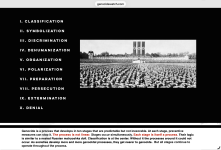
Implementing the Ten Stages of Genocide.

1769931228816.png

1769931159274.png

The worst case scenario for Pakistan, Bangladesh and the Muslims of the subcontinent is clearly defined
 
we’re never going to allow that kind of demographic adventurism to repeat itself.

The forgotten massacre that ignited the Kashmir dispute​

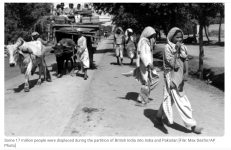
In November 1947, thousands of Muslims were killed in Jammu by paramilitaries led by the army of Dogra ruler Hari Singh.
1769931829704.png


Users who are viewing this thread

Pakistan Defence Latest

Latest Posts

Back
Top