US Economy - News, Updates and Discussion

The only thing stable about Warsh is that we can guarantee he is not fighting with Trump, as Powell did. Powell should have increased the rate now because inflation is still high. The trouble will start once we have our half-yearly economic forecast in FY 26, which is coming in March, IIRC. The last one, Deloitte said, we are on a downward trajectory going from 2.6 to 1.9% real growth in Q1 2026, if that holds, it would not make any sense at all to drop the rate or even hold the rate.
 
The only thing stable about Warsh is that we can guarantee he is not fighting with Trump, as Powell did. Powell should have increased the rate now because inflation is still high. The trouble will start once we have our half-yearly economic forecast in FY 26, which is coming in March, IIRC. The last one, Deloitte said, we are on a downward trajectory going from 2.6 to 1.9% real growth in Q1 2026, if that holds, it would not make any sense at all to drop the rate or even hold the rate.

...they will start warming up the printers.
 

US stocks mixed amid shift away from tech shares

  • S&P 500 lost less than 0.1% while Nasdaq Composite Index declined 0.3%
AFP
February 4, 2026

NEW YORK: Wall Street stocks were mixed early Wednesday following lackluster hiring data as a drop in AMD shares suggested greater momentum away from large tech equities.

US private employers added 22,000 jobs last month, about half the level forecast by analysts, according to payroll firm ADP.

Meanwhile, shares of Advanced Micro Devices sank more than 12 percent despite blowout fourth-quarter earnings that concluded a year of strong revenue growth due to artificial intelligence.

About 10 minutes into trading, the Dow Jones Industrial Average was up 0.6 percent at 49,537.29.
 

Senators push $70 billion funding deal to support Trump’s critical minerals push, reports

  • Lawmakers try to inject an extra $70 billion
Reuters

Senators will introduce legislation on Wednesday to reauthorise funding for the United States Export-Import Bank for the next decade, as lawmakers try to inject an extra $70 billion into the agency to support U.S. President Donald Trump’s critical minerals push, the Financial Times reported on Wednesday.

Kevin Cramer, a Republican senator from North Dakota is co-sponsoring the reauthorization legislation with Democrat Mark Warner, the report said.

Cramer told the Financial Times that Trump was “all in” on funding the Ex-Im Bank, adding the U.S. President “sees the value” of the institution.

Cramer also told the newspaper that he would advocate for Ex-Im’s lending cap to be lifted from $135 billion to $205 billion as part of the reauthorization package.
 

US floats price floor plan for critical minerals

Anwar Iqbal
February 5, 2026
1770295802191.png

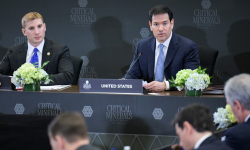
US Secretary of State Marco Rubio speaks alongside Jacob Helberg during the inaugural Critical Minerals Ministerial meeting.— AFP

• Proposes a preferential trading arrangement to cut reliance on China
• Pakistan weighs options to maintain ties with both Washington and Beijing


WASHINGTON: The United States on Wednesday outlined plans to establish price floors for critical minerals and form a preferential trading arrangement among participating countries, a proposal that Pakistan has so far chosen to approach cautiously as it seeks to maintain close ties with both Washington and Beijing.

US Vice President J.D. Vance told representatives from more than 50 countries that Washington was proposing a coordinated system to stabilise prices of critical minerals essential for clean energy, advanced technology and defence industries, arguing that market volatility had discouraged long-term investment.

Diplomatic sources in Washington told Dawn that Pakistan has been briefed on the US proposal but has not yet signed on. Islamabad was represented at the two-day meeting by Federal Minister for Energy Ali Pervaiz Malik, rather than a senior political delegation, in what officials described as a calibrated approach to an initiative widely seen as aimed at reducing global dependence on China.

Pakistan, which is believed to possess substantial but largely untapped reserves of copper, gold and rare earth elements, used the Washington gathering to highlight its mineral potential while avoiding any public alignment with efforts to counter China’s dominance in the global critical minerals trade.

Speaking at the meeting, Vice President Vance said erratic pricing had made sustained investment in critical mineral industries “nearly impossible”.

“Consistent investment in critical mineral industries is nearly impossible when prices are wildly volatile,” he said, pointing to the impact of foreign supplies flooding markets before new projects could get off the ground.

Mr Vance proposed what he described as “a concrete mechanism to return the global critical minerals market to a healthier, more competitive state,” including the establishment of reference prices at each stage of production.

“We will establish reference prices for critical minerals at each stage of production — pricing that reflects real-world fair market value,” he said. “And for members of the preferential zone, these reference prices will operate as a floor, maintained through adjustable tariffs to uphold pricing integrity.”

He hinted at the formation of a trading bloc among allies and partners, saying the goal was to prevent market manipulation that undermines domestic producers.

“We want to eliminate that problem of people flooding into our markets with cheap critical minerals to undercut our domestic manufacturers,” he added, noting that several countries had already signed on to the initiative.
 
The Washington meeting forms part of a broader US effort to reduce reliance on China, which currently accounts for about 60 per cent of global production of critical minerals and nearly 90pc of their processing and refining — a concentration US officials describe as a strategic vulnerability.

US Secretary of State Marco Rubio hosted the inaugural Critical Minerals Ministerial and underscored the link between critical minerals and economic security.

“We are gathered here today as the first step to rectify the mistake,” Mr Rubio said, calling on participating countries to bring together “our collective talent and innovation” to diversify supply chains and improve affordability.

Mr Rubio said the objective was not merely to address past policy failures but to ensure resilience through coordinated international action.
 
To view this content we will need your consent to set third party cookies.
For more detailed information, see our cookies page.
 
To view this content we will need your consent to set third party cookies.
For more detailed information, see our cookies page.
 
To view this content we will need your consent to set third party cookies.
For more detailed information, see our cookies page.
 

Bessent says US, China could have very productive relationship

  • Bessent is preparing to meet with Chinese Vice Premier He Lifeng in coming weeks
Reuters
February 10, 2026

WASHINGTON: U.S. Treasury Secretary Scott Bessent said on Tuesday that the U.S. relationship with China could be very productive and welcomed Beijing as a rival.

“The U.S.-China relationship now is in a very comfortable place. We are going to be rivals, but we want the rivalry to be fair,” Bessent said during an appearance at the BTG Pactual CEO Conference, held in Sao Paolo, Brazil. “We do not want to decouple from China, but we do need to de-risk.”

Bessent is preparing to meet with Chinese Vice Premier He Lifeng in coming weeks ahead of a planned visit to China by U.S. President Donald Trump in April. Treasury has not given details about the timing or venue for Bessent’s meeting with He.

Bessent told the conference that the U.S. was working on “retaking sovereignty” from China in strategic industries including critical minerals, semiconductors and medicines.

“We’re always going to be competitors,” he said. “And I’m of the view that competition makes you better, keeps you from stagnating.” In the long run, he said China would have to rebalance its economy, adding, “The world cannot have a situation where China persistently runs a $1 trillion trade surplus. That’s just not possible.”
 
Bessent and U.S. Trade Representative Jamieson Greer spoke with He by phone in December, and both sides agreed to promote the stable development of bilateral trade and economic ties, China’s official Xinhua news agency reported at the time.

Bessent last met with He in Malaysia in October, when both sides discussed a framework agreement under which Beijing agreed to defer export controls on rare earth supplies and Washington dropped a 100% U.S. tariff on Chinese goods.

The U.S. Treasury Secretary has said in recent weeks that China is on track to meet its commitments under a U.S.-China trade agreement, including the purchase of 12 million metric tons of U.S. soybeans, by the end of February.
 

US stocks move sideways after lackluster data

  • S&P 500 was flat while Nasdaq Composite Index declined 0.2%
AFP
February 10, 2026

NEW YORK: Wall Street stocks moved indecisively early Tuesday, digesting downcast US retail sales data and mixed corporate earnings.

US retail sales showed no growth in December, according to delayed government data, missing analysts’ expectations and adding to worries about the economy.

The report could bolster the odds of additional Federal Reserve cuts, which investors should balance “with the possibility of an economic slowdown,” said CFRA Research’s Sam Stovall.

About 10 minutes into trading, the Dow Jones Industrial Average was up 0.3 percent to 50,305.63.

The broad-based S&P 500 was flat at 6,964.15, while the tech-rich Nasdaq Composite Index declined 0.2 percent to 23,197.19.

Tuesday’s retail sales report will be followed in the coming days by employment and inflation data.

Among companies reporting results, Coca-Cola dropped 0.8 percent, while Marriott International surged 8.6 percent.
 

Users who are viewing this thread

  • Country Watch Latest

    Back
    Top