Russia - Ukraine war part ll. News and Discussions

Footage of a Russian 300mm Tornado-S multiple rocket launcher, possibly a Sarma multiple rocket launcher, striking Ukrainian drone operators stationed in an abandoned building. The video was filmed in the village of Velyka Pisarevka in Ukraine's Sumy Oblast.

To view this content we will need your consent to set third party cookies.
For more detailed information, see our cookies page.
 

Power drought tips Ukraine's economy into worst crisis since war's first year

KYIV, Feb 23 (Reuters) - Ukraine's economy is enduring its toughest period since the early months of Russia's invasion after sustained air strikes left its power system in tatters as the war enters a fifth year, forcing firms to cut output and shrinking state revenues.
From steel mills to miners, cement makers and food producers, Ukrainian industry is being forced to cut output and absorb rising costs as it struggles to shift work schedules and save equipment from emergency shutdowns, executives at eight companies said.
Sergii Pylypenko, CEO of Kovalska Group, Ukraine's largest producer of concrete and building materials, said the diesel generators it had bought could not power the entire output of its large factories:
"For more than two months now, we have been working under emergency power cuts without any predictable schedule.
"In certain periods, the lack of a stable power supply can reduce production volumes by up to 50%."

UKRAINE'S ECONOMY SHRANK 30% IN FIRST YEAR OF WAR​

Ukraine’s economy shrank by nearly a third in the first year of the war and, despite modest growth during subsequent years, it remains far smaller than before the invasion and heavily reliant on government spending. Nearly 6 million people have left Ukraine and more than 3 million are displaced within its borders, accounting for over a fifth of the pre-war population.
In February, the monthly business activity recovery index of the Institute for Economic Research in Kyiv – which compares the number of companies reporting that business is worse or better than last year - turned negative for the first time since 2023.
Ukraine's economy is vital not only to provide tax revenues to finance the war and fund debt, and to produce armaments, but also to provide jobs and economic prospects for soldiers and returning refugees when peace finally returns.
Oleksandr Myronenko, chief operating officer at Metinvest, a mining and metals group with annual revenues of around $7 billion, said the long power outages made it difficult to restart production after Russian strikes.
Metinvest - controlled by Rinat Akhmetov, one of Ukraine’s richest men - has been a major generator of tax revenues and steel for the war effort.
It has forecast growth this year in Ukraine, but failed to achieve that in the first two months owing to the impact of Russian bombardment, Myronenko said.
"This included damage to generating capacities and also to the transport infrastructure, which affects not only steel makers but all producers in Ukraine: they have to decrease volumes," he said.

BLACKOUTS DAMPEN UKRAINIAN CONSUMER DEMAND​

Nataliia Kolesnichenko, economist at the Centre for Economic Studies in Kyiv, estimated energy demand had exceeded supply by 30% in January and February. "The energy situation has deteriorated dramatically in recent months," she said.
Energy Minister Denys Shmyhal said on February 12 that, even though temperatures were warming, peak demand stood at 16.4 gigawatts, still well above the 12.3 gigawatts Ukraine was able to produce, and that it was importing almost 2 gigawatts at peak times.
Businesses are having to contend with lower output, rising costs, disruption of supply chains and longer delivery times. These all affect competitiveness and will increase inflation, already running at around 7%, three economists said.
The power crisis has already prompted Ukraine’s central bank to cut its forecast for economic growth this year to 1.8% from 2% – in line with the 1.8% growth expected to be announced for last year.
Independent economists are more cautious. Dragon Capital, an investment house, forecasts growth of 1% this year due to the electricity deficit, while ICU – a Kyiv-based asset manager and investment bank - has downgraded its growth forecast to 0.8% from 1.2%.
ICU said about 20-25% of economic output is reliant on steady electricity supplies.
Many small businesses have struggled to stay afloat during the coldest, darkest winter of the war, contending also with the chilling effect of long blackouts on consumer demand.
Prime Minister Yulia Svyrydenko said the energy crisis had cost the state budget about 12 billion hryvnias ($280 million) in customs and tax revenues in January alone.
A jump in the level of Ukraine’s debt to almost 100% of gross domestic product – despite two restructurings - has unsettled some investors. Last week, when peace talks in Geneva appeared to stall, the price of Ukraine’s bonds slid.

KYIV FACES HUNGARIAN RESISTANCE IN GETTING EU FUNDS​

But Ukraine looks close to clinching a deal with the International Monetary Fund for a new $8.1 billion lending programme after the IMF agreed to ease some conditions, including sensitive tax increases, Svyrydenko has said.
IMF approval should help to pave the way for assistance from the European Union worth around 90 billion euros ($105 billion) over two years, if Hungarian resistance can be overcome – a lifeline after President Donald Trump's U.S. administration stopped direct budget aid.
Hungary last week threatened to block the assistance unless Kyiv restores supplies of Russian oil through the Druzhba pipeline.
But more immediately, Hungary and Slovakia last week threatened to halt their power exports to Ukraine if oil flows did not resume. Kyiv blamed damage to the pipeline on a Russian strike and by Monday had given no timeframe for repairs.
Hungary and Slovakia accounted for 68% of Ukraine's imported power this month, according to the consultancy ExPro in Kyiv.
Although businesses have invested millions of hryvnias in back-up power supplies, ranging from generators to batteries, solar panels and gas, a recent survey by Ukraine's European Business Association showed that outages had made life difficult for four in five. Half had reduced output, while 61% complained about rising costs.
Global steelmaker ArcelorMittal lost around 10% of its hot metal production and more than 25% of finished rolled products to electricity shortages in January, it said.
ArcelorMittal suspended one of its continuous casting machines to avoid emergency shutdowns and prevent equipment damage, losing more than 70% of its planned hot-rolled billet output.

Source:Reuters
 

Power drought tips Ukraine's economy into worst crisis since war's first year

KYIV, Feb 23 (Reuters) - Ukraine's economy is enduring its toughest period since the early months of Russia's invasion after sustained air strikes left its power system in tatters as the war enters a fifth year, forcing firms to cut output and shrinking state revenues.
From steel mills to miners, cement makers and food producers, Ukrainian industry is being forced to cut output and absorb rising costs as it struggles to shift work schedules and save equipment from emergency shutdowns, executives at eight companies said.
Sergii Pylypenko, CEO of Kovalska Group, Ukraine's largest producer of concrete and building materials, said the diesel generators it had bought could not power the entire output of its large factories:
"For more than two months now, we have been working under emergency power cuts without any predictable schedule.
"In certain periods, the lack of a stable power supply can reduce production volumes by up to 50%."

UKRAINE'S ECONOMY SHRANK 30% IN FIRST YEAR OF WAR​

Ukraine’s economy shrank by nearly a third in the first year of the war and, despite modest growth during subsequent years, it remains far smaller than before the invasion and heavily reliant on government spending. Nearly 6 million people have left Ukraine and more than 3 million are displaced within its borders, accounting for over a fifth of the pre-war population.
In February, the monthly business activity recovery index of the Institute for Economic Research in Kyiv – which compares the number of companies reporting that business is worse or better than last year - turned negative for the first time since 2023.
Ukraine's economy is vital not only to provide tax revenues to finance the war and fund debt, and to produce armaments, but also to provide jobs and economic prospects for soldiers and returning refugees when peace finally returns.
Oleksandr Myronenko, chief operating officer at Metinvest, a mining and metals group with annual revenues of around $7 billion, said the long power outages made it difficult to restart production after Russian strikes.
Metinvest - controlled by Rinat Akhmetov, one of Ukraine’s richest men - has been a major generator of tax revenues and steel for the war effort.
It has forecast growth this year in Ukraine, but failed to achieve that in the first two months owing to the impact of Russian bombardment, Myronenko said.
"This included damage to generating capacities and also to the transport infrastructure, which affects not only steel makers but all producers in Ukraine: they have to decrease volumes," he said.

BLACKOUTS DAMPEN UKRAINIAN CONSUMER DEMAND​

Nataliia Kolesnichenko, economist at the Centre for Economic Studies in Kyiv, estimated energy demand had exceeded supply by 30% in January and February. "The energy situation has deteriorated dramatically in recent months," she said.
Energy Minister Denys Shmyhal said on February 12 that, even though temperatures were warming, peak demand stood at 16.4 gigawatts, still well above the 12.3 gigawatts Ukraine was able to produce, and that it was importing almost 2 gigawatts at peak times.
Businesses are having to contend with lower output, rising costs, disruption of supply chains and longer delivery times. These all affect competitiveness and will increase inflation, already running at around 7%, three economists said.
The power crisis has already prompted Ukraine’s central bank to cut its forecast for economic growth this year to 1.8% from 2% – in line with the 1.8% growth expected to be announced for last year.
Independent economists are more cautious. Dragon Capital, an investment house, forecasts growth of 1% this year due to the electricity deficit, while ICU – a Kyiv-based asset manager and investment bank - has downgraded its growth forecast to 0.8% from 1.2%.
ICU said about 20-25% of economic output is reliant on steady electricity supplies.
Many small businesses have struggled to stay afloat during the coldest, darkest winter of the war, contending also with the chilling effect of long blackouts on consumer demand.
Prime Minister Yulia Svyrydenko said the energy crisis had cost the state budget about 12 billion hryvnias ($280 million) in customs and tax revenues in January alone.
A jump in the level of Ukraine’s debt to almost 100% of gross domestic product – despite two restructurings - has unsettled some investors. Last week, when peace talks in Geneva appeared to stall, the price of Ukraine’s bonds slid.

KYIV FACES HUNGARIAN RESISTANCE IN GETTING EU FUNDS​

But Ukraine looks close to clinching a deal with the International Monetary Fund for a new $8.1 billion lending programme after the IMF agreed to ease some conditions, including sensitive tax increases, Svyrydenko has said.
IMF approval should help to pave the way for assistance from the European Union worth around 90 billion euros ($105 billion) over two years, if Hungarian resistance can be overcome – a lifeline after President Donald Trump's U.S. administration stopped direct budget aid.
Hungary last week threatened to block the assistance unless Kyiv restores supplies of Russian oil through the Druzhba pipeline.
But more immediately, Hungary and Slovakia last week threatened to halt their power exports to Ukraine if oil flows did not resume. Kyiv blamed damage to the pipeline on a Russian strike and by Monday had given no timeframe for repairs.
Hungary and Slovakia accounted for 68% of Ukraine's imported power this month, according to the consultancy ExPro in Kyiv.
Although businesses have invested millions of hryvnias in back-up power supplies, ranging from generators to batteries, solar panels and gas, a recent survey by Ukraine's European Business Association showed that outages had made life difficult for four in five. Half had reduced output, while 61% complained about rising costs.
Global steelmaker ArcelorMittal lost around 10% of its hot metal production and more than 25% of finished rolled products to electricity shortages in January, it said.
ArcelorMittal suspended one of its continuous casting machines to avoid emergency shutdowns and prevent equipment damage, losing more than 70% of its planned hot-rolled billet output.

Source:Reuters

Ukraine is a Jewish side project and it must fail at all costs. They're sacrificing poor Orthodox Christians (Goyim) to further their agenda. They funded the uprising and the jew clown of Kiev to trap Russia to keep them occupied, so that they can continue their dirty work in Palestine, Syria and now Iran.
 

Power drought tips Ukraine's economy into worst crisis since war's first year

KYIV, Feb 23 (Reuters) - Ukraine's economy is enduring its toughest period since the early months of Russia's invasion after sustained air strikes left its power system in tatters as the war enters a fifth year, forcing firms to cut output and shrinking state revenues.
From steel mills to miners, cement makers and food producers, Ukrainian industry is being forced to cut output and absorb rising costs as it struggles to shift work schedules and save equipment from emergency shutdowns, executives at eight companies said.
Sergii Pylypenko, CEO of Kovalska Group, Ukraine's largest producer of concrete and building materials, said the diesel generators it had bought could not power the entire output of its large factories:
"For more than two months now, we have been working under emergency power cuts without any predictable schedule.
"In certain periods, the lack of a stable power supply can reduce production volumes by up to 50%."

UKRAINE'S ECONOMY SHRANK 30% IN FIRST YEAR OF WAR​

Ukraine’s economy shrank by nearly a third in the first year of the war and, despite modest growth during subsequent years, it remains far smaller than before the invasion and heavily reliant on government spending. Nearly 6 million people have left Ukraine and more than 3 million are displaced within its borders, accounting for over a fifth of the pre-war population.
In February, the monthly business activity recovery index of the Institute for Economic Research in Kyiv – which compares the number of companies reporting that business is worse or better than last year - turned negative for the first time since 2023.
Ukraine's economy is vital not only to provide tax revenues to finance the war and fund debt, and to produce armaments, but also to provide jobs and economic prospects for soldiers and returning refugees when peace finally returns.
Oleksandr Myronenko, chief operating officer at Metinvest, a mining and metals group with annual revenues of around $7 billion, said the long power outages made it difficult to restart production after Russian strikes.
Metinvest - controlled by Rinat Akhmetov, one of Ukraine’s richest men - has been a major generator of tax revenues and steel for the war effort.
It has forecast growth this year in Ukraine, but failed to achieve that in the first two months owing to the impact of Russian bombardment, Myronenko said.
"This included damage to generating capacities and also to the transport infrastructure, which affects not only steel makers but all producers in Ukraine: they have to decrease volumes," he said.

BLACKOUTS DAMPEN UKRAINIAN CONSUMER DEMAND​

Nataliia Kolesnichenko, economist at the Centre for Economic Studies in Kyiv, estimated energy demand had exceeded supply by 30% in January and February. "The energy situation has deteriorated dramatically in recent months," she said.
Energy Minister Denys Shmyhal said on February 12 that, even though temperatures were warming, peak demand stood at 16.4 gigawatts, still well above the 12.3 gigawatts Ukraine was able to produce, and that it was importing almost 2 gigawatts at peak times.
Businesses are having to contend with lower output, rising costs, disruption of supply chains and longer delivery times. These all affect competitiveness and will increase inflation, already running at around 7%, three economists said.
The power crisis has already prompted Ukraine’s central bank to cut its forecast for economic growth this year to 1.8% from 2% – in line with the 1.8% growth expected to be announced for last year.
Independent economists are more cautious. Dragon Capital, an investment house, forecasts growth of 1% this year due to the electricity deficit, while ICU – a Kyiv-based asset manager and investment bank - has downgraded its growth forecast to 0.8% from 1.2%.
ICU said about 20-25% of economic output is reliant on steady electricity supplies.
Many small businesses have struggled to stay afloat during the coldest, darkest winter of the war, contending also with the chilling effect of long blackouts on consumer demand.
Prime Minister Yulia Svyrydenko said the energy crisis had cost the state budget about 12 billion hryvnias ($280 million) in customs and tax revenues in January alone.
A jump in the level of Ukraine’s debt to almost 100% of gross domestic product – despite two restructurings - has unsettled some investors. Last week, when peace talks in Geneva appeared to stall, the price of Ukraine’s bonds slid.

KYIV FACES HUNGARIAN RESISTANCE IN GETTING EU FUNDS​

But Ukraine looks close to clinching a deal with the International Monetary Fund for a new $8.1 billion lending programme after the IMF agreed to ease some conditions, including sensitive tax increases, Svyrydenko has said.
IMF approval should help to pave the way for assistance from the European Union worth around 90 billion euros ($105 billion) over two years, if Hungarian resistance can be overcome – a lifeline after President Donald Trump's U.S. administration stopped direct budget aid.
Hungary last week threatened to block the assistance unless Kyiv restores supplies of Russian oil through the Druzhba pipeline.
But more immediately, Hungary and Slovakia last week threatened to halt their power exports to Ukraine if oil flows did not resume. Kyiv blamed damage to the pipeline on a Russian strike and by Monday had given no timeframe for repairs.
Hungary and Slovakia accounted for 68% of Ukraine's imported power this month, according to the consultancy ExPro in Kyiv.
Although businesses have invested millions of hryvnias in back-up power supplies, ranging from generators to batteries, solar panels and gas, a recent survey by Ukraine's European Business Association showed that outages had made life difficult for four in five. Half had reduced output, while 61% complained about rising costs.
Global steelmaker ArcelorMittal lost around 10% of its hot metal production and more than 25% of finished rolled products to electricity shortages in January, it said.
ArcelorMittal suspended one of its continuous casting machines to avoid emergency shutdowns and prevent equipment damage, losing more than 70% of its planned hot-rolled billet output.

Source:Reuters
talk about biased reporting - a country with rolling blackout of 11 hours daily is projected to have 1.8-2% annual growth while being under seige for 4,000 days and an exodus of 6m people.
 
Ukraine is a Jewish side project and it must fail at all costs. They're sacrificing poor Orthodox Christians (Goyim) to further their agenda. They funded the uprising and the jew clown of Kiev to trap Russia to keep them occupied, so that they can continue their dirty work in Palestine, Syria and now Iran.
Honestly I see it as a win win - it keeps the Euro countries fighting each other and too busy to meddle in the affairs of our countries.
There is a huge schism between the frontier eastern euro countries like poland hungary that will face the wrath next and the countries in western europe who are just enjoying the show.
The strain on their economies is immense now, supporting this jew project full of corrupt leaders is draining their coffers, if you see even the EU assistance of $105b is still being delayed and contingent on so many other projects like the IMF funding
 
Ukrainian East Ukraine losing ground to Russian East Ukraine.

To view this content we will need your consent to set third party cookies.
For more detailed information, see our cookies page.


To view this content we will need your consent to set third party cookies.
For more detailed information, see our cookies page.


Situation and developments on day 4,386 of the civil war between Russian East Ukraine backed by Russia and Ukrainian East Ukraine backed by West Ukraine.

Encirclement Near Lyman? | Stavky Pocket Closing [23 February 2026]​


To view this content we will need your consent to set third party cookies.
For more detailed information, see our cookies page.
 
Last edited:
Ukrainian East Ukraine losing ground to Russian East Ukraine.

To view this content we will need your consent to set third party cookies.
For more detailed information, see our cookies page.


To view this content we will need your consent to set third party cookies.
For more detailed information, see our cookies page.


To view this content we will need your consent to set third party cookies.
For more detailed information, see our cookies page.
 
Russian FPV drone strikes against Ukrainian Armed Forces equipment in February. It's worth noting that many more drones are being used, numbering in the thousands. VT-40 FPV drones, "Prince Vandal Novgorodsky" drones, and other models, including those controlled via fiber optic cable, are being used in combat. The exact filming location is not disclosed. The video shows drone strikes against various Ukrainian military equipment and structures. Information about some models is available on the channel. The footage also captured the strike on a rare Ukrainian AMX-10RC wheeled tank, made in France.

To view this content we will need your consent to set third party cookies.
For more detailed information, see our cookies page.
 
today marks the beginning of the fifth year of the war between russia and ukraine.

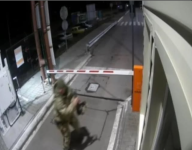
this image shows the start of the russian invasion of ukraine on february 24, 2022. screenshots taken from a CCTV camera at a border checkpoint between crimea and mainland ukraine, showing a ukrainian border guard fleeing from advancing forces.
1771960140160.png
 
today marks the beginning of the fifth year of the war between russia and ukraine.

this image shows the start of the russian invasion of ukraine on february 24, 2022. screenshots taken from a CCTV camera at a border checkpoint between crimea and mainland ukraine, showing a ukrainian border guard fleeing from advancing forces.
View attachment 180713

War started in February 2014 shortly after Euro Maidan riot.

Footage of a Russian 300mm Tornado-S multiple rocket launcher, possibly a Sarma multiple rocket launcher, striking Ukrainian drone operators stationed in an abandoned building. The video was filmed in the village of Velyka Pisarevka in Ukraine's Sumy Oblast.

To view this content we will need your consent to set third party cookies.
For more detailed information, see our cookies page.


Europe lacks MRLS such as 300 mm 9M544. This gives Russia an edge in firepower.

The mighty Russian Army continues with its playbook from the Soviet Union:


China and Russia are fascist countries modeled after 1930s Italy, Japan, Germany.
 
Last edited:
War started in February 2014 shortly after Euro Maidan riot.


Europe lacks MRLS such as 300 mm 9M544. This gives Russia an edge in firepower.


China and Russia are fascist countries modeled after 1930s Italy, Japan, Germany.
Doesn't excuse Russia's abuse of its own men. Maybe you find that acceptable. Many civilized people do not.
 

Users who are viewing this thread

  • Pakistan Defence Latest

    Back
    Top