
hasssanali8998
Elite Member

amazing yes but sad at the same timeThat is an amazing image.
jets are cool war sucks
Follow along with the video below to see how to install our site as a web app on your home screen.
Note: This feature may not be available in some browsers.
amazing yes but sad at the same timeThat is an amazing image.
In current times, there is proliferation of low-cost weaponry that is not only lethal but can put even the most capable war machine to the test by creating a cost-benefit imbalance. The Middle East is mired in conflict situations and such conditions allowed well-armed asymmetric forces to emerge and challenge even regional powers head on. Even the world's sole superpower is conducting operation after operation to degrade and dismantle such threats in said region.Iran is not a major power , exploits against Venezuela and Iran don't count much.
Your entire post gives credence to what BW said.....if America has to work her ass off to contain the likes of houthis and Iran then what chances her carriers have against peer equals ?In current times, there is proliferation of low-cost weaponry that is not only lethal but can put even the most capable war machine to the test by creating a cost-benefit imbalance. The Middle East is mired in conflict situations and such conditions allowed well-armed asymmetric forces to emerge and challenge even regional powers head on. Even the world's sole superpower is conducting operation after operation to degrade and dismantle such threats in said region.
The Houthi demonstrated formidable anti-shipping capability and pressed the US Navy even more than Iran (a country that is the principal supplier of weapons, technology, and training to the Houthi movement). The Houthi created a very dangerous threat environment in the Red Sea as they could sink a massive cargo ship with a single well-placed strike. The US Navy was the only force to step up in that region to impose costs on the Houthi for that. The Houthi used anti-ship ballistic missiles, cruise missiles and drones and also employed them in combination to attack the US Navy and could maintain that scenario for 6 months. The US Navy held up and learned a lot from the experience of-course. Others mostly watched from a distance. The US have a battle proven force while some boast about their options in theory.
Iran represents a much bigger battlespace with a massive ballistic missile force and superior power projection capability than the Houthi in all domains. Iran is larger (and became stronger) than any country in the Middle East with few rivals in the asymmetric warfare strategy. Iran was also expanding its naval capability to control the Persian Gulf waters, if necessary. They even added a drone carrier to the fleet. But the US found a way to wipe out Iranian Navy and degrade Iranian military industrial complex on a broader level. So?
How do you think the US turned the tide in the Pacific War during World War 2? The US Navy had a pivotal role on that front. So I don't buy the assumption that a carrier strike group is useless in a supposedly peer fight. The US Navy holds up in all battle situations.
Bro, you didn't get the point. I shall present another analogy. Russian Navy experienced anti-shipping capability in the Black Sea and suffered heavy losses there. Ukrainian forces used cruise missiles to sink Moskva and Novocherkassk separately. Ukrainian forces also used drones to attack other Russian naval ships and boats in the Black Sea and scored multiple hits. The US Navy also experienced anti-shipping activity in the Red Sea and suffered minimum losses there. The US Navy was up against a more capable threat in the Red Sea in fact. The Houthi demonstrated superior anti-shipping capability than Ukraine by combining anti-shipping ballistic missiles, cruise missiles and drones into a strike package that they could unload on the US Navy with Russia providing targeting support to the Houthi forces. However, the US Navy have excellent defenses and intercepted volley after volley of such weapons during the war. Not just that but the US Navy retaliated and imposed heavy costs on the Houthi during the war. Russia is regarded as a near-peer adversary to the US, right? Yet all can see the disparity between Russian Navy and the US Navy.Your entire post gives credence to what BW said.....if America has to work her ass off to contain the likes of houthis and Iran then what chances her carriers have against peer equals ?
It is doing fine. There is more focus on propaganda and less focus on data.American and western media used to make a fun of Russian air defense systems and now see what's happening with their THAADs....

American peers (China, Russia) have the weapons, with great capabilities .yes . but they don't really know how to put them in battlefield.Your entire post gives credence to what BW said.....if America has to work her ass off to contain the likes of houthis and Iran then what chances her carriers have against peer equals ?
Well, that was kind of in line with saying artillery was sitting ducks for air power when it came in during WW2. Or the same way artillery is used against line infantry with musket/rifle, or even now, drones to engage armor.Reread what Beijing walker said , he said aircraft carriers will be sitting ducks in future wars with major powers.... that's pretty accurate assessment , you are dragging the discussion towards something he didn't contest.
Well , you can still fight with bows and arrows and win the war if your opponent is armed with swords only.Well, that was kind of in line with saying artillery was sitting ducks for air power when it came in during WW2. Or the same way artillery is used against line infantry with musket/rifle, or even now, drones to engage armor.
The thing is, I can say it's pointless to have artillery because in a peer (not near-peer) fight, it will surely be overwhelmed by enemy air power. That, while it is factually correct (as in the existence of artillery depends on air superiority, if you don't have it, you will suffer), but on the other hand, you don't see any country, big or small, abandoning the idea with artillery because they can't fight them without air superiority?
That is because war does not fight with just one component; it's fought with a group of matrices, and that is a very complex subject that you will learn in military science, but it was not hard to understand how combined arms work.
I will say this, Carrier by itself is not invincible, actually nothing is, and there are no "Wonder Weapons" anywhere in the world, it's all about how you use a single platform with the general usage within a subset of other weapon, I can make the case if you have a space canon type of direct energy weapon and if a compentent country can develop that and shoot at anything on earth, that would basically render everything we had pointless, but just because battle is being brought to a different battle space, like we had from 2 dimensional warfare between 2 battleline firing musket ball on each other like we did back in Civil War even tho it was already been brought into 3-dimensional by artillery or how informational domain or 4th dimensional warfare (Which drone based on) brought into the battlefield in Ukraine against anything that move in battlefield, all those won't stop war from happening, and won't stop conventional deployment of weaponry from happening, that would be the same when we have some sort of direct energy weapon on our disposal, I don't know how or what or even when, but I can tell you, the use of "conventional" weapon will continue.
In a way, we are, because we are still using bayonets. Hell, I personally used a bayonet in Iraq, and I am pretty sure that the Iraqi I faced is not using swords only or throwing stones at me.Well , you can still fight with bows and arrows and win the war if your opponent is armed with swords only.
Bro , forget the wonder weapons analogy or call it red herring .... platforms evolve then they reach a stage where laws of diminishing returns set in.... for decades even American csg were wonder weapons , there was no effective counter to them...new carriers cost around 15 billion dollars , one hit by a missile ( you may call it a lucky hit ) and it's gone ... You launch a salvo 50 missiles and one of them hits the target it's game over my friend...In a way, we are, because we are still using bayonets. Hell, I personally used a bayonet in Iraq, and I am pretty sure that the Iraqi I faced is not using swords only or throwing stones at me.
The issue here is not what a single platform can do in war; if this is the case, then you probably should NOT go to war to begin with.
We are talking about Battlespace and Battlefield concepts, not just weaponry; it's never one weapon to end it all. Instead, it's a combination of weapons to use in war to make sure you have the upper hand. If you are singling out a weapon platform, then I can guarantee you that regardless of what you did, it's going to be useless, I don't care if that is Aircraft Carrier, Fighter Jet, Tanks, Artillery, or Rifle, everyone of those was suspectible to something else, the issue is not that we don't use Fighter Jet anymore when advance SAM were there, but the entire thesis of war is to how you use a combine effort to fight a war.
That's why I always said, comparing a single platform to another platform is pointless......because that's not how wars are fought...
That is the issue, not whether or not something is a wonder weapon.


 www.19fortyfive.com
So that mountain hitting US submarine now is still sitting in the shipyard?The US Navy’s Most Embarrassing Secret: A $2 Billion Submarine Is Stuck In Dry Dock And Can’t Go To Sea
Mar 25, 2026
Former Special Forces Warrant Officer Steve Balestrieri analyzes the U.S. Navy’s maintenance crisis. Following a 2021 collision, the $3 billion USS Connecticut remains stuck in dry dock due to a lack of Seawolf-class spare parts, exposing severe vulnerabilities in America’s naval shipbuilding and repair infrastructure.
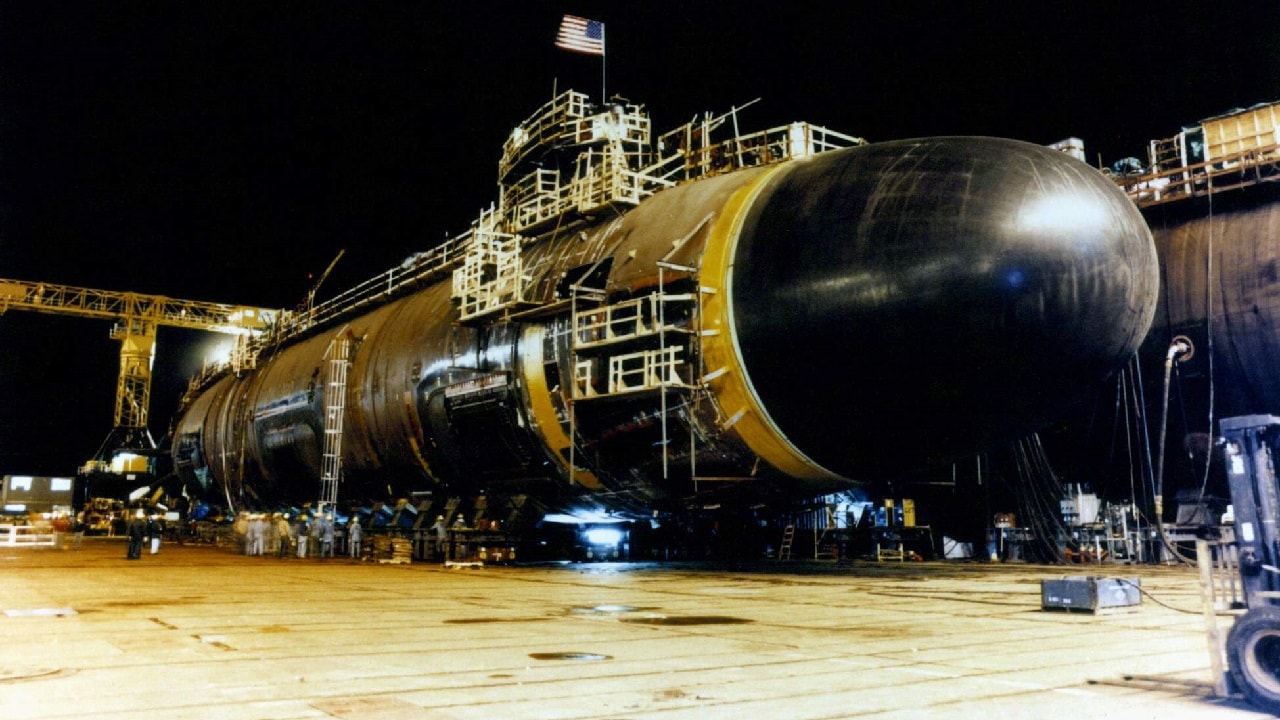
The first of a revolutionary new class of fast attack submarine, the Seawolf (SSN-21). Shown during construction at the Electric Boat Division of General Dynamics Corporation in Groton, Conn. She was christened by Margaret Dalton, wife of Secretary of the Navy John H. Dalton, on June 24, 1995.
Summary and Key Points: Defense columnist Steve Balestrieri exposes a staggering crisis within the U.S. Navy’s submarine fleet. Following a 2021 underwater collision with an uncharted seamount in the South China Sea, the $3 billion Seawolf-class USS Connecticut remains paralyzed in a Washington dry dock.
-Because the Seawolf production line closed in the 1990s after only three boats were built, critical parts like the bow sonar dome must be fabricated entirely from scratch.
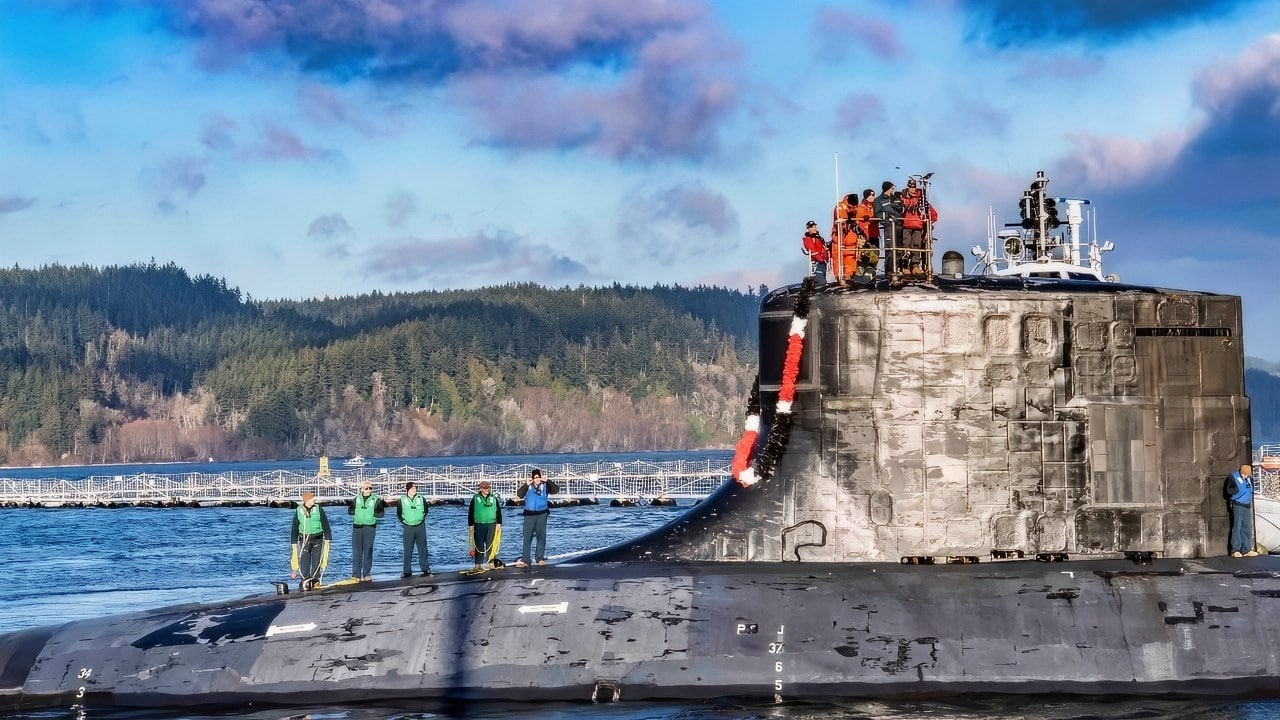
The Seawolf-class fast-attack submarine USS Seawolf (SSN 21) returns home to Naval Base Kitsap-Bangor, Washington, Dec. 14, 2022, following a seven-month deployment. Seawolf is the first of the Navy’s three Seawolf-class submarines, designed to be faster and quieter than its Los Angeles-class counterpart. (U.S. Navy photo by Mass Communication Specialist 2nd Class Gwendelyn L. Ohrazda)
USS Jimmy Carter Seawolf-Class. Image Credit: Creative Commons.
-Balestrieri highlights that this multi-year delay—alongside the devastating decade-long maintenance backlog facing the USS Boise—signals a severe, systemic breakdown in America’s naval shipbuilding and repair infrastructure.
The $3 Billion Paperweight: Why Seawolf-Class USS Connecticut Can’t Go to Sea
The USS Connecticut (SSN-22), a $3 billion Seawolf-class nuclear-powered attack submarine, is currently undergoing extensive repairs and a major maintenance overhaul at the Puget Sound Naval Shipyard in Bremerton, Washington.
The USS Connecticut is one of three Seawolf-class attack submarines. It was severely damaged on October 2, 2021, after a collision with an uncharted seamount.
The impact caused severe damage to the submarine’s bow, sonar dome, and ballast tanks. The sonar dome was completely lost during transit after the crash.
The impact on the seamount in the South China Sea, located off the coast of Japan, damaged the sonar dome, making underwater travel unsafe, several Navy officials said at the time.
The USS Connecticut (SSN-22) was initially expected to return by 2025, but the timeline has been delayed to late 2026 or early 2027. The nuclear-powered submarine has been undergoing extensive repairs at the Puget Sound Naval Shipyard in Washington following the underwater mountain collision.
And this is at a time when the Navy is desperately short of attack submarines.
The Submarine’s Entire Command Element Was Quickly Relieved
The submarine’s Commanding Officer, Cmdr. Cameron Aljilani, Executive Officer, Lt. Cmdr. Patrick Cashin, and Chief of the Boat Master Chief Sonar Technician Cory Rodgers were relieved from command following the completion of an investigation by U.S. 7th Fleet commander Vice Adm. Karl Thomas in early November 2021.
“We have very rigorous navigation safety procedures, and they fell short of what our standard was,” Naval Submarine Forces commander Vice Adm. William Houston said.
The Navy conducted an investigation and determined that the accident was preventable and resulted from a “command environment” and “lax attitudes toward the performance of key tasks,” leading to the relief of the commanding officer, executive officer, and chief of the boat from their duties.
The command investigation led by the chief of U.S. Pacific Fleet’s Maritime Headquarters, Rear Admiral Christopher Cavanaugh, said the sub was sailing rapidly in an area of the ocean that was not charted properly.
Cavanaugh’s report noted that Commander Cameron Aljilani contributed to a “poor command climate” and his actions “set the conditions of the boat’s performance.”
After a month’s trip back to the West Coast of the US, the Connecticut entered into extensive repairs at Puget Sound Naval Shipyard and Intermediate Maintenance Facility.
Repairs to the USS Connecticut Have Been Slow And Complex
The submarine required extensive and complex repairs at the Puget Sound Naval Shipyard, which have taken years to complete. As it was a rare Seawolf-class vessel, a specialized sonar dome needed to be replaced.
The collision caused significant damage, primarily to the submarine’s bow sonar dome and ballast tanks.
The Seawolf production line consisted of only three vessels, and it was shut down in the 1990s. Unlike other classes, there are no decommissioned sister ships to cannibalize for parts, meaning critical components, including the specialized bow sonar dome, had to be specially fabricated, a process with a lead time of over three years.
The Seawolf submarines are used for highly sensitive undersea surveillance and infiltration missions, and the loss of one of these three boats for more than five years has significantly degraded overall fleet readiness.
Extensive Shipyard Work And Upgrades
The submarine was moved to the Puget Sound Naval Shipyard for extensive repairs, including replacement of the damaged sonar dome and other hull components.
“USS Connecticut (SSN 22) is in Dry Dock at Puget Sound Naval Shipyard & Intermediate Maintenance Facility (PSNS & IMF) in Bremerton, Washington, undergoing an Extended Docking Selected Restricted Availability (EDSRA), which is a major maintenance availability that all submarines undergo during their maintenance life cycle,” a Navy spokesperson told TWZ in July of last year.
“The damage USS Connecticut sustained in October 2021 is also being repaired during this EDSRA. Connecticut is expected to return to service in late 2026. PSNS & IMF and Naval Sea Systems Command are continuing to prioritize investments in materiel, infrastructure, and personnel to meet the needs of the fleet.”
Long Repairs Due To The Shutdown Of The Production Line
Repairs are expected to be completed in late 2026, with the process taking several years due to the severity of the damage and the specialized nature of the repairs.
The Seawolf class production was cut short by the Navy at the end of the Cold War, as only three boats were ever built, and those were constructed in the 1980s. By cutting production short, the Seawolf class was the most expensive attack submarine ever built, each costing $3 billion, which translates to over $10 billion today.
The Navy is not just repairing the damage but also increasing the boat’s lethality while it is in dry dock.
“As one of the most advanced and stealth-capable submarines in the fleet, the vessel is seen as critical to future U.S. naval strategy in the Indo-Pacific. Its capabilities include speeds exceeding 35 knots, under-ice operations, and the ability to carry up to 50 weapons. That includes weapons like Mk 48 torpedoes, Tomahawk cruise missiles, and Harpoon anti-ship missiles.”
New Sonar Dome Requested In Navy’s FY 2025 Budget Request
“The Seawolf Class submarines’ sustainment strategy did not include the provisioning of replacement bow domes; therefore, no replacement bow domes for these in-service submarines are within the Navy’s inventory,” the budget requested.
“This program would procure one Seawolf-class bow dome for use in the event replacement is required. Funds in FY25 are to purchase a bow dome, which has a lead time of three-plus years.
“Congress approved an initial trench of $40 million for ’emergency repairs’ and an additional $10 million for a new bow dome in 2021.” However, that’s not believed to include the total cost of the repairs to the boat.
The USS Connecticut is scheduled to finish its repairs late this year and return to the fleet. However, some analysts estimate that the boat won’t be ready until 2027. The USS Seawolf is then expected to enter its own lengthy EDRSA, which will keep it in dry dock until 2029. Which would only leave the Navy with one Seawolf-class submarine on active duty.
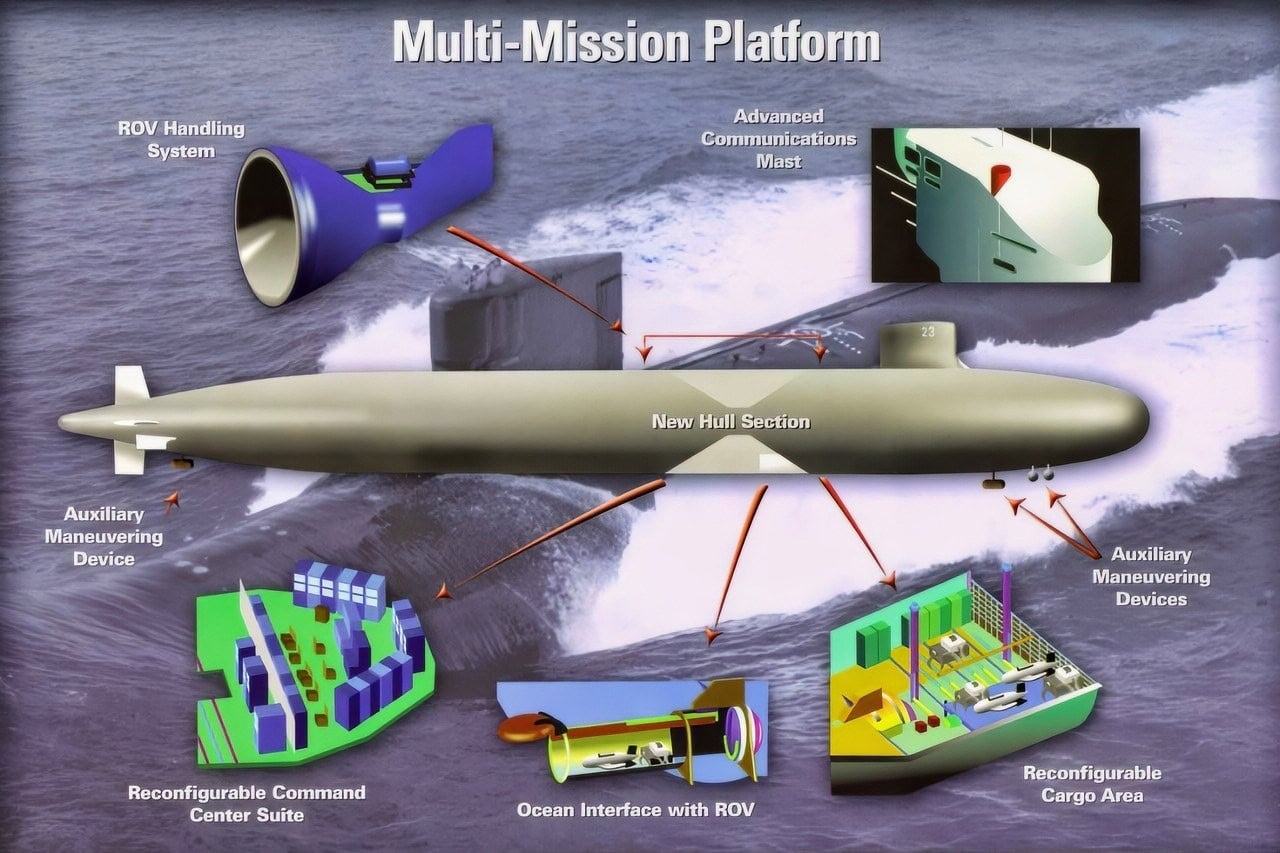
The only other Seawolf-class submarine is the highly modified USS Jimmy Carter (SSN-23), which was designed and built for underwater espionage missions and features a 100-foot-long Multi-Mission Platform (MMP) hull extension.
The prolonged repair work of the USS Connecticut highlights the precarious position of the US shipbuilding industry, where new construction, maintenance work, and repairs are constantly over budget and behind schedule.
The USS Boise Is A Prime Example Of What Ails US Shipyards
Another not-so-stellar example of this is the USS Boise, (SSN-764) a Los Angeles-class attack submarine. The USS Boise delivered some of the opening salvos of Operation Iraqi Freedom when she launched a full load of Tomahawk cruise missiles in support of the initial invasion in March 2003.
The USS Boise has faced a nearly decade-long delay in its maintenance schedule, with its official engineering overhaul (EOH) finally beginning in early 2024, nearly nine years behind its original planned start date.
Sidelined since its last patrol ended in early 2015, the submarine lost its dive certification in 2017 and has since become the “poster child” for the U.S. Navy’s maintenance backlogs and shipyard capacity crises.
Current projections estimate the overhaul won’t be completed until September 2029, meaning the submarine will have been out of service for approximately 15 years, which is almost half its total expected service life.
The US Navy's Most Embarrassing Secret: A $2 Billion Submarine Is Stuck in Dry Dock and Can't Go to Sea
Former Special Forces Warrant Officer Steve Balestrieri exposes the severe shipyard backlogs keeping the $3 billion USS Connecticut in dry dock.


