“China Can Hit Any Target On Earth”: Beijing Unveils DF-5C Nuclear Missile With 12,427 Mile Range That Carries Ten Warheads

Beijingwalker

VIP Member
Joined
Nov 4, 2011
Messages
94,042
Reaction score
114,275
Reputation
1,918.5
Country of Origin
Country of Residence

“China Can Hit Any Target On Earth”: Beijing Unveils DF-5C Nuclear Missile With 12,427 Mile Range That Carries Ten Warheads​

China's recent unveiling of the DF-5C intercontinental ballistic missile during a grand Victory Day parade in Beijing signifies a significant advancement in the nation's military capabilities, highlighting its strategic deterrence and global reach in an increasingly complex geopolitical landscape.
Eirwen Williams09/08/2025

Gz8nlFZWkAAwAif.jpg:large


IN A NUTSHELL
  • China’s DF-5C missile, showcased in Beijing, demonstrates a significant leap in military capabilities.
  • The missile’s range of over 12,427 miles underscores China’s strategic global reach and deterrence capabilities.
  • With advanced features like MIRVs and rapid launch preparation, the DF-5C poses challenges to existing defense systems.
  • The parade, attended by world leaders, signals China’s growing military strength and complex geopolitical posture.
In a striking demonstration of military prowess, China recently showcased its DF-5C intercontinental ballistic missile during a grand Victory Day parade in Beijing. This event commemorated the 80th anniversary of the end of World War II in Asia, attracting global attention for both its historical significance and the advanced military technology on display. The DF-5C missile, with its extensive range and advanced capabilities, stood out as a central highlight. This development marks a significant step in China’s military strategy, as it aims to project power across the globe and reinforce its strategic deterrence capabilities.

Technological Advancements in the DF-5C​

The DF-5C represents a leap forward in missile technology, boasting several sophisticated features that enhance its operational capabilities. One of the most notable advancements is its structure, which allows for transportation in three separate sections by three different vehicles. This modular design significantly reduces launch preparation time, offering a strategic advantage over earlier DF-5 models.

Furthermore, the DF-5C’s range exceeds 12,427 miles, effectively placing any target on the globe within reach. This capability is bolstered by the missile’s ability to be launched through multiple methods, drawing on experience from previous iterations in the Dongfeng series. The missile’s flight speed, estimated at several times the speed of sound, presents a formidable challenge to missile defense systems worldwide.

An additional feature of the DF-5C is its ability to carry multiple independently targetable reentry vehicles (MIRVs). These MIRVs can be armed with nuclear or conventional warheads and are capable of deploying decoys, making interception by defense systems exceedingly difficult. The missile’s advanced guidance system, which combines inertial, starlight, and Beidou navigation, ensures remarkable precision, comparable to that of short- and mid-range missiles.

Strategic Role and International Implications​

China’s unveiling of the DF-5C underscores its commitment to a nuclear strategy centered on deterrence and defense. Despite the missile’s formidable capabilities, China maintains its policy of no first use of nuclear weapons and pledges not to target non-nuclear states. This stance is intended to reassure the international community while reinforcing China’s strategic deterrent.

Military analysts, like Ma Yan, emphasize the credibility and reliability of China’s strategic deterrence as demonstrated by the DF-5C. The missile’s capacity to carry up to ten warheads allows it to engage multiple targets simultaneously, ensuring effective retaliatory capabilities under adverse conditions. The exhibition of such strategic weapons also serves as a reminder of the complex security landscape China navigates and signals its growing military strength.

Additional Military Displays​

The parade featured a wide array of advanced weaponry beyond the DF-5C. Other nuclear-capable missiles, such as the JL-1 and JL-3, highlighted China’s nuclear triad, which comprises land, sea, and air components. The event also showcased developments in naval aviation, with appearances by carrier-based aircraft like the J-35 stealth fighter and J-15T, indicating a shift from near-sea to far-sea defense capabilities.

Air formations included the H-6J long-range bomber, equipped with YJ-12 supersonic anti-ship missiles, as well as new drones demonstrating artificial intelligence-driven swarming and reconnaissance-strike capabilities. These displays underscore China’s focus on integrating cutting-edge technology into its military arsenal, enhancing its ability to project power and defend its interests globally.

Geopolitical Reactions and Future Considerations​

The international response to China’s military parade and the unveiling of the DF-5C has been mixed. While some countries view the demonstration as a legitimate assertion of national strength, others express concern over the potential escalation of regional tensions. The presence of world leaders like Russia’s Vladimir Putin and North Korea’s Kim Jong-un at the event further complicates geopolitical dynamics.

As China continues to advance its military capabilities, questions arise about the implications for global security and stability. The strategic decisions made by China and other major powers in response to these developments will shape the international landscape in the coming years. What measures should be taken by the global community to ensure that advancements in military technology contribute to peace rather than conflict?
 

China to arm submarines with new hypersonic missile​

By Dylan Malyasov
Sep 8, 2025

Captures via WeiboCaptures via Weibo
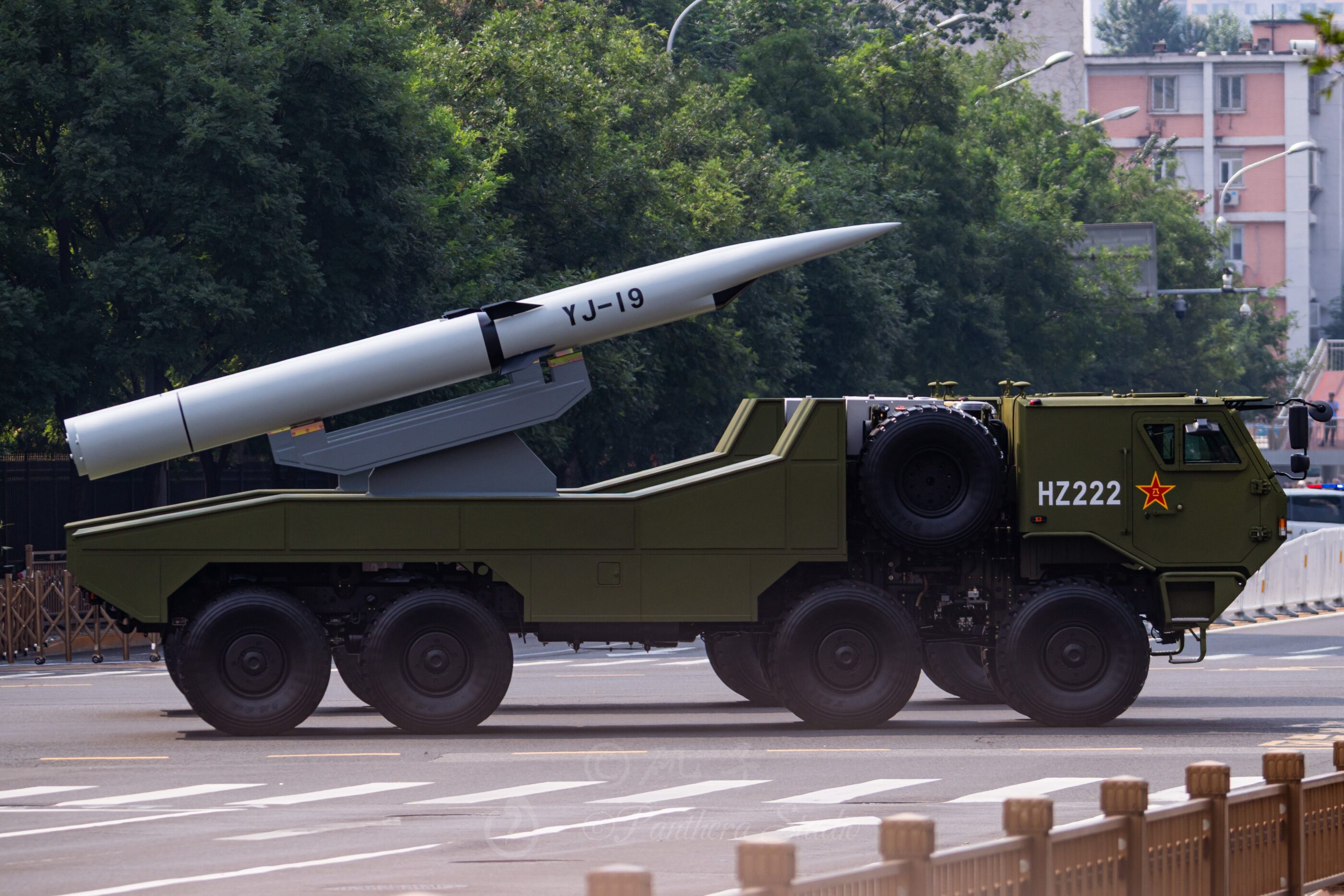
China is preparing to equip its navy’s submarines with a new scramjet-powered hypersonic cruise missile, known as the YJ-19.

Mockups of the YJ-19 hypersonic missile, publicly displayed for the first time during the parade in Beijing attended by Chinese President Xi Jinping, Russian President Vladimir Putin, and North Korean leader Kim Jong Un, point to a system designed for underwater launch from the People’s Liberation Army Navy’s (PLAN) submarines, including both conventional and nuclear-powered platforms.

The missile is expected to be launched from standard 533 mm torpedo tubes, a configuration common across China’s expanding submarine fleet.

Military analysts describe the YJ-19 as a scramjet-powered, high-altitude cruise missile with boosted launch capability, offering the PLAN a new standoff strike weapon that combines submerged survivability with hypersonic speed. Its compact dimensions—noticeably smaller than China’s YJ-17 and YJ-20 systems—suggest compatibility with existing torpedo launch infrastructure, eliminating the need for vertical launch systems.

Footage aired by Chinese state media showed the YJ-19 mockup displayed in a distinct white paint scheme, contrasting with the blue typically used for PLAN anti-ship weapons. The absence of visible suspension lugs further supports the assessment that the missile is not intended for aircraft or deck-mounted launch, but rather for encapsulated storage and deployment from underwater platforms.

Captures via WeiboCaptures via Weibo

Defense analyst Shahryar Pasandideh noted that, “Given how the YJ-19 has a much smaller diameter (including its booster) than the YJ-17 and YJ-20, there has been speculation that the YJ-19 is designed to be launched from a standard 533 mm diameter torpedo tube of PLAN submarines.”

China’s emphasis on unveiling submarine-launched weapons—alongside surface-launched anti-ship missiles and advanced torpedoes—during a parade attended by key geopolitical allies highlights its drive to modernize undersea strike capabilities. The YJ-19, if fielded, would mark a new phase in PLAN submarine warfare by introducing hypersonic weapons to its underwater arsenal, allowing for faster, longer-range engagement of naval targets.

While the Chinese government has not officially confirmed the operational status of the YJ-19, its appearance at a nationally televised military event strongly suggests the system is progressing toward deployment. China’s broader investment in hypersonic and long-range maritime strike systems aligns with its strategic focus on deterring adversary naval forces and denying access to key regional waters.

The inclusion of the YJ-19 in the Beijing parade, set against the backdrop of tightening ties between China, Russia, and North Korea, signals an intent to publicly display strategic deterrent capabilities and emerging naval technologies. Observers note that China’s submarine fleet continues to expand not just in numbers but in technological sophistication—now poised to carry one of the most advanced submarine-launched hypersonic weapons yet unveiled.

If fielded successfully, the YJ-19 would expand the PLAN’s ability to strike from below the surface with near-immediate impact, presenting a new operational challenge to Western and regional navies operating in the Indo-Pacific.


“China Can Hit Any Target On Earth”: Beijing Unveils DF-5C Nuclear Missile With 12,427 Mile Range That Carries Ten Warheads​

China's recent unveiling of the DF-5C intercontinental ballistic missile during a grand Victory Day parade in Beijing signifies a significant advancement in the nation's military capabilities, highlighting its strategic deterrence and global reach in an increasingly complex geopolitical landscape.
Eirwen Williams09/08/2025

Gz8nlFZWkAAwAif.jpg:large


IN A NUTSHELL
  • China’s DF-5C missile, showcased in Beijing, demonstrates a significant leap in military capabilities.
  • The missile’s range of over 12,427 miles underscores China’s strategic global reach and deterrence capabilities.
  • With advanced features like MIRVs and rapid launch preparation, the DF-5C poses challenges to existing defense systems.
  • The parade, attended by world leaders, signals China’s growing military strength and complex geopolitical posture.
In a striking demonstration of military prowess, China recently showcased its DF-5C intercontinental ballistic missile during a grand Victory Day parade in Beijing. This event commemorated the 80th anniversary of the end of World War II in Asia, attracting global attention for both its historical significance and the advanced military technology on display. The DF-5C missile, with its extensive range and advanced capabilities, stood out as a central highlight. This development marks a significant step in China’s military strategy, as it aims to project power across the globe and reinforce its strategic deterrence capabilities.

Technological Advancements in the DF-5C​

The DF-5C represents a leap forward in missile technology, boasting several sophisticated features that enhance its operational capabilities. One of the most notable advancements is its structure, which allows for transportation in three separate sections by three different vehicles. This modular design significantly reduces launch preparation time, offering a strategic advantage over earlier DF-5 models.

Furthermore, the DF-5C’s range exceeds 12,427 miles, effectively placing any target on the globe within reach. This capability is bolstered by the missile’s ability to be launched through multiple methods, drawing on experience from previous iterations in the Dongfeng series. The missile’s flight speed, estimated at several times the speed of sound, presents a formidable challenge to missile defense systems worldwide.

An additional feature of the DF-5C is its ability to carry multiple independently targetable reentry vehicles (MIRVs). These MIRVs can be armed with nuclear or conventional warheads and are capable of deploying decoys, making interception by defense systems exceedingly difficult. The missile’s advanced guidance system, which combines inertial, starlight, and Beidou navigation, ensures remarkable precision, comparable to that of short- and mid-range missiles.

Strategic Role and International Implications​

China’s unveiling of the DF-5C underscores its commitment to a nuclear strategy centered on deterrence and defense. Despite the missile’s formidable capabilities, China maintains its policy of no first use of nuclear weapons and pledges not to target non-nuclear states. This stance is intended to reassure the international community while reinforcing China’s strategic deterrent.

Military analysts, like Ma Yan, emphasize the credibility and reliability of China’s strategic deterrence as demonstrated by the DF-5C. The missile’s capacity to carry up to ten warheads allows it to engage multiple targets simultaneously, ensuring effective retaliatory capabilities under adverse conditions. The exhibition of such strategic weapons also serves as a reminder of the complex security landscape China navigates and signals its growing military strength.

Additional Military Displays​

The parade featured a wide array of advanced weaponry beyond the DF-5C. Other nuclear-capable missiles, such as the JL-1 and JL-3, highlighted China’s nuclear triad, which comprises land, sea, and air components. The event also showcased developments in naval aviation, with appearances by carrier-based aircraft like the J-35 stealth fighter and J-15T, indicating a shift from near-sea to far-sea defense capabilities.

Air formations included the H-6J long-range bomber, equipped with YJ-12 supersonic anti-ship missiles, as well as new drones demonstrating artificial intelligence-driven swarming and reconnaissance-strike capabilities. These displays underscore China’s focus on integrating cutting-edge technology into its military arsenal, enhancing its ability to project power and defend its interests globally.

Geopolitical Reactions and Future Considerations​

The international response to China’s military parade and the unveiling of the DF-5C has been mixed. While some countries view the demonstration as a legitimate assertion of national strength, others express concern over the potential escalation of regional tensions. The presence of world leaders like Russia’s Vladimir Putin and North Korea’s Kim Jong-un at the event further complicates geopolitical dynamics.

As China continues to advance its military capabilities, questions arise about the implications for global security and stability. The strategic decisions made by China and other major powers in response to these developments will shape the international landscape in the coming years. What measures should be taken by the global community to ensure that advancements in military technology contribute to peace rather than conflict?
images (23).jpeg
 

China to arm submarines with new hypersonic missile​

By Dylan Malyasov
Sep 8, 2025

Captures via WeiboCaptures via Weibo
China is preparing to equip its navy’s submarines with a new scramjet-powered hypersonic cruise missile, known as the YJ-19.

Mockups of the YJ-19 hypersonic missile, publicly displayed for the first time during the parade in Beijing attended by Chinese President Xi Jinping, Russian President Vladimir Putin, and North Korean leader Kim Jong Un, point to a system designed for underwater launch from the People’s Liberation Army Navy’s (PLAN) submarines, including both conventional and nuclear-powered platforms.

The missile is expected to be launched from standard 533 mm torpedo tubes, a configuration common across China’s expanding submarine fleet.

Military analysts describe the YJ-19 as a scramjet-powered, high-altitude cruise missile with boosted launch capability, offering the PLAN a new standoff strike weapon that combines submerged survivability with hypersonic speed. Its compact dimensions—noticeably smaller than China’s YJ-17 and YJ-20 systems—suggest compatibility with existing torpedo launch infrastructure, eliminating the need for vertical launch systems.

Footage aired by Chinese state media showed the YJ-19 mockup displayed in a distinct white paint scheme, contrasting with the blue typically used for PLAN anti-ship weapons. The absence of visible suspension lugs further supports the assessment that the missile is not intended for aircraft or deck-mounted launch, but rather for encapsulated storage and deployment from underwater platforms.

Captures via WeiboCaptures via Weibo

Defense analyst Shahryar Pasandideh noted that, “Given how the YJ-19 has a much smaller diameter (including its booster) than the YJ-17 and YJ-20, there has been speculation that the YJ-19 is designed to be launched from a standard 533 mm diameter torpedo tube of PLAN submarines.”

China’s emphasis on unveiling submarine-launched weapons—alongside surface-launched anti-ship missiles and advanced torpedoes—during a parade attended by key geopolitical allies highlights its drive to modernize undersea strike capabilities. The YJ-19, if fielded, would mark a new phase in PLAN submarine warfare by introducing hypersonic weapons to its underwater arsenal, allowing for faster, longer-range engagement of naval targets.

While the Chinese government has not officially confirmed the operational status of the YJ-19, its appearance at a nationally televised military event strongly suggests the system is progressing toward deployment. China’s broader investment in hypersonic and long-range maritime strike systems aligns with its strategic focus on deterring adversary naval forces and denying access to key regional waters.

The inclusion of the YJ-19 in the Beijing parade, set against the backdrop of tightening ties between China, Russia, and North Korea, signals an intent to publicly display strategic deterrent capabilities and emerging naval technologies. Observers note that China’s submarine fleet continues to expand not just in numbers but in technological sophistication—now poised to carry one of the most advanced submarine-launched hypersonic weapons yet unveiled.

If fielded successfully, the YJ-19 would expand the PLAN’s ability to strike from below the surface with near-immediate impact, presenting a new operational challenge to Western and regional navies operating in the Indo-Pacific.

Sub launched HCM, this is really dope...
 
The willingness is there, but the ability is not. So why bother? Sums up everything u need to know about american containment strategy of china.
 
China is too conventionally strong of an opponent now, at a far greater scale than anything the US has ever dared to face, and is thankfully not interested in direct war anyway. If they leave us alone we leave them alone. China is simply too big and integrated into the global supply chain. It is in fact so indispensable to the global economy that the US is reliant on it for basically everything. You simply can’t contain your biggest supplier
 

China’s Nuclear Expansion Accelerates—New Facilities Rise Where Villages Once Stood​

Apr 02, 2026 13:45

aa41286be5a566e37685becdc84bd2b0.jpgThe nuclear missile formation consisting of DF-31BJ land-based intercontinental missiles marches through Tian’anmen Square on September 3, 2025, in Beijing, China. (Source: Getty Images)

A new investigation has uncovered a significant expansion of China’s nuclear infrastructure in Sichuan province, where entire villages were previously cleared to make way for strategic military facilities, according to a report published by CNN on April 1.

Residents of one village said that when authorities began seizing land in 2022 and forcing people to relocate, officials offered little explanation beyond a brief statement that the project was a “state secret.”

That explanation now appears to have masked a broader effort by Beijing to rapidly expand its nuclear capabilities.

Satellite imagery analyzed as part of the investigation shows that more than three years later, the village has been completely demolished. In its place, a series of new structures has been built to support what analysts describe as critical components of China’s nuclear weapons infrastructure.

The construction aligns with assessments based on dozens of official documents and supports longstanding warnings from US officials that China is undertaking its most significant nuclear modernization effort in decades.

One of the most striking features identified at the site is a massive dome-like structure near the Tongjiang River, covering roughly 36,000 square feet. Experts say the facility appears designed for handling highly radioactive materials, including uranium and plutonium.

The site is equipped with extensive protective systems, including radiation monitoring, blast-resistant doors, and specialized ventilation. It is also heavily secured, with multiple layers of fencing and tunnel networks built into the surrounding mountainous terrain. The area is reportedly known as Zone 906.

According to the investigation, the transformation of the site began around 2021, following directives from Chinese leader Xi Jinping to accelerate the development of strategic deterrence capabilities.

Analysts say China is simultaneously expanding its early-warning systems and missile launch capabilities, suggesting a shift toward a more advanced and responsive nuclear posture—one that could play a decisive role in any potential conflict involving Taiwan.


Experts warn that the rapid pace of China’s nuclear buildup could have far-reaching consequences for global security, potentially triggering a new arms race and further straining relations between Washington and Beijing.

Tong Zhao, a senior fellow cited in the report, noted that expanding nuclear capabilities also carries a psychological dimension, reinforcing China’s growing influence and shaping how other major powers perceive its strategic strength.

At the same time, analysts caution that Beijing’s increasing military advantage and centralized control over its armed forces may complicate future arms control efforts.

Negotiations on strategic stability—including nuclear issues—risk becoming largely symbolic, with limited prospects for meaningful reductions in weapons stockpiles.

Earlier, China became the world’s second-largest operator of nuclear-powered submarines, overtaking Russia and narrowing the gap with the US.

The shift places China behind only the United States Navy, while pushing Russia into third place in terms of the number of nuclear submarines currently in service.

The People’s Liberation Army Navy now operates around 32 active nuclear-powered submarines. By comparison, Russia’s fleet is estimated to include roughly 25 to 28 such vessels.

 
I just hope China can beat the Americans to landing man on the moon first
 
You see only what we permit. Peace rests on strength.

The vile schemes of hostile forces will never stop — and they will never succeed.
 

Users who are viewing this thread

Pakistan Defence Latest

Latest Posts

Back
Top