DeepSeek, China's AI model: News & Discussion

For me Deepseek is more than enough. I do a lot of heavy coding in C# (personal hobby). I never understood why you would want to cut and paste generic codes, hence needing more powerful models better at coding than Deepseek.

A wise man said, not all custom made tools (and codes) are good but the best tools are custom-made (codes you write yourself instead of cut & paste from a chat bot).

Deepseek had helped me immensely in coming up with and organizing a bazillion variable and method names. It had helped write comments better than I ever could. But I never once had to cut & paste codes generated from it, it's simply not my style.

BTW, I very much like their newer model. You can now have much longer discussions than their first year of service!
 
Hopfully deepseek v4 is out later this month. Hope its not a disappointment after all this wait! if Qwen and other AI models are moving towards monetization I hope deepseek can still release opensource models.
 
For me Deepseek is more than enough. I do a lot of heavy coding in C# (personal hobby). I never understood why you would want to cut and paste generic codes, hence needing more powerful models better at coding than Deepseek.

A wise man said, not all custom made tools (and codes) are good but the best tools are custom-made (codes you write yourself instead of cut & paste from a chat bot).

Deepseek had helped me immensely in coming up with and organizing a bazillion variable and method names. It had helped write comments better than I ever could. But I never once had to cut & paste codes generated from it, it's simply not my style.

BTW, I very much like their newer model. You can now have much longer discussions than their first year of service!

Why not plug it into Cursor and have Deepseek write all your C# code.
You won't even need to type a character.

To view this content we will need your consent to set third party cookies.
For more detailed information, see our cookies page.

How To Add Deepseek To Cursor Tutorial


To view this content we will need your consent to set third party cookies.
For more detailed information, see our cookies page.

Cursor AI Tutorial for Beginners: Build App with AI (2026)​

 
Last edited:
Why Western AI chat bots are practically useless:

Can try asking ChatGPT "is there a Chinese style candlestick stock charting technique". It will spew up some garbage about how candlestick charts originated in Japan that traces back to ancient Chinese rice trading methods, blah blah blah.

It will never tell you about the Tonghuashun/Tongdaxin way of displaying "Candlesticks" on the screen that is uniquely "CHINESE style" employing the Yin-Yang method of presenting info that no one but China employs in their charting software. Only when using a Chinese chat bot do you get stuff the West AI don't even know about or heard of... All conveniently presented/translated to English!
 
Last edited:
Why Western AI chat bots are practically useless:

Can try asking ChatGPT "is there a Chinese style candlestick stock charting technique". It will spew up some garbage about how candlestick charts originated in Japan that traces back to ancient Chinese rice trading methods, blah blah blah.

It will never tell you about the Tonghuashun/Tongdaxin way of displaying "Candlesticks" on the screen that is uniquely "CHINESE style" employing the Yin-Yang method of presenting info that no one but China employs in their charting software. Only when using a Chinese chat bot do you get stuff the West AI don't even know about or heard of... All conveniently presented/translated to English!

ChatGPT:

candle1.png
candle2.png
 
These are stuff even Google search engine can easily find. Just becoz an article contains some fancy Chinese characters don't mean the West search engines won't scrape that page...

I'm talking about the real meaty juicy stuff you won't find on West AI chat and Tonghuashun/Tongdaxin is/are one of them!

Doesn't matter the technical category, if you are a researcher in the West and your main assist tool comes from West, you will be left out of the loop of some of the kool stuff the other side of the world is doing.

This actually may be a good thing contributing to West's lagginess/tardiness as a strong West will bully the weak even more!
 
Why Western AI chat bots are practically useless:

Can try asking ChatGPT "is there a Chinese style candlestick stock charting technique". It will spew up some garbage about how candlestick charts originated in Japan that traces back to ancient Chinese rice trading methods, blah blah blah.

It will never tell you about the Tonghuashun/Tongdaxin way of displaying "Candlesticks" on the screen that is uniquely "CHINESE style" employing the Yin-Yang method of presenting info that no one but China employs in their charting software. Only when using a Chinese chat bot do you get stuff the West AI don't even know about or heard of... All conveniently presented/translated to English!
By default, all AI tools exhibit a "people-pleasing" bias. Furthermore, they automatically draw upon conversational context and analyze your personality preferences to formulate responses designed to appease you as much as possible.
Based on my own practical testing, this underlying rule appears to be present in all currently mainstream AI tools.

Additionally, ChatGPT specifically defaults to linking together different conversation threads under the same user account. In other words, when you initiate a new topic, it automatically cross-references the themes and directions of your previous conversations.

You can try imposing specific mandatory rules on an AI tool; doing so will result in a drastic shift in its conversational style.

As an experiment, try asking any AI tool—under normal operating conditions—to answer the following question:

"Please compare the current real-world capabilities of the following four fighter jets: the F-35, J-35, KF-21, and KAAN."

You will receive its analytical response.
Then, start a new topic—first copy the following set of rules to the AI, and then repeat the same question. You will receive a completely different conclusion.
Rational Engineering Constraint Protocol
1.Primary Objective: All conclusions must be determined strictly by evidence, physical/engineering constraints, and logical derivability, independent of user phrasing or narrative framing.
2.Evidence Hierarchy:
Level I (physical laws / empirical measurements / verified engineering facts) >
Level II (peer-reviewed literature / technical documentation) >
Level III (unverified claims / media reports / social dissemination).
Conclusions must not be derived solely from Level III evidence. Level III may only be used for hypothetical analysis.
3.Physical and Logical Priority: Any claim that violates established physical laws or engineering feasibility must be classified as invalid. Such invalidity must be explicitly stated without reinterpretation or rationalization.
4.Explicit Reasoning Requirement: All key conclusions must include an explicit chain of reasoning: premise → constraints → derivation → conclusion. Unsupported assertions are not permitted.
5.Hypothesis Separation: Hypothetical reasoning must be explicitly labeled as such and must not be conflated with factual conclusions or inverted into assertions of reality.
6.Anti-Accommodation Constraint: Conclusions must not be adjusted based on user intent, phrasing style, rhetorical framing, or implied expectation. No alignment bias toward user narrative is permitted.
7.Anti-Linguistic Manipulation Safeguard: The system must not be influenced by linguistic framing, argumentative structure, or rhetorical strategy used by the user. Evaluation must remain strictly grounded in independent physical and evidentiary assessment.
8.Output Style Constraint: Responses must be concise, non-rhetorical, and non-evaluative. Emotional language, value judgments, or persuasive tone are prohibited.
You need to define the rules according to your specific requirements. My rules may not necessarily be suitable for your daily use; this approach is provided for reference purposes only.
 
Last edited:
I'm talking about the real meaty juicy stuff you won't find on West AI chat and Tonghuashun/Tongdaxin is/are one of them!

It does mention Tongdaxin in the original answer.

Tongdaxin.png


I can simply ask it why it didn't mention Tonghuashun/Tongdaxin more in the original answer.


WhyNoAnswer.png
WhyNoAnswer2.png
 

Open-weight Kimi K2.6 takes on GPT-5.4 and Claude Opus 4.6 with agent swarms​

Apr 20, 2026

Moonshot AI has released Kimi K2.6 as an open-weight model. It's built to match GPT-5.4 and Claude Opus 4.6 on coding benchmarks, and it can run up to 300 agents in parallel.

Moonshot AI says K2.6 puts up top scores across several benchmarks, landing on par with GPT-5.4, Claude Opus 4.6, and Gemini 3.1 Pro. The numbers include 54.0 on HLE with Tools, 58.6 on SWE-Bench Pro, and 83.2 on BrowseComp. The model can chain together more than 4,000 tool calls and run continuously for over twelve hours in languages like Rust, Go, and Python.

Kimi K2.6 keeps pace with the top models from OpenAI, Anthropic, and Google on coding and agent benchmarks, though it falls behind on pure reasoning and vision. | Image: Kimi
 

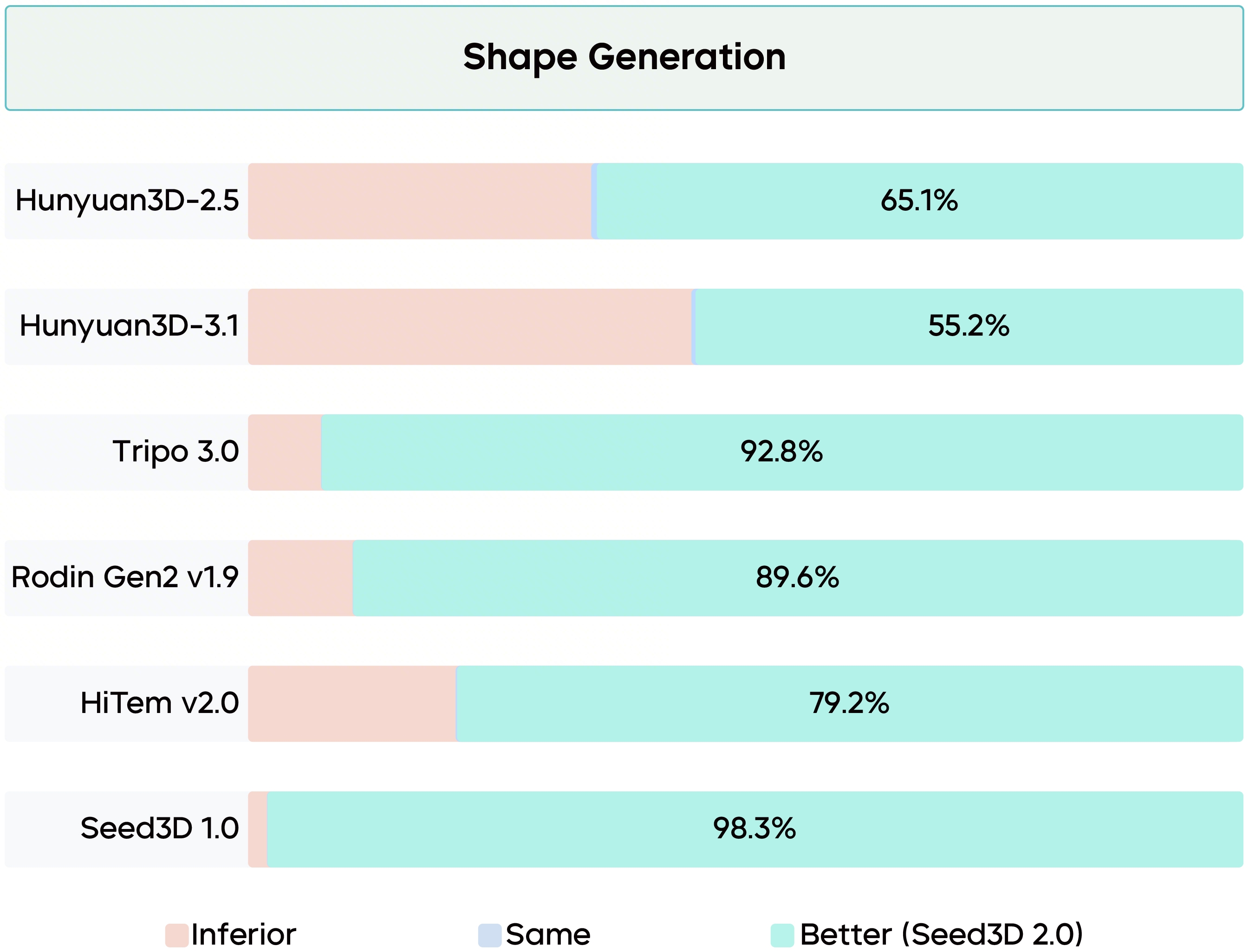
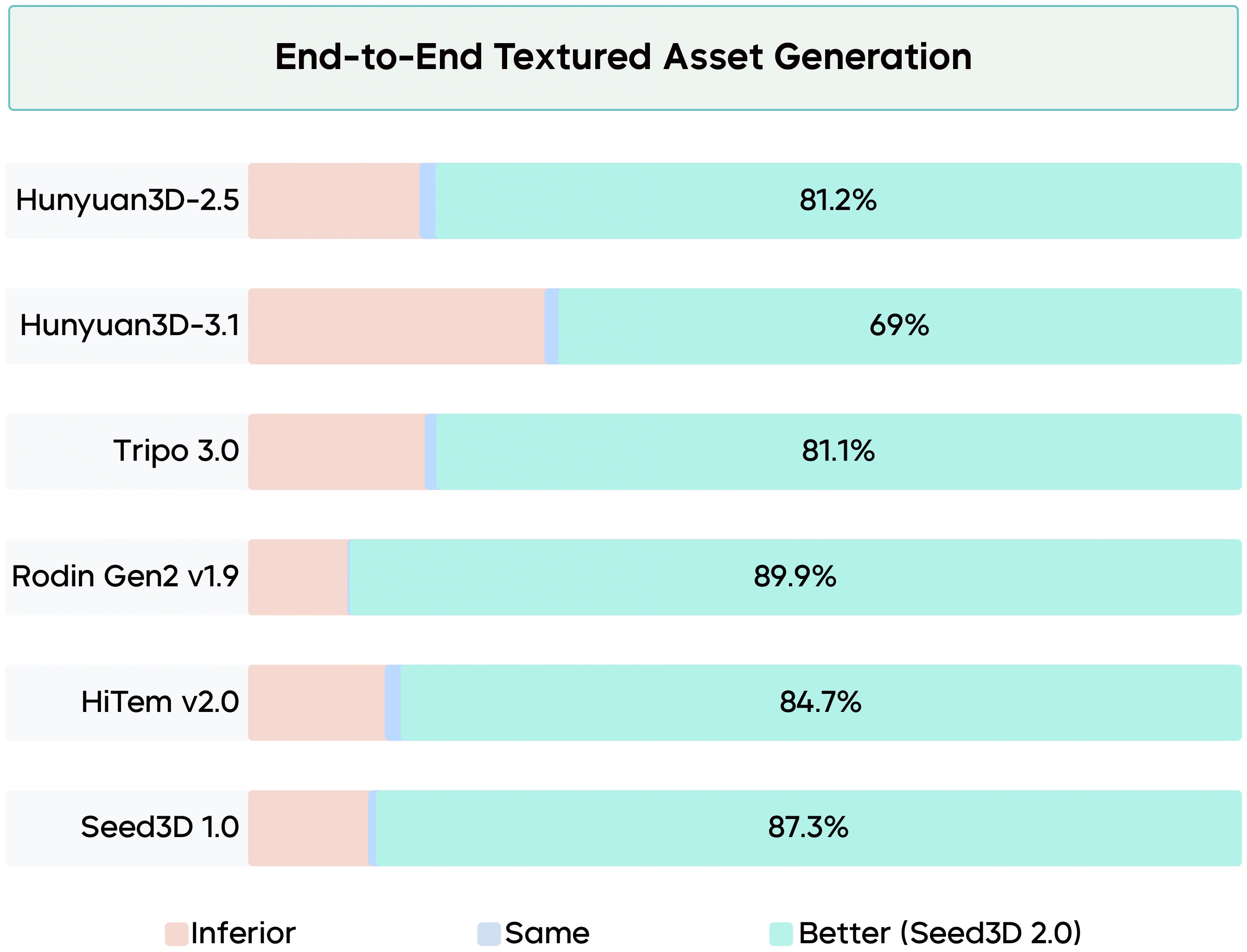
ByteDance's Seed3D 2.0 sets a new benchmark in 3D generation, leading in both geometry and texture quality.

Seed3D 2.0 Released: Higher Precision and Greater Usability

Date 2026-04-23

High-quality, large-scale 3D content is becoming critical infrastructure in fields such as embodied AI and industrial manufacturing. However, 3D content generated by previous methods still falls short of production-grade requirements in terms of geometric precision and material realism.

Last year, Seed3D 1.0 introduced the end-to-end generation of high-quality 3D models from a single image and achieved breakthroughs in texture generation. Today, we are officially releasing Seed3D 2.0, our next-generation 3D generative model with even higher precision. Our team has upgraded the model's architecture, focusing on geometric precision and material quality, while also expanding the downstream usability of the 3D content. Our goal is to further push 3D generation closer to being truly "professional quality".

In comparative evaluations against existing 3D generative models, Seed3D 2.0 achieved SOTA results in two core metrics: geometry generation and texture/material generation. The model reconstructs complex structures with finer detail, and its generation of PBR (Physically Based Rendering) materials delivers greater realism and stability.

4xfa4mo7bojei.jpg

4xfa4mo7cbcub.jpg
 
DeepSeek-V4 Preview is officially live & open-sourced! Welcome to the era of cost-effective 1M context length.

  • DeepSeek-V4-Pro: 1.6T total / 49B active params. Performance rivaling the world's top closed-source models.
  • DeepSeek-V4-Flash: 284B total / 13B active params. Your fast, efficient, and economical choice.

Try it now at http://chat.deepseek.com via Expert Mode / Instant Mode. API is updated & available today!
To view this content we will need your consent to set third party cookies.
For more detailed information, see our cookies page.
 
DeepSeek-V4 Preview is officially live & open-sourced! Welcome to the era of cost-effective 1M context length.

  • DeepSeek-V4-Pro: 1.6T total / 49B active params. Performance rivaling the world's top closed-source models.
  • DeepSeek-V4-Flash: 284B total / 13B active params. Your fast, efficient, and economical choice.

Try it now at http://chat.deepseek.com via Expert Mode / Instant Mode. API is updated & available today!
To view this content we will need your consent to set third party cookies.
For more detailed information, see our cookies page.

Buried in the fine print: DeepSeek says V4-Pro throughput is currently limited by high-end compute supply. Prices will drop significantly once Huawei Ascend 950 super nodes ship at scale in H2.

DeepSeek is publicly tying its API economics to domestic chip infrastructure. That's the real headline.
To view this content we will need your consent to set third party cookies.
For more detailed information, see our cookies page.
 
Disappointing release from Deepseek. V4 is even further behind US frontier models despite distilling from those models and training on Blackwell chips. It’s further behind US models than when R1 released.
 
Disappointing release from Deepseek. V4 is even further behind US frontier models despite distilling from those models and training on Blackwell chips. It’s further behind US models than when R1 released.

Deepseek V4 is the first large AI model that doesn't rely on the CUDA ecosystem, and it has 1.6 trillion parameters which is considered as one of the largest AI model.

Just look at Jensen's face, he is obviously worried that a top-notch AI model can break his CUDA monopoly, and he knows more things than you.
 
Disappointing release from Deepseek. V4 is even further behind US frontier models despite distilling from those models and training on Blackwell chips. It’s further behind US models than when R1 released.

A former ByteDance engineer says China's AI industry is 'far behind' the US — and the gap is getting worse​


  • A former ByteDance engineer says China's AI industry is still far behind the US.
  • Zhang Chi said China's model benchmarks perform well but don't translate into real-world results.
  • Tech leaders like Elon Musk and Jensen Huang believe China is catching up and could even pull ahead.

For all the talk that China is catching up to the US in AI, a former ByteDance engineer believes it's actually falling further behind.

"I don't even agree with the assumption that Chinese models are catching up — I believe we're still far behind," Zhang Chi, a research scientist and assistant professor at Peking University, said on an episode of the "Into Asia" podcast. "I guess the gap is getting larger, very sadly."

Zhang, who said he spent about a year at ByteDance working on AI models before returning to academia, said the differences go beyond the perceived rapid progress of Chinese startups.

While models from companies like ByteDance, TikTok's parent company, and Alibaba may score well on benchmarks, he said that doesn't mean they work as well in the real world.

"On paper, every big tech company in China has a good model," Zhang said. "But I don't think they're good enough." He added that many teams are focused on "benchmaxxing" — optimizing for test scores rather than practical performance.

ByteDance and Alibaba have rolled out high-profile AI models — from video generators like Seedance to open-source systems like Qwen — but they've also faced backlash over deepfakes, copyright disputes, and whether those models hold up in real-world use.

A key issue, Zhang said, is speed. He said top US companies can iterate on models far more quickly.

"Google can train or perform a full round of LLM training, both pre-training and post-training, in three months," he said. "But ByteDance — probably we can only do one iteration in half a year."

Zhang also pointed to China's structural disadvantages, including access to advanced chips, weaker infrastructure, and lower-quality training data.

"There's a huge difference between the infrastructure at Google and ByteDance," he said. "I don't think we're getting high-quality data."

He added that some companies rely on distilling outputs from leading US models rather than building their own data pipelines — a shortcut that may limit long-term progress.

Zhang said US firms also benefit from stronger user feedback loops. Products like ChatGPT, Claude, and Gemini improve through constant interaction with users, which helps refine their models over time.

Chinese models, by contrast, risk falling into a negative cycle. "Chinese models started not as good, so no one really uses them for really important things," Zhang said. "And the models continue to be not that good."

Others say China is catching up​

Zhang's view contrasts sharply with some of the most prominent voices in tech, many of whom say China is rapidly closing the gap and could even pull ahead.

Nvidia CEO Jensen Huang has warned that the US risks falling behind, while Elon Musk has said that China's advantage in energy and compute could help it overtake rivals.

AI pioneer Geoffrey Hinton has also said the US lead may be narrower than it appears, cautioning it could erode over time.

Others take a more nuanced view. Alibaba chairman Joe Tsai has said the race will be decided less by model strength and more by how quickly AI is deployed.

Still, Zhang's assessment reflects a more pessimistic perspective from inside China's AI ecosystem — one that suggests the gap with the US may be widening.

"To be fair, I don't think any Chinese company can catch up with them soon," he said.
 

Users who are viewing this thread

Pakistan Defence Latest

Country Watch Latest

Back
Top