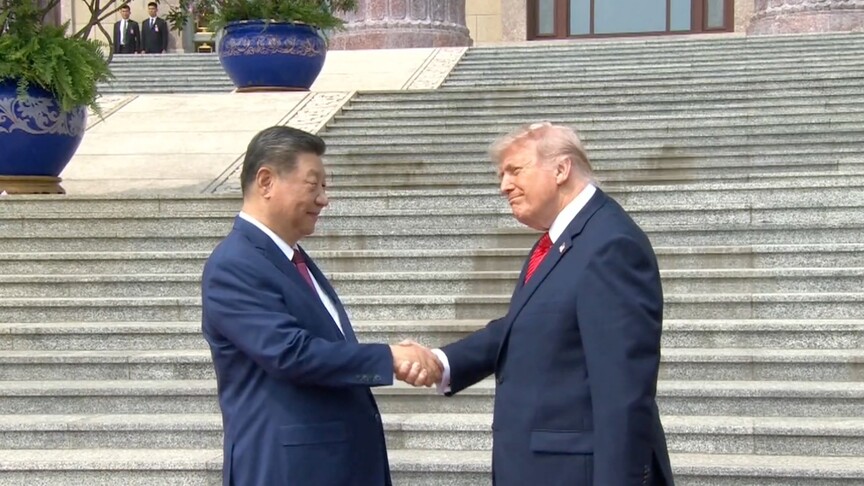
US Political News and Trump’s China visit

When Clinton visited China, the Chinese people felt that he was like the Earth's President.

When Bush visited China, the Chinese people felt that the United States was still a cooperative partner.

When Obama visited China, the Chinese people felt that his visit was not important.

Now that Trump has visited China, the Chinese people just want to see what interesting shenanigans he will make.
 
Ignore those scumbags. They are eager for U.S.–China relations to deteriorate so they can profit from it themselves.
 
This article contains several errors.

First, Chinese leaders did not visit the United States in 2017, and the claim that Trump received Chinese leaders at Mar-a-Lago is incorrect.

Second, the claim that China challenges U.S. hegemony is wrong. This is a Cold War confrontation mindset from the West, and we have no interest in such confrontation.

In 2017, Chinese leaders promised: China will not become a hegemonic country. (https://www.mfa.gov.cn/web/ziliao_6...0ggs/jszgddzg/202208/t20220824_10750619.shtml)

In November 2023, Chinese leaders said: This Earth can accommodate both China and the U.S. (https://www.gov.cn/yaowen/liebiao/202311/content_6915511.htm)

In March 2025, the Chinese Ministry of Foreign Affairs said: We have no intention to surpass anyone or replace anyone. (https://tv.cctv.com/2025/03/07/VIDE9c0WnbviW7X79LLbWMdQ250307.shtml)

Of course, everyone has their own understanding.

Third, the article claims that China complains about U.S. sanctions preventing Iran from obtaining supplies but also says that China and Russia maintain Iran's theocratic government. This statement is self-contradictory. This media outlet lacks respect for a country's government and other religions. In fact, if China aids Iran, U.S. warships and aircraft would face greater risk.

Fourth, China purchasing Iranian products is a commercial activity; this cannot be seen as support for Iran. It is based on China’s interests. The Epstein Coalition initiated an aggressive war, and China’s diplomatic support for Iran is the correct choice based on international law. There is no evidence or reason to prove that China pressured Iran, and Trump’s remarks cannot serve as valid evidence.

Fifth, China will not buy U.S. energy. The reason is simple: U.S. energy is too expensive. If Western countries defeat Russia through economic sanctions, China will be the next target. China supporting Russia economically is a cooperation between the two countries and a choice China makes to safeguard its own interests.

Sixth, Iran’s Foreign Minister visited China before Trump. We know Iran’s bottom line, and we will not betray Iran’s interests because of Trump. The initiators of this war are the Epstein Coalition, and they should bear responsibility.

Seventh, I really dislike the word 'invasion.' Taiwan Province is legally part of China; this is the result of China's victory in World War II. If Western countries cannot accept China reclaiming lost territory, they can send troops to participate in the war.

In summary: This is an article full of political bias from a Western perspective. I believe this meeting will not achieve significant results. Taiwan Province is China's internal affair, and internal affairs are not open for discussion. There will be no consensus on the Russia-Ukraine conflict, and the United States cannot intervene in Russia, so why assume China has the ability to intervene in Russia? Epstein's aggressive war can only end with American concession; otherwise, China will not interfere in this war.

Japan rearming in violation of World War II regulations is a topic that must be discussed. The good news is that China and the U.S. will cooperate economically.

This visit is a performance by Trump for the midterm elections; Trump will leave tomorrow. We should not have too high expectations for this meeting.
 
ANALYSIS
News|US-Israel war on Iran

Trump-Xi summit: China’s help in Iran may require US concessions​

Analysts say China may seek changes in US policy towards Taiwan if it were to pressure Iran reopen Hormuz.

Listen (9 mins)
Save
View attachment 197097

Click here to share on social media
Share

Add Al Jazeera on Google
US and Chinese flags

US and Chinese national flags next to the portrait of late Chinese Chairman Mao Zedong, before US President Donald Trump's visit to China, Beijing, May 13, 2026 [Go Nakamura/Reuters]

By Ali Harb
Published On 13 May 202613 May 2026
When President Donald Trump meets with his counterpart, Xi Jinping, a new item will be added to the long list of issues of mutual interest and potential disagreement between the United States and China: the war in Iran.

US officials have suggested that China should play a greater role in pushing Iran to reopen the Strait of Hormuz, but analysts say Beijing will require concessions from the US, likely over Taiwan, if it were to aid in resolving the crisis.

Recommended Stories​

list of 3 items
end of list
And Iran is unlikely to be at the top of the agenda in the Trump-Xi meeting.

“The Iran issue is not really the central issue for either party in this summit,” said Christopher Heurlin, an associate professor of government and Asian studies at Bowdoin College.

Heurlin said that, although the meeting was delayed earlier this year due to the war, Taiwan will remain China’s top issue, while Trump will likely push Beijing to buy more US soya beans.

China is a major importer of Iranian and Middle East oil, so its economy could come under strain from the disruption caused by Tehran’s Hormuz blockade and the US naval siege on Iran.

Still, Heurlin said Beijing has been reluctant to get involved in the crisis.

“In terms of Iran, the Chinese have sort of been positioning themselves as someone who might possibly be helpful in this regard,” he said.

“They hosted the Iranian foreign minister recently, but it seems like they’ve been holding off on putting any pressure on Iran to end the conflict, just waiting for this visit.”
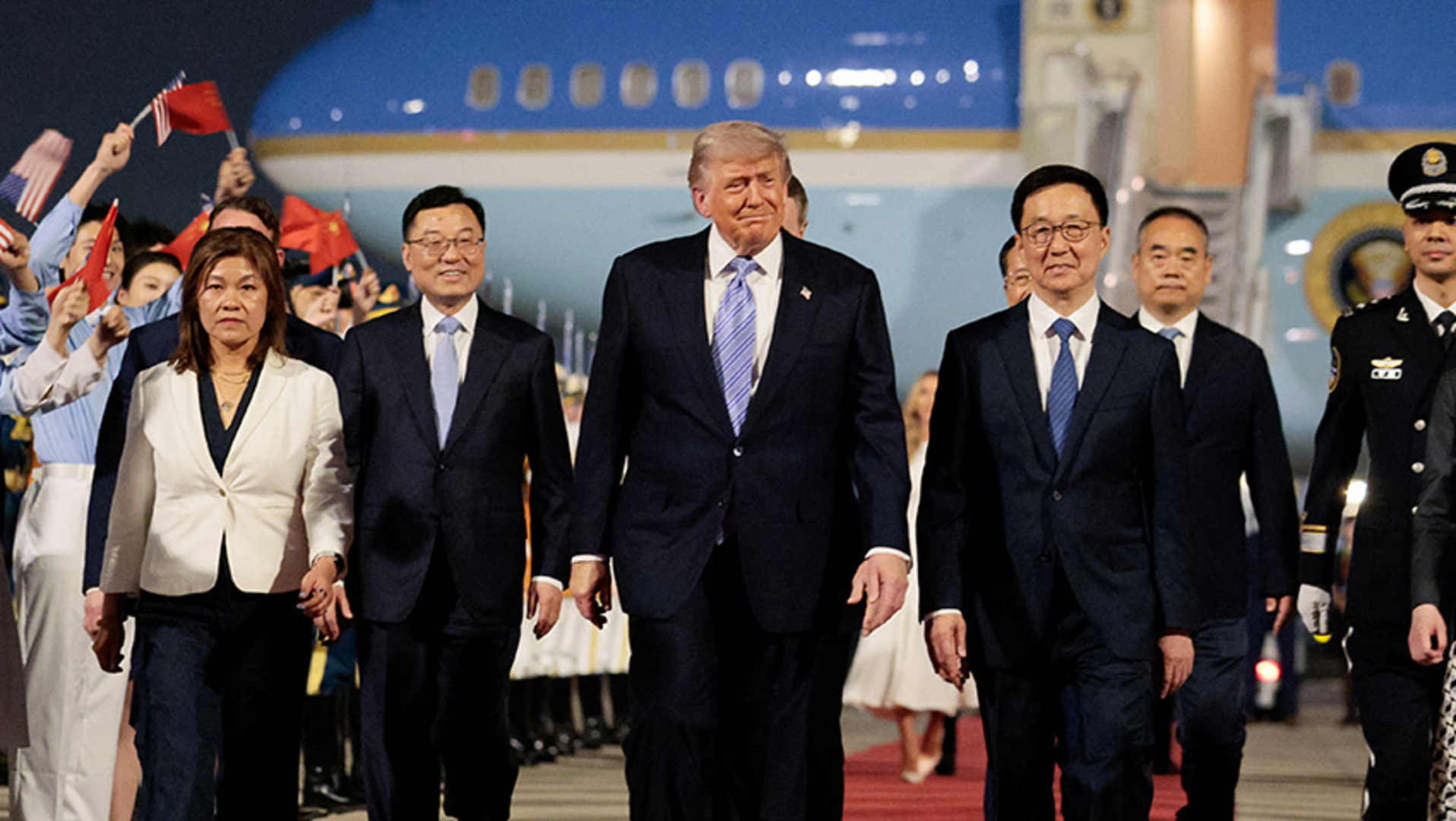


image.jpg


Play Video
0:43
  • Now Playing
    00:43

    Trump arrives in China for two-day summit with Xi​

  • Next
    05:06

    China can be 'catalyst and mediator' to end war on Iran, analyst says​

  • 00:43

    12 killed by a series of Israeli strikes on cars in Lebanon​

  • 01:46

    What Trump and Xi want from China visit​

  • 03:01

    Lebanon's hospitals struggle as Israeli strikes kill paramedics, wound thousands​


Trump ‘chastened’​

While Beijing has amassed oil reserves that have helped it weather global energy shortfalls, such resources are finite, so China has an interest in opening the strait.

Advertisement


At the same time, if Washington – Beijing’s chief strategic competitor – is weakened globally from the Iran conflict, which is increasingly looking like an unwinnable war for many observers.

Get instant alerts and updates based on your interests. Be the first to know when big stories happen.
Yes, keep me updated
The Economist magazine summed up that dynamic on its front cover last month, featuring a photo of Xi looking at Trump with a quote attributed to Napoleon Bonaparte: “Never interrupt your enemy when he is making a mistake.”

Inderjeet Parmar, professor of international politics at City St George’s, University of London, said Trump heads to China “chastened” by the shortcomings of the Iran war.

“So Trump is going there in a bit of a situation,” Parmar told Al Jazeera.

“He needs Chinese support for opening the Strait of Hormuz. China needs the Strait of Hormuz to open for its own reasons – of oil and energy from Iran and so on. At the same time, they can use this as leverage regarding Taiwan.”

Trump said before departing for China on Tuesday that he does not need Xi’s help on Iran, saying that the conflict is “very much under control”.

However, with petrol prices in the US skyrocketing and fuelling inflation, diplomacy stalled, and Trump’s popularity plummeting, the war appears to be hampering the Republican president’s domestic and global standing.

Last week, US Treasury Secretary Scott Bessent called on China to intervene in the crisis.

“The attacks from Iran have closed the strait. We are reopening it. So I would urge the Chinese to join us in supporting this international operation,” Bessent said.

He also underscored that China is the top importer of Iranian oil, accusing Beijing of “funding the largest state sponsor of terrorism”, referring to Tehran.

“Let’s see them step up with some diplomacy and get the Iranians to open the strait,” he said.


image.jpg


Play Video
7:15
Oil supply to lag demand until 2027 as Iran war hits global growth, analyst says


China’s plan​

William Yang, senior analyst for Northeast Asia at the International Crisis Group, said China and the US both want Hormuz to open, but “their preferred approach to achieve this goal don’t align.”

While China has been calling for restraint from all sides, Trump has been threatening Iran with enormous military attacks almost daily.

Iran has refused to hold direct talks with the US before Washington lifts its naval blockade.

A US military initiative to reopen Hormuz by force, while maintaining the siege on Iranian ports, earlier this month was short-lived, ending in less than 48 hours without significantly increasing traffic in the strait.

“Washington understands that it may need Beijing’s help to nudge Iran back to the negotiating table, but it is also aware of the implications of directly seeking support from Beijing to end the blockade, as it would likely mean giving China the upper hand in the bilateral relations,” Yang told Al Jazeera.

Advertisement


“As a result, Trump has been trying to push Iran to accept the conditions that the US had put forward through coercion, threatening to resume bombing if Tehran doesn’t agree to its terms.”

In April, Xi proposed a “four-point plan to safeguard and promote Middle East peace and stability”:

  • Commitment to peaceful coexistence
  • Respect for national sovereignty
  • Commitment to international law
  • Backing a “balanced approach to development and security”
While vague, the proposal reflected a preference for multilateralism and diplomacy in contrast with Trump’s reliance on military power to advance his goals in the region.

Chinese Foreign Minister Wang Yi hosted his Iranian counterpart, Abbas Araghchi, last week.

“China believes that a comprehensive ceasefire is of utmost urgency, that resuming hostilities is even less acceptable, and that adhering to negotiations is particularly important,” Beijing’s Foreign Ministry said after the meeting.

“China supports Iran in safeguarding its national sovereignty and security, and appreciates Iran’s willingness to seek a political solution through diplomatic channels.”

At the same time, China called for restoring “normal and safe passage” through Hormuz, which appears to be at odds with Iran’s claim of sovereignty over the strategic waterway, which emerged after the war.


image.jpg


Play Video
1:46
What Trump and Xi want from China visit


US-China ties​

China buys oil from Iran despite US sanctions, and Washington has voiced concern about Beijing’s sale of products that could be repurposed for military use by Tehran.

However, before the war, the Iran file was an afterthought in the competition between the US and China.

Over the past two decades, Washington has come to see Beijing as its top global challenger as the Chinese economy and regional and global influence have grown.

During his first term, Trump formally recognised China as a strategic competitor of the US.

“Although the United States seeks to continue to cooperate with China, China is using economic inducements and penalties, influence operations, and implied military threats to persuade other states to heed its political and security agenda,” the 2017 US National Security Strategy read.

“China’s infrastructure investments and trade strategies reinforce its geopolitical aspirations.”

Former President Joe Biden picked up where Trump left off with his administration declaring Beijing a “pacing challenge” for Washington.

The US has pushed to deepen its alliances in the Asia Pacific region to counter China’s rise.

As the competition intensified, the relationship between the two countries soured in recent years over several points of tension: trade practices, sanctions, Beijing’s claims to the South China Sea, the COVID-19 pandemic, and the status of Taiwan.

Ties particularly worsened in 2022 when then-US House Speaker Nancy Pelosi visited Taiwan.

Months later, there was another crisis – Washington accused Beijing of sending a “spy balloon” into US airspace. China insisted that the aircraft was a weather balloon that drifted over the US.
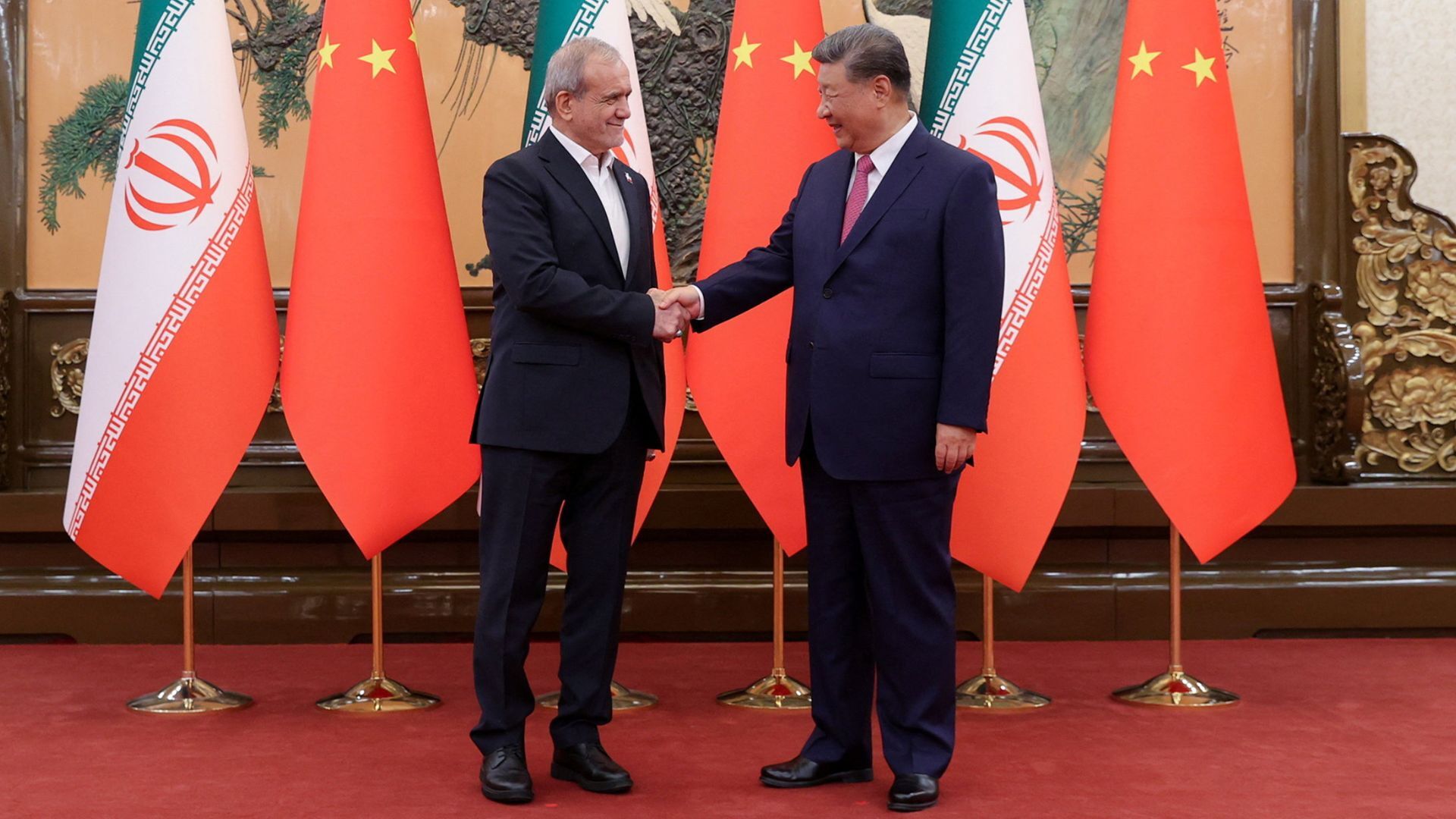


image.jpg


Play Video
4:19
Iran downplays Trump's visit to China, hails ‘strategic’ partnership with Beijing


But since returning to the White House in January 2025, Trump and his administration have put less emphasis on the great power competition.

Advertisement

Trump’s most recent National Security Strategy said the US aims to shift its focus to the Western Hemisphere, rather than the rivalry in the Asia Pacific region.

Still, tariffs and trade remain a major irritant in the relationship. Iran and Taiwan could also exacerbate tensions.

What might China want?​

While Iran considers itself a regional power and stresses its independence from allies and foes alike, China does have levers of leverage that it can crank up against Tehran – namely, trade ties.

But if Xi were to help Trump in his push to reopen Hormuz, the assistance would not come for free, analysts say.

A major priority for Beijing is Taiwan, the self-governing island that China claims as its own.

While the US nominally has a “one China policy”, it has armed and forged trade ties with Taiwan, while stopping short of officially recognising the island as a state.

Trump is yet to sign off on the latest arms package to Taiwan – worth $14bn – which has been approved by Congress.

Parmar, the professor, said China may demand opposition to Taiwanese independence in exchange for putting pressure on Iran to reopen Hormuz.

Heurlin also said China is mostly interested in talking about Taiwan.

“They see the Trump administration as potentially vulnerable or perhaps more persuadable on their position on Taiwan, and specifically, it sounds like the Chinese are going to be trying to convince Trump not to go forward with this weapon sale agreement that’s been essentially sitting on his desk,” Heurlin told Al Jazeera.

Brian Osgood contributed to the reporting.

How many threads are you going to open. You've already opened two
 
To view this content we will need your consent to set third party cookies.
For more detailed information, see our cookies page.


Wow
 
And not only that china was telling word about UNDENIABLE evidence of CIA COVID ops a week ago… and today we have this…


To view this content we will need your consent to set third party cookies.
For more detailed information, see our cookies page.
 

US-China ties will be ‘better than ever,' Trump says during meeting with Xi

'I have such respect for China, the job you’ve done. You’re a great leader,' US president tells his Chinese counterpart

Diyar Guldogan
14 May 2026•Update: 14 May 2026

Content media


WASHINGTON

US President Donald Trump expressed optimism about the future of US-China relations Thursday, telling his Chinese counterpart Xi Jinping that ties between the two countries are poised to become “better than ever before.”

"It's an honor to be with you. It's an honor to be your friend, and the relationship between China and the USA is going to be better than ever before," Trump said at a meeting with Xi in Beijing.

His remarks came after Xi hosted a welcoming ceremony for the president at the Great Hall of the People.

"We've had a fantastic relationship. We've gotten along when there were difficulties, we worked it out," Trump said.

It marked the first official visit to China by a sitting US president since Trump’s visit in 2017 during his previous term.

Trump highlighted what he called a strong personal relationship with Xi, saying the two leaders had consistently managed tensions through direct communication.

“I would call you, and you would call me, and whenever we had a problem — people don’t know — whenever we had a problem, we worked it out very quickly,” he said. “And we’re going to have a fantastic future together.”

Trump repeatedly praised Xi’s leadership and China’s development under his rule.

“I have such respect for China, the job you’ve done. You’re a great leader,” he said. “I say it to everybody. You’re a great leader. Sometimes people don’t like me saying it, but I say it anyway, because it’s true.”

'Maybe the biggest summit ever'​

Trump also emphasized the economic focus of the summit, noting that members of his delegation — including prominent business executives — were eager to expand commercial ties with China.

“They look forward to trade and doing business, and it’s going to be totally reciprocal on our behalf. So I really look very much forward to our discussion," he said, adding this was "maybe the biggest summit ever."

The Middle East conflict and Taiwan as well as trade and tariffs are high on the agenda.

Trump is accompanied by Secretary of State Marco Rubio and Defense Secretary Pete Hegseth along with numerous CEOs of major US companies, including Nvidia’s Jensen Huang and Tesla’s Elon Musk.

The US business delegation also includes Apple's Tim Cook, BlackRock's Larry Fink, Blackstone's Stephen Schwarzman, Boeing's Kelly Ortberg, Cargill's Brian Sikes, Citigroup's Jane Fraser, GE Aerospace's Larry Culp, Goldman Sachs' David Solomon, Micron's Sanjay Mehrotra and Qualcomm's Cristiano Amon.

Trump's son Eric Trump and his wife, Lara Trump, are also accompanying the president and disembarked from the plane shortly after him.

First lady Melania Trump is not accompanying the president, unlike in 2017, when the two were hosted by Xi and Chinese First Lady Peng Liyuan.

The visit comes amid the Middle East conflict, triggered after US and Israeli forces launched strikes against Iran on Feb. 28, prompting retaliation against Israel and US allies in the Gulf along with the closure of the Strait of Hormuz.

A prolonged ceasefire is currently in effect.

China has reiterated calls for dialogue in the region, while Washington has accused Beijing of supporting Iran’s military and economic capabilities.
 

Trump’s disappearing China hawks

The once vocal GOP wing that warned against making deals with Beijing has largely left the conversation ahead of Trump’s China summit.

President Donald Trump walks with China's Vice President Han Zheng in Beijing

President Donald Trump walks with China's Vice President Han Zheng during a welcome ceremony on May 13, 2026, at Beijing Capital International Airport. | Mark Schiefelbein/AP
By JACK DETSCH, KATHERINE LONG, PAUL MCLEARY and ARI HAWKINS05/13/2026 03:57 PM EDT

As the world’s two most powerful leaders prepare to meet, the usual chorus of Republican warnings about the perils of dealing with Beijing has disappeared.

The silence is a culmination of President Donald Trump’s stifling of GOP orthodoxy on China, which has washed away years of hawkish policy on everything from tech to defense.

He has green-lighted the sale of advanced AI chips to Beijing, even as Congress warned about espionage risks. He signed off on a deal to allow Chinese-founded TikTok to continue operating in the U.S., despite intelligence concerns. And his National Defense Strategy abandoned tough rhetoric on China for a more conciliatory tone as the administration focuses on protecting the homeland.


Now, as the president begins a high-stakes summit with Chinese leader Xi Jinping — accompanied by tech executives, family members and Cabinet officials — Trump aims to make new deals on tech, trade and possibly even Taiwan. But senior Republicans inside the administration and on Capitol Hill have gone quiet, bowing to Trump’s vision for closer cooperation between once fierce rivals.

“Donald Trump is the key dove,” said Dan Blumenthal, a former Defense Department official under George. W. Bush and U.S.-China Economic and Security Review commissioner. “He wants stability. He’s just very impressed with Chinese power and doesn’t believe that we’re in any position at the moment to win a strategic competition.”

The shift from Trump’s first administration has been significant. The president, ahead of Wednesday’s summit, told reporters he would speak with Xi about U.S. arms sales to Taiwan. That would repudiate longstanding American policy that has held across seven previous administrations — including the first Trump term — that the U.S. does not consult with Beijing on weapons transfers to Taipei.

Nvidia CEO Jensen Huang hitched a last-second ride on Trump’s plane to Beijing, just months after the U.S. approved the company’s sales of H200 artificial intelligence chips to China. The move, lawmakers worry, could dent America’s lead in the AI race.

Within the White House, voices that would have argued against those changes are gone.

China hawks in Trump’s previous administration — from former national security adviser H.R. McMaster to John Bolton and former CIA Director Mike Pompeo — all had a seat at the table. They’ve been replaced by Defense Secretary Pete Hegseth, Vice President JD Vance and White House AI adviser David Sacks, who have been quick to accommodate Trump’s newfound desire for deals with Beijing above all else. Sacks in particular has lobbied against bipartisan legislation pushing for tighter export controls on semiconductors.

The White House argued Trump is reversing the mistaken assumptions of past presidents. “Unlike previous administrations that helped China build its wealth and power to use against us, President Trump is rebalancing the relationship with China, prioritizing reciprocity and fairness to restore American economic independence,” said White House spokesperson Olivia Wales.

The Pentagon did not respond to a request for comment.

Still, there is a recognition within the upper echelons at the Pentagon that China remains the largest military threat facing the nation.

“It is a pacing threat, precisely that,” said Emil Michael, the Pentagon’s top research and engineering official, at POLITICO’s Global Security summit, using a defense term that describes how an opponent — in this case China — helps set the pace for American strategy and weapons development.

Michael, along with other Trump administration officials, has pressed for ways to counter Beijing, including efforts to reduce dependency on China’s supply of rare earths and drone technologies by backing American startups in those industries.

And some lawmakers still remain wary of Trump’s moves.

The president’s decision to approve sales of Nvidia’s H200 chips to China, which was made a month following his last meeting with Xi in South Korea, was swiftly countered by a broad bipartisan push on Capitol Hill to limit exports of more advanced AI chips and expand congressional power over them. Several bills have advanced to the floor, but none has passed. Administration officials have since said none of those chips has actually been sold.

And since Trump’s first term, China has constructed seven major artificial islands in the South China Sea, built the world’s largest Navy and established an arsenal of long-range missiles.

“China was a main feature of the foreign policy of the first [Trump] administration,” said Ely Ratner, who led the Indo-Pacific Security Affairs office in the Pentagon under the Biden administration. “But the views within the administration are much more varied all around [in Trump’s second term]. All of this comes together to create this softer policy we see now, philosophically this group appears geared toward a more accommodationist approach to China.”

Many of the GOP’s China hawks appear to be standing behind Trump, despite previous concerns.

Sen. Mike Rounds (R-S.D.), who has been involved in bipartisan efforts to crack down on China’s access to advanced chips, said Wednesday he backed exporting some U.S. tech to Beijing.

“If you can get into China and allow them some so that they’re using ours rather than creating their own, that gives us a technological advantage, even though they may be able to continue months behind us,” Rounds said in an interview.

Sen. Steve Daines (R-Mont.), who was part of a recent delegation visit to China, said he was “thrilled” that Huang would be in attendance. The CEO is “one of the greatest thought leaders” when it comes to chips, he said. “Jensen needs to be at the table.”

But when Trump sits down with Xi, it may not matter who has counseled him.

“The policy process is different with President Trump feeling much more confident, less willing to listen to his advisers,” said Blumenthal, the former Bush administration official. “There’s less input, and everybody who’s serving him knows that he’s going to make the decisions, particularly on China.”

 
And not only that china was telling word about UNDENIABLE evidence of CIA COVID ops a week ago… and today we have this…


To view this content we will need your consent to set third party cookies.
For more detailed information, see our cookies page.

It was well known, and quickly covered up, that funding for gain of function research came via Dr. Fauci.
 
The vast majority of bloggers on Chinese online platforms are welcoming Musk's visit to China, rather than Trump. Haha.

We admire idealists like Musk and despise fools like Trump.
 
When Clinton visited China, the Chinese people felt that he was like the Earth's President.

When Bush visited China, the Chinese people felt that the United States was still a cooperative partner.

When Obama visited China, the Chinese people felt that his visit was not important.

Now that Trump has visited China, the Chinese people just want to see what interesting shenanigans he will make.
The US lost much of its status.
 
The vast majority of bloggers on Chinese online platforms are welcoming Musk's visit to China, rather than Trump. Haha.

We admire idealists like Musk and despise fools like Trump.
Musk is no idealist...he's a white supremacist fascist zionist cuck charlatan who didn't invent anything that didn't already exist and is a college drop out piss poor coder who failed up his whole life due to white privilege and corporate socialism and gov't handouts.
 
Xi Jinping said to Trump in the meeting that the Taiwan issue is the most important issue in China-US relations. If handled well, bilateral relations can maintain overall stability. If handled poorly, the two countries will clash.
 

Users who are viewing this thread

Latest Posts

Back
Top