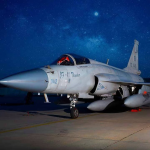
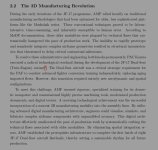
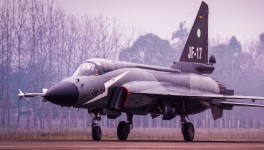
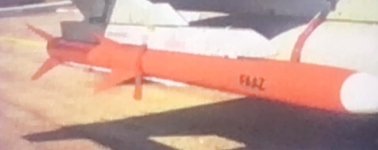
The SD-10 was already undergoing testing on PT-4 (rolled out in 2006), and the Chinese Embassy's own public relations material clearly suggests that the JF-17 was envisioned as both BVR- and nuclear-capable from the outset. Here's an extract from the PR of Chinese embassy in Pakistan on rollout of first Jeff
"An ability to carry short- as well as long-range air-to-air missiles lends the aircraft a first shot capability of conventional as well as non-conventional arsenal."
That raises an interesting question: why did the PAF need to procure the SD-10 when, as far as I know, it had already developed or deployed a derivative of the R-Darter (possibly the Red Crescent project) for its Mirage fleet?
In theory, the PAF could have expanded upon the R-Darter/A-Darter technology base to develop indigenous BVR and WVR solutions for the JF-17. Instead, the domestic missile ecosystem appears to have remained largely confined to the Mirage fleet. That may also help explain why the Mirages remained in service for so long despite their age.
Transferring the Mirage weapons stack and associated know-how to the JF-17 could potentially have saved the PAF a significant amount of money and reduced dependence on foreign suppliers. Yet that transition never seems to have materialized, which is somewhat puzzling. It makes me wonder whether the obstacle was technical integration, intellectual property restrictions, industrial limitations, or simply the availability of the SD-10 as a ready-made and relatively mature solution.