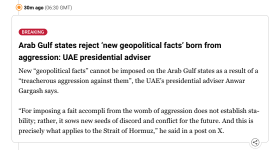
Iran - Israel/US War: Israel-US declare war on Iran, Iran responds

Naheen yaar!

They've already beaten em without hair-force no?

Hair-Force only for these boyz now:

View attachment 203015


The good (or should we say bad thing) about any military strategy is that it only works once. Because any sensible enemy will plan for all the military strategies that were previously used by its enemy.

So I won't bet too much on the missiles based systems too much. After all they are offensive capabilities, but what about defensive ??

If Iran had defensive capabilities do you think USA would be able to land multiple transport planes, helicopters, vehicles etc in middle of Iran for hours and then leave ?
 
The good (or should we say bad thing) about any military strategy is that it only works once. Because any sensible enemy will plan for all the military strategies that were previously used by its enemy.

So I won't bet too much on the missiles based systems too much. After all they are offensive capabilities, but what about defensive ??

If Iran had defensive capabilities do you think USA would be able to land multiple transport planes, helicopters, vehicles etc in middle of Iran for hours and then leave ?
To be fair Iran has been shown to adapt to situations rapidly faster than the American military has otherwise if they were as confident as they boast they would have taken over the straits day one but they couldn’t.
Agree though Irans defense needs to a huge upgrade but honestly when it was 20 to 1 they did a bang up job
20 countries include offensive defensive and logistical allies
 
I think we should wait to see the results of negotiations before calling this a victory for Iran.

If Iran manages to impose its control of the Strait of Hormuz after the war or refuses to hand over its HEU, I think it'll definitely be an Iranian victory. But if Iran loses its HEU and also loses its control over the Strait of Hormuz, then I think most people wouldn't call it an Iranian victory.
Well, the Strait was opened prior to the war. Re-opening it won’t make it a US victory, but a return to the pre war conditions.

Enriching uranium strictly to % for civilian use only, destroying or diluting the HEU, and letting IAEA inspectors on the ground in Iran will definitely be conditions favoring the US.

But considering what Iran is getting for doing this, and not resolving the “threat from their ballistic missiles”, or their support for the resistance groups in the neighborhood; I would still call that a big Iran win. Which (the deal) is reflective of what Iran achieved in the war.
 
The good (or should we say bad thing) about any military strategy is that it only works once. Because any sensible enemy will plan for all the military strategies that were previously used by its enemy.

So I won't bet too much on the missiles based systems too much. After all they are offensive capabilities, but what about defensive ??

If Iran had defensive capabilities do you think USA would be able to land multiple transport planes, helicopters, vehicles etc in middle of Iran for hours and then leave ?
Bhai......I mean I totally agree on that notion dat what works once or twice or a dozen times.......might not work again......Sure!

Problem is trump ka ulla has given up no? He fukkin threw in da towel, long ago no?

Between trump ka ulla and hendu ka dalit......wez caught in da middle of da diddle no?

but you know.....deep down, Iran is not a joker, like da rest of em so called 'Muzz-Lims' no?

Just came across their latest vid from da 'Street scenes' series.

You see their country/ society/ infra/ quality of citizenry/ hygiene/ municipal services and what not.

To view this content we will need your consent to set third party cookies.
For more detailed information, see our cookies page.


Can you compare this with our situation or for dat matter that of the Hindu's across de baaddurr?

Well?.....:p

Iran's already won here.......but, I believe that da west/ Zio-cabal ain't done yet. They'll have a go at Iran again, no shit.

They're just looking for a weakness, whether societal or military, they'll try again to bring down Iran.
 
Iran's already won here.......but, I believe that da west/ Zio-cabal ain't done yet. They'll have a go at Iran again, no shit.

They're just looking for a weakness, whether societal or military, they'll try again to bring down Iran.

As sir @VCheng would say in his infinite wisdom, the US/Israel can try, certainly they have the right to do what they think is in their national interests. I expect these countries to make rational decisions for their people.

But I don’t see how the outcome will be any different: Iran will close the Strait again and choke the global economy, and the US will need to commit a huge number of troops on the ground in Iran for years, which won’t happen.
 
Last edited:
@RealNapster

Its just so over bhai. 'Hair force' and Golly wog dolls in India? Are you kidding?.......:p

To view this content we will need your consent to set third party cookies.
For more detailed information, see our cookies page.
 
@RealNapster

Its just so over bhai. 'Hair force' and Golly wog dolls in India? Are you kidding?.......:p

To view this content we will need your consent to set third party cookies.
For more detailed information, see our cookies page.


Only if I had the patience to watch 2 old men talking about politics for 24 minutes :giggle:
 
It looks like Iran opened the strait in exchange for promises of money. This was agreed to by the same negotiating team that agreed to pour cement in Arak reactor's fuel rod tubes and a accepted a one way trigger mechanism in the JCPOA. So that's par for the course.

Iran also gets to sell oil for 60 days to help build inventory in the US and fill the fuel tanks of the war machine so Iran may be attacked again.

Not surprising as the history of Iran is filled with sellouts and incompetent fools acting as politicians. The only sad part is Iran actually won this round militarily against everyone's prediction. Only for Zarif's buddies to give it away.

In the meantime a regional Sunni, anti Iran force seems to be shaping up. We are yet to see how this will be used.
I completely agree with you. The US is using Iran against itself and people here are cheering it as if it's some sort of victory.

I do not think any sort of cash is going to enter Iran any time soon. The price of USD in Iran is on the rise again, rising from 153K IRT after signing the MoU to 166K IRT again, as of today. That doesn't indicate any sort of access to frozen funds in my opinion. It shows nothing has changed for Iran yet.

And I completely agree with you on the last part. That's what I think too.

Well, the Strait was opened prior to the war. Re-opening it won’t make it a US victory, but a return to the pre war conditions.

Enriching uranium strictly to % for civilian use only, destroying or diluting the HEU, and letting IAEA inspectors on the ground in Iran will definitely be conditions favoring the US.

But considering what Iran is getting for doing this, and not resolving the “threat from their ballistic missiles”, or their support for the resistance groups in the neighborhood; I would still call that a big Iran win. Which (the deal) is reflective of what Iran achieved in the war.
It does make it a US victory because Iran will have lost one of its hard-earned cards in the negotiations. You don't lose your cards in negotiations unless you're in a weak position.

Most of these "resistance groups" are useless parasites. A money pit without any sort of meaningful return for Iran. Hezbollah is perhaps the only exception, but they already knew they wouldn't survive a day without Iran as the Lebanese government was already trying to disarm them and suffocate them. When Iran needed them in the 12-day war, they issued only one statement at the end of the war. That's all they did during the 12-day war. Houthis of Yemen literally abandoned Iran and said they would stay faithful to their agreements with the US. PMU and Iraqi militias were involved to the minimum, launching FPVs mostly. And we have already lost Syria. Iran's regional dominance is nothing like it used to be in early 2010s.

As for our missiles, they were proven ineffective in establishing deterrence. Our damage to Israel was not significant as we thought and we couldn't even threaten the US Navy at the height of war. Right now, the main US problem is our HEU, which cannot be confiscated without some sort of local help in Iran. They're going to do everything in their power to get this out of our country with fake promises and "diplomacy". Only after the HEU has been secured, they will think about their next biggest issues in my opinion.
 
It does make it a US victory because Iran will have lost one of its hard-earned cards in the negotiations. You don't lose your cards in negotiations unless you're in a weak position.

Most of these "resistance groups" are useless parasites. A money pit without any sort of meaningful return for Iran. Hezbollah is perhaps the only exception, but they already knew they wouldn't survive a day without Iran as the Lebanese government was already trying to disarm them and suffocate them. When Iran needed them in the 12-day war, they issued only one statement at the end of the war. That's all they did during the 12-day war. Houthis of Yemen literally abandoned Iran and said they would stay faithful to their agreements with the US. PMU and Iraqi militias were involved to the minimum, launching FPVs mostly. And we have already lost Syria. Iran's regional dominance is nothing like it used to be in early 2010s.

As for our missiles, they were proven ineffective in establishing deterrence. Our damage to Israel was not significant as we thought and we couldn't even threaten the US Navy at the height of war.
I’m sorry, but I cannot agree with this assessment.

Iran has not lost one of its hard-earned cards, they can close the strait whenever they feel like it; and the US/Israel cannot get it open by force. Iran would have only lost that card if it didn’t have the ability to re-close the strait.

The opening of the strait also lifts the US naval blockade, and Iran is able to export and provide economic relief for the population affected by the war.

About the resistance groups, there are strong indications that the Houthis were not asked to engage against Israel at this time. And when there was talk of Israeli escalation, Iran said they could play an additional card of closing Bab Al Mandab. That shows that only if the war escalated, Iran would ask the Houthis to engage. They were quite comfortable with the way the war was going compared to the comfort level of the US, and they knew the US would give in. It was a smart strategy by the Iranians not to activate the Houthi threat immediately, you don’t play all your cards at once.

The missiles did not do a lot of damage in $$ terms of destroyed infrastructure in Israel. However, they significantly deteriorated the number of interceptors Israel and the US had (especially Israel) to critically low levels, so if you were being honest; you would factor in how much each interceptor costs and how long it takes to replenish the used interceptors. The US had to end the war for the sake of Israel’s existence.

Not to mention the $$$ damage in infrastructure in the GCC and other Arab countries, forcing them (Qatar, Saudi Arabia, Oman) to rethink their security relationship with the US.
 
I’m sorry, but I cannot agree with this assessment.

Iran has not lost one of its hard-earned cards, they can close the strait whenever they feel like it; and the US/Israel cannot get it open by force.

The opening of the strait also lifts the US naval blockade, and Iran is able to export and provide economic relief for the population affected by the war.

About the resistance groups, there are strong indications that the Houthis were not asked to engage against Israel at this time. And when there was talk of Israeli escalation, Iran said they could play an additional card of closing Bab Al Mandab. That shows that only if the war escalated, Iran would ask the Houthis to engage. They were quite comfortable with the way the war was going compared to the comfort level of the US, and they knew the US would give in. It was a smart strategy by the Iranians not to activate the Houthi threat immediately, you don’t play all your cards at once.

The missiles did not do a lot of damage in $$ terms of destroyed infrastructure in Israel. However, they significantly deteriorated the number of interceptors Israel and the US had (especially Israel) to critically low levels, so if you were being honest; you would factor in how much each interceptor costs and how long it takes to replenish the used interceptors. The US had to end the war for the sake of Israel’s existence.

Not to mention the $$$ damage in infrastructure in the GCC and other Arab countries, forcing them (Qatar, Saudi Arabia, Oman) to rethink their security relationship with the US.
The US naval blockade has already been lifted, and Iran can close the Strait of Hormuz again, no disagreement there, but it won't have the same panic effect on the global economy next time. The US is preparing for that scenario as we speak. Lifting all sanctions on our oil is one of those preparations unfortunately.

Not to mention that shared control of the strait could earn Iran and Oman billions of US dollars each year and Iran will lose that if it gives up on this card.

I don't know about the Houthis of Yemen. Iran was being suffocated by the US naval blockade and the Houthis of Yemen talked loud about closing Bab El-Mandeb multiple times but did absolutely nothing in that regard. I don't think getting suffocated economically through a blockade was part of Iran's plan. So, I don't see how everything was going well for Iran when Iran could barely export 300K barrels of oil per day and was being choked.

Yeah, they're low on interceptors, but I am one of those skeptics that believe if push comes to shove, they will ramp up their production. The US has the industrial capacity to ramp up its production and they're already asking German factories and Europeans to help them too. This whole idea that Iran has exhausted the US and Israeli AD for the years to come is not completely true. It's not wrong either, because Iran has done that, but this whole idea that the US rates will stay the same is a wrong assumption that leads to miscalculation.

Honestly, excluding Qatar's LNG production, I do not see extensive economic damage in the Arab states of the Persian Gulf. Iran's infrastructure has been hit way worse than those "GCC" countries unfortunately. I expected the Emirates to be blown up to pieces at least, but even our damage to the Emirates is not significant enough to establish deterrence.

Also, there's this issue of mistrust within the system in Iran. If Iran is in talks with the US to secure its victory, then why is Ghalibaf refusing to reopen the parliament? Nearly everything in Iran has returned to normal after the MoU but the parliament of Iran hasn't had a session in months. Parliament members have too many questions regarding the negotiations but Ghalibaf simply refuses to discuss it with Iranian PMs.
 
The US naval blockade has already been lifted, and Iran can close the Strait of Hormuz again, no disagreement there, but it won't have the same panic effect on the global economy next time. The US is preparing for that scenario as we speak. Lifting all sanctions on our oil is one of those preparations unfortunately.

Not to mention that shared control of the strait could earn Iran and Oman billions of US dollars each year and Iran will lose that if it gives up on this card.

I don't know about the Houthis of Yemen. Iran was being suffocated by the US naval blockade and the Houthis of Yemen talked loud about closing Bab El-Mandeb multiple times but did absolutely nothing in that regard. I don't think getting suffocated economically through a blockade was part of Iran's plan. So, I don't see how everything was going well for Iran when Iran could barely export 300K barrels of oil per day and was being choked.

Yeah, they're low on interceptors, but I am one of those skeptics that believe if push comes to shove, they will ramp up their production. The US has the industrial capacity to ramp up its production and they're already asking German factories and Europeans to help them too. This whole idea that Iran has exhausted the US and Israeli AD for the years to come is not completely true. It's not wrong either, because Iran has done that, but this whole idea that the US rates will stay the same is a wrong assumption that leads to miscalculation.

Honestly, excluding Qatar's LNG production, I do not see extensive economic damage in the Arab states of the Persian Gulf. Iran's infrastructure has been hit way worse than those "GCC" countries unfortunately. I expected the Emirates to be blown up to pieces at least, but even our damage to the Emirates is not significant enough to establish deterrence.

Also, there's this issue of mistrust within the system in Iran. If Iran is in talks with the US to secure its victory, then why is Ghalibaf refusing to reopen the parliament? Nearly everything in Iran has returned to normal after the MoU but the parliament of Iran hasn't had a session in months. Parliament members have too many questions regarding the negotiations but Ghalibaf simply refuses to discuss it with Iranian PMs.
I think you’ve moved off your original position quite a bit here.

Your original argument was that if Hormuz is reopened, Iran has lost one of its hard-earned cards. But now you’re explicitly saying Iran can still close the Strait again whenever it wants. If Iran can still re-close Hormuz, then it has not lost that card. What you’re arguing now is not that the card is gone, but that it may not have the same effect next time. That is a much weaker argument than the one you started with.

And even that is speculative. The US can prepare for a future closure all it wants, but that does not mean it has neutralized the leverage. The Strait of Hormuz still handles roughly 20% of global oil and energy flows. The US has not built some alternative route that can suddenly replace that. That would take years to implement, if not a decade or more. So yes, maybe the second closure causes slightly less shock than the first, but the strategic leverage is still there because the structural dependence is still there.

Your own point about shared control of the Strait earning Iran and Oman billions actually proves my point more than yours. It shows this is not some symbolic card. It is a major economic and geopolitical lever, whether Iran uses it commercially or coercively.

On the Houthis, I still think you are drawing too much from non-use. The fact that they did not fully activate Bab al-Mandab in this phase does not prove they are useless, nor does it prove Iran had lost control of the situation. It just means Iran did not play every escalation card at once. A country can be under pressure and still hold back some options for a wider confrontation later. Those two things are not contradictory.

Same with the missile point. You’re no longer really disputing that Israel and the US burned through a huge number of interceptors. You’re now saying they can ramp up production. Fine, maybe they can. But that still does not answer the key question, which is how long that takes, how much it costs, and whether they can replenish those systems faster and more cheaply than Iran can keep producing drones and ballistic missiles.

That asymmetry is the whole point. It is not enough to just say “the Americans will ramp up production” and leave it there. These are expensive systems, they take time to replenish, and Iran does not need to match them interceptor for interceptor. It just needs to keep imposing costs faster than they can comfortably absorb them.

And on the GCC, I think you’re using the wrong benchmark again. The point was never that the UAE had to be “blown up to pieces” for the missiles to matter. The point is that the war reminded the Gulf states that they are still exposed to Iranian retaliation and to the fallout of a US-Israel war with Iran. That by itself is enough to make them reassess how much they can rely on Washington and how much hedging they may need to do with Tehran. You do not need Dubai or Abu Dhabi to look like Gaza for that strategic effect to exist.

So I still come back to the same basic point: even if the US gets concessions on HEU, that alone does not turn the overall outcome into a US victory if Iran still keeps its missile force, still keeps the ability to threaten Hormuz, still retains regional escalation options, and comes out of this with sanctions relief and economic breathing room. In that scenario, the US may have won something important on the nuclear file, but it still has not resolved the broader Iranian challenge. That is why I still see the overall package as leaning more in Iran’s favour than America’s.
 

Users who are viewing this thread

Latest Posts

Back
Top