In a moment of brazen hubris in the Oval Office last year, US President Donald Trump
railed at Ukrainian President Volodymyr Zelensky. He accused Zelensky of not being thankful for US support in Ukraine’s existential struggle against invading Russian forces, and famously told him: “You don’t have the cards”.
Now, more than a year later, it is Trump who doesn’t have a winning hand in his standoff with Iran.
Iran may be no match for the United States militarily, but it’s been very successful in exerting what leverage it does have over the Strait of Hormuz. Trump can declare the strait open to commercial shipping as much as he wants, but he
cannot make it so.
The US has resumed bombing Iran this week to try to wrest control of the strait from Iran, but Trump could go even further if he finds himself backed into a corner.
How Iran is wielding its leverage
Iran’s leverage over the strait comes down to playing a spoiling role – one of the key tactics in
asymmetric warfare.
The longer it can keep the strait closed, the more pressure it places on the US and its partners in the Persian Gulf to end the war. Some
20% of the world’s oil and gas and large
supplies of sulphur, ammonia, urea and helium transit through the narrow passageway every day.
And as evidenced by
its actions over the last week, the Islamic Revolutionary Guard Corps (
IRGC) can threaten commercial traffic with drones or missile strikes anytime it likes. Despite heavy US bombardments since the war began, most of Iran’s missile sites along the strait are
operational again.
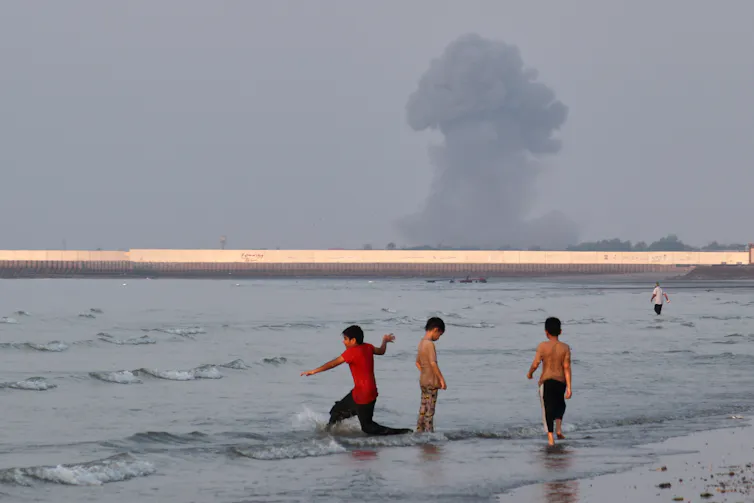
Three boys play in the shallow waters of the Strait of Hormuz, as a plume of smoke rises from an explosion in the background, off Bandar Abbas, Iran, on July 13 2026. Razieh Poudat/ISNA via AP
Given this, shipping insurers, such as
Lloyd’s of London, will either refuse to insure transits through the strait or charge hefty, nonviable premiums as long as the war continues.
Not only can the IRGC threaten shipping, it can also strike sites in every single Gulf state, as it has
been doing at scale this week.
Many US military bases across the region have been severely damaged. And the myth that having America as a house guest guaranteed security for Gulf states has been completely blown apart.
Why escalation is possible
The reality is there is no
military pathway to reopening the Strait of Hormuz.
At the same time, neither the Iranian regime nor the Trump administration want to return to a significant escalation of hostilities. Both have much to lose – the military operations alone may have
already cost the US more than US$100 billion – and nothing to gain from a prolonged war.
But the hardliners in Tehran, emboldened by an emotional week of national mourning for the martyred Supreme Leader Ali Khamenei, have a much larger appetite for conflict than more pragmatic leaders in other countries. Analysts believe they could
withstand a US naval blockade and bombardments for many more months.
As unpopular as it might be with the majority of the Iranian people, the regime appears to be in a stronger position now than it was when the war began.
Trump, meanwhile, wants desperately to be seen as a winner. And now that many of the conventional checks and balances that constrain a president’s power have been
weakened, there is a real risk of reckless escalation.
For instance, Trump has long
threatened to strike Iranian civilian infrastructure, such as electric and desalination plants, which could trigger a similar response by the Iranian regime on Gulf state energy infrastructure.
This happened earlier in the war, when
Iran targeted energy sites in several Gulf states. If these sites are targeted again, it could have lasting impacts on the global economy.
Should the escalation go further and involve direct strikes on the
400 desalination plants the Gulf states depend on for their drinking water, the consequences would be devastating.
The Iranian regime could also pressure the Houthis in Yemen to escalate from merely blocking Israeli ships from transiting the Bab el-Mandeb Strait at the southern end of the Red Sea to returning to
attacking vessels in the chokepoint. About
10% of global trade passes through that strait.
So far, the Houthis have held off on further attacks, in part because after years of war, they have achieved a
detente with their neighbour, Saudi Arabia.
However, this ceasefire now appears shaky,
after an airport attack this week that the Houthis blamed on Saudi Arabia.
A ground campaign would be disastrous
The larger reality is that military campaigns from the air have never achieved regime change. Another reality: America, for all its formidable military might, has
failed to win a major war in the past 80 years.
Any serious military escalation against Iran would require US “boots on the ground”, similar to Iraq two decades ago. But an international coalition force of hundreds of thousands of military personnel proved to be insufficient in bringing stability to that country after the 2003 invasion. And Iran is almost four times the size of Iraq. It is inconceivable the vastly larger force that would be required to take control of just the mountainous southern coast of Iran could ever be assembled.
With the advent of modern drones, we have also entered a
new era of warfare – one Iran is better positioned to exploit than the US. Iran possesses a remarkable depth of industrial military capacity, which has produced a
more even match than might have been expected against the world’s most powerful military.
The implications for a US ground campaign are clear: any forces attempting an occupation of even a limited part of the Iranian coast, or
Kharg Island, would face formidable opposition.
The risk of a much more serious escalation, though, remains. This includes the very small, but not negligible, risk of
tactical nuclear weapons being deployed by the US, opening a Pandora’s box of
global consequences.
What is Trump’s best option, then? Allowing Iran to retain a new level of control over the Strait of Hormuz establishes a terrible precedent, but it might be the least worst of all possible outcomes.
The reality is there is no military pathway to opening the Strait of Hormuz. Trump may attempt to find one anyway.

theconversation.com