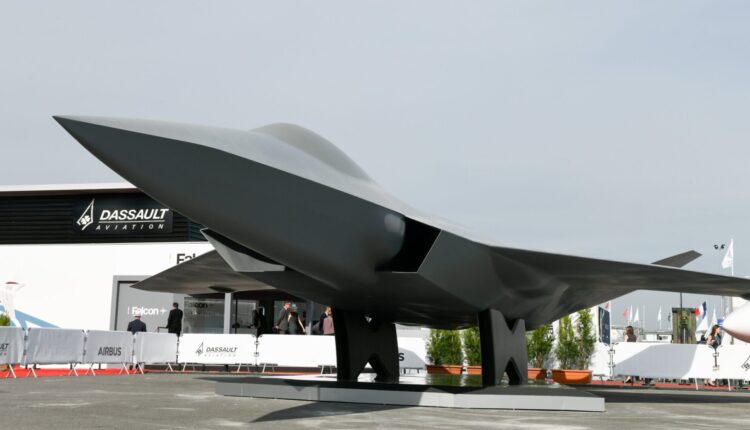
India Moves to Join France’s FCAS Sixth-Generation Fighter Programme After Germany’s Exit, Reshaping Indo-Pacific Airpower and the Global Combat Aviation Race
New Delhi’s pursuit of France’s FCAS after Germany’s withdrawal could connect European aerospace technology with Indian industrial scale, transforming sixth-generation combat aviation, Indo-Pacific force posture and the future global airpower balance.
On
Aug 11, 2026
FCAS
India has formally initiated efforts to join France’s Future Combat Air System, positioning New Delhi to enter sixth-generation fighter development after Germany’s departure dismantled the programme’s original European industrial structure.
The initiative could transform FCAS from a troubled Franco-German-Spanish venture into a consequential France-India aerospace partnership connecting European combat-aircraft technology, Indian manufacturing capacity and Indo-Pacific operational requirements.
India’s Ministry of Defence informed the Parliamentary Standing Committee on Defence that concerted efforts had begun to “co-join” the French-government-led sixth-generation fighter aircraft development programme.
That disclosure elevates India’s interest beyond informal observation, although no bilateral agreement, financial commitment, industrial workshare arrangement or legally binding technology-transfer framework had been announced by mid-August 2026.
The parliamentary committee identified FCAS and the British-Italian-Japanese Global Combat Air Programme as the principal sixth-generation projects, warning that delayed participation could leave the Indian Air Force technologically disadvantaged.
It consequently requested a detailed status report, development roadmap and tentative acquisition timeline, signalling growing political scrutiny over how India will transition from conventional fighters towards networked, collaborative combat aviation.
FCAS combines a stealthy New Generation Fighter with remote-carrier drones, loyal wingmen and a combat cloud linking distributed sensors, weapons and command nodes across an electronically contested battlespace.
This system-of-systems architecture matters because future air superiority will increasingly depend upon information dominance, unmanned mass, electronic warfare and resilient connectivity instead of isolated comparisons between crewed fighter airframes.
India’s approach follows the June 8, 2026 collapse of the joint FCAS fighter element, when unresolved industrial and operational disagreements made continued cooperation between France and Germany commercially and strategically untenable.
French President Emmanuel Macron and German Chancellor Friedrich Merz concluded that Dassault Aviation and Airbus could not reconcile disputes involving programme leadership, intellectual property, workshare, design authority and engineering control.
France has therefore gained freedom to pursue its carrier-compatible, nuclear-capable fighter vision with alternative partners, while inheriting substantial financial, technological and schedule risks previously distributed across three European governments.
India could supply investment, production scale and operational demand, but successful collaboration would require enforceable access to sensitive technologies rather than symbolic participation that merely underwrites a predominantly French aircraft.
FCAS Collapse Opens a Strategic Window for India
France and Germany launched FCAS in 2017, with Spain joining during 2019, to replace French Rafale and German-Spanish Eurofighter Typhoon fleets through a networked combat-air system entering service around 2040.
The programme’s projected value approached €100 billion, approximately USD115 billion or RM460 billion, making industrial control economically important because intellectual property could shape European combat-aircraft exports for several decades.
Dassault led the New Generation Fighter element, while Airbus represented German and Spanish interests, creating overlapping authority within a project whose success demanded unusually close integration between competing national aerospace industries.
Disagreement intensified because Paris sought undisputed control over fighter design, whereas Berlin and Madrid required meaningful industrial participation commensurate with their funding, technical capabilities and anticipated aircraft orders.
Operational divergence further weakened cooperation because France required a carrier-capable fighter supporting nuclear deterrence, while Germany lacked equivalent naval aviation requirements and followed a different nuclear-delivery framework.
These differences affected airframe dimensions, structural reinforcement, range, weapons integration and development cost, demonstrating that political compromise alone could not reconcile fundamentally different military mission profiles.
The crewed fighter component consequently ended despite demonstrator planning and a previously targeted 2028–2029 first flight, potentially disrupting the broader timetable for replacing ageing Rafale and Eurofighter fleets.
Residual FCAS components, particularly the combat cloud, may continue, but their relationship with an independently developed French fighter remains uncertain because network standards, security architecture and national ownership still require agreement.
Germany’s exit creates negotiating space for India, yet it simultaneously illustrates the programme’s central danger: any partnership without clearly allocated authority could reproduce the workshare and intellectual-property disputes that fractured FCAS.
New Delhi must therefore evaluate whether France seeks a genuine development partner or primarily requires capital, orders and manufacturing support to preserve an ambitious sixth-generation programme after losing Germany’s financial weight.
India’s Fighter Squadron Crisis Drives Sixth-Generation Strategy
The Indian Air Force operates approximately 29 fighter squadrons against an authorised strength of 42, leaving a 13-squadron deficit that constrains simultaneous planning against China and Pakistan across geographically separated theatres.
That shortage could deepen as roughly 110–120 Jaguar aircraft across six squadrons begin retiring from around 2028 through the mid-2030s, unless replacement deliveries accelerate sufficiently to offset disappearing legacy capacity.
FCAS cannot solve this near-term numerical crisis because an operational sixth-generation aircraft remains a long-term prospect, but participation could prevent India’s future force structure from becoming technologically obsolete after 2040.
India must consequently pursue layered modernisation through Tejas expansion, additional Rafales, upgraded Su-30MKIs and the Advanced Medium Combat Aircraft while protecting funding required for genuinely next-generation capabilities.
The indigenous AMCA is targeting a first flight around 2028–2029, placing its development window close to the original FCAS demonstrator schedule but addressing a different technological and operational transition.
AMCA would establish India’s fifth-generation stealth foundation, whereas FCAS could introduce deeper manned-unmanned teaming, distributed sensing, artificial-intelligence-enabled mission management and collaborative weapons employment across multiple platforms.
Operating both programmes could diversify capability and reduce strategic dependence, although parallel development would also pressure engineering personnel, test infrastructure, propulsion research and already contested defence-capital allocations.
Sixth-generation concepts potentially incorporate all-aspect stealth, variable-cycle propulsion, advanced electronic warfare, cyber integration, directed-energy weapons and autonomous teaming, although several capabilities remain developmental rather than guaranteed programme outcomes.
These technologies could allow smaller crewed formations to coordinate expendable or recoverable unmanned aircraft, expanding sensor coverage and weapons capacity while complicating an opponent’s targeting and air-defence calculations.
India’s central challenge is balancing urgent squadron regeneration against investment in capabilities required decades later, because excessive emphasis on either horizon could produce immediate vulnerability or long-term technological inferiority.
France-India Alignment Extends Beyond Fighter Aircraft
Potential FCAS cooperation rests upon an established defence relationship encompassing 36 Indian Air Force Rafales, naval Rafale-M procurement, Scorpene submarines and discussions involving propulsion, weapons and advanced aerospace manufacturing.
India and France examined sixth-generation collaboration during their February 2026 Annual Defence Dialogue involving Indian Defence Minister Rajnath Singh and his French counterpart, before the Franco-German fighter partnership formally collapsed.
The June 2026 meeting between Prime Minister Narendra Modi and President Macron in Nice elevated relations to a “Special Global Strategic Partnership,” emphasising co-design, co-development and co-production of advanced defence platforms.
That political framework could accelerate FCAS negotiations, but diplomatic terminology cannot substitute for contractual clarity covering source-code access, export rights, intellectual property, upgrade sovereignty and domestic production responsibilities.
India may prefer one principal foreign partner because bilateral decision-making could reduce the institutional friction associated with multinational programmes, although concentrated dependence would also increase France’s leverage over technology and schedules.
Operational alignment is comparatively strong because both countries operate aircraft carriers and maintain nuclear-delivery capabilities, allowing common requirements involving maritime operations, long-range penetration, survivability and strategic strike integration.
A carrier-compatible FCAS derivative could interest India’s future naval aviation planning, yet navalisation would impose substantial weight, undercarriage, corrosion-resistance and low-speed handling requirements affecting performance and acquisition cost.
French industry would gain Indian orders, investment and manufacturing depth, while India could seek advanced design participation, supply-chain integration and access to technologies unavailable through straightforward fighter acquisition.
Negotiations concerning an additional Indian Rafale package, frequently associated with approximately 114 aircraft and extensive local production, could provide industrial infrastructure supporting subsequent FCAS manufacturing if both projects become contractually connected.
However, linking Rafale expansion with FCAS entry might strengthen negotiating leverage for either party, making transparency essential to distinguish immediate aircraft procurement from long-term participation in sovereign combat-aircraft development.
Technology Transfer and Workshare Will Determine Success
India previously withdrew from the Russian fifth-generation fighter aircraft partnership after concerns involving workshare, costs, performance and technology access, creating an institutional precedent directly relevant to any FCAS negotiation.
New Delhi is therefore unlikely to treat final assembly or component manufacturing as sufficient sixth-generation participation, particularly when Atmanirbhar Bharat policy prioritises indigenous design competence, production sovereignty and lifecycle control.
Meaningful collaboration would require Indian engineers to participate in aerodynamic design, mission-system architecture, stealth materials, electronic warfare, sensor fusion, propulsion integration and the combat cloud’s security framework.
France must nevertheless protect technologies connected with nuclear deterrence, stealth signatures and sovereign mission systems, producing unavoidable boundaries that could conflict with India’s expectations for unrestricted knowledge transfer.
Safran-related engine cooperation could become strategically decisive because propulsion remains among India’s most persistent aerospace constraints, while variable-cycle or adaptive engines would demand sustained investment beyond conventional technology-transfer arrangements.
The combat cloud presents equally sensitive challenges because interoperability requires trusted data links, common protocols, cyber resilience and access controls governing information exchanged among crewed fighters, drones, satellites and ground nodes.
Remote carriers could enlarge India’s combat mass without proportionally increasing crewed aircraft numbers, but their effectiveness would depend upon survivable communications, autonomous navigation and affordable production at operationally significant scale.
Industrial workshare must also reflect manufacturing risk rather than political percentage allocations, because poorly integrated production could generate certification delays, supply-chain vulnerabilities and configuration differences undermining fleet readiness.
Any agreement must define export authority, since India could seek third-country sales or derivative development while France may demand restrictions protecting intellectual property, strategic relationships and competition with Rafale.
Until financing, design leadership and sovereign technology boundaries are disclosed, the initiative should be understood as structured exploration rather than confirmation that India has formally joined FCAS or selected its future sixth-generation fighter.
FCAS Could Reshape Indo-Pacific Airpower and Global Defence Industry
Indian participation would give FCAS an Indo-Pacific dimension, connecting French strategic interests with India’s requirement to counter increasingly sophisticated Chinese combat aircraft, long-range missiles, integrated air defences and unmanned systems.
A networked FCAS-AMCA force could eventually distribute sensors and weapons across crewed and uncrewed platforms, improving survivability against dense air-defence networks while extending India’s targeting reach over maritime and continental approaches.
Such capability would influence force planning beyond South Asia because China would need to account for stealth aircraft, collaborative drones and networked weapons operating from dispersed Indian bases and potentially carrier groups.
Pakistan would also monitor the programme’s trajectory, although FCAS timelines mean its immediate response would more likely involve Chinese aircraft, air-defence systems, electronic warfare and unmanned capabilities than a comparable indigenous project.
For France, partnership with India could preserve aerospace scale after Germany’s withdrawal while reinforcing Paris as an autonomous combat-aircraft power outside both American fighter programmes and the British-led GCAP structure.
For India, joining FCAS could reduce dependence upon Russian platforms while avoiding exclusive reliance on American technology, supporting its broader strategy of diversified partnerships and strategic autonomy.
The programme would nevertheless create a substantial logistics footprint involving specialised maintenance, secure software infrastructure, drone support equipment, low-observable restoration facilities, advanced weapons storage and resilient multinational supply chains.
Dispersed Indo-Pacific operations would require these systems to function under missile attack, electronic disruption and contested communications, making deployability and sustainment as strategically important as stealth or maximum aircraft performance.
India’s declared interest consequently signals ambition rather than acquisition certainty, while Germany’s exit provides opportunity without eliminating the governance, financing and technology disputes that destabilised the original programme.
The decisive test will be whether France and India convert strategic convergence into equitable engineering authority, credible timelines and sustainable force posture without weakening AMCA, near-term squadron recovery or national technological sovereignty.