Beijingwalker
VIP Member

U.S. Dealers, Congress Launch Anti-China Auto Campaign
U.S. imposes 27.5% tariffs on Chinese vehicles, 100% on EVs, as global nations counter Chinese auto surgePublished 2026.08.14. 00:32
The American International Automobile Dealers Association (AIADA), representing approximately 9,400 U.S. import car dealerships, announced on the 4th the launch of a campaign named “No China Autos.” In a statement released under the association’s president’s name, AIADA warned, “Unfair competition with Chinese automakers, which mass-produce low-cost vehicles backed by massive government subsidies, will erode profitability and lead to job losses in the U.S.” While companies like Toyota, Hyundai, and Volkswagen have established production and R&D facilities in the U.S., creating jobs and integrating into the local industry, AIADA argued, “Chinese automakers aim to dominate the entire U.S. market, unlike their counterparts.”
◇U.S. raises barriers, blocking even Chinese joint ventures
The U.S. imposes a base tariff of 27.5% on Chinese-made vehicles and an additional 100% tariff on electric vehicles (EVs). Beyond this, Congress is pushing legislation to ban Chinese-funded companies with over 15% Chinese capital from entering the U.S. market through third-country production or joint ventures. Against this backdrop, dealers who have long imported Japanese, Korean, and European cars for sale in North America have unusually joined the anti-China vehicle movement.
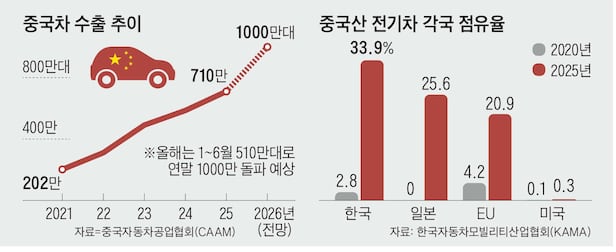
Analysts attribute this shift to the growing threat of Chinese automakers, which has already materialized in Europe, Australia, Latin America, and Africa. China’s overseas expansion is indeed rapid: its auto exports are likely to surpass 10 million units for the first time this year—a fivefold increase in just five years.
In Europe, where Chinese automakers are aggressively expanding, the combined market share of five Chinese brands, including BYD, reached 10.9% in the first half of 2026, surpassing Hyundai Motor and Kia (7.4%) and closing in on Japanese brands like Toyota (12%). The penetration rate of Chinese EVs, where the country holds a technological edge, is even faster. In Europe, Chinese EV market share jumped from 4.2% in 2020 to 20.9% last year. In South Korea, the figure surged more sharply, from 2.8% to 33.9% over the same period.
The rise of Chinese automakers is also impacting the performance of established global automakers. European brands, which once dominated the Chinese market, are now losing ground both in their home market and in China. Volkswagen Group, the world’s second-largest automaker, is reportedly considering restructuring nearly 100,000 employees over four to five years—a move analysts link to these challenges. While the U.S. remains a relative safe zone from Chinese vehicles, there is growing concern that, as seen in Europe, the market could quickly open to Chinese automakers if trade barriers weaken.
◇Major countries step up defenses against Chinese vehicles
Globally, nations are beginning to counter Chinese automakers. The EU is considering expanding additional tariffs of up to 35.3% on Chinese EVs to include plug-in hybrids (PHEVs). Japan has also widened disparities in EV subsidies based on supply chain stability and domestic industry contributions since this year. It offers tax credits to domestically produced EVs depending on production volume.
South Korea, however, lacks effective measures to counter the Chinese onslaught. Chinese-made Teslas, which receive subsidies from the government and local authorities, have even outsold domestic combustion-engine vehicles. BYD, Zeekr, and Xpeng are also preparing to enter the market. During this year’s revision of the Ministry of Climate, Energy and Environment’s EV subsidy program, a proposal to exclude companies with low domestic industry contributions was softened from its original form. EVs were also excluded from the Ministry of Trade, Industry and Resources’ domestic production tax credit program.