Watandar
Elite Member


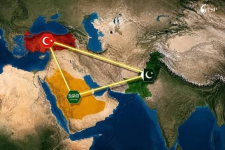
A reason why Saudis are looking for additional protectors.
Pentagon weighing smaller U.S. military presence in Gulf once Iran war ends
The analysis, which the Defense Dept. said was not yet a formal review, will address whether to rebuild strike-battered bases, said people familiar with the matter.August 18, 2026 at 11:11 a.m. EDT35 minutes ago

President Donald Trump during a trip to al-Udeid Air Base in Qatar on May 15. (Alex Brandon/AP)
By Noah Robertson
,
John Hudson
and
Susannah George
The Pentagon is evaluating its military footprint in the Middle East in an early sign of the Iran war’s potential to transform the U.S. presence in the region, according to eight people, including officials and others familiar with the matter.
One of the key areas the Defense Department is assessing is whether to pull back troops from the Persian Gulf, where America’s large overseas military bases have been battered by months of Iranian strikes, two people familiar with the ongoing analysis said.
The damage to these facilities has prompted a once-in-a-generation chance for the Pentagon to reconsider its presence in the region. The Defense Department has already signaled that it might not rebuild its bases as they were before the conflict.

U.S. military bases in and near the Middle East
The evaluation is being led by the Pentagon’s policy office, though a senior Pentagon official, who like others spoke on the condition of anonymity to discuss the sensitive analysis, said that the Joint Staff and U.S. Central Command were also studying the issue.
Defense Secretary Pete Hegseth had not yet ordered a formal review of U.S. posture in the region, the official said. Instead, the official cast the analysis as “prudent planning” that could eventually inform how the administration addresses whether to rebuild the bases damaged during the war.
“Decisions are going to have to be made on some of this stuff,” the official said.
U.S. Central Command, which runs U.S. military operations in the Middle East, normally stations about 40,000 troops across almost 20 sites in a 1,500-mile arc from Jordan to Oman.
Since early this year, the military has surged warships, fighters, air defense assets and other scarce military equipment to the region to defend U.S. forces and carry out more than 13,000 strikes against Iran.
America’s largest and most permanent bases in the Middle East are in the Persian Gulf, where Bahrain hosts the headquarters of the U.S. Fifth Fleet and where other states, such as Kuwait, house Army and Air Force assets.
Allies in the Gulf have for decades depended on U.S. forces for their defense. Any regional drawdown could leave states unable to defend themselves against Iranian attacks. Investing in domestic capabilities or partnering with other powers to offset the shortfall could take months to years.
People familiar with the Pentagon’s analysis said the issue is likely to intensify a debate between camps within the administration that support military interventions and others that have argued the Pentagon should curtail some of its security commitments to refocus on defending the U.S. homeland or deterring more powerful adversaries, like China.
The discussions have also involved Adm. Bradley Cooper, the head of U.S. Central Command, who supports deliberations about potentially moving U.S. troops west from the Persian Gulf, said a U.S. official.
A spokesperson for U.S. Central Command declined to comment.
Before the start of the war in February, U.S. Central Command evacuated many of its bases, judging them too vulnerable to Iranian missile and drone attacks to maintain normal staffing levels. Some of the shifts away from the major Gulf facilities might last after the war, a person familiar with the posture adjustments said.
“Iran thinks we are in the traditional places,” the person said, declining to specify the changes so as not to put U.S. service members at risk. “And we are not.”

Trump and first lady Melania Trump in Dover, Delaware, on March 7, as a U.S. Army team moves a flag-draped transfer case containing the remains of a service member killed in a March 1 attack on Port Shuaiba in Kuwait. (Anna Moneymaker/Getty Images)
Six U.S. service members were killed in a March strike on Port Shuaiba, a military facility in Kuwait, and more than 200 U.S. facilities have been damaged or destroyed during the conflict, The Washington Post reported in May.
While defending its personnel in the region, the U.S. military has also expended more than 1,000 sophisticated air-defense interceptors, draining the Pentagon’s stockpile of Patriot and Terminal High Altitude Area Defense missiles, The Post reported in March.
“The war really did highlight the vulnerability ... of U.S. forces in the region,” said Michael Ratney, a former diplomat who served as the U.S. ambassador to Saudi Arabia and the deputy chief of mission in Qatar.
Moving troops and equipment further west to Jordan, Israel or the Red Sea coast of Saudi Arabia could help alleviate some of the pressure, he argued, while noting the added distance wasn’t a “perfect solution to this problem.”
Iran has already demonstrated it can strike faraway targets in Jordan and Israel. Last month an Iranian attack on Jordan killed four U.S. service members.
Tehran’s retaliatory attacks against bases in the Persian Gulf plunged the region into crisis and are stoking frustration among core U.S. allies there, who feel they were not properly consulted by the Trump administration before starting the war.
Allison Minor, who served during the first Trump administration as the director for Arabian Peninsula affairs on the National Security Council, said the Gulf countries could maintain elements of their security partnership with the U.S. — such as arms sales and intelligence sharing — while hosting a smaller troop presence.
“But you need to be discussing all of those comprehensively and not just the question of the sheer number of troops,” she said.
The Pentagon has publicly estimated that the war’s cost will reach about $37.5 billion by the end of September, but that price tag does not account for the money it will take to rebuild bases in the region.
Jules Hurst III, the Defense Department’s comptroller, told the Senate in May that the reconstruction costs were being left out because the administration has not yet decided how it wants to rebuild from the damage.

Secretary of Defense Pete Hegseth with Israeli Prime Minister Benjamin Netanyahu at the Pentagon on Feb. 5, weeks before the start of the Iran war. (Manuel Balce Ceneta/AP)
In April, the center-right American Enterprise Institute estimated it would cost $5 billion to repair the U.S. bases that have been targeted.
Multiple people familiar with the Pentagon’s analysis cautioned that any permanent changes to U.S. posture were still distant and would require the approval of senior administration officials.
In June, President Donald Trump signed a preliminary peace deal with Tehran and signaled that the war was coming to a close. The agreement later collapsed, and the two sides have sporadically exchanged strikes in the months since.
A recent policy proposal from Defense Priorities, a think tank that advocates for military restraint, calls for closing U.S. bases in close striking range of Iran’s missiles and drones, such as Kuwait. The proposal also calls for moving forces dispersed in the United Arab Emirates, Jordan and Bahrain to more secure facilities such as the Prince Sultan Air Base near Riyadh.
More hawkish voices in Washington have sought to influence the Pentagon’s planning by proposing the movement of U.S. troops in the region to Israel. A report by the pro-Israel group Jewish Institute for National Security of America in March called for more U.S. military assets to be moved to Israel’s Ovda Airbase.
This winter, in the run-up to Operation Epic Fury, Washington sent F-22 Raptor fighter jets to the base in a sign of deepening U.S.-Israel military relations.
There is disagreement within the Trump administration over that recommendation given concerns that an expanded U.S. presence there could pose a counterintelligence vulnerability amid the Pentagon’s growing concern about Israeli espionage.
Also, the office of Undersecretary of Defense for Policy Elbridge Colby has launched a public review of America’s military presence in NATO, after the Trump administration announced it was pulling thousands of troops out of Germany and Poland. The study is set to conclude in December.