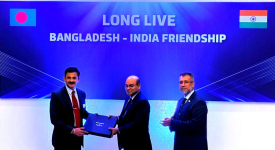
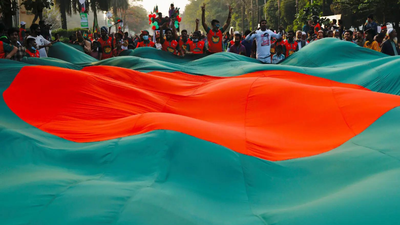
India foreign policy thread

There is a saying "actions speak louder than words".


Beyond all the rhetoric and nonsense, what is actually happening? Bangladesh is doing business with India because it needs to. We have no other option. This forum and some of the delusional trolls in it have no connection to reality.

Also any modernisation or development of Bangladesh's armed forces is not linked to any offensive posture against India (a nuclear giant) but because we have to be strong and have a strong defensive capability. Our population is bigger than Russia, but we are not seeking to have armed forces bigger than Russia or equal to Russia but still smaller than Russia, but bigger than what we have now, especially given the genodical racist, fascist Myanmar regime next door.

India is a liberal democracy with a strong civil society and nothing like Myanmar.
100% agreed on everything and especially bold part.... I or in general Indians (barring trolls on forum) have no grudge if Bangladesh wants a strong and modern military.... it's a right of Bangladesh if they want to be a strong country.... Bangladesh faces sometimes hostile Myanmar and internal instability in that country somehow affects Bangladesh.... India though doesn't have any conflicts like it has with China or Pakistan sometimes things go very hot.... so better be prepared than regret later.....
 
Thanks.

Just to give some context. Bangladesh is in no position to be antagonistic to neighbours or looking for fights. However what normal country can accept 1 million refugees (Rohingya) thrown into their country?

Myanmar is not a normal country and run by extreme racists and around half of the country is run by rebel groups.

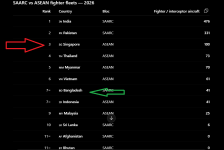
Here is a table of air forces in terms of fighter jets and interceptors amongst SAAR and ASEAN states.

1788285970269.png

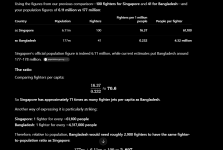
Singapore has 100 fighter jets + interceptors according to this and Bangladesh has 41.

Singapore's population is over 6 million and Bangladesh is 177 million approx, so Bangladesh has a population 29 times more than Singapore. Look at this below.

1788286199452.png

Our air force is severely understrength and underfunded. Do we need a strong air force? Yes. Why?

Has Thailand had 1 million refugees from Myanmar expelled in to its country?

The build up of our air force is regularly used by anti-Bangladeshi Indians to vilify Bangladesh and to demonise as some sort of money hell-bent on some war, which is ridiculous.

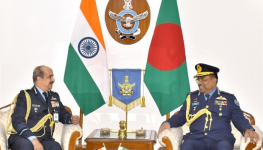
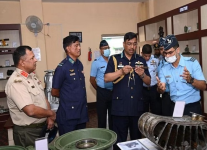
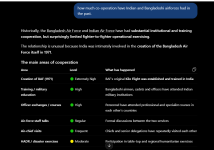
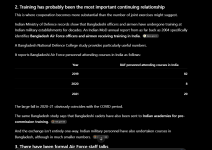
Anyway the Bangladeshi and Indian air forces have had good relations in the past.

1788286464527.png

1788286523703.png
Former head of Bangladesh air force Shaikh Abdul Hannan at Barrackpore air force base in West Bengal, India.

1788286704278.png
 
Continued....

1788286819938.png

Policy makers or think tank analysts in New Delhi cannot insist on a weak understrength for the Bangladesh airforce as this is highly offensive and carries insinuations that Bangladesh should remain weak to please Delhi. On the other hand Bangladesh has to make it clear that it is a state whose nation project is poverty alleviation and recognises the territorial inviolability of the Indian union and the utmost need for a stable and prosperous India and particularly its north-east. Any development of Bangladesh's airforce is natural to keep it up to par with others in the region and a basic right of a sovereign state.
 

India, Bangladesh Eye Stronger Grassroots Ties as High Commissioner Meets LGRD Minister​

Bikram Anik, AA

1788357548040.png

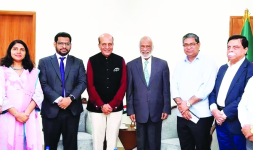
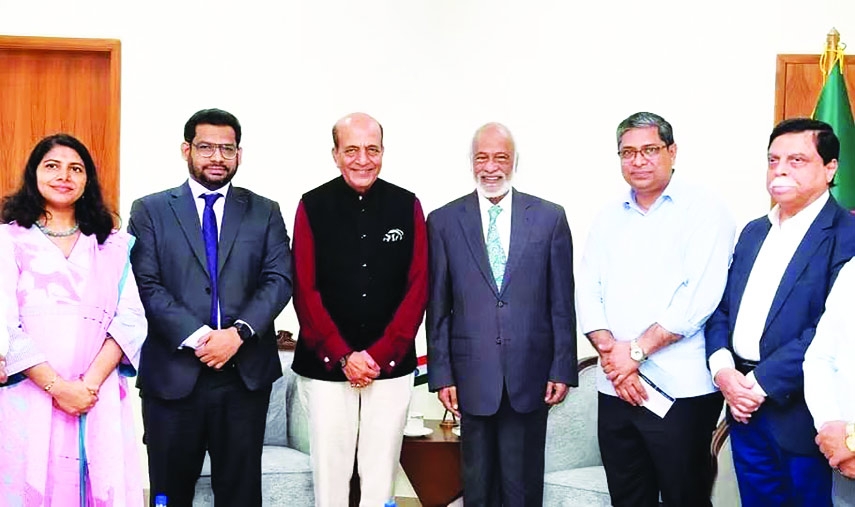
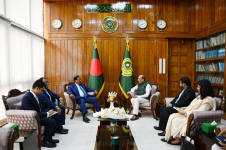
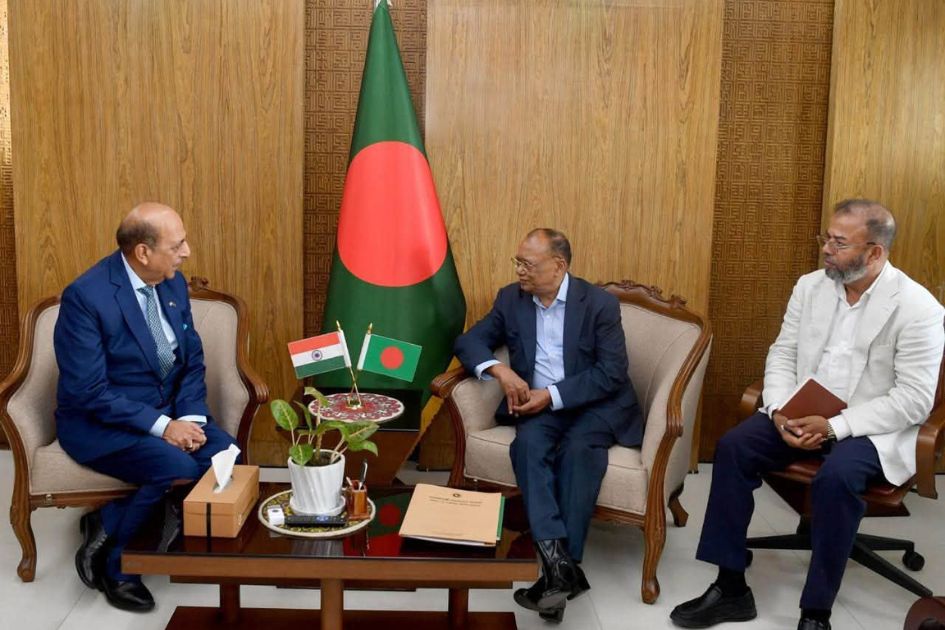
In a high-profile diplomatic engagement underscored by warm camaraderie, Indian High Commissioner to Bangladesh Dinesh Trivedi held a comprehensive bilateral meeting yesterday with Bangladesh government's Minister of Local Government, Rural Development and Cooperatives, Dr. Abdul Moyeen Khan. State Minister Mir Shahe Alam was also present during the talks.

Indian High Commissioner Dinesh Trivedi opened the meeting by extending heartfelt congratulations and good wishes to the leadership on the occasion of the 48th Founding Day of the Bangladesh Nationalist Party (BNP). The centerpiece of the discussion was a shared vision to deepen the historical and cultural bonds between the citizens of both nations.


Reaffirming that robust democratic institutions begin at the foundational level, both sides exchanged ideas on modernizing and strengthening local government frameworks to better serve communities. Beyond high-level diplomacy, the dialogue highlighted a mutual commitment to empowering local governance, a vital priority for both vibrant democracies as they look to build a more connected and resilient neighborhood.


@BananaRepublic
 
Are they trolling the jamatis lol

The nationalists....(Bangladesh Nationalist Party, BNP, ruling party) ditched the Jamaatis in 2020 after decades of alliance with them. It was inevitable.

1. The BNP are founded by people who fought against the Pakistan army.

Jamaat is a party who fought for the Pakistan army.

2. BNP sees an independent Bangladesh as a major accomplishment.

Jamaat sees it as a shame and loss and realises though it cannot "reunite" Bangladesh and Pakistan, it can try to make a de facto union, or make Bangladesh an "east Pakistan" in the sense of being hostile to India or even going to war with India.

1788361645645.png


1788361675094.png

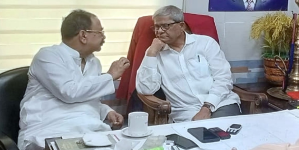
One of the people in that meeting was a Hindu member of the BNP, Gayeshwar Chandra Roy.

1788361786904.pngRoy (left) with then BNP senior member, Mirza Fakhrul Alamgir who is now president of Bangladesh.


Begum Selima Rahman was one of the nationalists in this very important high level nationalists meeting.

1788361898054.png

So we now have a nationalist government in power that wanted to Jamaat from their alliance as far back as 2020 (though most say the actual end of the BNP-Jamaat alliance was 2022) when Hasina's position seemed unshakeable. It seems to have been an ideological decision. At the time it might have seemed unwise, but the nationalists seem to have decided to follow their principles and ditch the razakar Jamaatis, 6 years later they gained power.

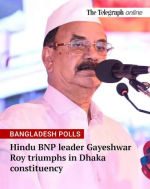
One of the nationalists involved in this major decision, Gayeshwar Chandra Roy, won his seat in a massive electoral victory for the nationalists.

1788362120169.png


The nationalists in Bangladesh are strong and powerful, and they view India as a neighbour whom they wish to have good relations with.
 
Last edited:
The nationalists....(Bangladesh Nationalist Party, BNP, ruling party) ditched the Jamaatis in 2020 after decades of alliance with them. It was inevitable.

1. The BNP are founded by people who fought against the Pakistan army.

Jamaat is a party who fought for the Pakistan army.

2. BNP sees an independent Bangladesh as a major accomplishment.

Jamaat sees it as a shame and loss and realises though it cannot "reunite" Bangladesh and Pakistan, it can try to make a de facto union, or make Bangladesh an "east Pakistan" in the sense of being hostile to India or even going to war with India.

View attachment 213674


View attachment 213676

One of the people in that meeting was a Hindu member of the BNP, Gayeshwar Chandra Roy.

View attachment 213677Roy (left) with then BNP senior member, Mirza Fakhrul Alamgir who is now president of Bangladesh.


Begum Selima Rahman was one of the nationalists in this very important high level nationalists meeting.

View attachment 213678

So we now have a nationalist government in power that wanted to Jamaat from their alliance as far back as 2020 (though most say the actual end of the BNP-Jamaat alliance was 2022) when Hasina's position seemed unshakeable. It seems to have been an ideological decision. At the time it might have seemed unwise, but the nationalists seem to have decided to follow their principles and ditch the razakar Jamaatis, 6 years later they gained power.

One of the nationalists involved in this major decision, Gayeshwar Chandra Roy, won his seat in a massive electoral victory for the nationalists.

View attachment 213681


The nationalists in Bangladesh are strong and powerful, and they view India as a neighbour whom they wish to have good relations with.


Only problem is our nationalists have military roots.

And as you know from world over - brightest people do not join the military.

Hence I am always sceptical of their approach.
 
Only problem is our nationalists have military roots.

And as you know from world over - brightest people do not join the military.

Hence I am always sceptical of their approach.

Bangladeshi nationalism can really be traced back to way earlier and you could talk about the desire for the partition of Bengal and the formation of a Muslim-majority east Bengal as 'proto-Bangladeshi nationalism which itself was the precursor to the partition of the sub-continent as a whole and the creation of Pakistan. This has nothing to do with the military and arguably the greatest Bengali/Bangladeshi of all time is Maulana Bashani along with other giants like Sher i Bangla A.K. Fazlul Haque.

1788379046083.png


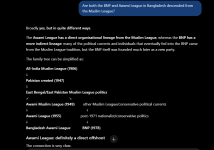
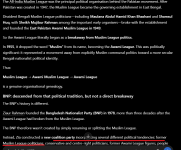
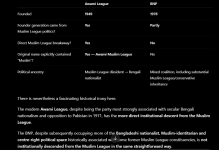
Both major parties in Bangladesh are arguably descended from the Muslim league (which Bashani later renamed to the Awami Muslim League and then Awami League).
1788379151258.png

1788379248769.png

1788379339719.png

However with time both parties developed from the original desire for a Muslim Bengali state and then focused on a more inclusive form of nationalism for all citizens of that state regardless of religion.

1. The Awami League became somewhat ethno-centric or linguo-centric focusing on the Bengali language and "Bengali-ness".

2. The 'Bangladeshi' nationalism of the BNP is inclusive of all citizens of Bangladesh be they Hindu, Chakma (Buddhist), Christian etc and less focused on language.

However in real terms there is not that much difference. Both are pro-independence which Jamaat are not.

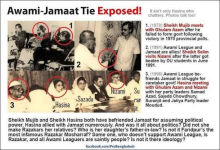
Both the Awami League and the BNP have allied themselves with Jamaat at various times.

1788379530620.png

However unlike the Awami League and BNP which are both pro-independence parties and probably represent 90% of all Bangladeshis, Jamaat is a razakar anti-independence party ditched by both major parties.

They are anti-Bangladesh, anti-India and the no.1 domestic enemy of Bangladesh at the moment.

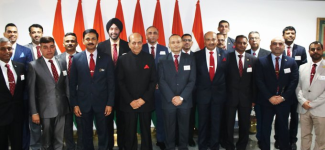
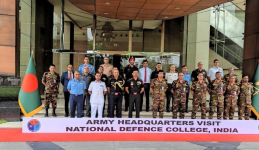
The fact that our military is providing "hospitality" to a delegation of Indian military personnel is just one evidence of how very little real power Jamaat enjoy in the real corridors of power in the upper echeleons of our business community and military.

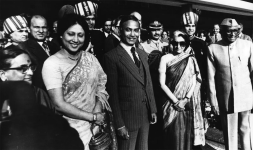
So Bangladeshi nationalism has little to do with the military. It is pro-independence but to a degree has an inherent fondness, liking and desire for friendship with India, as well as warm feelings for fellow Bengalis of West Bengal (some Bengalis on both sides of the border view each other as members of one greater Bengali nation/community).

1788379854180.png

Zia Rahman with Indian leader, Indira Gandhi.
 
Indian foreign policy thread went from aspiring to become the 3rd pole of the world to extreme isolationism of courting BD.


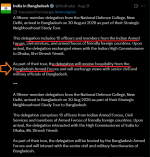
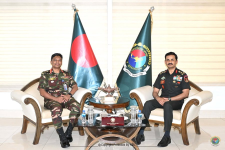
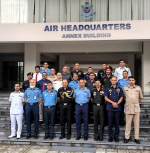
Translation: "As part of the Strategic Neighborhood Study Tour to Bangladesh, the delegation from New Delhi's National Defence College visited the Naval Headquarters, Army Headquarters, Armed Forces Division, and National Defence College in Mirpur on the first day. In the evening, the Bangladesh Navy hosted the delegation for dinner at BNS Dhaka. Next, on the second day, the delegation visited the Ministry of Foreign Affairs, Bangladesh Military Museum, and Air Headquarters. On the third day, the delegation visited the BAF Base in Cox's Bazar. During this tour, the Honorable Defence Advisor and the Head of the Delegation met with the senior leadership of the Bangladesh Armed Forces and exchanged views on various topics, including defence cooperation. These exchanges further strengthened the enduring bond of friendship and spirit of camaraderie between the armed forces of the two countries. This educational tour provided the delegation with insights into Bangladesh's unique security challenges and its strategic priorities. These invaluable lessons will help consolidate the friendship and cooperation between the two neighboring countries."

1788474355924.png

1788474372864.png
1788474392167.png
1788474413959.png
 

Need good working ties with India: Bangladesh​

Ahsan Tasnim / TNN / Sep 06, 2026, 03:57 IST

Comments
Share
AA
+Text Size
  • Small
  • Medium
  • Large

Need good working ties with India: Bangladesh

Bangladesh wants engagement and good working relationship with India

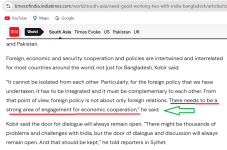
DHAKA: Bangladesh wants engagement and good working relationship with India despite existing challenges, state minister for foreign affairs Humayun Kobir said Saturday, seeking continued dialogue with New Delhi.His remarks come amid strained ties between the neighbours over issues such as former PM Sheikh Hasina's extradition and Dhaka growing cooperation with China and Pakistan.Foreign, economic and security cooperation and policies are intertwined and interrelated for most countries around the world, not just for Bangladesh, Kobir said."It cannot be isolated from each other. Particularly, for the foreign policy that we have undertaken, it has to be integrated and it must be complementary to each other. From that point of view, foreign policy is not about only foreign relations. There needs to be a strong area of engagement for economic cooperation," he said.Kobir said the door for dialogue will always remain open. "There might be thousands of problems and challenges with India, but the door of dialogue and discussion will always remain open. And that should be kept," he told reporters in Sylhet.


1788689521812.png

Humayun Kabir.

1788689549389.png


Kabir has been calling for the optimisation of economic trade and relations with India for a while now, let's hope the current incumbent nationalist government in power in Dhaka, can help to achieve that.

The article below is from June.

1788689716043.png

Later on in the June article:

1788689870571.png

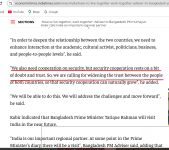
The nationalists are clearly calling for greater friendship with India including increased people to people friendship.

In terms of security co-operation that would obviously mean complete respect for the territorial integrity of both states including the Indian union and particularly it's north-east, but from the India side they should understand we have 1 million Rohingya refugees which we cannot host indefinitely and which we may have to use military force to ensure their safe repatriation and the creation of a safe zone in northern Rakhine but with any concerns from New Delhi about this to be respected and acted upon.
 

Bangladesh-India trade faces restrictions from both sides: Commerce minister​

Bilateral trade stands at $12.75 billion, with Bangladesh exporting goods worth $1.89 billion to India, Khandakar Abdul Muktadir tells parliament
3 September 2026
UPDATED 3 September 2026
ECONOMY
SHARE
Star Online Report
Bangladesh India Trade


Bilateral trade between Bangladesh and India continues to face restrictions from both sides, Commerce Minister Khandakar Abdul Muktadir told parliament today.


Replying to a supplementary question from Abdul Baten MP, the minister said Bangladesh’s trade deficit with India increased further in the 2025-26 fiscal year compared with the previous year.

Tap here to add The Daily Star as a trusted source google-preferred-source-badge
The volume of bilateral trade currently stands at nearly $12.75 billion, of which Bangladesh exports goods worth $1.89 billion to India. The remainder comes in as imports from India, he said.


However, the government does not view the trade deficit with any single country in isolation, but considers the overall trade situation, Muktadir said. Bangladesh also has a large trade deficit with China, he added.


“There were some restrictions from India, and during the last two years some restrictions have also been created from Bangladesh,” he said.

The minister said there are opportunities to increase Bangladesh’s exports to the Indian market.


“Although the gap with one country is so wide, importers make their decisions based on convenience and cost,” he said.

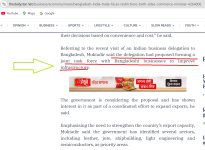
Referring to the recent visit of an Indian business delegation to Bangladesh, Muktadir said the delegation had proposed forming a joint task force with Bangladeshi businesses to improve infrastructure.


The government is considering the proposal and has shown interest in it as part of a coordinated effort to expand exports, he said.

Emphasising the need to strengthen the country’s export capacity, Muktadir said the government has identified several sectors, including leather, jute, shipbuilding, light engineering and semiconductors, as priority areas.

Explaining why imports from India are significantly higher, he said the government itself does not conduct imports, which are primarily carried out by private businesses. Traders source goods from wherever they find competitive prices, making India a major supplier under such conditions.


Policy support is being provided to these sectors, alongside efforts to attract new investment, he said. Plans are also underway to bring other potential sectors up to export-ready levels.

In response to a question from Lutfur Rahman MP, the minister presented data on Bangladesh’s trade deficit with India from FY2020-21 to FY2024-25.

The trade deficit stood at $7.31 billion in FY2020-21, $11.70 billion in FY2021-22, $7.72 billion in FY2022-23, $7.43 billion in FY2023-24 and $7.86 billion in FY2024-25.

Emphasising the need to strengthen the country’s export capacity, Muktadir said the government has identified several sectors, including leather, jute, shipbuilding, light engineering and semiconductors, as priority areas.

Explaining why imports from India are significantly higher, he said the government itself does not conduct imports, which are primarily carried out by private businesses. Traders source goods from wherever they find competitive prices, making India a major supplier under such conditions.


1. The people who are ensuring a net Indian trade surplus with Bangladesh are individual citizens and businesses who voluntarily opt for India for economic reasons. This is of course totally legitimate and is their democratic right, but it also shows the importance of India economically for Bangladesh.

1788690264817.png
Khandaker Abdul Muktardir.

This is clear from Muktadir's statement when he said:

'“Although the gap with one country is so wide, importers make their decisions based on convenience and cost,” he said.'

In other words it is just simply market economics dictating outcomes in the same way China also has a net surplus with Bangladesh.


2. The good news is Indian businessman seem to be trying hard to help Bangladesh.
1788690442411.png

So hopefully Bangladeshi infrastructure can improve with Indian help and we can also diversify our exports and accelerate our path to a $1 trillion economy. That too benefits India as we then have the cash to purchase even more Indian products.
 
India, Bangladesh To Discuss Restarting Train Services At Key Meeting

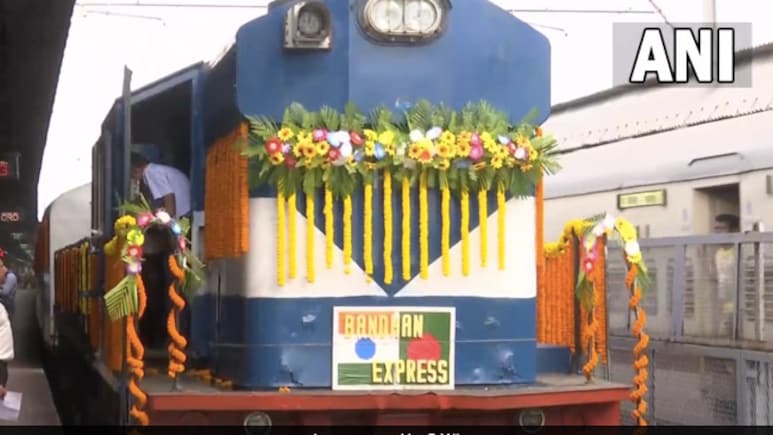
The process of restarting the Maitree, Mitali and Bandhan Express trains operating between India and Bangladesh will be on the agenda at the meeting this time.​

  • Reported by:Saurabh Gupta
  • India News
  • Sep 08, 2026 00:18 IST
    • Published OnSep 08, 2026 00:18 IST
    • Last Updated OnSep 08, 2026 00:18 IST
Read Time:4 mins
trusted source


India, Bangladesh To Discuss Restarting Train Services At Key Meeting

The Bandhan Express is an international passenger train that runs between Kolkata and Khulna.

Following the discontinuation of railway services between India and Bangladesh in 2024 due to security concerns, efforts to restart train services from Kolkata to Dhaka and Khulna and New Jalpaiguri to Dhaka are now taking shape, as the issue is coming up for discussion during the two-day meeting of the Inter-Governmental Railway Meeting (IGRM). This meeting is held every year, and the last meeting took place in New Delhi last year.


The IGRM between India and Bangladesh is an annual bilateral forum where railway authorities and ministry representatives from both countries meet to discuss and decide on cross-border train operations, rail infrastructure projects, and freight transit.

The process of restarting the Maitree, Mitali and Bandhan Express trains operating between India and Bangladesh will be on the agenda at the meeting this time, and this is the first time since 2024 that the issue will be discussed formally at the annual meeting between the railway authorities of the two countries.

The two-day meeting begins in Dhaka on Tuesday, and sources have confirmed to NDTV that if there is a resolution, then the three cross-border trains that originate from Kolkata and New Jalpaiguri could resume services as early as next month.


The Maitree Express is an international express train that connects Kolkata and Dhaka. It was the first international train between India and Bangladesh, and it covers a distance of around 375 to 400 km in about 9 hours. The train crosses into Bangladesh through the Gede-Darshana border. The Bandhan Express is an international passenger train that runs between Kolkata and Khulna, and it covers the 180km route in five and a half hours. The train enters Bangladesh through the Petrapole-Benapole border.

The Mitali Express is a bi-weekly international express train connecting New Jalpaiguri in West Bengal, India, and Dhaka Cantonment in Bangladesh. It was the last international train service to be inaugurated between the two countries, with Prime Minister Narendra Modi and former Prime Minister of Bangladesh Sheikh Hasina flagging off the services jointly in 2021. The train covers the distance of nearly 600 km in around 11 hours and crosses into Bangladesh via the Haldibari-Chilahati border.

The Mitali Express rake had been held up in Bangladesh for over five months in 2024 during the unrest in the country. The train had originally left New Jalpaiguri for Dhaka on July 17 but had been unable to return due to political unrest in Bangladesh. With the deteriorating law and order situation in Bangladesh, Indian Railways suspended all three inter-country passenger trains for an indefinite period and the rake returned only in December through the Chilahati-Haldibari border in Cooch Behar District of West Bengal this morning amid heightened security measures

Bangladesh is also going to propose launching a new passenger train service from Rajshahi to Kolkata. Bangladesh is also going to propose re-routing the Dhaka-Kolkata Maitree Express via the Padma Bridge instead of its current route.

Freight transport via the railways is also going to be on the agenda of the meeting, along with stalled railway projects that are being implemented with loans from India, including the construction of two new railway lines from Kamalapur in Dhaka to Joydebpur in Gazipur.

India is also supplying new rakes to Bangladesh. India is set to supply a rake of 19 LHB broad-gauge passenger coaches to the neighbouring country, offering much-needed support to its rail network. The first rake of 19 LHB broad-gauge passenger coaches for Bangladesh Railway has been rolled out from Rail Coach Factory in Punjab's Kapurthala.

Bangladesh is set to import 200 broad-gauge railway coaches from India, with the first delivery now being rolled out. The delivery of the 200 coaches is likely to be completed by December 2027 under a Rs 915 crore deal. The project, financed by the European Investment Bank, will see the new coaches being added to the ageing Bangladesh Railway fleet between June 2026 and December 2027.

 
Bangladesh, India agree to hold Sundarbans, tiger conservation talks


Bangladesh, India agree to hold Sundarbans, tiger conservation talks​


https://www.facebook.com/sharer.php...-to-hold-sundarbans-tiger-conservation-talks/
Bangladesh under existing cooperation frameworks on Sundarbans biodiversity conservation and the protection of the Royal Bengal tiger, Bangladesh’s environment ministry said Monday(7 September).

The agreement came during a courtesy meeting between Bangladesh Environment, Forest and Climate Change Minister Abdul Awal Mintoo and Indian High Commissioner to Bangladesh Dinesh Trivedi at the minister’s office at the Bangladesh Secretariat in Dhaka on September 7.

Environment State Minister Sheikh Faridul Islam was also present at the meeting.

During the talks, both sides agreed that the next meeting of the joint working group under an existing memorandum of understanding between Bangladesh and India on conserving the biodiversity of the Sundarbans, the world’s largest mangrove forest shared by the two countries, would be held in Bangladesh.

They also agreed that the next bilateral meeting under the protocol signed between the two countries on conserving the Royal Bengal tiger would take place in Bangladesh.

The two sides decided, however, that the next meeting on the conservation of transboundary Asian elephants would be held in India.

The meeting also covered environmental and climate change cooperation, transboundary environmental problems, carbon credits, carbon emission reductions and the development of a green economy.

Mintoo said Bangladesh and India were close neighbours whose environmental and ecological interests were closely connected.

“Climate change, floods, droughts, river and water resource management, air pollution and biodiversity loss are not challenges confined within one country,” he said.

He said stronger mutual trust, sharing of data and experience and effective regional cooperation were needed to address such problems.

Mintoo said Bangladesh was interested in advancing a positive and constructive relationship with India based on mutual respect and shared interests.
He expressed hope that cooperation between the two countries in the environment and climate sectors would deepen in the coming days to ensure the welfare of their peoples and a sustainable future.

The minister said maintaining a balance between environmental protection and economic development was essential to ensure sustainable development.

In this regard, he said the exchange of technology, knowledge and successful experience among South Asian countries could play an important role.

State Minister Sheikh Faridul Islam highlighted the importance of joint initiatives to conserve biodiversity and ecologically significant areas shared by Bangladesh and India, including the Sundarbans.

He said the Sundarbans was a shared natural asset of the two countries and served as an important protective barrier against climate change and natural disasters.
He said Bangladesh and India could further expand exchanges on research, technology and management experience to protect the Sundarbans ecosystem and wildlife.

The meeting also discussed transboundary air pollution and river pollution.

Both sides stressed the need for scientific data sharing, regular communication among relevant agencies and effective coordination to address such environmental problems.

Trivedi said there was scope to expand cooperation between the neighbouring countries by prioritising mutual interests and the welfare of their peoples.

He said Bangladesh and India had significant potential to work together on environmental protection, building climate resilience and sustainable development.

The Indian high commissioner also expressed his commitment to strengthening friendly relations between the peoples of Bangladesh and India and advancing cooperation in different areas of mutual interest.

Dr Fahmida Khanam, acting secretary of Bangladesh’s Ministry of Environment, Forest and Climate Change, was also present at the meeting.


Users who are viewing this thread

Pakistan Defence Latest

Country Watch Latest

Back
Top