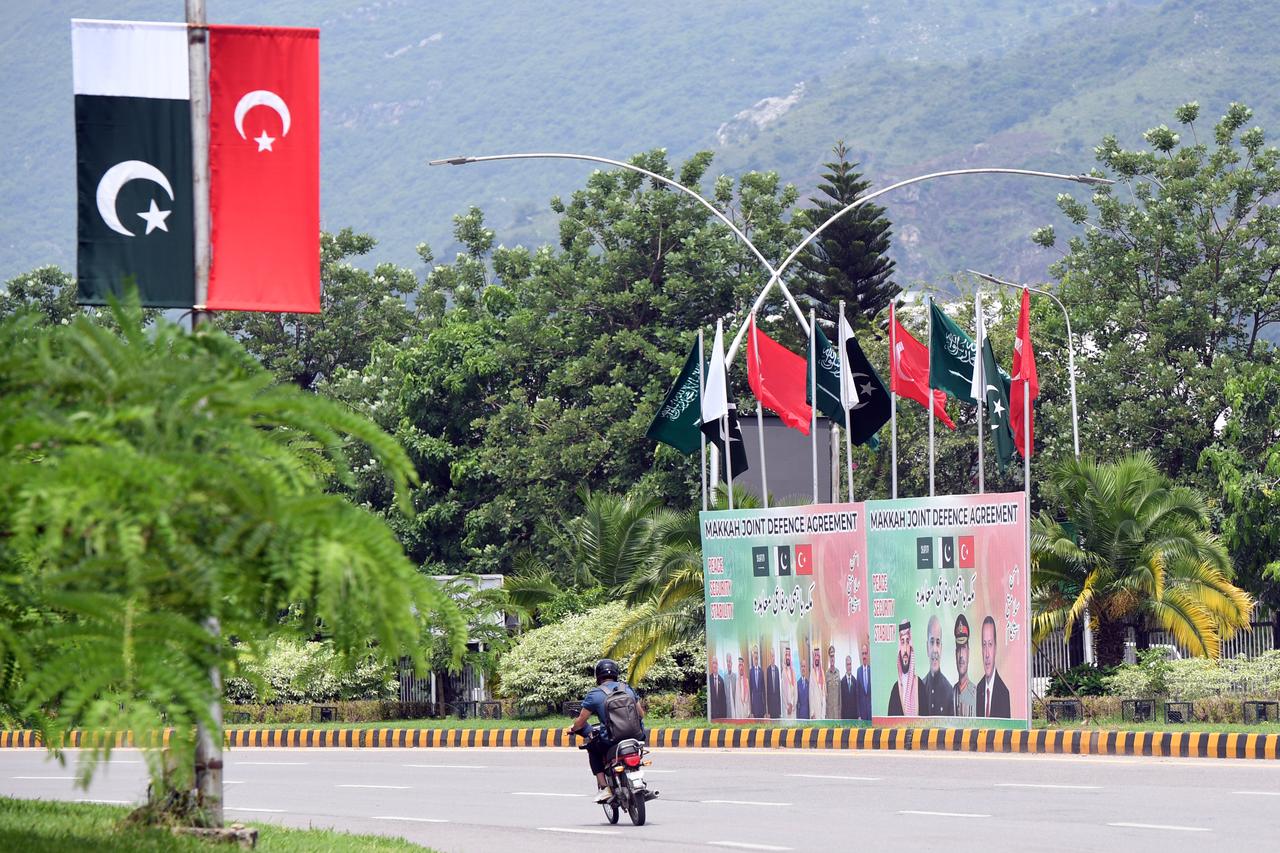
The Mecca Pact’s First Test Has Exposed Its Central Weakness

I agree. Only time will tell what happens, but given the current situation, it makes everyone a little antsy.
It is, the whole region is on fire, no one got any time to sit and relax and make strategies or solidify pacts and rules, everything will happen in due time.
 
No that didn't happen
More importantly - Cultists need to insert something of their beliefs in a yahoo(very reputable Im sure) .

Now if you had a few years ago said
“RMAF conducts weeklong exercises with IAF” and then commented “Looks like IK’s sucking up to Mahatir failed” these same squealers would be giving all sorts of excuses when in reality both are mutually exclusive and have different tracks to them.
 
More importantly - Cultists need to insert something of their beliefs in a yahoo(very reputable Im sure) .

Now if you had a few years ago said
“RMAF conducts weeklong exercises with IAF” and then commented “Looks like IK’s sucking up to Mahatir failed” these same squealers would be giving all sorts of excuses when in reality both are mutually exclusive and have different tracks to them.

newspapers are just that, they create sensationlsim

however; to think, everyone is just a fool, is a sheer stupidity, as well!

it is like a prankster telling to a magician, I know, I was magician in a real life!

they can fool 'almost' anyone (that includes themselves!)
 
No that didn't happen
What do you mean ? The article I linked to , which is the same you strangely linked, does not mention Munir at all. It means Pakistan is no longer being used as an intermediary by China and the Saudis.

This discredits Mr Munir who has been trading on his so-called special relationships with China and Mr Trump to act as an intermediary and mediator in this conflict.

Additionally this article contains the rebuke to Munir by the Iranians and explores how Pakistan may have bitten off more than it can chew in the MidEast.

As Saudi tensions with Iran-backed Houthis escalate, mediator Pakistan faces pressure to choose a side​

By Mubasher Bukhari, Parisa Hafezi, Asif Shahzad and Ariba Shahid

ISLAMABAD/DUBAI, Sept 11 (Reuters) - For much of the past year, Pakistan has played a dual role as Riyadh's defence partner and Washington's backchannel to Tehran but this week's fighting between Yemen's Iran-backed Houthi movement and Saudi forces is increasingly testing how long Islamabad can hold both positions at once.

The fighting represents the first major test of the mutual defence alliance that was signed between Pakistan, Saudi Arabia and Turkey last month, adding to ‌a pre-existing pact between Islamabad and Riyadh. Under the arrangement, an armed attack on any one of the three countries is to be regarded as an attack on all.

Pakistani officials worry the Houthi threat is more likely to draw Islamabad into a war than Iranian missile strikes on Saudi energy infrastructure were earlier this year. Pakistani soldiers are deployed near the Saudi border with Yemen, two Pakistani officials told Reuters in July, increasing their direct exposure.

Defence deals with Gulf nations have been a key part of Pakistan's plans to boost its fledgling economy after years of crisis, and have often been accompanied by parallel or subsequent talks about Gulf investments.

However, Pakistan also relies on oil and gas shipments through the Strait of Hormuz and the Red Sea — routes that Iran and the Houthis have shown they can disrupt — giving Islamabad reason to avoid alienating Tehran even as it deepens ties with the Gulf.

WARNING TO IRAN​

In the past, ⁠tensions between Iran and nuclear-armed Pakistan have at times escalated into deadly clashes. Two years ago, Iranian missile and drone strikes on alleged militant hideouts in Pakistan's Balochistan province, along their shared border, prompted retaliatory attacks from Islamabad — tensions that briefly raised the spectre of a new conflict but soon calmed.

This time, Pakistan is seeking to prevent an escalation before it's too late.
This week, it delivered a Saudi warning urging Iran to rein in its Yemeni Houthi allies, Saudi, Pakistani and Iranian sources told Reuters on Wednesday. Pakistan army chief Field Marshal Asim Munir also held a call with Iranian Foreign Minister Abbas Araqchi on Thursday evening to discuss "ways to restore diplomatic efforts to de-escalate on all fronts", a Pakistani source said.

"Pakistan is trying to keep a low profile in the Saudi-Houthi conflict because Pakistan’s own stakes are high," a second Pakistani government official told Reuters. "It does not want to spoil relations with Iran."

In a briefing on Thursday, Pakistani foreign ministry spokesman Sajjad Haider Khan said no military response to the Houthi attacks was currently under discussion.
"Iran’s leadership has consistently appreciated Pakistan’s mediation efforts," Khan told Reuters in response to a request for comment. "Pakistan has consistently opposed escalation and advocated restraint, dialogue and diplomacy."

BALANCING ACT​

Publicly, Iranian officials have praised Pakistan's role and said they do not view the defence pact as a threat. But in private it is a different story, three Iranian sources familiar with the discussions told Reuters, explaining that while Pakistan might have good intentions, it does not have ‌the means to ⁠deliver or the experience of negotiators such as Qatar.

Iran's foreign ministry did not respond to a request for comment.
There are signs Islamabad is now recalibrating as it digests the scale of the balancing act it has taken on.

After Pakistan and Saudi Arabia signed their initial defence pact last year, Kuwait pushed for a largely identical arrangement, according to four sources with knowledge of the talks. Pakistani officials, wary of deepening military ties with another Gulf state exposed to Iranian bombardment, scaled the discussions back, the sources said.

The two countries instead signed a narrower protocol in Islamabad last month covering training, border security and capacity-building — falling short of what Kuwait had hoped for.

On Thursday, foreign ministry spokesman Khan said there were no plans to expand the broader Pakistan-Saudi-Turkey alliance to new members at the moment.

MEDIATOR OR COMBATANT?​

Farzana Shaikh, ⁠an associate fellow at Chatham House, questioned whether Tehran's trust in Islamabad was ever as solid as assumed.
She said Pakistan "does not have the kind of wherewithal or indeed experience that Qatar and Oman would have brought to the table," and that Islamabad's elevated role owed less to its own diplomatic capital than to "the personal bonhomie" between President Donald Trump and Pakistani Field Marshal Asim Munir.


Trump has called Munir his "favorite field marshal" on numerous occasions, following a charm offensive by Pakistan that revolved around crypto deals, American access to rare minerals, and counterterrorism.

Others argue ⁠that this may not need to be a fatal blow for Islamabad's role as a mediator.

Kamran Bokhari, a Washington-based analyst on Pakistan-Iran relations, said Tehran engages Islamabad precisely because of its alignment with Riyadh and Washington.
Islamabad's alignment lets it deliver messages in ways a genuinely neutral party could not, which is exactly the value Riyadh and Washington are counting on when they route messages through Islamabad, he said.

But an escalation in fighting between the Houthis and Saudi Arabia could upend that calculus.

"Relaying and shaping ⁠messages is one thing," said Bokhari, but "active air-defense or intelligence support is another, tipping Pakistan from stakeholder into combatant."
Pakistan, which maintains the seventh-largest military in the world measured by active military personnel, had already deployed thousands of soldiers and a squadron of fighter jets to Saudi Arabia under the earlier defence arrangement. With troops also being deployed along Pakistan's tense border with India and fighting multiple insurgencies in the country's western provinces, Islamabad is now trying to temper demand from other Gulf states eager for similar guarantees.

"Pakistani forces are stretched," Bokhari said, making additional commitments "daunting."
 
  • Dislike
Reactions: TAC
What do you mean ? The article I linked to , which is the same you strangely linked, does not mention Munir at all. It means Pakistan is no longer being used as an intermediary by China and the Saudis.

This discredits Mr Munir who has been trading on his so-called special relationships with China and Mr Trump to act as an intermediary and mediator in this conflict.

Additionally this article contains the rebuke to Munir by the Iranians and explores how Pakistan may have bitten off more than it can chew in the MidEast.

As Saudi tensions with Iran-backed Houthis escalate, mediator Pakistan faces pressure to choose a side​

By Mubasher Bukhari, Parisa Hafezi, Asif Shahzad and Ariba Shahid

ISLAMABAD/DUBAI, Sept 11 (Reuters) - For much of the past year, Pakistan has played a dual role as Riyadh's defence partner and Washington's backchannel to Tehran but this week's fighting between Yemen's Iran-backed Houthi movement and Saudi forces is increasingly testing how long Islamabad can hold both positions at once.

The fighting represents the first major test of the mutual defence alliance that was signed between Pakistan, Saudi Arabia and Turkey last month, adding to ‌a pre-existing pact between Islamabad and Riyadh. Under the arrangement, an armed attack on any one of the three countries is to be regarded as an attack on all.

Pakistani officials worry the Houthi threat is more likely to draw Islamabad into a war than Iranian missile strikes on Saudi energy infrastructure were earlier this year. Pakistani soldiers are deployed near the Saudi border with Yemen, two Pakistani officials told Reuters in July, increasing their direct exposure.

Defence deals with Gulf nations have been a key part of Pakistan's plans to boost its fledgling economy after years of crisis, and have often been accompanied by parallel or subsequent talks about Gulf investments.

However, Pakistan also relies on oil and gas shipments through the Strait of Hormuz and the Red Sea — routes that Iran and the Houthis have shown they can disrupt — giving Islamabad reason to avoid alienating Tehran even as it deepens ties with the Gulf.

WARNING TO IRAN​

In the past, ⁠tensions between Iran and nuclear-armed Pakistan have at times escalated into deadly clashes. Two years ago, Iranian missile and drone strikes on alleged militant hideouts in Pakistan's Balochistan province, along their shared border, prompted retaliatory attacks from Islamabad — tensions that briefly raised the spectre of a new conflict but soon calmed.

This time, Pakistan is seeking to prevent an escalation before it's too late.
This week, it delivered a Saudi warning urging Iran to rein in its Yemeni Houthi allies, Saudi, Pakistani and Iranian sources told Reuters on Wednesday. Pakistan army chief Field Marshal Asim Munir also held a call with Iranian Foreign Minister Abbas Araqchi on Thursday evening to discuss "ways to restore diplomatic efforts to de-escalate on all fronts", a Pakistani source said.

"Pakistan is trying to keep a low profile in the Saudi-Houthi conflict because Pakistan’s own stakes are high," a second Pakistani government official told Reuters. "It does not want to spoil relations with Iran."

In a briefing on Thursday, Pakistani foreign ministry spokesman Sajjad Haider Khan said no military response to the Houthi attacks was currently under discussion.
"Iran’s leadership has consistently appreciated Pakistan’s mediation efforts," Khan told Reuters in response to a request for comment. "Pakistan has consistently opposed escalation and advocated restraint, dialogue and diplomacy."

BALANCING ACT​

Publicly, Iranian officials have praised Pakistan's role and said they do not view the defence pact as a threat. But in private it is a different story, three Iranian sources familiar with the discussions told Reuters, explaining that while Pakistan might have good intentions, it does not have ‌the means to ⁠deliver or the experience of negotiators such as Qatar.

Iran's foreign ministry did not respond to a request for comment.
There are signs Islamabad is now recalibrating as it digests the scale of the balancing act it has taken on.

After Pakistan and Saudi Arabia signed their initial defence pact last year, Kuwait pushed for a largely identical arrangement, according to four sources with knowledge of the talks. Pakistani officials, wary of deepening military ties with another Gulf state exposed to Iranian bombardment, scaled the discussions back, the sources said.

The two countries instead signed a narrower protocol in Islamabad last month covering training, border security and capacity-building — falling short of what Kuwait had hoped for.

On Thursday, foreign ministry spokesman Khan said there were no plans to expand the broader Pakistan-Saudi-Turkey alliance to new members at the moment.

MEDIATOR OR COMBATANT?​

Farzana Shaikh, ⁠an associate fellow at Chatham House, questioned whether Tehran's trust in Islamabad was ever as solid as assumed.
She said Pakistan "does not have the kind of wherewithal or indeed experience that Qatar and Oman would have brought to the table," and that Islamabad's elevated role owed less to its own diplomatic capital than to "the personal bonhomie" between President Donald Trump and Pakistani Field Marshal Asim Munir.


Trump has called Munir his "favorite field marshal" on numerous occasions, following a charm offensive by Pakistan that revolved around crypto deals, American access to rare minerals, and counterterrorism.

Others argue ⁠that this may not need to be a fatal blow for Islamabad's role as a mediator.

Kamran Bokhari, a Washington-based analyst on Pakistan-Iran relations, said Tehran engages Islamabad precisely because of its alignment with Riyadh and Washington.
Islamabad's alignment lets it deliver messages in ways a genuinely neutral party could not, which is exactly the value Riyadh and Washington are counting on when they route messages through Islamabad, he said.

But an escalation in fighting between the Houthis and Saudi Arabia could upend that calculus.

"Relaying and shaping ⁠messages is one thing," said Bokhari, but "active air-defense or intelligence support is another, tipping Pakistan from stakeholder into combatant."
Pakistan, which maintains the seventh-largest military in the world measured by active military personnel, had already deployed thousands of soldiers and a squadron of fighter jets to Saudi Arabia under the earlier defence arrangement. With troops also being deployed along Pakistan's tense border with India and fighting multiple insurgencies in the country's western provinces, Islamabad is now trying to temper demand from other Gulf states eager for similar guarantees.

"Pakistani forces are stretched," Bokhari said, making additional commitments "daunting."

I have a bridge to sell to Munir and others who have wrongly thought they've had some sort of special relationship
 
What do you mean ? The article I linked to , which is the same you strangely linked, does not mention Munir at all. It means Pakistan is no longer being used as an intermediary by China and the Saudis.

This discredits Mr Munir who has been trading on his so-called special relationships with China and Mr Trump to act as an intermediary and mediator in this conflict.

Additionally this article contains the rebuke to Munir by the Iranians and explores how Pakistan may have bitten off more than it can chew in the MidEast.

As Saudi tensions with Iran-backed Houthis escalate, mediator Pakistan faces pressure to choose a side​

By Mubasher Bukhari, Parisa Hafezi, Asif Shahzad and Ariba Shahid

ISLAMABAD/DUBAI, Sept 11 (Reuters) - For much of the past year, Pakistan has played a dual role as Riyadh's defence partner and Washington's backchannel to Tehran but this week's fighting between Yemen's Iran-backed Houthi movement and Saudi forces is increasingly testing how long Islamabad can hold both positions at once.

The fighting represents the first major test of the mutual defence alliance that was signed between Pakistan, Saudi Arabia and Turkey last month, adding to ‌a pre-existing pact between Islamabad and Riyadh. Under the arrangement, an armed attack on any one of the three countries is to be regarded as an attack on all.

Pakistani officials worry the Houthi threat is more likely to draw Islamabad into a war than Iranian missile strikes on Saudi energy infrastructure were earlier this year. Pakistani soldiers are deployed near the Saudi border with Yemen, two Pakistani officials told Reuters in July, increasing their direct exposure.

Defence deals with Gulf nations have been a key part of Pakistan's plans to boost its fledgling economy after years of crisis, and have often been accompanied by parallel or subsequent talks about Gulf investments.

However, Pakistan also relies on oil and gas shipments through the Strait of Hormuz and the Red Sea — routes that Iran and the Houthis have shown they can disrupt — giving Islamabad reason to avoid alienating Tehran even as it deepens ties with the Gulf.

WARNING TO IRAN​

In the past, ⁠tensions between Iran and nuclear-armed Pakistan have at times escalated into deadly clashes. Two years ago, Iranian missile and drone strikes on alleged militant hideouts in Pakistan's Balochistan province, along their shared border, prompted retaliatory attacks from Islamabad — tensions that briefly raised the spectre of a new conflict but soon calmed.

This time, Pakistan is seeking to prevent an escalation before it's too late.
This week, it delivered a Saudi warning urging Iran to rein in its Yemeni Houthi allies, Saudi, Pakistani and Iranian sources told Reuters on Wednesday. Pakistan army chief Field Marshal Asim Munir also held a call with Iranian Foreign Minister Abbas Araqchi on Thursday evening to discuss "ways to restore diplomatic efforts to de-escalate on all fronts", a Pakistani source said.

"Pakistan is trying to keep a low profile in the Saudi-Houthi conflict because Pakistan’s own stakes are high," a second Pakistani government official told Reuters. "It does not want to spoil relations with Iran."

In a briefing on Thursday, Pakistani foreign ministry spokesman Sajjad Haider Khan said no military response to the Houthi attacks was currently under discussion.
"Iran’s leadership has consistently appreciated Pakistan’s mediation efforts," Khan told Reuters in response to a request for comment. "Pakistan has consistently opposed escalation and advocated restraint, dialogue and diplomacy."

BALANCING ACT​

Publicly, Iranian officials have praised Pakistan's role and said they do not view the defence pact as a threat. But in private it is a different story, three Iranian sources familiar with the discussions told Reuters, explaining that while Pakistan might have good intentions, it does not have ‌the means to ⁠deliver or the experience of negotiators such as Qatar.

Iran's foreign ministry did not respond to a request for comment.
There are signs Islamabad is now recalibrating as it digests the scale of the balancing act it has taken on.

After Pakistan and Saudi Arabia signed their initial defence pact last year, Kuwait pushed for a largely identical arrangement, according to four sources with knowledge of the talks. Pakistani officials, wary of deepening military ties with another Gulf state exposed to Iranian bombardment, scaled the discussions back, the sources said.

The two countries instead signed a narrower protocol in Islamabad last month covering training, border security and capacity-building — falling short of what Kuwait had hoped for.

On Thursday, foreign ministry spokesman Khan said there were no plans to expand the broader Pakistan-Saudi-Turkey alliance to new members at the moment.

MEDIATOR OR COMBATANT?​

Farzana Shaikh, ⁠an associate fellow at Chatham House, questioned whether Tehran's trust in Islamabad was ever as solid as assumed.
She said Pakistan "does not have the kind of wherewithal or indeed experience that Qatar and Oman would have brought to the table," and that Islamabad's elevated role owed less to its own diplomatic capital than to "the personal bonhomie" between President Donald Trump and Pakistani Field Marshal Asim Munir.


Trump has called Munir his "favorite field marshal" on numerous occasions, following a charm offensive by Pakistan that revolved around crypto deals, American access to rare minerals, and counterterrorism.

Others argue ⁠that this may not need to be a fatal blow for Islamabad's role as a mediator.

Kamran Bokhari, a Washington-based analyst on Pakistan-Iran relations, said Tehran engages Islamabad precisely because of its alignment with Riyadh and Washington.
Islamabad's alignment lets it deliver messages in ways a genuinely neutral party could not, which is exactly the value Riyadh and Washington are counting on when they route messages through Islamabad, he said.

But an escalation in fighting between the Houthis and Saudi Arabia could upend that calculus.

"Relaying and shaping ⁠messages is one thing," said Bokhari, but "active air-defense or intelligence support is another, tipping Pakistan from stakeholder into combatant."
Pakistan, which maintains the seventh-largest military in the world measured by active military personnel, had already deployed thousands of soldiers and a squadron of fighter jets to Saudi Arabia under the earlier defence arrangement. With troops also being deployed along Pakistan's tense border with India and fighting multiple insurgencies in the country's western provinces, Islamabad is now trying to temper demand from other Gulf states eager for similar guarantees.

"Pakistani forces are stretched," Bokhari said, making additional commitments "daunting."
You talking cr@p

A unique ability to be absurdly simplistic when it suits

Countries talking to countries is not a rebuff of a third party

Field marshal is not planet earth diplomat, if Pakistan has a role so be it, who thought it should be oermi

Your type of nationalism is bizarre, if even nationalism, you take your domestic gripes to the point you undermine the national interest

Listen.... imperfect stability is better than total collapse, if you want change you necessarily have to find a way that's not implying sovereign collapse, and frankly what right do you have to egg this on when the situation is clearly so challenging, so high stakes, yet you just see munir munir everywhere

it's reminiscent of Iranian monarchists who became so debased they supported the bombing of their nation so their faction, their tribe their people can take power .
 
Disagree.
We do not know the explicit terms of the pact and it is unlikely that they are applicable in the context of the Yemen Civil War. "Proxy civil wars" are not even articles of relevance to NATO, let alone the Mecca Pact. Does NATO invoke Article 5 every time some French Legionnaire, or even some allied mercenary of France, gets blown up in Africa?
This is not, IMHO, a test of the agreement at all. And I am saying that as one of the sceptics of the agreement, as you might know from my historic posts on the matter.
I do believe it will be tested though, all in good time.

Good post.
People need to listen to what great Chas Freeman says about the Mecca/Makkah Pact: He calls it an 'entente' :
"An entente is an informal diplomatic understanding or alliance between two or more nations to cooperate on shared interests or policy goals, rather than a strict formal treaty" [Google]
He also says that 'Pakistanis are far too smart' to get deeply involved against the hard-core warriors like the Houthis.
 
Your type of nationalism is bizarre, if even nationalism, you take your domestic gripes to the point you undermine the national interest

To many here, everything boils down to a certain Idiot Khan is not in power. The foreign policy of Pakistan is heavily guided by Pakistan's Foreign Office, which is one of the rare bright spots in Pakistan. The same policy would be in effect right now regardless of 'who occupied the Iron Throne', to borrow from a certain popular show!
 
To many here, everything boils down to a certain Idiot Khan is not in power. The foreign policy of Pakistan is heavily guided by Pakistan's Foreign Office, which is one of the rare bright spots in Pakistan. The same policy would be in effect right now regardless of 'who occupied the Iron Throne', to borrow from a certain popular show!
It's cult worship, irrational and encoded to end in lament, anger and implosion.


They all think Iran can do no wrong, how interesting this parallel is

They all also don't worry about proper civic responsibility, like pay your taxes, because ik is more important than that
 
Good post.
People need to listen to what great Chas Freeman says about the Mecca/Makkah Pact: He calls it an 'entente' :
"An entente is an informal diplomatic understanding or alliance between two or more nations to cooperate on shared interests or policy goals, rather than a strict formal treaty" [Google]
He also says that 'Pakistanis are far too smart' to get deeply involved against the hard-core warriors like the Houthis.
Yes, better framing


People are in the world of 18th century European alliance politics

Reality has changed, now it's about an overarching architecture and arrangement to create disincentives to whoever wants to be hostile, by having military intelligence economic alignment.

If you have no intention to be hostile then the pact is no big deal, that's how it works.

If you have an incentive to attack these countries you won't like the pact

No wonder India, Iran and Israel are undermining it
 
The confusion continues. After spending a week saying this defense pact first needs parliamentary approval, the establishment of a joint command and inter-operability of forces that could take years, suddenly Pakistan's govt says its ready to implement.


They truly just make it up as they go along. This aligns with the previous articles I posted where it says Pakistan has bitten off more than it can chew in the Mideast.
 

Users who are viewing this thread

Country Watch Latest

Back
Top