Japanese companies exit China in record numbers

indo17787

Registered Member
Joined
Jul 10, 2026
Messages
221
Reaction score
368
Reputation
530.9
Country of Origin
Country of Residence
1791142755608.png
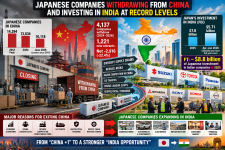
A record number of Japanese companies have closed their China businesses under the triple pressure of slowing momentum in the Chinese economy, US tariffs and a diplomatic freeze between Tokyo and Beijing.

As of June 2026, a total of 10,118 Japanese companies had an established presence in mainland China, according to Teikoku Databank, Japan’s largest corporate credit research firm.

That figure, published on Wednesday, was the lowest number since the group began compiling the statistic in 2010. It represented a 22 per cent fall from 2024 and a 30 per cent drop from a 2012 peak for Japanese corporate presence in China.

Teikoku Databank researchers said the drop “clearly indicates a shift in Japanese companies’ business in China from an expansion phase to a restructuring phase”.

They added that the “China withdrawal” was likely to continue as Japanese companies of all sizes reassess decades-long understandings about the risks of investing in Chinese manufacturing capacity and the strength of domestic competition for its consumer markets.

A major part of those restructuring efforts, companies told researchers, was aimed at diversifying supply chains to lower Japanese companies’ reliance on China while not completely decoupling from the country, according to the report.

Japanese businesses were looking to pivot to India, as well as destinations such as Vietnam, Thailand and other parts of south-east Asia, after years of intensive investment in China.

“We fed the dragon and it breathed fire,” he said of the increasingly competitive environment in China.

Corporate Japan has also been caught in the middle of a now year-long diplomatic spat that was triggered by Prime Minister Sanae Takaichi’s remarks in parliament regarding Japan’s hypothetical military involvement in a conflict over Taiwan.

Those comments sparked a furious response from China, which has restricted exports of critical minerals to Japanese companies.

Travel has also dried up, with the exception of a few small-scale business delegations. The most recent figures from the Japan National Tourist Organisation showed a 59 per cent year-on-year drop in mainland Chinese tourists visiting Japan in August.

In Guangzhou, a huge annual travel expo held ahead of China’s October 1 National Day featured no exhibits from Japanese companies.

Rising labour costs and worsening economic conditions in China, following the collapse of real estate prices and huge industrial overcapacity, were also driving the trend, Teikoku researchers said.

New Japanese investment into China has dwindled. Between 2024 and 2026, 1,221 Japanese companies entered China, either through local subsidiaries, factories or representative offices, according to the Teikoku report, the lowest number on record apart from during the Covid-19 pandemic.

They were offset by a record 4,137 Japanese companies that completely withdrew from China during that period.

US President Donald Trump’s on-again, off-again tariff war with China has also cast a heavy shadow, companies told the researchers. Teikoku found that around 60 per cent of Japanese manufacturers with production bases in China reported an impact on revenues from the US tariffs.

@Nimble @Vikramaditya1
@Sam6536
 
Good, the Japs can get out China and all go invest in their BFF India. Hopefully, many of theses companies will become bankrupted or fined by Indian gov soon. And China will stop supplying any rare earth minerals to these Jap companies. Good luck.
 
Good, the Japs can get out China and all go invest in their BFF India. Hopefully, many of theses companies will become bankrupted or fined by Indian gov soon. And China will stop supplying any rare earth minerals to these Jap companies. Good luck.
Just another indian propaganda channel. The same people who talked about india becoming superpower 2012 and 2020 lol.
 
Good, the Japs can get out China and all go invest in their BFF India. Hopefully, many of theses companies will become bankrupted or fined by Indian gov soon. And China will stop supplying any rare earth minerals to these Jap companies. Good luck.
The more you push at material supply restrictions the more you loose ground in that market. China used to supply 99% of ReM. Then they started having the American complex, wearing a suit and tie is not just it, they thought sanctioning countries will work and now tell me what percentage of ReM China supplies?
 
The more you push at material supply restrictions the more you loose ground in that market. China used to supply 99% of ReM. Then they started having the American complex, wearing a suit and tie is not just it, they thought sanctioning countries will work and now tell me what percentage of ReM China supplies?
You Indians don't come to China to beg for rare earth minerals and your PM Modi if didn't complain in recent BRICS summit about China has a stranglehold on the minerals supplies, then you people have my respect, otherwise just beggars. China today still has the complete control of rare earths supplies, lol. Ask your white masters Yanks and Japs, how their companies have been cut off from supplies and how they are affected if you people are not sleeping. Your country India will suffer the same fate if your country behaves like an a****** to China or continue to smuggle the minerals to your master American companies. So, making English your country's official national language will make you Indians accepted by US and the West as whites or equal, keep dreaming, have the gall always to mock Chinese dress in business attire, or you think Chinese should be like your PM Modi always wearing skirt to summits and meetings, what a joke.

BTW, what dress do Indian businessmen wear ? Look yourselves in the mirror first, lol.

Indian businessmen wear a standard Western-style dark suit and tie for formal corporate meetings, boardrooms, and international business settings. [1, 2]

Corporate and Formal Wear
    • Western Suit and Tie: Worn in conservative corporate environments, banking, multinational companies, and high-level formal meetings. Dark colors like navy, grey, or black are standard. [1, 2]
 
Good, the Japs can get out China and all go invest in their BFF India. Hopefully, many of theses companies will become bankrupted or fined by Indian gov soon. And China will stop supplying any rare earth minerals to these Jap companies. Good luck.
salty-salt.gif
 
  • Haha
Reactions: ety
Good riddance. These Japs are Indian cheerleaders.
 
  • Like
Reactions: ety
I dont think India is preferable from Japanese businesses perspective, particularly after US-Iran war

Middle East war has shown India vulnerability

-------------

The Indian government drastically cut and rationed commercial LPG and natural gas supplies to industries, diverting vital hydrocarbons exclusively to household cooking gas to mitigate domestic civil unrest.

Industrial and Manufacturing Impacts
  • Petrochemical Production: Refiners redirected propane, butane, and propylene streams toward domestic cooking gas instead of manufacturing. Major players like Reliance Industries scaled down aromatics output, while Bharat Petroleum halted certain chemical production lines at its Kochi plant.
  • Ceramics and Tiles: Energy-intensive regional manufacturing hubs—notably ceramic and tile clusters in Morbi, Gujarat—were forced to suspend or heavily curtail operations due to severe commercial fuel rationing.
  • Textiles: Textile and weaving operations in manufacturing centers like Surat and Tarapur slowed production significantly, resulting in multi-million-dollar daily losses and sudden layoffs.
  • Fertilizers and Feedstock: Natural gas feedstock costs for the fertilizer sector surged, squeezing operating margins and dramatically inflating the federal agricultural subsidy burden.

Mitigation and Policy Adjustments
  • Temporary Fuel Switching: The government permitted industrial and commercial operators temporary exemptions to switch back to alternate fuels like biomass, coal, and heavy oils where clean gas wasn't available.
  • Refinery Output Mandates: Federal mandates required state and private refiners to maximize daily local cooking gas output quotas, sacrificing industrial chemical yields in the process.
 
This is a purely economic issue, not a political one. The vast majority of Japanese companies operating in China have successfully navigated the sensitive political issues between the two nations; generally, their operations remain unaffected by such politics.

However,

Japanese enterprises in China are concentrated primarily in the home appliance, consumer electronics, and automotive sectors—areas that constitute their largest industrial clusters in the country.

Yet, as domestic Chinese industries in these sectors have risen, the market share of Japanese companies has steadily declined. Many Japanese brands in home appliances and consumer electronics have either been forced to exit the Chinese market or have been acquired by Chinese firms.

The same holds true for the automotive industry. During the era of internal combustion engine vehicles, Japanese automakers in China were largely insulated from political factors; even when intense political tensions caused brief disruptions, operations quickly returned to normal. However, the rapid ascent of China’s domestic electric vehicle (EV) industry has dealt a severe blow to all foreign automotive brands—Japanese ones included. Consequently, many foreign automakers have either scaled back their presence in China or entered into partnerships with Chinese companies to break into the EV market.

Many Japanese companies have suffered defeat in the Chinese commercial market and have been forced to withdraw. Nevertheless, certain proponents of political conspiracy theories and some Western media outlets have framed this phenomenon as a political issue.
 

Users who are viewing this thread

Latest Posts

Back
Top