
clutch
Elite Member


WASHINGTON (AP) — President Donald Trump said he has struck a deal to obtain diesel from Russia, a stunning reversal of years of U.S. pressure on Moscow over its war with Ukraine and an attempt to address high fuel prices ahead of the U.S. midterm elections.
Trump said on social media on Friday that he struck the deal with Russian President Vladimir Putin in a phone call in which he was expected to discuss a suspected case of plague in Russia. Instead, Trump announced that Russia will immediately supply more than 300,000 tons of diesel, followed by an additional 500,000 tons in November and 1 million tons “immediately thereafter.” Russia will deliver an additional 3 million tons “within a short period of time” after that, he wrote.
Trump’s shocking announcement was in stark contrast to a sweeping Russia sanctions law he signed last month that aimed at clamping down on the oil and gas revenues that fuel Russia’s war against Ukraine.
Ukrainian President Volodymyr Zelenskyy called it “a weak decision, unfortunately, a weak decision by strong partners,” according to a statement released by the Ukrainian Embassy in Washington.
Trump announced the deal as his envoy Steve Witkoff and son-in-law Jared Kushner were meeting with Ukrainian officials in Miami to discuss a proposal to end the Russia-Ukraine war.
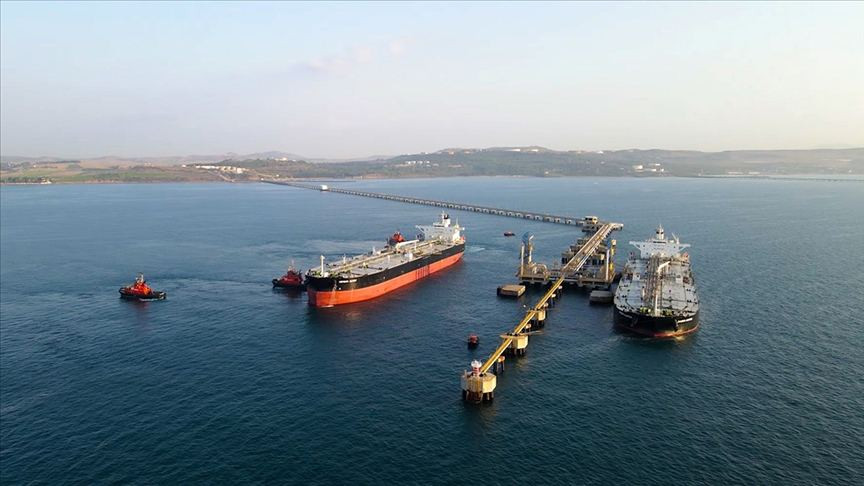
Inside The Secret Russian-Iranian Military-Energy-Pipeline Laundering Machine | OilPrice.com
Russia and Iran are reportedly preparing to exploit the Baku-Tbilisi-Ceyhan pipeline from 2027, potentially routing 600,000–750,000 bpd through the corridor to circumvent Western sanctions.
 oilprice.com
Inside The Secret Russian-Iranian Military-Energy-Pipeline Laundering Machine
By Simon Watkins - Oct 12, 2026, 10:00 AM CDT
Russian and Iranian crude is being blended into Kazakhstan’s CPC oil exports, allowing sanctioned barrels to reach Europe under Kazakh documentation.
Discounted Iranian oil is financing Russian military supplies to Tehran, including missiles and surveillance technology, through an alleged oil-for-arms arrangement.
Russia and Iran are reportedly preparing to exploit the Baku-Tbilisi-Ceyhan pipeline from 2027, potentially routing 600,000–750,000 bpd through the corridor to circumvent Western sanctions.
Ceyhan oil terminal
As has been proven time and time again in multiple scenarios: 'Where there's a will, there's a way around any sanctions' and, despite looming deadlines to end all Russian oil and gas imports -- with promises to keep reducing them before that -- the European Union (EU) appears to be continuing to play a sanctions-skirting game with Moscow. Under the strict terms of Regulation (EU) 2026/261, a hard legal cliff drops on 1 January 2027, completely banning all long-term Russian liquefied natural gas (LNG) imports, followed by a total phase-out of remaining piped gas and crude exemptions by the end of that same year. On paper, the West's regulatory chokehold on the Kremlin's war machine in Ukraine is reaching its absolute zenith. In reality, however, a massive, highly sophisticated infrastructure back door has been swung wide open for Russia and Iran to exploit, but which keeps European grids alive through a toxic, sanctions-busting military-energy swap between Moscow and Tehran.
In terms of Russian crude oil exports continuing to be transported specifically via pipeline to Europe -- which the EU has committed to completely phase out by 31 December 2027 -- the Caspian Pipeline Consortium (CPC) is the primary, active corridor through which the EU effectively evades its own sanctions framework, and that of the U.S., as managed by the Office of Foreign Assets Control (OFAC). While the EU has officially banned seaborne imports of Russian crude, the 'CPC Blend' crude oil stream -- which terminates at and ships from the Russian port of Novorossiysk -- was granted a specific legal exemption by Brussels on 3 June 2022. This carve-out was justified on the grounds that the underlying volumes originate in Kazakhstan. Since that date, annual throughput of this supposedly Kazakh-only crude oil has surged from 52 million metric tonnes -- around 1.04 million barrels per day (bpd) -- to a record-breaking 72 million metric tonnes: a massive 38.5% increase. However, over that period, Kazakhstan's actual domestic oil production has grown less than 2%, with its true crude oil output this year having fallen significantly due to operational disruptions and strict OPEC+ quota limits. According to a very senior EU source in its energy security complex exclusively spoken to by OilPrice.com last week, the huge discrepancy between the crude oil volume rise in the CPC over the period and Kazakhstan's own oil output volume over the period represents the active 'ghost volume' where a heavily discounted cocktail of Russian crude -- mixed with Iranian oil -- is being quietly blended and laundered straight to European destinations completely outside the G7-monitored Russian shadow fleet.
Source:
News
News


