Five reasons India's stock market is sinking even when its economy is growing

Ok. Say that mis-estimation happened. The follow-on impact of the mis-estimation has not been on GDP growth, credit ratings and foreign investments (and reserves). All three represent the strength of economy.

Stock market is not an indicator of an economy's strength (from a core metric/driver perspective). One can make "reasonable" guess what would happen to stock if say credit ratings go down - but still that is a "guess". This is esp. true for BSE and many Asian markets where a lot of "gambling" tendencies are seen in stock market. E.g., GoI banned certain types of stock market activties (in options market) because the retail investors were engaging in "gambling" type behavior.
I agree with your second paragraph. I never actually claimed otherwise.

But since you brought it up, a crashed stock market does generally reflect harm to one's qol. Wages will fall.

Similarly, increased wages (relative to inflation) should raise the stock value of whatever is listed overall.

Your first paragraph I explained already. Geopolitical concerns frequently excuse bad bookkeeping.
 
I agree with your second paragraph. I never actually claimed otherwise.

But since you brought it up, a crashed stock market does generally reflect harm to one's qol. Wages will fall.

Similarly, increased wages (relative to inflation) should raise the stock value of whatever is listed overall.

Your first paragraph I explained already. Geopolitical concerns frequently excuse bad bookkeeping.

Sure stock markets are a one, but small component which determine QoL especially in developing economies such as India where per capita is ~3K. I mean, how many companies are listed and how many people actually invest in stocks - a single digit % if that

Whether US, India, Pakistan or any other country - looking at stocks (ups and downs) as a sign of economy doing good or bad over say < 3-5 years is just folly... and frankly people on TV screens talking about stocks going up and down and giving verdicts are ambulance chasers - no better or worse than ex-cricketers / commentators signing praising after the last matches performance...

Real wage growth, real GDP growth, levels of inflation, interest rates, sovereign bond rating, FDI, CAD and forex reserves are some of the ones I would look at (as a combination to have a semblance of verdict on an economy)
 
Why is anyone "forced" to sell their nifty stocks? Bond markets are more attractive than Infian stocks for a reason. Nobody forces anyone to sell stocks and buy US bonds.
The "reason" being bond yields are at record highs.
 
Sadly, this is not proof of the absence of manipulation of Indian GDP data.
Neither is your claim. People like you seem to love reversing the burden of proof, as if it's our responsibility to prove that the GDP data was fake rather than the responsibility of those making such claims to substantiate them.
 
1 main reason - Much harder to fake the fundamentals of a publicly listed business venture than it is to fake national GDP.
For more than 99% of the general public, "GDP" is merely a topic of conversation—something far removed from our daily lives and personal interests.

But...

The stock market is closely tied to the personal interests of many people.

Therefore, the public can fully accept government data fabrication regarding GDP, but finds it absolutely unacceptable when it comes to stock market manipulation.
 
Neither is your claim. People like you seem to love reversing the burden of proof, as if it's our responsibility to prove that the GDP data was fake rather than the responsibility of those making such claims to substantiate them.
Why on earth would I want you to prove GDP data is fake? Such a course of action would lead you to demand reform and transparency from your government. I have merely pointed out the discrepancy. Please preserve it.
 
1 main reason - Much harder to fake the fundamentals of a publicly listed business venture than it is to fake national GDP.
Glad to see you write one sentence without the help of AI, but sad news for you is that companies are posting solid results 😉
 
Glad to see you write one sentence without the help of AI, but sad news for you is that companies are posting solid results 😉

Indian trolls used to join in with Pakistani and Bangladeshi trolls in accusing Hasina of GDP manipulation in Bangladesh.

So, I am enjoying seeing Indians being trolled.

But just as in Hasina’s case - India’s fundamentals are solid I.e. exports and reserves.

Just as low electricity consumption wasn’t proof that Bangladesh’s GDP was manipulated.

Stock market volatility isn’t proof that India’s GDP is manipulated.

Also, India has the largest private gold holdings in the world.

Pakistanis should focus on their own precarious economy rather than trolling their much stronger south Asian counterparts.
 
Everything in the article is correct except the implied premise that the divergence between the overall economy and India's benchmark index is an unusual situation.

The two major indices that have underperformed India's benchmark index this year are the Hang Seng ( which includes H-shares of mainland Chinese companies) and Indonesia's IDX, and both those economies are doing fine. Even the counterexample in the article proves the point. South Korea is only growing at around 3%, yet Kospi is the best performing index.

And yes, rising Treasury yields are "forcing " asset reallocation, because those who borrowed in dollars to invest in "hot" markets like China ( via Hang Seng H-shares ), Indonesia and India are being stopped out.

Also, it is notable that the Shanghai Composite and Nifty Small Cap indices, which include smaller Chinese and Indian companies compared to Hang Seng and Nifty 50, are outperforming the benchmarks. If the move were more about fundamentals than positioning, you would expect blue chips to outperform, since blue chips generally attract more foreign hot money.
 
Everything in the article is correct except the implied premise that the divergence between the overall economy and India's benchmark index is an unusual situation.

The two major indices that have underperformed India's benchmark index this year are the Hang Seng ( which includes H-shares of mainland Chinese companies) and Indonesia's IDX, and both those economies are doing fine. Even the counterexample in the article proves the point. South Korea is only growing at around 3%, yet Kospi is the best performing index.

And yes, rising Treasury yields are "forcing " asset reallocation, because those who borrowed in dollars to invest in "hot" markets like China ( via Hang Seng H-shares ), Indonesia and India are being stopped out.

Also, it is notable that the Shanghai Composite and Nifty Small Cap indices, which include smaller Chinese and Indian companies compared to Hang Seng and Nifty 50, are outperforming the benchmarks. If the move were more about fundamentals than positioning, you would expect blue chips to outperform, since blue chips generally attract more foreign hot money.


can you define, hot money/hot deposits, in a single line, without looking into GPT!

just want to know!
 
For me the defining characteristics are the speed at which it moves around and the short time horizon of the institutions deploying it.


at low correlation levels when there is higher VIX (uncertainty!)


these dualities of hot money deposits, have modelled here!
this explains in detail, dry water (one is incapable of distinguishing water here!) destroys sodium metal (itself a liquid metal!)


at low correlation levels when there is higher VIX (uncertainty!)


these dualities of hot money deposits, have modelled here!
this explains in detail, dry water (one is incapable of distinguishing water here!) destroys sodium metal (itself a liquid metal!)


Fair points , though if one were to be really pedantic, I suppose you mean close to 0 correlation, since a correlation of -1 is technically the lowest possible, but will be as or even more disastrous for these strategies than +1 , and for VIX ( which is a blended market implied volatility )you probably mean realized volatility, which is what realized Sharpe Ratio depends on ( haven't looked at the video yet).
 
Fair points , though if one were to be really pedantic, I suppose you mean close to 0 correlation, since a correlation of -1 is technically the lowest possible, but will be as or even more disastrous for these strategies than +1 , and for VIX ( which is a blended market implied volatility )you probably mean realized volatility, which is what realized Sharpe Ratio depends on ( haven't looked at the video yet).


Post GFC, senior tranches suffered loss even at lower correlation levels.

this was because of the very fact, that repo deposits (hot money deposits) were moving through off the books CDO SPVs.


this is characterized in many post GFC (nature of hot money deposits!) studies!
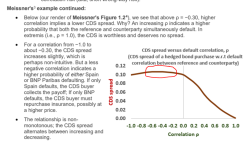
as seen below, correlation levels cooling down (highlighted in red circle!) when CDS spreads were rising (which does not make sense initially!)

1791888136278.png
 

Users who are viewing this thread

Pakistan Defence Latest

Back
Top