Any knowledgeable person can tell the difference bw dual thrust and dual pulse motors?
In the fields of launch vehicles and missiles, it is very common—due to a variety of factors—to employ multiple engines, whether of the same or different types, arranged in a series configuration.
For instance:
Launch vehicles often utilize a series of different rocket engines to accommodate the varying conditions encountered throughout their flight into space.
Missiles frequently employ multi-stage engine configurations to meet specific tactical requirements.
A key feature of these systems is the use of explosive bolts for structural connection. Once a given stage has completed its operation, the explosive bolts are detonated, allowing that stage—along with its propulsion system—to detach from the main body of the vehicle.
===============================================
In the realm of military missiles, liquid-propellant rocket engines are less than ideal because the fueling process is time-consuming—a drawback that runs counter to the requirement for rapid response. Consequently, solid-propellant rocket engines are preferred for military missiles. (It should be noted that some intercontinental ballistic missiles—ICBMs—still utilize liquid-propellant engines.)
However, solid-fuel rocket engines have one critical limitation: once they begin operating, they cannot be controlled or interrupted; they must continue running until all their fuel has been completely consumed. This represents the most significant, fundamental difference between them and liquid-fuel rocket engines, which can be shut down and reignited at any time.
Clearly, ingenious humans have devised methods to address this challenge.
They designed a component—a partition—placed between two segments of solid rocket fuel. A key feature of this component is its ability to withstand extreme heat and pressure while the first segment of fuel burns, ensuring that the second segment remains unignited.
Once the first segment has finished burning, the missile continues its flight via inertia. Upon reaching the intended position, the system triggers the ignition of the second segment of solid fuel. The entire device partition will be instantly destroyed, turning into dust, which will be ejected from the engine body along with the fuel. ------ The central dividing device is the biggest technical challenge.
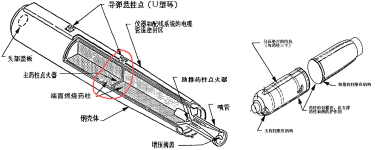
This is a dual-pulse solid rocket motor. It is, in fact, a single motor—not two motors connected in series—in which the solid propellant is consumed in two separate, controlled ignition-and-combustion phases. (There are now even triple-pulse solid rocket motors.)
BTW,
This is not a technology pioneered by the Chinese. In fact, the United States possessed this technology long ago. The crux of the issue is that the Americans have been unable to miniaturize it sufficiently for use in beyond-visual-range (BVR) air-to-air missiles (AAMs). This is the primary reason why their BVR AAMs lag behind China’s.