🏆 'Almost magic': SpaceX's Starship 🚀 Flight 15 makes history, catching upper stage from orbit [first 100% reusable spacecraft]

Hamartia Antidote

Elite Member
Joined
Nov 17, 2013
Messages
48,395
Reaction score
27,573
Reputation
440.7
Country of Origin
Country of Residence

'Almost magic': SpaceX's Starship Flight 15 makes history, catching upper stage from orbit​


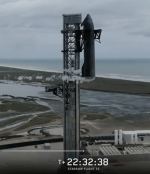
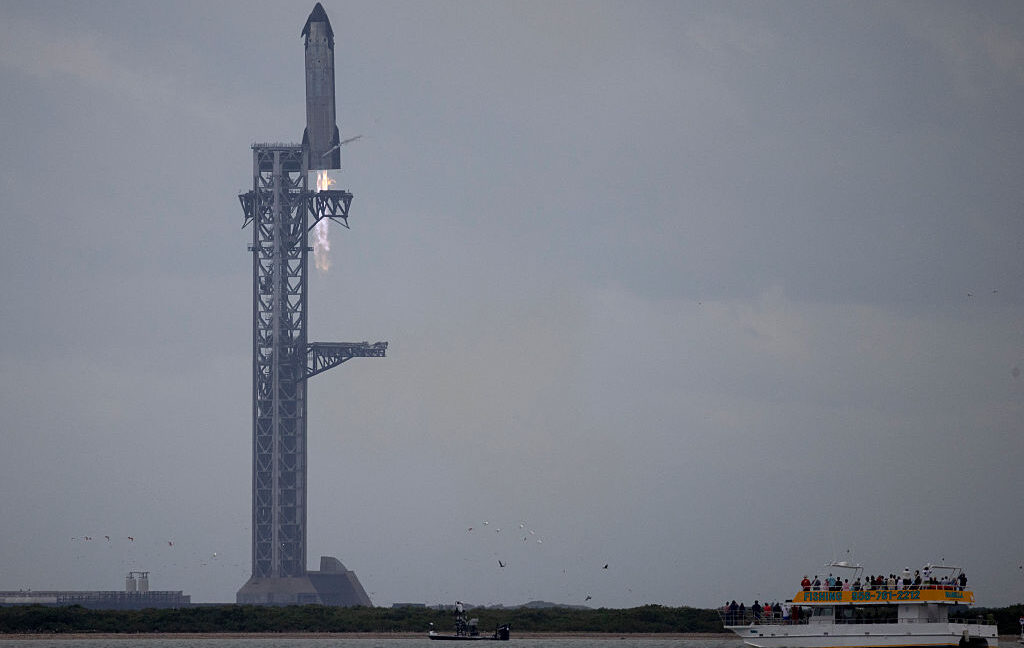
Starship2ndstage.png
Starship "upper" stage caught in 2026

STARBASE, Texas —
SpaceX on Friday launched the 15th flight test of its Starship rocket from Starbase in Texas and, on Saturday, successfully caught the upper stage of the launch vehicle.

Starship rockets are designed with sections that can be reused after being caught with large "chopsticks" back on Earth. Friday's flight test sought to recover both the upper stage and booster from the launch vehicle, yet the booster ultimately landed in the ocean instead of returning to Starbase.

The upper stage went on to orbit the Earth 14 times before returning after about 22 hours for what would become a history-making, successful maneuver.

The mission marked the second time Starship's upper stage has made it to orbit, and the first time SpaceX has caught it.

Starship late Friday otherwise delivered 26 Starlink V3 satellites to orbit to expand the network's capacity and user speeds, SpaceX said.

In a statement, NASA Administrator Jared Isaacman congratulated SpaceX and its CEO, Elon Musk, on a mission that "was almost magic."

When is Starship coming to Florida?​

While test flights of SpaceX's Starship continue in Texas, construction is well underway at Kennedy Space Center to house the mega rocket.

Each test flight marks a step toward future missions to the moon and Mars.

Engineers are currently focused on refining Starship's launch reliability, improving its heat shield, and perfecting booster recovery. SpaceX is also continuing construction of its massive Gigabay at Kennedy Space Center, where the rocket will eventually move to support NASA's Artemis missions.

Isaacman shared his enthusiasm for space exploration.

"What has me excited about space exploration and NASA goes to the heart of it," he said. "We're pursuing the secrets of the universe. I can't imagine a more exciting endeavor."

He also explained how SpaceX and competitor Blue Origin's focus on reusability will help reduce the cost of space travel, which will be key to supporting regular missions.

Before Starship can achieve its ambitious goals, it must prove it can fly safely, reliably, and repeatedly.

SpaceX has acknowledged that several test flights have ended in anomalies or explosions, which it says are a normal and necessary part of the rocket's development process.

For now, in Texas and eventually in Florida, the future of space travel continues to unfold one launch at a time.
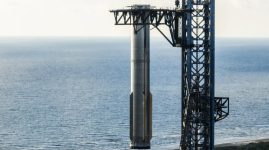


Starship1stStage.png
Starship "lower" stage caught in 2024
 
Last edited:
Mod Notice: advance request please avoid trolling or posting off-topic posts in this thread.

Just take a moment to marvel at this achievement - what was once the realm of science fiction is slowly becoming reality.

In the words of commander Spock - "fascinating" 🖖
 
But the booster exploded.


No, it was off shore diverted because it was slightly low on fuel. It probably would have been caught anyway. The explosion was the FTS being activated. SpaceX has already caught the booster 3 times.

Starship catch was the holy grail. SpaceX essentially unlocked space travel at commercial airliner scale.
 
Focus on the positives, musk already explained the reasons behind that

People aren’t ready for the scale. SpaceX already built a tower at KSC. Louisiana Starbase buildout. SpaceX is setup to mass manufacture today. They could easily be at hundreds of flights a year in 5 years. They’re already on track to launch weekly next year.
 

With Starship catch, SpaceX still shows it can dazzle the world​


STARBASE, Texas—The black and silver ship fell out of the sky, emerging from the cloud deck near the very end of its flight. Incongruously, the rocket flew horizontal until the last moment when three Raptor rocket engines ignited and it swooped into a vertical position.

Slowly, gently, haltingly, the Starship upper stage eased its way toward the waiting tower where two arms extended outward, awaiting expectantly. The margins are so incredibly narrow. Two nubs on either side of the rocket, each protruding only about one foot, were the only purchase the rocket would have on the arms.

Then, less than a minute after it came into view, the Starship upper stage was snagged by the launch tower, as snug as you like. And so it was all over. SpaceX, nearly a quarter of a century after its founding, had just taken a hugely significant step toward developing and optimizing a massive, rapidly reusable rocket.

We are dazzled​

This was a breathtaking feat; a brilliant technical achievement that required the best engineering minds to think through a million different, difficult problems. And on Saturday evening, following a handful of practice runs into the Indian Ocean, they did it before the entire world.

Watching Starship launch from here a little less than a day earlier, and knowing it had orbited the planet multiple times, added to the sense of unreality in seeing this spaceship return to Earth under its own power, and be captured by the tower.

It felt like stepping into the future. SpaceX has dazzled us before, by landing rockets on barges and returning humans to space with Crew Dragon. But this flight took things to another level. Starships are huge. They carry a huge amount of energy coming back from orbit. And until a few years ago, it seemed beyond fantastical to think about capturing a rocket with what are essentially outsized chopsticks.

Nevertheless, it happened.

Rapid reuse is firmly on the horizon​

Humans have built reusable spacecraft that flew into orbit before. In the 1970s, flush with confidence after the triumphant Moon landings, NASA designed and built several Space Shuttles. They had solid rocket boosters that were fished from the ocean and reused. The large orange external tank was not recovered after each flight, but the orbiters went to space for two weeks, or even longer, before returning to Earth and landing on a runway.
The shuttles were engineering marvels. But during the return to Earth they acted as gliders, not igniting their engines. And their heat shields were delicate flowers, requiring painstaking refurbishment after each flight. At the outset of the shuttle program, the space agency contemplated sending dozens of humans into space at a time, and carrying cargo at a cost as low of $25 per pound.

Reality never matched these rosy projections. The crew space capped out at seven astronauts, and the cost-per-pound was closer to $25,000. Each orbiter cost an extraordinary amount of money to build; NASA only ever built five that went to space.

SpaceX has five Starships in an advanced state of development at Starbase today; and its factory houses the components for a dozen more. The company can currently manufacture a Starship upper stage in its South Texas Starfactory every three weeks. The factory was sized to produce a ship every three days. When SpaceX founder Elon Musk discussed these build targets in an interview five years ago, he sounded mad. But he no longer does.

A proof of concept​

The Space Shuttle was nearly a fully reusable space launch system, but it fell far short of low-cost, rapid launch. Over 30 years the vehicle made 135 flights. Within a few years SpaceX aims to fly 135 times a year, then thousands of times.

Such was the significance of Saturday. SpaceX aspires to fundamentally change the relationship between humanity and the heavens. The first step is to get the entire rocket back. SpaceX has now returned both elements of a Starship rocket safely to its launch tower. It will take time to reach a high rate of success with such landings, but Saturday’s safe return offered a proof of concept.

The landings will come with increasing frequency; and so will the launches. Over time SpaceX will perfect the heat shield that is likely to be the most difficult aspect of rapid reuse. And eventually, as difficult as it may be to believe, what we experienced with amazement this weekend will become routine. One day, we will take this all for granted.

But not today.

 
Just another big milestone in human history achieved by engineers/scientists/innovators in the US like electricity, lightbulb, telephone, air conditioning/refrigeration, plastic, nuclear fission, transistor, microchip, polio vaccine, computers, internet, GPS, quantum computers, AI,...


SpaceX Makes Major Breakthrough, Catches Starship Rocket​


‘Holy Grail of spaceflight’: SpaceX pulls off first-ever midair 'catch' of Starship returning from orbit​


'Now everything changes': SpaceX catches Starship upper stage for 1st time ever​


rowlaunchers.jpeg
SpaceX has announced plans to build a massive rocket base on the Gulf Coast of Louisiana: Starbase Louisiana.

Elon Musk Says SPCX Could Reach 10,000 Starship Launches Annually by 2030: ‘Still Tiny’ Compared With Air Travel​


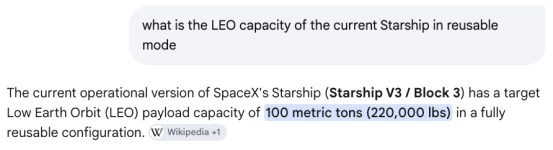
LEOCapacity.png
 
Last edited:
They want to aim for a launch cadence of 100 a day by 2030. Imagine the implications of that?

Moon will become accessable for commerce/military. Cost of sending anything into space will plummet.
Colonies on the moon and mining for resources.

Eventually he wants to aim for Mars too. This was a small but important step towards that. Not only have humans never sent anything as large as starship into space before, but to have it return and reused is INSANE.

I bought Spacex shares at $112 , they are hovering at around $136 now and markets open tomorrow. As i have said before, if you can afford it, buy SpaceX now. Morgan Stanley have. $300 target for 2027 on these and Bank of America $275 for 2027.

My guess is stock will be north of $500 in 2 years and by 2030 (if revenues hit $1 Trillion) you are looking at a $12 trillion marcap and stock price of around $800
 
SpaceX just unlocked interplanetary travel at economically feasible cost. This is one of the greatest engineering feats in human history.
Great. Lets send all the politicians on a one way ticket to Mars. They can play their games there.
 
They want to aim for a launch cadence of 100 a day by 2030. Imagine the implications of that?

Moon will become accessable for commerce/military. Cost of sending anything into space will plummet.
Colonies on the moon and mining for resources.

Eventually he wants to aim for Mars too. This was a small but important step towards that.


While this is a terrific engineering feat, let us not get carried away.

Humans haven't even conquered or colonized Antarctica yet. And comparatively, Antarctica is a heavenly paradise as opposed to the moon or Mars.

Building a self sustaining colony on the moon or mars will remain a pipe dream, when we cannot even do so in Antarctica.

This post is as stupid as it is ignorant. Exploring Antartica is well within our capabilities, it's just not economically feasible to do so yet, no money in it.

A self sustaining colony on the moon is far off but we just got closer to realising it.
 

Users who are viewing this thread

Latest Posts

Back
Top