PAF J-35AE - News, Updates and Discussions

Chinese State Media Points to Major Upgrades for New J-35 Stealth Fighters

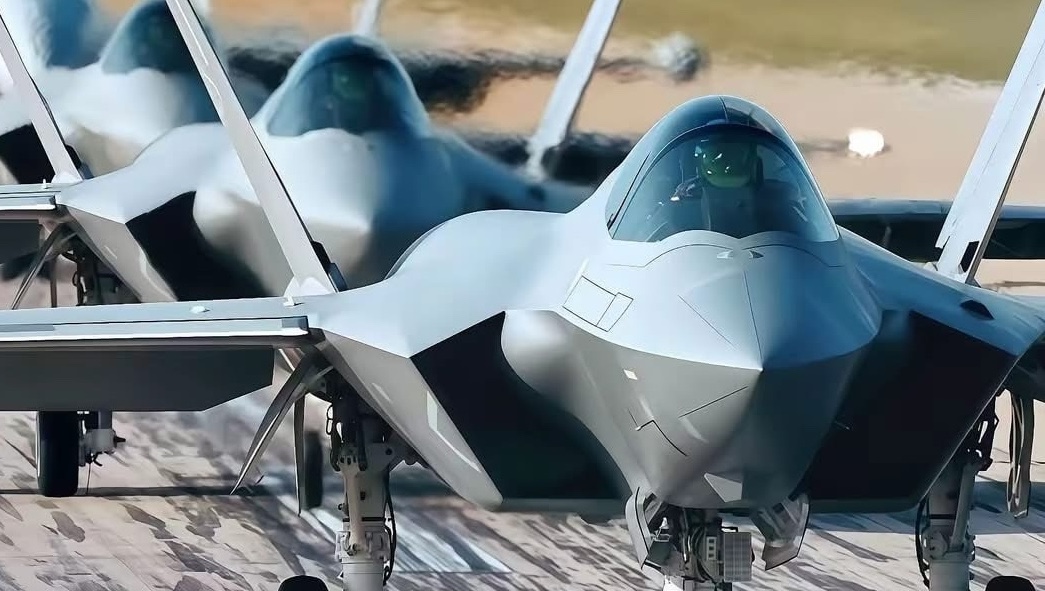
China’s J-35A fifth generation fighter is poised receive a series of upgrades centred on a more powerful domestic engine, improved sensors and expanded weapons capacity, according state media reports citing local analysts. The proposed improvements would help establish the J-35A as a more capable and widely fielded complement to the heavier J-20, while strengthening the People’s Liberation Army Air Force’s ability to conduct networked operations involving stealth aircraft, conventional fighters and unmanned platforms. Developed by the Shenyang Aircraft Corporation, the single-seat, twin-engine aircraft is intended to provide a medium-weight stealth platform capable of both air-superiority and strike missions.

The J-35A made its public debut in November 2024 and is China’s second fighter of its generation to enter service. Separate export, Air Force, and Navy variants have been unveiled, with the latter two confirmed in 2025 to have entered service. The most significant anticipated upgrade is the integration of a superior version of the domestically developed WS-19 turbofan engine, which could provide greater thrust and improve the aircraft’s acceleration, climb performance and ability to sustain high-speed flight. It could also offer greater flexibility in carrying weapons and fuel, although the precise performance improvements and timetable for integration have not been disclosed. It has been speculated that the WS-19 could eventually also power future variants of the JF-17 lightweight export fighter in single engine configuration.

China’s fighter engine industry established itself as a global leader with the development of the WS-15 to power the J-20A fighter, which is one of the most sophisticated fighter engines in production anywhere in the world. Its reported weight to thrust ratio is rivalled only by the F135 powering the F-35 fifth generation fighter among known engine types. A similarly efficient design for the WS-19, which is a smaller less powerful engine, would be a major contributor to the J-35’s range and combat potential. Improvements to avionics and sensor integration were reported by state media to be another priority, and could improve the detection and tracking of low-observable aircraft, while reducing the workload imposed on pilots operating in increasingly complex battlespaces. These improvements could be particularly important as stealth aircraft become more widespread and conventional radar-based detection becomes less reliable.

Weapons integration is another area identified for improvement. The J-35A has an internal weapons bay intended to accommodate air-to-air missiles while preserving its low-observable configuration. An enlarged or redesigned internal bay could permit the carriage of additional weapons or a wider range of munitions without requiring external pylons. Further possibilities include a two-seat variant and a dedicated electronic warfare version, with local analysts having assessed that a two-seat configuration could serve as a command platform for coordinating unmanned wingmen, allowing one crew member to concentrate on managing the wider combat network while the other pilots the aircraft. It nevertheless remains uncertain to what extent the Air Force or Navy intent to invest in the J-35 program, as the more capable J-20 in the former service, and the expected service entry of more advanced sixth generation fighters in both services in the early 2030s, could overshadow the lighter of the two currently operational stealth fighters.


Of course the wait is worth it. Especially when such major upgrades are on their way.
Then we should wait for better version with dual seat version too to control loyal wingman drone
 
Chinese State Media Points to Major Upgrades for New J-35 Stealth Fighters

China’s J-35A fifth generation fighter is poised receive a series of upgrades centred on a more powerful domestic engine, improved sensors and expanded weapons capacity, according state media reports citing local analysts. The proposed improvements would help establish the J-35A as a more capable and widely fielded complement to the heavier J-20, while strengthening the People’s Liberation Army Air Force’s ability to conduct networked operations involving stealth aircraft, conventional fighters and unmanned platforms. Developed by the Shenyang Aircraft Corporation, the single-seat, twin-engine aircraft is intended to provide a medium-weight stealth platform capable of both air-superiority and strike missions.

The J-35A made its public debut in November 2024 and is China’s second fighter of its generation to enter service. Separate export, Air Force, and Navy variants have been unveiled, with the latter two confirmed in 2025 to have entered service. The most significant anticipated upgrade is the integration of a superior version of the domestically developed WS-19 turbofan engine, which could provide greater thrust and improve the aircraft’s acceleration, climb performance and ability to sustain high-speed flight. It could also offer greater flexibility in carrying weapons and fuel, although the precise performance improvements and timetable for integration have not been disclosed. It has been speculated that the WS-19 could eventually also power future variants of the JF-17 lightweight export fighter in single engine configuration.

China’s fighter engine industry established itself as a global leader with the development of the WS-15 to power the J-20A fighter, which is one of the most sophisticated fighter engines in production anywhere in the world. Its reported weight to thrust ratio is rivalled only by the F135 powering the F-35 fifth generation fighter among known engine types. A similarly efficient design for the WS-19, which is a smaller less powerful engine, would be a major contributor to the J-35’s range and combat potential. Improvements to avionics and sensor integration were reported by state media to be another priority, and could improve the detection and tracking of low-observable aircraft, while reducing the workload imposed on pilots operating in increasingly complex battlespaces. These improvements could be particularly important as stealth aircraft become more widespread and conventional radar-based detection becomes less reliable.

Weapons integration is another area identified for improvement. The J-35A has an internal weapons bay intended to accommodate air-to-air missiles while preserving its low-observable configuration. An enlarged or redesigned internal bay could permit the carriage of additional weapons or a wider range of munitions without requiring external pylons. Further possibilities include a two-seat variant and a dedicated electronic warfare version, with local analysts having assessed that a two-seat configuration could serve as a command platform for coordinating unmanned wingmen, allowing one crew member to concentrate on managing the wider combat network while the other pilots the aircraft. It nevertheless remains uncertain to what extent the Air Force or Navy intent to invest in the J-35 program, as the more capable J-20 in the former service, and the expected service entry of more advanced sixth generation fighters in both services in the early 2030s, could overshadow the lighter of the two currently operational stealth fighters.


Of course the wait is worth it. Especially when such major upgrades are on their way.
Allow me to offer some interpretation regarding this matter.

While it is true that the Chinese state media outlet CCTV reported on this, the manner in which it was presented raises significant questions. There is a major misconception here: although CCTV is a state-run media outlet, it remains, at its core, a media organization—it has no authority to speak on behalf of the actual official entities, such as AVIC or SAC.

When reporting on such topics, CCTV typically employs a few distinct approaches:

1. Direct interviews with representatives from official institutions, featuring their own words—this represents an authentic, primary perspective and carries a very high degree of reliability.

2. Official press releases or voice-overs provided by news anchors—this also constitutes an authoritative, primary official perspective.

3. Interviews with—or commentary provided by—guest experts—the reliability of such input is no different from that of statements found on platforms like Twitter or Weibo; the audience must exercise their own judgment regarding its credibility.

The news report you mentioned falls into this third category: it consists of analysis and opinions offered by military experts or commentators invited by CCTV. It does not represent the official stance of AVIC or SAC.

It is worth noting that, among the military experts and commentators invited by CCTV, there are some whose statements should be interpreted in the exact opposite way. Experienced Chinese military enthusiasts are well-versed in discerning the true nature of such commentary, but foreign media often struggle to make accurate distinctions. This is not to say that these experts lack military knowledge; rather, this is a deliberate approach. While their identities as experts are genuine, their statements should be viewed with skepticism.

It remains to be seen. From Pakistan's perspective, even if only a fraction of the reporting is accurate, delaying until a more refined and mature product is available is the most sensible approach.
 

Users who are viewing this thread

Pakistan Defence Latest

Back
Top