Sami_1
Registered Member

Setting Sail in the Eastern Mediterranean: A Comparative Analysis of Egyptian MEKO-200EN and Turkish İstif Class Frigates
Date: Issue 127 - December 2023 Update: April 11, 2024
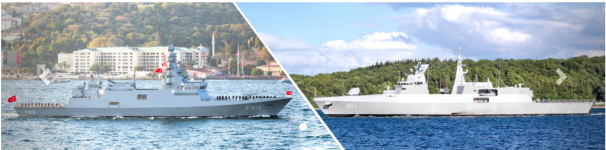
In the ever-changing dynamics of the Eastern Mediterranean, two prominent naval forces, Egypt and Türkiye, are concurrently enhancing their maritime capabilities through the acquisition of new frigates. However, the paths they have chosen to procure these vessels reflect distinct approaches, embodying strategic choices that extend beyond the naval domain. This article delves into a comparative analysis of the Egyptian MEKO-200EN class frigate procurement project and the Turkish Istif class frigate procurement project, examining the divergent strategies employed by these nations.
The first indigenous frigate constructed in Türkiye, TCG Istanbul is not commissioned yet, however she was the lead ship of 100 plus ship strong naval parade held on 29 October 2023 to commemorate the 100th anniversary of the Turkish Republic. The Contract for the construction of the TCG Istanbul (F-515) Frigate, the lead ship of the MILGEM ISTIF-Class Frigate Project, was signed between the Defense Industry Agency (SSB) and the Main Contractor STM on April 12, 2019 and the contract into the effect on September 27, 2019.
TCG Istanbul will make the Turkish frigate force younger. The keel of the second frigate was laid on 15 November 2023 at Anadolu Shipyard. Türkiye has bought second-hand frigates from the USA and bought MEKO 200 class frigates from Germany. Half of them were constructed in Türkiye with German material help. All the know-how and expertise gained in these projects later showed themselves in the Ada class corvette and Istif class frigate projects. In the last decade the Turkish Naval Forces only commissioned major warships constructed in Turkish shipyards. With the exception of TCG Anadolu, all of them were designed in Türkiye too.
Another nation investing in their frigates is Egypt. The Egyptian naval forces are adding MEKO A-200En class frigates to their existing eclectic mix of frigates including one Fremm class, 2 Bergamini class with two option, four Perry class, two Jianghu, two Descubierta and 2 Knox class frigates. France, Italy, Spain, China and the USA have all supplied frigate sized warships to Egypt. Now Germany has joined the suppliers.
The agreement between TKMS and Egypt was signed in September 2018 for up to four MEKO A-200 frigates.
Under the terms of the contract, the first three units are being built in Germany, while construction of the fourth vessel is taking place at Alexandria Shipyard in Egypt. The contract also covers crew training.
Construction activities for the first ships started in late 2019, and Al-Aziz and second-in-class Al Qahhar were laid down in 2020 and launched in August 2021. Third-in-class Al Qadeer was laid down in 2021 and launched in April 2022.
Let us compare the two frigate procurement programs and the features of these warships.
ENS AL-AZIZ
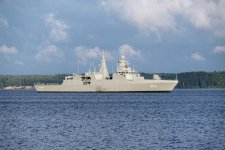
The first ship of the class Al-Aziz was officially handed over to the Egyptian Navy in Germany in October 2022. The second ship Al-Qahhar followed on May 2023.
These frigates have a full load displacement of 3,700 tons, a length of 121 m, a beam of 16.4 m, a top speed of 28 kt, and a standard range of 7,700 n miles at 15 kt, and carry a crew complement of 110.
Their main machinery consists of one LM-2500 gas turbine, two MTU 16V 1163 TB93 diesels in CODAG configuration. The ships have two CP propellers and one waterjet in the central line.
The main offensive weapon on board of the MEKO A-200EN class frigates is the Exocet MM40 Block 3 anti-ship missiles. Each frigate will be able to carry up to 16 missiles on board.
The Exocet MM40 Block 3 is the latest generation shipborne variant within the Exocet family anti-ship missile capability, providing very long-range capability up to 200 kilometres at a very low altitude against all classes of warship, even in adverse weather conditions:
The missile has a high hit probability even against moving targets and outstanding penetration capability against enemy air defenses.
According to MBDA, the new navigation and propulsion package on Exocet MM40 Block 3 allows for the programming of 3D waypoints, optimized trajectories and simultaneous terminal attacks of multiple missiles.
The only other warship using the same missile in the Egyptian Navy is the Fremm class frigate
ENS Tahya Misr, giving these warships a common weapon.
For defense against airborne threats the ship is equipped with the MICA NG missile, which is, by MBDA, the only missile in the world equipped with two, interoperable, state-of-the-art seekers, providing superior features to counter all types of threat (cruise missiles, UAVs, aircraft, helicopters, PGMs, smart bombs, etc). The MICA NG missile has an active RF AESA seeker providing all weather shoot-up/shoot-down capability and a passive Imaging IR seeker with dual-band IR matrix for anti-flare maximum capability.
The missile is stored and vertically launched from its individual storage container, thus eliminating the need for a special vertical launcher system, providing 360° engagement coverage.
The main gun of the A-200EN class frigates is one Leonardo 127/64LW gun. Additionally, for close in defense there are two Nexter Narwhal RCWSs.
The main air and surface search radar of Al-Aziz class frigates are the NS110 radars from Thales. This is a member of the E/F-band AESA radar family. Thales is the first company to introduce a family of E/F-band AESA radars based upon the dual axis multi-beam processing, significantly increasing situational awareness to deal with newest threats in the littoral environment. According to Thales the dual axis multi-beam enables simultaneous detection of a high variety of targets in a single operational mode. Detection beams are simultaneously positioned in elevation as well as in azimuth direction. Besides providing unrivalled air and surface surveillance performance, NS110 also includes multi-function capabilities. By adding forward and backward scanning, excellent situational awareness is combined with fast-track initiation and high-quality weapon support for high priority targets.
The radar has a 280 km maximum instrumented range and 80 km for surface targets. It can track more than 1,000 air and surface tracks. The radar has 4D air surveillance and 3D surface surveillance modes as well as weapon support for active missiles and surface gun fire support.
For fire control the Al-Aziz class frigates have Thales STIR 1.2 EO Mk2 radars on board. This is the latest system for gun and missile fire control in the successful family of Thales Track radars. The superior stealth target tracking capabilities ensure optimal performance in demanding littoral environments. Dual band radar and a full EO suite provide excellent ECCM performance. High reliability and graceful degradation are achieved by the application of new technologies including solid state transmitters.
For non-radio detection the Al-Aziz class frigates have the Mirador Mk2 electro-optical observation and tracking system on board. It provides target tracking data of highly manoeuvring air and surface targets for precise fire control of weapon systems. The system has an IR camera, an HDTV zoom camera, an optional low-light near infrared camera, and an eye-safe laser range finder. The Mirador Mk2 can provide very accurate data for small and medium caliber guns and short-range missile systems’ fire control. The system is also capable of automatic target acquisition without operator intervention during autonomous sector scan or following an external target designation.
The Al-Aziz class frigates have Altesse CESM (communications electronic support measures) and COMINT (communications intelligence) solution from Thales. Altesse provides the bearing of radio transmitters and allows standoff ranges beyond other radar or EO/IR sensors according to the company. This is a passive sensor with a greater detection range than other sensors, making it a key asset for asymmetric threat detection and positioning in all
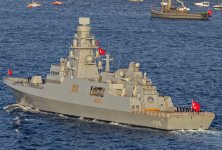
TCG ISTANBUL
These frigates have a full load displacement of 3,100 tons, a length of 113.2m, a beam of 14.4m, a draft 4.05m, a top speed of 29 kt, and a standard range of 6,000 n miles at 12 kt, and carry a crew complement of 125.
The main machinery of TCG Istanbul consists of one LM-2500 gas turbine, two MTU 4000 Series MTU 20V4000M93L diesels in CODAG configuration. The ships have two CP propellers. The following ships will have MAN Spain diesels as engines.
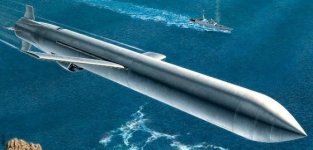
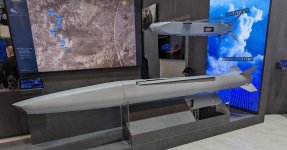
The main offensive weapons on board TCG Istanbul will be 16 Atmaca anti-ship missiles. ATMACA can be utilized in all weather conditions, and it is resistant to countermeasures with target update, re-attack and mission abort capabilities. In addition, thanks to the advanced mission planning system (3D routing), it can be effective against fixed and moving targets. Equipped with a Global Positioning System (GPS), an Inertial Measurement Unit, Barometric Altimeter and Radar Altimeter subsystems, ATMACA uses its active radar seeker to find its target with high accuracy.
With a range of over 220 km, ATMACA has an advanced and modern data link for its target update, re-attack and mission abort capabilities. The system offers the most efficient mission profile and provides operation modes of timing, firing and hitting the target.
For defense against airborne threats these frigates will be armed with Hisar-D and ESSM surface to air missiles. These missiles will be stored and launched from the National Vertical Launching System (MIDLAS).
When the project for the construction had started, it was envisaged to use the 16-cell Mk-41 VLS that was on the TCG Istanbul Frigate, and the SSB had assigned Roketsan to procure the Mk-41 VLS from the United States. On February 14, 2018, a contract was signed between the SSB and ROKETSAN for the procurement of 4 Vertical Launching Systems (VLS). However, after the acquisition of the S-400 Triumph Air Defense Missile System, the US Government imposed CAATSA sanctions on Türkiye, resulting in the non-fulfilment of the Mk-41 VLS procurement.
As a result, the decision was made to use MIDLAS, developed by Roketsan, on the ships. The 16-cell National Vertical Launching System (MIDLAS) was announced to allow the simultaneous use of both Hisar-D RF Block-II surface to air and ESSM (Evolved SeaSparrow Missile) B1 and B2 missiles. According to the Turkish Navy's planning, MIDLAS can accommodate a total of 64 (16x4) ESSM Block 2 missiles or 16 Hisar missiles or a combination of ESSM Block 2 missiles in quad-pack configuration and HISAR missiles. As MIDLAS is a national launcher, the integration of ESSM requires an umbilical port (a connection system between the launcher and the missile). Roketsan had previously initiated efforts to develop an umbilical port-like system for ESSM integration with MIDLAS.
With a diameter of less than 250 mm and the quad-pack capability afforded by its folding fins and control surfaces, each MIDLAS cell can accommodate four HISAR-D RF Block-II G/Ms. Consequently, a total of 64 Hisar-D RF Block-II G/Ms can be housed in 16 MIDLAS cells, assuming there are no weight or budget constraints. The first test firing of the Hisar-D RF Block-II was conducted in December 2022.
The main gun of TCG Istanbul is the Leonardo 76mm. The following ships will be fitted with the 76mm naval gun developed by MKE. For asymmetrical threats or for close in protection there is one Gökdeniz turret on the top of the hangar and two Aselsan 25mm Stop remote controlled weapon stations.
The main search radar on board TCG Istanbul is the CENK-S, which features a rotating antenna and employs two-axis AESA technology. The radar is currently undergoing Sea Acceptance Tests (SAT) and is expected to be delivered to the TNFC on the TCG Istanbul Frigate at the end of 2023. The S-Band CENK-S 3D AESA Search Radar, which previously featured liquid-cooling, weighs 1,700 kg and is said to include 4,000 GaN-based T/R modules. It has been stated that it will have an air/surface target detection capacity of over 1,000 and will offer double the range performance compared to the SMART-S Mk2 Radar.
TCG Istanbul is fitted with the Aselsan Ahtapot electro-optical reconnaissance, surveillance and targeting system. The system has an IR camera, one full HDTV camera, one SWIR camera, and an eye-safe laser rangefinder. The Ahtapot E/O system can illuminate targets with a laser, perform target geolocation and automatic target detection. This system was first introduced on TCG Kınalıada an Ada class frigate.
Another important non-radio detection system on board TCG Istanbul is the Piri infra-red search and track system. One notable feature of Piri is the distributed sensor architecture, ensuring full azimuth coverage of 360° by strategically placing sensor units around the ship mast. This eliminates any blocked views, a significant advantage over rotating systems. The system is capable of movement in elevation, allowing for the detection and tracking of higher-altitude threats. This feature is complemented by accurate stabilization, definable masking zones, and video recording capability.
The Passive Search and Track system can detect and track multiple targets simultaneously, thanks to staring sensors that offer a very high image update rate compared to rotating systems. This results in a shorter time for track declaration, a longer track declaration range, and extended available time for countermeasures. The simultaneous dual-band IR imaging minimizes false alarms, while the large elevation FOV enables the simultaneous detection of sea-skimming missiles and higher-altitude airborne targets.
For electronic warfare there are two different systems. For electronic counter measure (ECM) the Aselsan made AREAS-2NC is used. The system is designed for electronic attack missions on surface platforms. The system has the capability to internally generate ECM techniques, which can be applied either separately or simultaneously. It is programmable via a mission data file and can also seamlessly integrate with the combat management system.
The distinctive shape of the Aselsan ARE2N ESM system is a prominent feature of the main mast. ARES-2N is designed for intercepting, detecting, and identifying radar signals with precise parameter measurement and accurate direction finding. It characterizes advanced emitters and automatically identifies them via a mission data file. The system features a wide-band microwave receiver architecture, a high gain antenna array, and employs the amplitude comparison method for direction finding according to Aselsan.
The system also allows digital recording of intercept files, seamless integration with Combat Management Systems, blanking interface with on-board emitters, and support for ship navigation data. ARES-2N is a modern, field-proven solution catering to the evolving needs of surface platforms.
Conclusion
The two prominent navies of the Eastern Mediterranean are adding almost simultaneously new frigates to their naval forces. How they are obtaining their frigates clearly indicates the two very distinct and separate procurement paths these two navies are following.
In conclusion, the Egyptian MEKO-200EN class frigate procurement project and the Turkish Istif class frigate procurement project exemplify two distinct approaches to bolstering naval capabilities in the Eastern Mediterranean. Egypt, opting for a proven and existing commercial-off-the-shelf design, has secured frigates equipped with weapons and sensors crafted by reputable European defense contractors. Some of them like the Exocet anti-ship missile has almost a household name status and has been extensively used in combat since 1982. The familiarity of these systems provides a sense of security, assuming the nation can sustain the capital and operational expenditures required throughout the ship's service life.
However, Egypt's reliance on financial support from the Kingdom of Saudi Arabia raises questions about the long-term sustainability of such projects. The continuity of Saudi largesse remains uncertain, potentially affecting the operational capabilities and maintenance of the Al-Aziz class frigates over time.
On the other hand, Türkiye has charted a more intricate path by opting to design its own frigate, tailoring it to meet specific operational needs and concepts. The decision to integrate locally made weapon and sensor systems introduces a level of complexity and risk. TCG Istanbul, as one of the first vessels to incorporate these new systems, faces the inevitable challenges associated with the teething troubles of novel designs. Unlike the off-the-shelf approach, the lack of combat experience for these brand-new systems raises valid concerns about their performance in real operations.
As both nations progress with their frigate projects, the Eastern Mediterranean naval landscape stands witness to a nuanced interplay between tradition and innovation, dependence and self-sufficiency. The success of these endeavours will be measured not only by the immediate operational capabilities of the frigates but by the long-term resilience and adaptability of each navy in the face of evolving geopolitical, technological, and financial landscapes. The Egyptian MEKO-200EN class frigate and the Turkish Istif class frigate symbolize not just naval power but also strategic foresight in navigating the complex currents of modern maritime challenges
https://www.defenceturkey.com/en/co...o-200en-and-turkish-istif-class-frigates-5812






 weapons. Just treat them like the Western world do not give more. Comparing missiles from over the world like they would sell them weapons with ToT. They did buy billions dollar of weapons they did get nothing, germans did sell them 30 years old design subs and they are happy with it.