Navigation
Install the app
How to install the app on iOS
Follow along with the video below to see how to install our site as a web app on your home screen.
Note: This feature may not be available in some browsers.
More options
Style variation
You are using an out of date browser. It may not display this or other websites correctly.
You should upgrade or use an alternative browser.
You should upgrade or use an alternative browser.
HAL LCA Tejas: Updates, News & Discussions
- Thread starter indushek
- Start date
More options
Who Replied?


MirageBlue
Registered Member

AMCA should be ready to replace the Su-30MKI within the next 10 years to prevent it from becoming another MiG-21 in IAF.
Mirage-2000 should also be replaced with Tejas MK2 as early as possible
the Su-30MKI is simply too good a jet to become a MiG-21 (I think you were referring to the high rate of attrition of the MiG-21).
First of, it's attrition rate isn't even a fraction of that of the MiG-21. With a fleet of 260+ Su-30MKIs (bigger than most air forces itself) the IAF has lost 11 in more than 20 years of flying them. The bulk of the fighter combat flying hours in the IAF are by Su-30MKI squadrons and will continue to remain so for the next 25 years at least, judging by the Super Su-30MKI upgrade that is in works.
Mirage-2000s are good for another 10 years. By the time they're at the fag end of their lives, the Tejas Mk2 will take over.
MirageBlue
Registered Member
The upgrades are expected to take 5-6 years, and after 20 years, the Su-30MKIs will begin to retire. While the Su-30MKI is a capable platform, it no longer represents the newest cutting-edge technology, unlike the Tejas MK1A, Rafales, or J10C. The focus of IAF should be on acquiring substantial numbers of Tejas MK1A and MK2. If the MK2 experiences delays, IAF may be compelled to purchase additional Tejas MK1A units.
The "cutting edge technology" that the Tejas Mk1A or Rafale have is that they have AESA radar and AESA EW suites and some other gizmos like HMDS, more advanced MC, processing power, etc.
All of these are slated to be there on the upgraded Su-30MKI, including a much bigger AESA radar with much more power and larger number of TRMs.
In terms of flexibility, the Su-30MKI offers much more to the IAF than even the Rafale where integrating new weapons means the IAF has to go to Dassault which will charge 10 times more than what any DRDO lab will charge to integrate weapons on the Su-30MKI.
There's a reason why ROCKS, Rampage, Brahmos A, Rudram series (1,2,3), Astra Mk1/2/3, SAAW, etc. will all be on the Su-30MKI (and on the Tejas Mk1A where possible). First it is the biggest in the IAF fleet number wise, but also due to the fact that India can integrate these weapons without Russian involvement. Not possible with Rafale as yet.
MirageBlue
Registered Member
Yasser lives in dream world
Pakistan with fifth generation fleet
He does not realise they will be fielding mostly thunders and legacy mlu f16until way past 2040
And at best a down graded cheap j31 in two squadrons
Yes few more j10 c may.come but the finance issue will always persist
The works is moving to missiles and drones as preferred first strike options not manned fighters
Fifth generation fighters will be important but not in the the huge no's because it's simply not financially feasible
Even in 2040! 70% of the combats fleets will still be mid 4th generation fighters
Exactly. Mungeri Laal ke hasseen sapne.
Pipe dreams at the most. I am really amazed at how delusional some Pakistanis really are and then they've giving gyaan to us on how the IAF should be thinking.
They're going to the IMF for 3 billion USD bailouts (lol) and then dream of having hundreds of 5th gen fighters replace all their hundreds of 3rd and 4th gen fighters, each of which will cost anywhere between 100 million USD to 150 million USD.
PAF, which to date hasn't flown modern twin engine fighters will move away from the nearly 250 single engine JF-17s, F-16s and J-10Cs in the next 30 years? Lol. If they even attempt to do so, their operational costs alone will mean that instead of 400 fighters, they'll only be able to afford 150 or so (that too if their economy is doing ok). Remember, twin engine fighters cost nearly twice as much as single engine fighters. And I'm not even going into the more extensive and expensive maintenance costs associated with stealth requirements.
Rest assured, they'll be flying JF-17s till 2050 at least. Not because it's so good but because they will have no other choice and will have no money to replace them in such large numbers. Trust me, they'll be doing studies into how to extend the 3000 hours hours airframe life of the JF-17 to keep them going.
They can't build a bigger and more capable JF-17 derived fighter without Chinese doing all the leg work, because they didn't do much design or engineering work on the JF-17. They didn't set up the infrastructure to do all the things that need to be done to design a fighter. But they've convinced themselves and their masses into thinking that the JF-17 is a JV because they invested their money in it.
They're basically investors and customers for the JF-17- the designers and builders are in Chengdu. Without going to them once again to build a larger JF-17 they can only sit and build more Blk 4 or 5 with iterative upgrades to the same airframe. Actually, even that they cannot do on their own.
Just look at the JF-17 Blk3. Everything was once again done by China, except for the PAF providing Staff Qualitative Requirements perhaps, some flight testing and then some integration work here and there. The same thing will happen when it comes time for a Block 4. The Pakistanis don't have the ability to do it on their own. And the best part is they're happy fooling themselves. Which is great for us, because they'll never go beyond being customers and having someone else do the development, which is where the country's real progress comes from.
If they did have the ability to build a larger JF-17 and were building a larger JF-17, like the Tejas Mk2, they'd all be shouting from rooftops that 5th gen is too expensive and 4th gen can meet most of the operational needs of an Air Force, which are mostly reliant on avionics, weapons and radar systems and not on stealth shaping.
If that weren't the case, they wouldn't be thinking of buying more J-10Cs with their precious money which is in such scarcity.

Luciferdd
Registered Member

KJL-7A is a liqued-cooled aese radar,and there is another one air-cooled radar named LKF601E(1000+TRM,rated power=11KW, range=200KM for 5㎡ rcs typical jet and only weighs 180KG) as an option but PAF didn't choiced it.Jaguars got upgraded with AESA Radar, And JF17 block 3 has air cooled AESA Radar
MirageBlue
Registered Member
No the F-35 is costlier when you consider the base infrastructure and other fixed costs that are needed to support a 5th gen fighter. Plus operating costs are higher per flying hour.Even if you exclude the additional costs mentioned, Rafales will still be more expensive than the F-35. Gripen and Eurofighter also cost more than the F-35.
Can anyone provide the combat range of the Tejas MK1A? It has significantly improved. The data currently available on Wikipedia about the combat range of the Tejas is for the IOC version, which was later enhanced in the FOC version and further improved in the MK1A.
Just look at it this way.
What the HAL CMD confirmed in his interview with Nitin Gokhale is that the Tejas Mk1 payload was 3000 kgs, whereas that of the Tejas Mk1A is 3500 kgs. Engine remains the same.
Now payload doesn't go up with the same thrust available without a corresponding reduction in empty weight.
Ergo, it is confirmed that the Tejas Mk1A has an Empty Weight reduction of at least 500 kgs.
So, when the Tejas Mk1A is not flying with it's full payload, it'll fly a little longer given that the Normal Take off weight will be lower than the Tejas Mk1.
For the same payload carried, the Tejas Mk1A will fly a little longer than the Tejas Mk1. With aerial refueling both can fly 2-3 hour sorties, depending on availability of LOX in the cockpit.
Last edited:

Guru Dutt
Elite Member
wrong information KJL-7A or for that matter even the KJL-7AA both are AIR COOLED VERSIONs made for BLK III and its upgrade as first version was very unsatisfactory and its maximum detection range for a 5sq mtrs target is 160Km not 200 and tracking can be done for a 5squ mtrs target as far as 120Km for latest version of KJL-7AA on JF17 BLK IIII go check your facts againKJL-7A is a liqued-cooled aese radar,and there is another one air-cooled radar named LKF601E(1000+TRM,rated power=11KW, range=200KM for 5㎡ rcs typical jet and only weighs 180KG) as an option but PAF didn't choiced it.


MirageBlue
Registered Member
KJL-7A is a liqued-cooled aese radar,and there is another one air-cooled radar named LKF601E(1000+TRM,rated power=11KW, range=200KM for 5㎡ rcs typical jet and only weighs 180KG) as an option but PAF didn't choiced it.
No.
It is the air cooled KLJ-7A AESA radar that was chosen for the JF-17 Blk3. Confirmed by Alan Warnes and also by QUWA.org.
Pakistan selects KLJ-7A AESA radar for JF-17 Block 3
Though the KLJ-7A was available in multiple versions, one with a fixed-array, another with a mechanically steered panel, and a form with side-mounted panels.[2] However, Warnes’ noted that the PAF opted for an air-cooled version of the KLJ-7A, potentially indicating the existence of a fourth variant.[3]
In 2016, NRIET reportedly said that the KLJ-7A offers a maximum range of 170 km against a target with a radar cross-section (RCS) of 5m2.[4] NRIET added that the KLJ-7A uses over 1,000 transmit/receive modules (TRM), and is capable of tracking 15 targets and simultaneously engaging four.[5] It also has over 11 modes for operation, including synthetic aperture radar (SAR).[6]
It is unclear how the air-cooled configuration would impact the KLJ-7A’s performance, but the competing LKF601E (also air-cooled) offered near-identical results. So, like the KLJ-7A, the LKF601E offers a range of 170 km for ‘fighter-sized’ targets, with the ability to track 15 of them simultaneously, and engage four at once.[7] However, LETRI did not disclose how many TRMs it is using in the LKF601E.[8]
Thus, an air-cooled variant of the KLJ-7A should at least be as capable of the LKF601E. However, compared to the liquid-cooled version of the KLJ-7A, the air-cooled variant could be lighter in weight, and smaller in size. The benefit of this choice could be that it would be easier to retrofit to earlier JF-17 models.
Luciferdd
Registered Member
That air-cooled radar you mentioned is LkF601E from 38th institute,that LKJ-7A is from 14th institute and had never been an air-cooled varient.wrong information KJL-7A or for that matter even the KJL-7AA both are AIR COOLED VERSIONs made for BLK III and its upgrade as first version was very unsatisfactory and its maximum detection range for a 5sq mtrs target is 160Km not 200 and tracking can be done for a 5squ mtrs target as far as 120Km for latest version of KJL-7AA on JF17 BLK IIII go check your facts again


Guru Dutt
Elite Member
But the TERM count in JF17 BLK III is no where near 1000 as its nose cone cannot adjust so many air cooled ... forget even liquid cooled GaA TERMs in such a small nose cone then RD-93 engine cannot produce that kind of electricity required to power those TERMs or its required cooling systemsNo.
It is the air cooled KLJ-7A AESA radar that was chosen for the JF-17 Blk3. Confirmed by Alan Warnes and also by QUWA.org.
Pakistan selects KLJ-7A AESA radar for JF-17 Block 3
Luciferdd
Registered Member
That artic only mentions JKL-7A was choied by PAF,and there was no another imformation.I doubt if you had been read it In detailNo.
It is the air cooled KLJ-7A AESA radar that was chosen for the JF-17 Blk3. Confirmed by Alan Warnes and also by QUWA.org.
Pakistan selects KLJ-7A AESA radar for JF-17 Block 3
Guru Dutt
Elite Member
PAF chose KLJ-7A AIR COOLED AESA radar for JF17 BLK IIII cause of its cost effectiveness and low power requirements as RD93 engine of JF17 BLK III dose not produce the required electricity to power a 1000 TERM LIQUID COOLED AESA radarThat artic only mentions JKL-7A was choied by PAF,and there was no another imformation.I doubt if you had been read it In detail
but this thread is about LCA and first 40 LCA MK1A are coming with latest verssion of ELTA EL 2052 GaA based LIQUID COOLED AESA which as per Janes the verssion on LCA MK1A can track a 3squ mtrs target from 130Km and start detecting it from 150Km onewards and simountaniously track 60 Targets and engage 8-12 of the most important ones
YES western RADARS are rated to detect target of 3squ mtrs while soviet or russian or chinese radars are rated for 5squ mtrs target go check your facts
Bhojpuranchali
SpeedLimited
The Tejas MK1A is 1,000 kg lighter than the Tejas MK1
Luciferdd
Registered Member
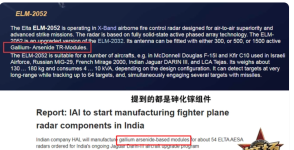
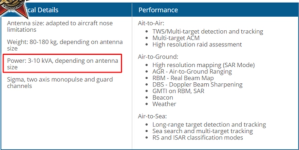
Even the GaN based air-cooled LKF601E radar's rated power is 11KW,it's higher than the biggest EL2052 radar model with 1500TRM,so what's the different?PAF chose KLJ-7A AIR COOLED AESA radar for JF17 BLK IIII cause of its cost effectiveness and low power requirements as RD93 engine of JF17 BLK III dose not produce the required electricity to power a 1000 TERM LIQUID COOLED AESA radar
but this thread is about LCA and first 40 LCA MK1A are coming with latest verssion of ELTA EL 2052 GaA based LIQUID COOLED AESA which as per Janes the verssion on LCA MK1A can track a 3squ mtrs target from 130Km and start detecting it from 150Km onewards and simountaniously track 60 Targets and engage 8-12 of the most important ones
YES western RADARS are rated to detect target of 3squ mtrs while soviet or russian or chinese radars are rated for 5squ mtrs target go check your facts
And BTW,i'm 100% sure the radar on LCA mk1A is not the one i mentioned that with 1500TRM.

Last edited:
MirageBlue
Registered Member
That air-cooled radar you mentioned is LkF601E from 38th institute,that LKJ-7A is from 14th institute and had never been an air-cooled varient.
View attachment 36974
You need to go tell Alan Warnes that the PAF lied to him.
THanks.
Users who are viewing this thread
Total: 3 (members: 0, guests: 3)
Pakistan Defence Latest


Country Watch Latest
-
 Iran - Israel/US War: Israel-US declare war on Iran, Iran responds (72 Viewers)
- Latest: Persian Gulf
-
-

-
-
Latest Posts
-

-

-
Iran - Israel/US War: Israel-US declare war on Iran, Iran responds (72 Viewers)
- Latest: Persian Gulf
-
-
 Makkah Defence Alliance: Turkey, Saudi Arabia, and Pakistan, news & updates (15 Viewers)
- Latest: Abdul q