Strapped down, blindfolded, held in diapers: Israeli whistleblowers detail abuse of Palestinians in shadowy detention center
At a military base that now doubles as a
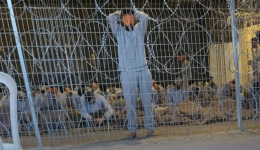
detention center in Israel’s Negev desert, an Israeli working at the facility snapped two photographs of a scene that he says continues to haunt him.
Rows of men in gray tracksuits are seen sitting on paper-thin mattresses, ringfenced by barbed wire. All appear blindfolded, their heads hanging heavy under the glare of floodlights.
A putrid stench filled the air and the room hummed with the men’s murmurs, the Israeli who was at the facility told CNN. Forbidden from speaking to each other, the detainees mumbled to themselves.
“We were told they were not allowed to move. They should sit upright. They’re not allowed to talk. Not allowed to peek under their blindfold.”
Guards were instructed “to scream
uskot” – shut up in Arabic – and told to “pick people out that were problematic and punish them,” the source added.
They paint a picture of
a facility where doctors sometimes amputated prisoners’ limbs due to injuries sustained from constant handcuffing; of medical procedures sometimes performed by underqualified medics earning it a reputation for being “a paradise for interns”; and where
the air is filled with the smell of neglected wounds left to rot.
CNN spoke to three Israeli whistleblowers who worked at the Sde Teiman desert camp, which holds Palestinians detained during
Israel’s invasion of Gaza. All spoke out at risk of legal repercussions and reprisals from groups supportive of Israel’s hardline policies in Gaza.
According to the accounts, the facility some 18 miles from the Gaza frontier is split into two parts: enclosures where around 70 Palestinian detainees from Gaza are placed under
extreme physical restraint, and a field hospital where wounded detainees are strapped to their beds, wearing diapers and fed through straws.
“
They stripped them down of anything that resembles human beings,” said one whistleblower, who worked as a medic at the facility’s field hospital.
“(The beatings) were not done to gather intelligence. They were done out of
revenge,” said another whistleblower. “It was
punishment for what they (the Palestinians) did on October 7 and punishment for behavior in the camp.”
Al-Ran, a Palestinian who holds Bosnian citizenship, headed the surgical unit at northern Gaza’s Indonesian hospital, one of the first to be shut down and raided as Israel carried out its aerial, ground and naval offensive.
He was arrested on December 18, he said, outside Gaza City’s Al-Ahli Baptist Hospital, where he had been working for three days after fleeing his hospital in the heavily bombarded north.
He was stripped down to his underwear, blindfolded and his wrists tied, then dumped in the back of a truck where, he said, the near-naked detainees were piled on top of one another as they were shuttled to a detention camp in the middle of the desert.
"When they removed my blindfold, I could see the extent of the humiliation and abasement … I could see the extent to which they saw us not as human beings but as animals."
Al-Ran’s account of the forms of punishment he saw were corroborated by the whistleblowers who spoke with CNN. A prisoner who committed an offense such as speaking to another would be ordered to raise his arms above his head for up to an hour. The prisoner’s hands would sometimes be zip-tied to a fence to ensure that he did not come out of the stress position.
For those who repeatedly breached the prohibition on speaking and moving, the punishment became more severe. Israeli guards would sometimes take a prisoner to an area outside the enclosure and beat him aggressively, according to two whistleblowers and al-Ran. A whistleblower who worked as a guard said he saw a man emerge from a beating with his teeth, and some bones, apparently broken.
“If you imagine yourself being unable to move, being unable to see what’s going on, and being completely naked, that leaves you completely exposed,” the source said. “I think that’s something that borders on, if not crosses to,
psychological torture.”
Another whistleblower said he was ordered to perform medical procedures on the Palestinian detainees for which he was not qualified.
“I was asked to learn how to do things on the patients, performing minor medical procedures that are totally outside my expertise,” he said, adding that this was frequently done without anesthesia.
For Dr. Al-Ran, his reunion with his friends was anything but joyful. The experience, he said, rendered him mute for a month as he battled an “emotional deadness.”
“It was very painful. When I was released, people expected me to miss them, to embrace them. But there was a gap,” said al-Ran. “The people who were with me at the detention facility became my family. Those friendships were the only things that belonged to us.”
Just before his release, a fellow prisoner had called out to him, his voice barely rising above a whisper, al-Ran said. He asked the doctor to find his wife and kids in Gaza. “He asked me to tell them that it is better for them to be martyrs,” said al-Ran. “
It is better for them to die than to be captured and held here.”