Israel’s Genocide in Gaza | 2023- till present

Status
Not open for further replies.

Israel Killed 31 of My Family Members in Gaza. The Pro-Palestine Movement Isn’t Helping.


Over the last two decades, Western activists have only made things worse for my people.

By Ahmed Fouad Alkhatib
June 11, 2024
https://www.thefp.com/p/pro-palestinian-movement-not-helping-gazans#
The conflict in Gaza has put my family through hell.

A few weeks ago, I flew to Egypt to help my brother’s wife and their four children flee Gaza and get safely to the UAE. It was just one day before the Rafah border closed on May 7, so we were cutting it close. My brother opted to stay behind. He’s a senior program manager for a British NGO in Gaza—similar to the American Red Cross—and he felt that without him, the whole operation might fall apart. But we all agreed it was time for his family to get out.

Our family’s home in Gaza City was hit by an Israeli air strike a week into the war, injuring several uncles and cousins on my dad’s side, and killing two. My brother’s family walked away from the rubble with minor injuries. But since then, they’ve been displaced eight times as they’ve made their way from Gaza City in the north to Khan Yunis, eventually reaching Rafah, where my mom’s family house has always been—effectively my second home.

That home was hit by an air strike in mid-December, just weeks before they arrived in Rafah. The attack killed twenty-nine of my relatives. All five of my aunts and uncles perished, as did most of my cousins. Those who made it out had the grim task of digging through the wreckage, pulling out the burnt and disfigured bodies of family members.

Almost everyone has known the pain of losing a beloved relative. But so many lost in the blink of an eye, all because they were bystanders in a bloody conflict they wanted no part of? It’s almost unbearable.

Whenever I share this story, people assume I must be consumed with rage, eager to get revenge on those responsible. I must despise all Israelis and consider them my sworn enemies.

Despite my deep frustration and resentment with the Israeli government’s action and the ongoing war in Gaza, I don’t. If anything, I’m more critical of some pro-Palestinian activists, many of whom are making things worse, putting the people they claim to defend in increasing danger. In fact, I’d argue that some aren’t all that interested in the well-being of Palestinians.
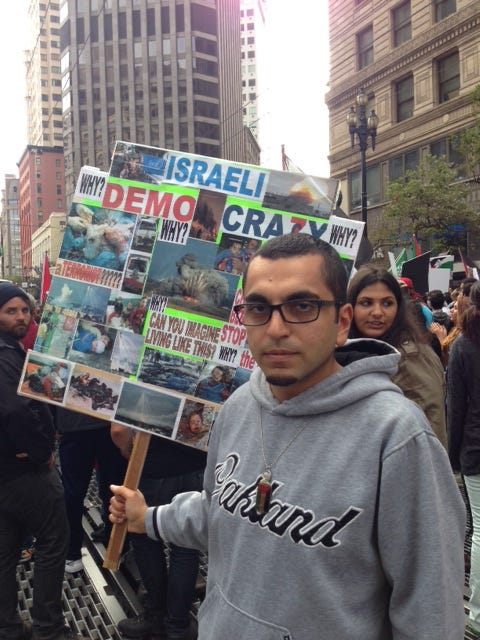

Ahmed Fouad Alkhatib: The pro-Palestinian movement isn't helping Gazans like my family.
Ahmed Fouad Alkhatib at a pro-Palestinian protest in the U.S. in 2014. (Photo courtesy of the author)

For the first fifteen years of my life, Gaza was my home. And from a very young age, I knew that my home wasn’t safe.

I was ten years old in 2000 when the Second Intifada began. I remember it vividly: my friends and older boys talking about the fight against Israeli occupation as if it was something romantic and heroic, claiming that we’d be part of a revolution that would live forever in the history books.

The reality was anything but that—the conflict was violent and bloody, with ongoing air strikes and scenes of death and destruction all around. I never felt completely secure or calm. One day in 2001, when I was eleven, I was walking home from school with friends, and we passed a police station just as it was hit by a massive Israeli air strike. Two of my friends were killed by the attack, and though I survived, the blast left me with asymmetric hearing loss in my left ear and memories that haunt me to this day.

Was I angry at Israel? I was furious. I mourned my friends, and a part of me wanted vengeance. But everything I was told as a kid, every plan for retaliation that I had heard adults and older boys discussing, never made sense to me. Wouldn’t violence just lead to more violence, and more dead children? What sense did it make for the Palestinian people to fight the Israelis, who clearly had far more military strength than we did? I was a preteen who knew almost nothing about the world, but I knew everything I was being told about the revolution wouldn’t work.

I realized I had no future in Gaza, so I worked relentlessly to get out. In 2005, when I was 15 years old, I boarded a plane for California as part of a high school cultural exchange program. By the time it ended a year later, the 33-Day War was raging, and I was unable to enter Gaza through Egypt after the border closure. With the help of some amazing human rights advocates and friends in the Bay Area, I applied for political asylum in the United States. The very day of my asylum interview—June 14, 2007—Hamas violently took over the Gaza Strip and ejected the Palestinian Authority.

In the meantime, I finished high school and obtained a bachelor’s degree. I also became involved in pro-Palestinian activist groups in the Bay Area. Initially, I was enamored. I volunteered with them. I marched with them. I gave them money. I attended dozens of rallies, went to countless university events, and participated in educational conferences and advocacy campaigns, including the Boycott, Divestment, and Sanctions movement.

I met and worked with intelligent, sincere, and highly committed individuals who inspired me. I also met a lot of idealists who were too stubborn to realize that their all-or-nothing belief system, by which all Zionists are bad and all Palestinians are angels, isn’t just self-defeating but does an active disservice to the very people they claimed to champion.

As my asylum application progressed, some of my activist friends accused me of being a traitor. They told me I should move back to Gaza to defend the land for my people. I should resist the Zionist plot to empty Gaza of all Palestinian inhabitants. Never mind that returning there would only put my life in danger; if I truly cared, they told me, I would be on the front lines, fighting to destroy our common enemy.

It’s easy to lecture about the virtues of holding the land when you live in a city where it’s unlikely a bomb will ever fall from the sky to kill you and everybody you love. It’s the romantic idealism of somebody who’s never had to bury a cousin or an uncle or a best friend.

In 2008, during a San Francisco rally in support of Gaza, I was approached by a news reporter who asked for an interview. She wanted my thoughts on rockets being fired at Israeli targets. I made it very clear that I didn’t support Hamas, and that I believed the random violence against Israeli citizens was abhorrent and wrong. After the interview, I was taken aside by one of the rally’s organizers, who chastised me.

Never talk about the rockets,” she told me. “You always pivot. If they ask you about Hamas, bring it back to the Israeli occupation.”

“But my family is there,” I insisted. “I don’t think either side should be killing civilians with rockets.”

“It doesn’t matter,” she said. “Stay on message.”

The biggest blow to my faith in the hard-line pro-Palestine movement came in 2015, when I tried (and ultimately failed) to lobby for a Gaza airport. An internationally run, Israeli-approved airfield in Gaza wasn’t going to end the fighting, but it might give people the option to go in and out of Gaza and provide some freedom of movement for Palestinians trapped by the blockade in the Strip.

I had detailed plans: the location, flight plans, the radar coverage, destinations, aircraft type, security, and robust outreach to all relevant parties. I was having productive talks with senior Israeli government officials and the Israel Defense Forces, and used intermediaries to obtain approval and support from the Palestinian leadership. The project received immense interest from the people of Gaza. What I didn’t have was the support of pro-Palestine activists.

They opposed my efforts, because cooperation would just make Israel “look good, if only parts of the blockade are addressed and not all of it.” That wasn’t acceptable to them, even if the Palestinian people stood to benefit. Some believed that with freedom of movement, many Gazans would choose to leave, thereby fulfilling the “Zionist plot” to empty the Strip of its inhabitants, essentially arguing that imprisoned Gazans were better for the greater cause.

I couldn’t believe what I was hearing. Trapping people in Gaza was okay because that made it easier to “expose” and attack Israel? What kind of a cause relies on forcing its people to stay in perpetual misery so that Western activists can have an easier time condemning their adversaries?

Their totalitarian approach to solving the crisis left no room for nuance. “We don’t want partial solutions,” they’d tell me. “We want it all. No blockade, no occupation, no nothing.” It frustrated me, but I didn’t walk away. I still thought I could have a positive influence on the movement. I just had to make the dogmatic activists understand.

Things got much worse after October 7. Those who claimed to be in solidarity with Gaza didn’t just avoid condemning Hamas’s horrendous attack—they dismissed it, claiming the extent of the atrocities committed against Israeli civilians was being exaggerated, or outright invented. When I tried to argue that we shouldn’t look the other way, they scolded me. Focus on what matters, they told me.

That was a turning point for me. I needed to walk away from the pro-Palestine groups that were my community, my second family. Right now, I am not engaged with any of these groups.

It often feels like Palestinians have become pawns for activists, our plight making it easier to criticize Israel. But it’s my family in the crosshairs. My brother and surviving family members are still over there, along with many people I grew up with. This is personal to me.

I remain very pro-Palestine. I’m also in favor of peace and pragmatism. I’m vehemently opposed to everything Hamas represents and all of their vile acts against the Israeli people. I also think Prime Minister Netanyahu is a war criminal, responsible for killing my family members along with tens of thousands of innocent Palestinians in Gaza. He has blood on his hands and will not be easily forgiven. Balancing these multiple truths is not something many activists seem capable of doing. They’re genuinely unwilling to acknowledge that the goal should be coexistence. To achieve true peace and anything approaching a realistic solution, we need to talk to each other as equals.

I have a large and robust network of friends within Jewish communities who are devoted to Israel, while viewing other Palestinians and me as humans who deserve to exist. I certainly don’t agree with many of their opinions, but they, like me, recognize our common humanity as well as the desperate need to work toward a shared future. We have a historic opportunity to push for the two-state solution. A secure and safe Israel right next to a free and independent Palestine is the only thing that would grant my homeland sovereignty and independence.

I know how hard it is not to get caught up in the emotions surrounding this conflict. I can’t stop thinking about my thirty-one dead relatives. I wake up every morning worried about my brother, family, and people, and I tense up every time the phone rings. But it’s precisely those losses and fears that make me want to find another way and not be driven solely by emotions and reactivity. I want to do something realistic, to look toward a better future when we finally break the repeating cycle of incitement, vengeance, anger, and hatred.



Ahmed Fouad Alkhatib is a political analyst from the Gaza Strip who writes about the coastal enclave’s political and humanitarian affairs, and is a non-resident senior fellow at the Atlantic Council. Follow him on Twitter (now X) @afalkhatib.
 
To view this content we will need your consent to set third party cookies.
For more detailed information, see our cookies page.

I don't think that is true. There is a lot of extremists there in this region (mainly ISIS, Al Qaeda etc... ), who are brainwashed and can attack Synagogues and Churches in the name of Islam which is very WRONG. We should condemn that because that isn't our Islam.
 
As of now, what you suggest is only a hypothetical scenario.
Your right. It’s not a forgone inevitability, the geo political chessboard is still in play.

Also, you’re right that American democracy works but boy is the disinformation campaign off the charts. Heck we don’t even see the candidates campaigning much in the media. Positions are known and the anti-incumbent sentiment has a lead. AIPAC is powerful but it’s on the back of campaign donations to candidates and PACs. The take away from this shouldn’t be to only call it out. It build up your own political machine to counter the narrative (as is being done) but also funding politicians, within the law, that share your view, AND get into most if not all parts of American life.

No more just having your kids just aiming to be doctors, lawyers and engineers, at least with a greater purpose to the endeavor, but to be visible and “part of the conversation”
 
“Red Arrow” missile is the Chinese HJ-8 or most likely Iranian made version of the Hj-8, that in Pakistani service is known as the Baktar-Shikan, if I’m not mistaken.


In the Bosnian war, the Baktar-Shikan was used well to destroy Serbian tanks
To view this content we will need your consent to set third party cookies.
For more detailed information, see our cookies page.

Yeah looks likely. I think it is an old design, it isn't like Konkurs, Faggot or Kornet
 
I don't believe Hamas was prepared for a full blown ground invasion. Even though I also don't believe you can do much to counter one. Gaza is too small and ill equipped.

Rocket fire is low because of many factors unrelated to supply. There are still thousands of rockets in Gaza but they're inaccessible and undeployable at the moment.

Hamas in Gaza started off as a guerilla group. So it has experience working with limited resources and manpower. And able to go underground. Hamas can still continue to survive for a long time and can recover rather quickly. It may not govern parts of Gaza for the time being but will survive as a military organization and popular movement.

Unless he's full of it, sounds like demon shaytan himself seems to be satisfied with what's been accomplished in Rafah, either that or he's been told Hamas has been weakened, start the ceasefire & get the hostages back (at least it will look like he tried) and it's time now to divert attention (and especially resources) to the north, as that represents a much larger threat, and by the looks of it, they seem to already be lining up for that. Plus, he needs Biden to keep the weapons flow going and by ending the Rafah genocide, Biden can take credit for that, now he's happy and keeps the cash cow floating for the northern diversion and that helps shaytanyahu also. That seems to be what's going on just by the way everything is lining up.
 
To view this content we will need your consent to set third party cookies.
For more detailed information, see our cookies page.

إنا لله وإنا إليه راجعون
لا حول ولا قوة الا بالله العلي العظيم
النصر أو جزء في سبيل الله. وقال الله - تبارك وتعالى:{ولا تحسبن الذين قتلوا في سبيل الله أمواتاً بل أحياء عند ربهم يرزقون إن شاء الله}
 
Last edited:
It was more than likely in their stocks before conflict started, but probably in limited numbers.
Probably captured from Terrorists in Syria and sent to the resistance in Gaza or Was given to Hamas when they were fighting against the SAA.
 
To view this content we will need your consent to set third party cookies.
For more detailed information, see our cookies page.


Israel has been and will always be a Western-led project. They're doing everything in their disposal to protect it.
 
Their is nothing uneasy about this alliance, the Arab states are whole hearted on the side of Israel

They protect it
Provide intelligence to it
Stop missiles from hitting it
Help it get around sanction and blockades
They stop others from helping Palestine
They block OIC and other resolutions

THEY ARE TO BLAME
EGYPT
SAUDI
UAE
JORDAN
BAHRAIN
MORROCO

We are talking about enemies of the Muslims in these regimes, and they will go down in history as cowards the same as the Arabs who befriended the crusaders

These countries are not only an enemy of their own people. These followers of the Abraham Accord are also a threat to the entire Islamic world.
 
Indians on the blogspace are admiring Israel for the support Israel gave during the Kargil War. What stupidity! It was a border skirmish, happened a quarter century ago, and, with Pakistan unwilling to escalate, Israeli support to India wouldn't be a strategic factor.

I think in case of a regional war, Pakistan will get indirectly involved and countries will closely watch Pakistan's nukes. The nukes have been repeatedly mentioned by Ritter and Col. Macgregor. I know they are loose cannons but there are not the only ones thinking about Pakistan's nukes.

I think Israel is going to use tactical nukes and blame it on the Resistance by saying that the Resistance screwed up and blew up a 'dirty bomb' on themselves. And that will bring to sharp relief what Pakistan would do. The pressure in the Islamic world would be immense on Pakistan.

Let's just say it openly. The Americans in Islamabad are only there for one reason and reason only. Nukes.
 
To view this content we will need your consent to set third party cookies.
For more detailed information, see our cookies page.

One can’t deny that terrorist state of Israel is on the death wish and I really hope it comes true for them.🤬
 

The IDF is on track to dismantle Hamas’s last brigade in Rafah

Despite the relatively slow pace of the IDF operation in Rafah, the overall strategy is proving effective.

YAAKOV LAPPIN
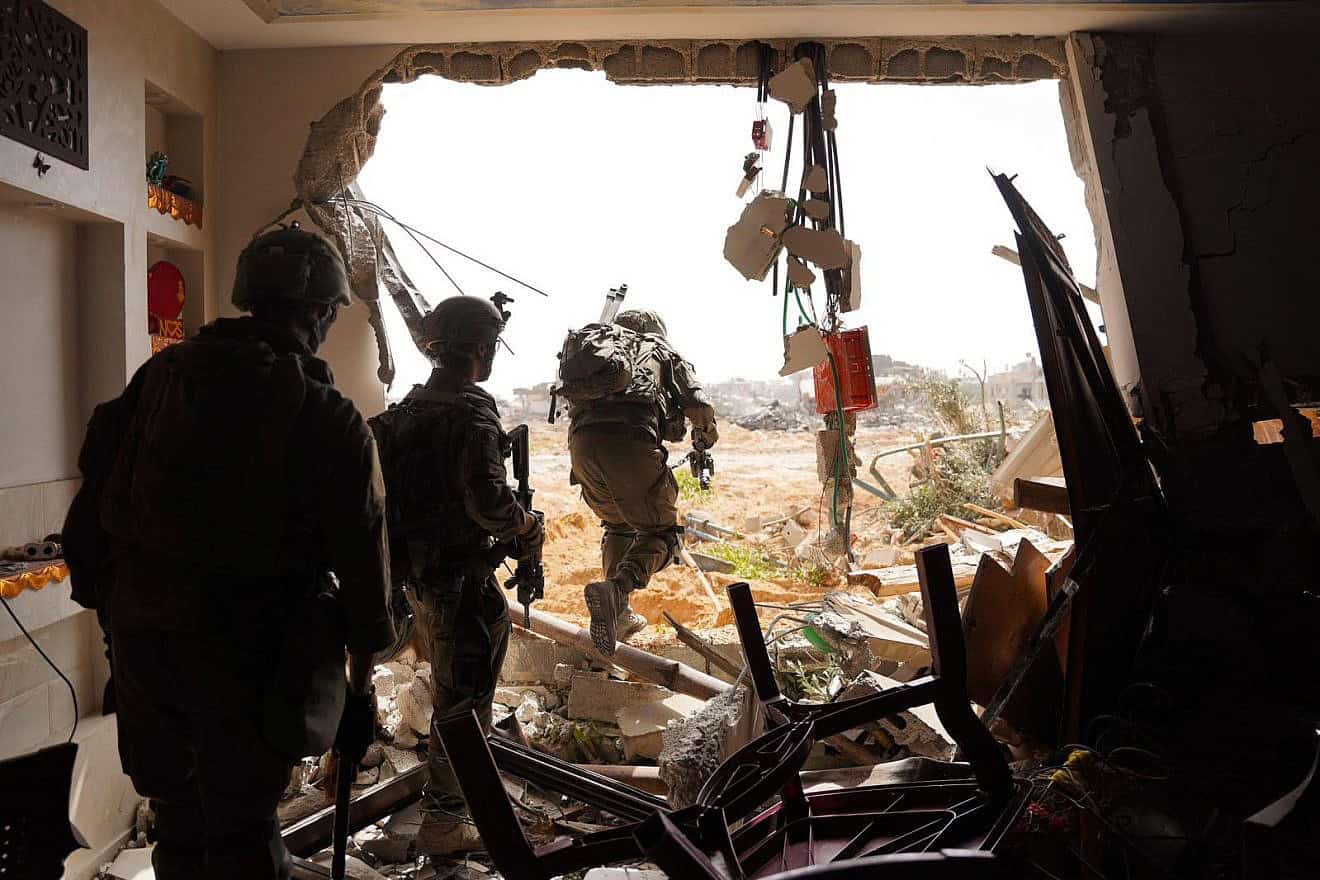
Israeli ground troops operating in the Rafah area of southern Gaza, June 1, 2024. Credit: IDF.

Israeli ground troops operating in the Rafah area of southern Gaza, June 1, 2024. Credit: IDF.

(June 24, 2024 / JNS)
The Israel Defense Forces is pursuing a phased approach in its ongoing offensive against Hamas’s last stronghold in Rafah, Gaza. By dividing Rafah into sub-areas and deploying a single division—the 162nd—rather than two, the IDF and the Israeli Cabinet have taken a slower path, but one that has avoided another crisis with the United States.

According to Israeli military assessments, Hamas’s final functioning brigade will be dismantled in Rafah within weeks. Its defeat will mark a major milestone in the war that began on Oct. 7 with Hamas’s mass invasion of southern Israel. Meanwhile, Hamas has lost its ability to smuggle weapons and contraband from Egypt’s Sinai into Gaza via the cross-border tunnels. This will severely harm Hamas’s ability to rebuild its terror army—assuming that Israel does not relinquish its control of the Gaza-Egypt border.

According to an IDF source, of Hamas’s four Rafah battalions, only two are currently functional.

The IDF has eliminated over 500 terrorists in Rafah, and has also discovered extensive tunnel networks under the city, and under the Philadelphi Corridor along the Gaza-Egypt border. Two of the tunnels destroyed by Israeli forces exceeded a kilometer in length.
IDF ground and air units are dismantling significant portions of Hamas’s terrorist infrastructure in the area. Much of this work is slow and extremely difficult, as Hamas employs asymmetric warfare tactics and stays out of sight until it strikes.

The Israeli Air Force has played a crucial role in these operations. IAF fighter jets and aircraft have been striking numerous targets across Gaza, and providing close air support for the 162nd Division in Rafah. The Israeli Navy has also been striking enemy targets from the sea.
On June 20, the IDF reported that the Nahal infantry brigade, operating under the 162nd Division, had discovered large quantities of hidden weapons and tunnel shafts within and under civilian residences in Rafah.

The IDF has learned an enormous amount about complex, large-scale urban warfare in recent months, and is applying those lessons effectively in Rafah.

All of this has led to considerable, steady progress in the systematic erosion of the Rafah Brigade’s capabilities.

The phased approach allowed for the safe evacuation of over a million civilians; the evacuations have continued at the local level.
This has been crucial in avoiding civilian casualties as much as possible and avoiding a crisis with the U.S. Biden administration. However, this approach also gave Hamas the option of fleeing Rafah under the cover of the evacuations, possibly taking hostages with them.

International media has reported that the IDF has accelerated the pace of the Rafah operation in recent days. Reuters reported on June 21 that the IDF had taken control of the eastern, southern and central parts of the city and was now focusing on the northern and western sections. The intensified activity has led to a new wave of evacuations, with Gazans moving northward, according to the report. Reuters cited U.N. estimates that there are now fewer than 100,000 civilians left in Rafah, compared with over a million before the IDF ground maneuver.

Despite the slower pace, the IDF’s strategy appears to have proven effective.

Meanwhile, the IDF’s destruction of Rafah’s massive tunnels network is crucial in cutting off supply lines and operational routes, significantly weakening Hamas’s overall capabilities.
Parallel to this effort in Rafah is the ongoing IDF effort to eliminate senior Hamas and Palestinian Islamic Jihad terrorists, harming the terrorist groups’ command and control capabilities. On June 22, the Israeli Air Force attempted to eliminate Hamas’s head of operations, Raed Sa’ad, in a strike in Gaza City. At time of publication, it remained unclear whether the attempt was successful.
 

The IDF is on track to dismantle Hamas’s last brigade in Rafah

Despite the relatively slow pace of the IDF operation in Rafah, the overall strategy is proving effective.

YAAKOV LAPPIN
Israeli ground troops operating in the Rafah area of southern Gaza, June 1, 2024. Credit: IDF.

Israeli ground troops operating in the Rafah area of southern Gaza, June 1, 2024. Credit: IDF.

(June 24, 2024 / JNS)
The Israel Defense Forces is pursuing a phased approach in its ongoing offensive against Hamas’s last stronghold in Rafah, Gaza. By dividing Rafah into sub-areas and deploying a single division—the 162nd—rather than two, the IDF and the Israeli Cabinet have taken a slower path, but one that has avoided another crisis with the United States.

According to Israeli military assessments, Hamas’s final functioning brigade will be dismantled in Rafah within weeks. Its defeat will mark a major milestone in the war that began on Oct. 7 with Hamas’s mass invasion of southern Israel. Meanwhile, Hamas has lost its ability to smuggle weapons and contraband from Egypt’s Sinai into Gaza via the cross-border tunnels. This will severely harm Hamas’s ability to rebuild its terror army—assuming that Israel does not relinquish its control of the Gaza-Egypt border.

According to an IDF source, of Hamas’s four Rafah battalions, only two are currently functional.

The IDF has eliminated over 500 terrorists in Rafah, and has also discovered extensive tunnel networks under the city, and under the Philadelphi Corridor along the Gaza-Egypt border. Two of the tunnels destroyed by Israeli forces exceeded a kilometer in length.
IDF ground and air units are dismantling significant portions of Hamas’s terrorist infrastructure in the area. Much of this work is slow and extremely difficult, as Hamas employs asymmetric warfare tactics and stays out of sight until it strikes.

The Israeli Air Force has played a crucial role in these operations. IAF fighter jets and aircraft have been striking numerous targets across Gaza, and providing close air support for the 162nd Division in Rafah. The Israeli Navy has also been striking enemy targets from the sea.
On June 20, the IDF reported that the Nahal infantry brigade, operating under the 162nd Division, had discovered large quantities of hidden weapons and tunnel shafts within and under civilian residences in Rafah.

The IDF has learned an enormous amount about complex, large-scale urban warfare in recent months, and is applying those lessons effectively in Rafah.

All of this has led to considerable, steady progress in the systematic erosion of the Rafah Brigade’s capabilities.

The phased approach allowed for the safe evacuation of over a million civilians; the evacuations have continued at the local level.
This has been crucial in avoiding civilian casualties as much as possible and avoiding a crisis with the U.S. Biden administration. However, this approach also gave Hamas the option of fleeing Rafah under the cover of the evacuations, possibly taking hostages with them.

International media has reported that the IDF has accelerated the pace of the Rafah operation in recent days. Reuters reported on June 21 that the IDF had taken control of the eastern, southern and central parts of the city and was now focusing on the northern and western sections. The intensified activity has led to a new wave of evacuations, with Gazans moving northward, according to the report. Reuters cited U.N. estimates that there are now fewer than 100,000 civilians left in Rafah, compared with over a million before the IDF ground maneuver.

Despite the slower pace, the IDF’s strategy appears to have proven effective.

Meanwhile, the IDF’s destruction of Rafah’s massive tunnels network is crucial in cutting off supply lines and operational routes, significantly weakening Hamas’s overall capabilities.
Parallel to this effort in Rafah is the ongoing IDF effort to eliminate senior Hamas and Palestinian Islamic Jihad terrorists, harming the terrorist groups’ command and control capabilities. On June 22, the Israeli Air Force attempted to eliminate Hamas’s head of operations, Raed Sa’ad, in a strike in Gaza City. At time of publication, it remained unclear whether the attempt was successful.

You can't do shit. Your own IDF commander has already accepted that Hamas cannot be defeated.

Israeli Military Says Hamas Can’t Be Destroyed, Escalating Feud With Netanyahu

 
Status
Not open for further replies.

Users who are viewing this thread

Back
Top