Bangladesh Socio-Political Crisis 2024 and onwards

How Bangladesh's protests ended Sheikh Hasina's 15-year reign​

Anbarasan Ethirajan
BBC News

p0jgh450.jpg


Shots heard and objects thrown at deadly anti-government protests in Bangladesh

“One, two, three, four, Sheikh Hasina is a dictator!"

The words had become a rallying cry for young Bangladeshis in recent weeks - and on Monday their fury ended the prime minister's 15-year reign.

The 76-year-old Ms Hasina had ruled the South Asian nation of 170 million with an iron fist since 2009 - just a month ago, protests demanding her resignation would have been unthinkable.

But by Monday morning, she was stuck in a deadly stalemate. It had been several days since the top court scrapped the job quotas that originally sparked the protests in early July. But the agitation continued, morphing into an anti-government movement that wanted her out of power.

What finally tipped the scales was the ferocity of the clashes between the protesters and police on Sunday. Nearly 300 people are estimated have died in the violence so far but Sunday alone saw at least 90 people, including 13 police officers, killed - the worst single-day casualty in protests in Bangladesh’s recent history.

Critics called it a “carnage”, even as Ms Hasina stood her ground.

Bangladesh PM resigns and flees country: Follow live

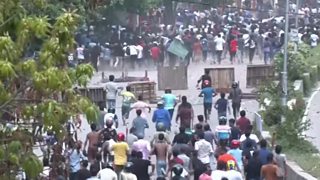
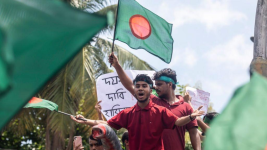
And yet, tens of thousands took to the streets on Monday, many of them marching towards the capital Dhaka, in defiance of a nationwide curfew.

Bangladeshis, it appeared, no longer feared bullets. What had been a political movement was now a mass uprising.

Ms Hasina's decision was also hastened by the military, which would have put pressure on her to step down. The army, which has ruled Bangladesh in the past and is still hugely respected, has an outsized influence over the country's politics.

The violence from the weekend as well as the prospect of facing fresh rounds of massive protests would have made the military establishment re-think its options.

Junior officers had already raised concerns about being asked to fire on civilians in a meeting with the military chief, General Waker-Uz-Zaman, on Friday.

What lies ahead is less clear but General Waker-Uz-Zaman is in talks with "various stakeholders", including opposition parties and civil society groups to find an "interim" solution, a high-level source familiar with the matter tells the BBC.
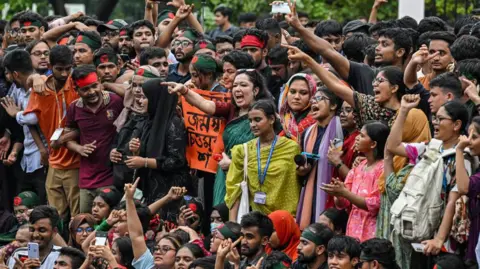
Getty Images Bangladeshi students and activists are shouting slogans during the Anti-Discrimination Student Movement rally at Central Shaheed Minar in Dhaka, Bangladesh, on August 3, 2024,
Getty Images

The protests have spread beyond students to become a wider movement
It is no surprise that Ms Hasina has fled to India. It's unclear what counsel she received from across the border but Bangladesh's giant neighbour has been a crucial ally of hers throughout.

It is partly why, as her popularity diminished, strong sentiment against India grew within Bangladesh.

Delhi always viewed its foothold in Bangladesh as key to the security of the seven landlocked states in India's north-east, some of which share a border with Bangladesh. Ms Hasina has given transit rights to India to make sure goods from its mainland make it to those states.

She also clamped down on anti-India militant groups based in Bangladesh, a key issue in India.

But in recent weeks, Delhi faced a dilemma - by backing its unpopular ally, it risked alienating a mass movement and damaging its long-term relationship with Bangladesh. Ms Hasina's resignation has solved that problem.

Sheikh Hasina: The pro-democracy icon who became an autocrat​


Why is the Bangladeshi government facing so much anger?​


The daughter of Bangladesh's founding president, Sheikh Hasina had been the world’s longest-serving female head of government.

Her father was assassinated with most of the family in a military coup in 1975 - only Ms Hasina and her younger sister survived as they were travelling abroad at the time.

After living in exile in India, she returned to Bangladesh in 1981 and joined hands with other political parties to lead a popular uprising for democracy that made her a national icon.

Ms Hasina was first elected to power in 1996 but later lost to her rival Begum Khaleda Zia of the Bangladesh Nationalist Party (BNP) in 2001.

She came back to power in 2009 in polls held under a caretaker government.

Her time in power was rife with accusations of forced disappearances, extra-judicial killings, and the crushing of opposition figures and her critics - she denied the charges, and her government often accused the main opposition parties of fuelling protests.

In recent weeks too, Ms Hasina and her party - the Awami League - blamed their political opponents for the unrest that gripped the country.

But this time, the anger was louder than ever before. It was certainly the most serious challenge Ms Hasina had faced since taking office after a contentious election win in January.

For weeks, she had refused to resign, even calling the protesters "terrorists" at one point.

But the realisation that the force of the security establishment couldn't keep people off the steets does not augur well for any leader - least of all an embattled one.
 
The demand looks genuine. But the way they are demanding is wrong. Use Gandhi's way. Hunger strike or sit peacefully somewhere in huge number and attract media.
So radical Bharti "kaafirs" like you can rape, murder and pillage because they don't like it when Muslims eat beef or lower-castes get reservations, but we're supposed to follow Gandhi's way when an oppressive government attacks us?
 

'Bangladesh is on the verge of an economic implosion,' says professor​


Regime change in Bangladesh is “an economic inevitability – a matter of when, not if”, according to Lutfey Siddiqi, a visiting professor-in-practice at the London School of Economics.

“Sheikh Hasina’s government appears to have lost both the right and might to govern. Soon it will run out of the resources to do so as well,” Siddiqi told the BBC. “Bangladesh is on the verge of an economic implosion.”

The same youth demographic that is largely spearheading the protests are also Bangladesh’s “core natural resource”, according to Siddiqi, who described them as “an asset that can easily flip into a liability without employment, hope or representation”.

More than 40% of Bangladeshi citizens aged between 15 and 24 are neither employed nor in education.

This, combined with persistent inflation and other economic woes, has created “an economic tinderbox that was simply waiting for a spark,” Siddiqi says.oes, created “an economic tinderbox that was simply waiting for a spark,” Siddiqi said.
 
If indians are whining about her toppling it must be great thing for Bangladesh and bad for them.
The vile scum won't be able to pretend Bishwaguru is South Asia's only democracy if the dictators they install in the one client state they have is uprooted. And if Bishwaguru loses that status, what else do they have to take pride in?
 
China is vital for South Asia

The hindutva extremists are common enemy for all south Asia, and China helps south Asia balance the threat from India

It's important Bangladesh takes this opportunity to push out India and the hindutva influence completely


While I do not trust India and dislike the current government, BD does not have much choice but to have a working relationship with India, when you consider that it also has Myanmar next door.

What will happen is that we will get less consideration of Indian interests as regards infrastructure projects that are given to China but the mainly mutually beneficial trade relationship will continue.

The relationship with China will get stronger but we need to temper this with the fact that BD will also want to make sure that it does not harm its relationship as well with US/West.

New government when it comes in will have to somehow give enough to each of the west/China/India to make sure that they all think it is in their interests to co-operate with BD in a mutually beneficial fashion.
 
Escaping to India, says it all

It was always India and hindutva pulling her strings

We wish the people of Bangladesh the best, it's important to unite the country and go forward together, get the military behind you BUT don't let them lead the country (we should know the risks of that)


Strong Muslim countries are vital in the region and beyond to take on our common enemies

Even Khaleda Zia will not 'flee' to Pakistan. She will also 'flee' to India only.
 
Like you, I didn't follow this thread at all or the news about the BD riots lately. I did wonder why the 'quota system' for jobs was becoming an issue large enough to cause the mayhem. Surely, there were major underlying issues.
I thought BD was going well with the stability under Hasina but there is an end to everything.
I Wish the BD people the best.


The economy was not doing well since Covid-19 and the Ukraine war.

This along with the stupid quota system for "freedom fighters" was the final spark that set the fire burning.

Hasina still could have retrieved the situation but did not take the student protestors seriously and should have showed more humility and willingness to compromise.

Only after mass killings and injuries of protestors then did civil society and the BA decide that Hasina should go.

In conclusion, it was a combination of a bad economy and Hasina's ineptness in handling the initial demonstrations that led to her downfall.
 
Last edited:

1722860794903.png

Summary​

  • Prime Minister Sheikh Hasina has resigned and fled the country after anti-government protests in which hundreds of people have been killed
  • Reports say she and her sister have been taken by army helicopter to safety. Hasina's whereabouts are unclear - she's thought to be heading to India
  • Huge crowds of cheering protesters stormed her official residence in the capital Dhaka, despite a curfew and internet clampdown
  • At least 90 people were killed on Sunday in clashes between police and protesters, taking the death toll in recent weeks to more than 300
  • The bloodshed is some of the worst the South Asian country has seen since it came into being in 1971
  • The student protest began in July with calls to abolish civil service job quotas, but spiralled into demands for Hasina to quit after over two decades in power
 
Imran Khan is fascist. No comparison with Bangladesh protests. PTI-supporter only movement just to install their fascist leader will always fail in Pakistan.

Now if somehow every party united to throw out establishment then that would be possible. But again not under fascist Imrandu.

Even if you give PTI seats based on 45 form then they will barely have majority. And all that because of anti-establishment vote. In Pakistan right now PTI/Imrandu is busy kissing establishment ass again for relief.


Why Patwari???Did Imran Khan Open Dalai Camp and Set Up FSF???Did He Attack Supreme Court and Make The Cheif Justice Run For His Life????Tell Me Noony Toon

Oh BTW He Doesn't Need To Kiss Anyone's Shit Stained Posterior.It's Only A Matter of Time Before GHQ Minions Run To Kiss His
 
In conclusion, it was a combination of a bad economy and Hasina's ineptness in handling the initial demonstrations that led to her downfall.

Not only that. People did not forget the massacre in BDR mutiny in 2009, massacre in 2013 of Hefajot demonstrators, they didn't forget the torture cell of BCL, DGFI, RAB to subdue opposition. The unprecedented level of corruption and billions of dollars that were laundered out of the country. Lack of free speech And the rigged elections one after the other.

Warning signs were all there, but Hasina and her gang didn't care about it. They thought they were untouchables.
 
If indians are whining about her toppling it must be great thing for Bangladesh and bad for them.
Indians know how to deal with South Asians. 😏There's plenty of examples.
 
Yes that is true for sure that it was mainly the hard work of BD'shis.

However without the infrastructure like roads, bridges and power stations that government provides then most of the potential cannot be realised.

Some infrastructure like Roppur nuclear power station probably would never have been built without her long-standing government.

Hasina like most leaders is a loud mouth and her constant references to her father was annoying and anyway all that infrastructure that were named after her father can be renamed. What matters is that it got built and so BD now has the foundation to use this to propel the economy forward.

Like it or not, she provided that political stability for 15 years that BD had lacked previously.

BNP and BAL take turns to name things - and it all gets undone lol

They never learn lol
 
If indians are whining about her toppling it must be great thing for Bangladesh and bad for them.

It certainly is bad for India but I don't know what someone like you would qualify as "good" for Bangladesh. Name one neighbor of India that is screaming "bad India" and is doing well, financially. Bangladesh economy will suffer massively. But as it has been shown, for some, pissing match with India holds more water. So yeah, good for Bangladesh!
 
Last edited:

Users who are viewing this thread

Pakistan Defence Latest

Latest Posts

Back
Top