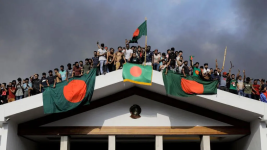
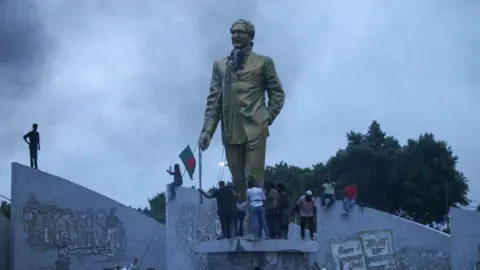
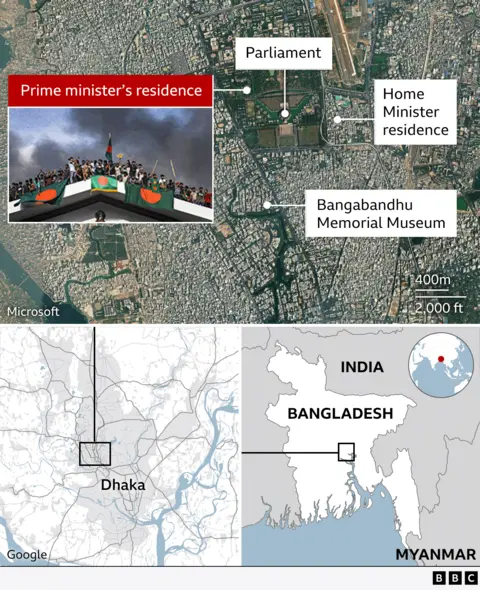
"There is a feeling that India completely backed Sheikh Hasina's government. Protesters make no distinction between India and Hindu citizens of Bangladesh, which has already led to attacks on temples and people.
"Now there is a power vacuum, there is nobody to implement law and order. The new government will need to protect religious minorities."
Ms Hasina's allies said she would not return to the country's politics. The former prime minister has spent a total of 20 years in office, first coming to power in 1996.
Her son, Sajeeb Wazed Joy, told the BBC's Newshour programme: "She’s in her late 70s. She is so disappointed that after all her hard work, for a minority to rise up against her, I think she’s done.
"My family and I are done."
Critics say Ms Hasina's rule was characterised by forced disappearances, extra-judicial killings and the crushing of opposition figures and government critics.
But Mr Wazed, who also served as a adviser to the prime minister on technology, defended his mother's record.
"She has turned Bangladesh around in the last 15 years.
"When she took over power, it was considered a failing state. It was a poor country.
"Until today, it was considered one of the rising tigers of Asia."
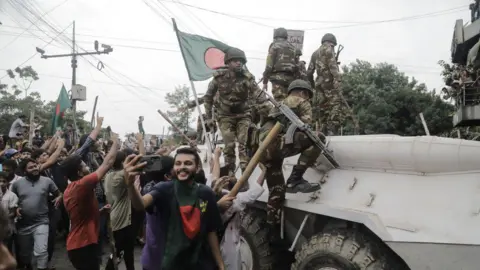
Getty Images
Protesters were seen celebrating with soldiers
About 300 people have been killed since protests broke out a month ago over a quota system for government jobs. The demonstrations, met with harsh repression by government forces, developed into a broader anti-government movement.
Dr Chietigj Bajpaee, a senior research fellow at the Chatham House think tank, said the country's high unemployment rates had made the quotas, which reserve a third of civil service jobs for descendants of veterans of the country's 1971 independence war with Pakistan, a particularly salient political issue.
"Public sector job quotas – with 400,000 new graduates competing for 3,000 civil service jobs – became a lightning rod for anti-government unrest," Dr Bajpaee said.
He added that the speed of events reflected frustration among Bangladeshi youth over the country’s "one-party rule" over the last 15 years.
"In a country with such a vibrant civil society, efforts to curb political freedoms and free speech were bound to trigger a blowback."
Most of the quota was scaled back by the government following a Supreme Court ruling last month, but students continued to protest, demanding justice for those killed and injured, and Ms Hasina' resignation.
Mr Bhattacharya said protesters now expected the new government to go through with their demands, including democratic reforms, better jobs and improvements to the education system.