Afghanistan: General News and Discussion

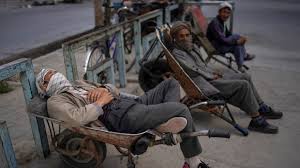
Life expectancy average declines in Afghanistan​


The Frontier Post

Life-expectancy-average.jpg


KABUL (Khaama Press): The United Nations, in its annual report analyzing Afghanistan’s situation in 2023, stated that despite the “tireless efforts” of the organization and its partners to address issues in Afghanistan, the country continues to grapple with “complex and multifaceted challenges.”

The report titled “UN Annual Results Report for Afghanistan in 2023” was released on Thursday, the 18th of April, revealing that in 2024, approximately 15.8 million people will face food insecurity and emergency levels of vulnerability.

Citing Gallup survey results and polls conducted by UN agencies in Afghanistan, the organization concluded that the “average life expectancy in the past five years [in Afghanistan] has decreased.”

The year 2024 is described as “highly challenging” for the people of Afghanistan, encompassing deep levels of need and emergency poverty levels. The UN report states: Afghans cite access to food as their most essential need. Millions who are unable to afford or produce basic sustenance face hunger and malnutrition.

The organization emphasizes the urgency of upholding human rights principles in Afghanistan and stresses the importance of remaining committed to human rights, gender equality, and women’s empowerment in 2024.
 

Over 74,000 migrants returned to Afghanistan in one week: IOM​


The Frontier Post

%D9%85%D9%87%D8%A7%D8%AC%D8%B1%D8%A7%D9%86-1200x700-1-810x473.jpeg


KABUL (amu tv): The International Organization for Migration reported that 74,291 migrants have returned to Afghanistan from April 21-27. According to IOM’s data, 43,176 migrants came from Iran and 31,115 from Pakistan.

Refugees from Pakistan re-entered through the Torkham, Ghulam Khan, and Spin Boldak crossings, while those from Iran used the Islam Qala and Milak border crossings.

The data also indicated an outflow of 43,422 Afghans to Iran and Pakistan during the same period. The breakdown shows 24,348 went to Iran and 19,074 to Pakistan.

Of the returnees from Iran, 6% held valid passports, 2% had valid visas, 18% possessed a Hamayesh card, 1% a Hoshmand card, 56% a valid Tazkira, and 36% had no documents.

Meanwhile, returnees from Pakistan included 7% with POR cards, 27% with valid passports, 24% with valid visas, 65% with valid Tazkira, 3% with ACC cards, and 25% with no documents. This influx of returnees comes as Pakistan and Iran have recently intensified crackdowns on Afghan refugees, resulting in the daily deportation of dozens of families.
 

Pakistan delegation visit to Kandahar ‘cancelled’ by Taliban​

Visit cancelled over reported cross-border strikes targeting terrorist hideouts in Afghanistan

Kamran Yousaf
May 12, 2024

Afghan Taliban officials claimed that a planned trip by a Pakistani military delegation to Kandahar on Sunday was cancelled in apparent protest over reported cross-border strikes by Pakistan targeting terrorist hideouts in Afghanistan.

There was no word from the Pakistani side either on the reported airstrikes or the visit of its delegation to Kandahar.

The foreign office had no knowledge of both developments, while the military's media wing didn't respond until the filing of this report.

However, diplomatic sources said the Pakistani military delegation, comprising mid-level officials, was to travel to Kandahar on Sunday as part of efforts by both sides to resolve the issue of the banned Tehreek-e-Taliban Pakistan (TTP).

According to sources, the delegation was to meet Mullah Shirin Akhund, the Governor of Kandahar, and the deputy head of Afghanistan's intelligence agency. Shirin is also considered close to Taliban supreme leader Haibatullah Akhundzada. He was one of the key members of the Taliban team that helped broker talks between Pakistan and the TTP.

Mullah Shirin is a key interlocutor of the Afghan Taliban trying to defuse tensions with Pakistan over the TTP. He travelled to Islamabad earlier this year to address Pakistan’s concerns.

The planned trip was believed to be a follow-up to those efforts to find a solution to the TTP problem.

The visit, however, was cancelled by the Afghan Taliban. There were reports, and some Afghan journalists claimed that Pakistan carried out fresh airstrikes in the Paktika province of Afghanistan on Friday, killing certain TTP terrorists.

Pakistan never confirmed those attacks, although it publicly acknowledged carrying out several cross-border attacks on March 18.

An Afghan media outlet claimed it obtained information that the Taliban had cancelled a scheduled trip of a Pakistani army delegation to Kandahar in response to reported recent air and missile strikes by Pakistan in Paktika province.

Originally, the delegation was to travel from Rawalpindi to Kandahar on Sunday, the Afghan International report said.

The report quoted security sources from Pakistan, confirming to Afghanistan International, claiming that the cancellation by the Taliban was officially attributed to "weather conditions," although it is widely believed that the real reason was the airstrikes on Paktika that occurred on Thursday. The specifics of the attack and any casualties remain undisclosed.

Previously, Afghanistan International had accessed a document indicating that Pakistan had detailed the aircraft, flight times, and arrival information to the Taliban's Ministry of Foreign Affairs through an official letter sent to Kabul.

The cancelled meeting was supposed to involve "mid-level" military officials from Pakistan and Mohammad Ali Hanafi, also known as "Mullah Shirin Akhund," who is a close aide to Hibatullah Akhundzada.

As of now, the Taliban has not issued an official statement regarding the Pakistani Air Force's attacks on Paktika or the reasons behind the cancellation of the Pakistani delegation's trip.
 
To view this content we will need your consent to set third party cookies.
For more detailed information, see our cookies page.
 
To view this content we will need your consent to set third party cookies.
For more detailed information, see our cookies page.
 
To view this content we will need your consent to set third party cookies.
For more detailed information, see our cookies page.
 
The 3rd Taliban Border Guard Regiment in Nimroz conducted military exercises using heavy weapons left behind by the US Army after the withdrawal of troops from Afghanistan. The Taliban also have Soviet equipment, we showed it earlier, but in the exercises we used US-made equipment. The exercises used M1117 armored vehicles, HMMWV armored vehicles, M2HB machine gun, M4A1 carbines, M24 sniper rifle, M249 machine guns, M16A2/M16A4 rifles and other weapons. The exercise was conducted by professional instructors in the city of Zaranj, Nimroz province. The exercise is being carried out by the Taliban as "tensions" rise between Iranian and Taliban border guards in Nimroz province amid disputes over water. The purpose of the military exercises is to improve the military experience of the Taliban forces.

To view this content we will need your consent to set third party cookies.
For more detailed information, see our cookies page.
 
To view this content we will need your consent to set third party cookies.
For more detailed information, see our cookies page.
 

Taliban bans women’s voices, bare faces in public under new vice laws in Afghanistan​


The Frontier Post


Taliban-bans-womens-voices-bare-faces-in-public-under-new-vice-laws-in-Afghanistan.jpg


KABUL (AP): Afghanistan’s Taliban rulers have issued a ban on women’s voices and bare faces in public under new laws approved by the supreme leader in efforts to combat vice and promote virtue.

The laws were issued Wednesday after they were approved by supreme leader Hibatullah Akhundzada, a government spokesman said. The Taliban had set up a ministry for the “propagation of virtue and the prevention of vice” after seizing power in 2021.

The ministry published its vice and virtue laws on Wednesday that cover aspects of everyday life like public transportation, music, shaving and celebrations.

They are set out in a 114-page, 35-article document seen by The Associated Press and are the first formal declaration of vice and virtue laws in Afghanistan since the takeover.

Vice and Virtue Ministry officials were not immediately available for comment about the laws.

The laws empower the ministry to be at the frontline of cracking down on personal conduct, administering punishments like warnings or arrest if they allege Afghans have broken the laws.

Article 13 relates to women. It says it is mandatory for a woman to veil her body at all times in public and that a face covering is essential to avoid temptation and tempting others. Clothing should not be thin, tight or short.

Muslim women are obliged to cover themselves in front of non-Muslim males and females to avoid being corrupted. A woman’s voice is deemed intimate and so should not be heard singing, reciting poetry, or reading aloud in public. It is forbidden for women to look at men they are not related to by blood or marriage and vice versa.

Article 17 bans the publication of images of living beings, which threatens an already fragile Afghan media landscape.

Article 19 bans the playing of music, the transportation of solo female travelers, and the mixing of men and women who are not related to each other. The law also obliges passengers and drivers to perform prayers at designated times.

Last month, a UN report said the ministry was contributing to a climate of fear and intimidation among Afghans through edicts and the methods used to enforce them.

It said the ministry’s role was expanding into other areas of public life, including media monitoring and eradicating drug addiction.

“Given the multiple issues outlined in the report, the position expressed by the de facto authorities that this oversight will be increasing and expanding gives cause for significant concern for all Afghans, especially women and girls,” said Fiona Frazer, the head of the human rights service at the UN mission in Afghanistan.
 
What is the Afghan Taliban's side of the story?

I believe UAE and China have recognized the Afghan Taliban now.

OIC should get involved to teach the Afghan Taliban what true Islam is.
 
Does Taliban Ulama even read whole Quran and find this verse ?

O believers! Do not forbid the good things which Allah has made lawful for you, and do not transgress. Indeed, Allah does not like transgressors.


https://quran.com/en/al-maidah/87-88

Human must not making something that is permitted by God as something Haram
 

Users who are viewing this thread

Country Watch Latest

Latest Posts

Back
Top