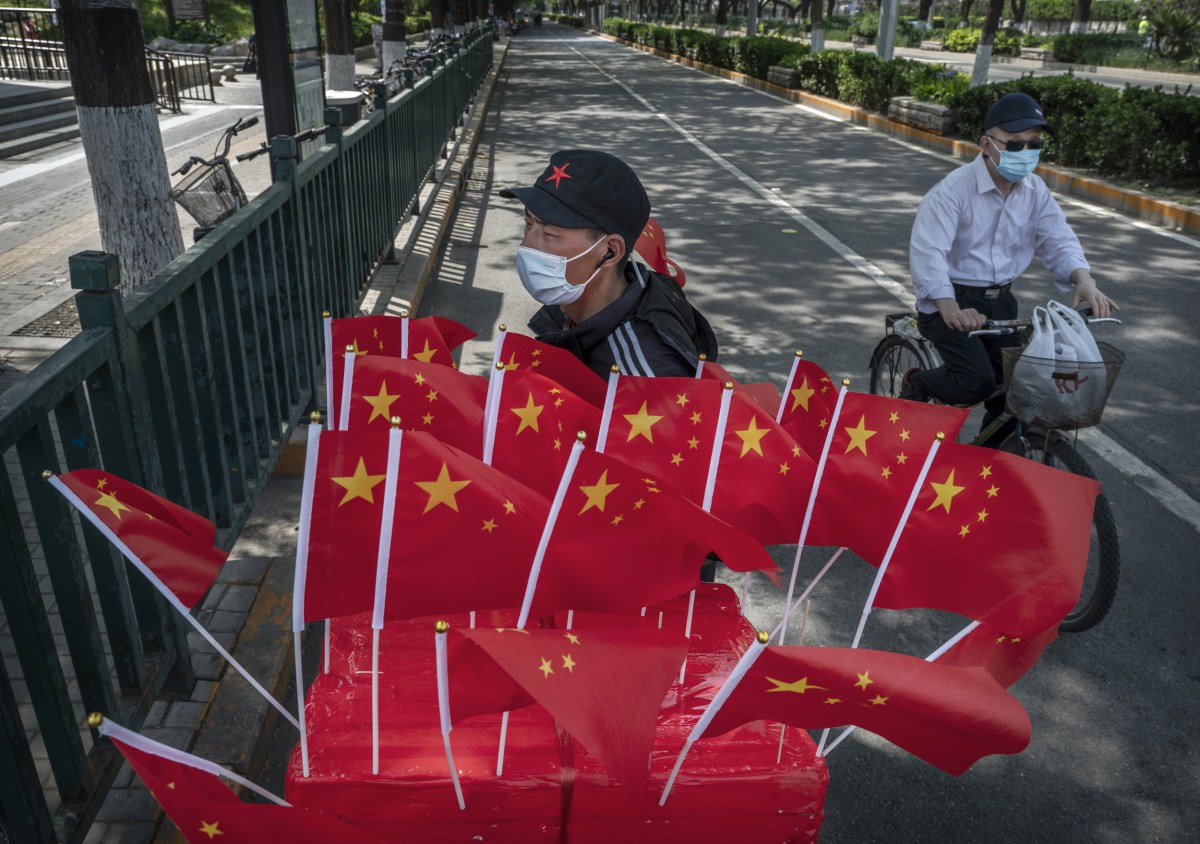
India - China History and Relations

Your attitude, FALSE bravedo and impression is not helping the thread at all. @Nilgiri
And India doesn't Need any enemy to unite India. It is in nature of India to be united. This is absolutely FALSE impression you have. I don't know from where you got it.

Asked and answered your honour, I already brought up in my earlier reply:

So it is not surprising if they get stuck running in circles and are unable to comprehend for example, exactly why the USSR broke up (as you will notice in my axis directions earlier w.r.t PRC) with its power/wealth levels attained and 3 constitutions... and India has not with its power/wealth levels and single 1950 constitution.

Read the rest of reply too. Some just make conclusions first and then try fit things to that (rather than other way around).
 
@Michael short on time today. I will continue hopefully in a few days time.

My apologies.
 
You have a primitive definition for a democracy

Democracy means representative form of government with checks and balances. You cannot have arbitrary and selective enforcement of laws like in China and still be called a democracy.
You have a primitive definition of democracy, democracy comes in different forms and means different things in different countries.
In Chinese mind and philosophy, we call what happens in US and India anarchy, or democrazy, not democracy.

 
Bound to be, and our respective explanations of what seems strange to people rooted in other points of view will throw light both on those things being explained, and on us, who seek to explain.


To be honest, those few, very few, among Indians who have some knowledge and information about China and the Han Chinese people have gathered what you have stated. Perhaps not with such accuracy, not with such width, but near enough for the rest of us Indians to get the impression.

It needs to be said, however, that you are speaking at a deep, conceptual level. Many posts tend to brush that aside, and straightaway point to transactional matters - the Sino-Indian War of 1962, that was never a war at all - to define the relationship between the two countries.


This is interesting. Interesting, because we get an opportunity to see what influences such development, what new thoughts, concepts and practices reach home to the people at large.


Your points are noted. The impression I, personally, have is not identical to what I read from your post.

For instance, the influence of Marxism, particularly of the developed concept of that ideology that stemmed from Stalin, and followed Lenin, that was interpreted in a particular manner, not necessarily a China-specific manner, by Mao Zedong, cannot be brushed aside. It has had a lasting imprint on China as a state, although it is also clear that the efforts of Mao to destroy the respect for traditions and the past, notably during the Cultural Revolution, did not work.

It also does not seem convincing to be told that the Chinese people chose the CCP. There is a lot more to it than that, and the struggle between the Communists and the Nationalists, once more, cannot be brushed aside. While it conveys a romantic and idealised notion of recent historical events, it may not be very accurate. Ignoring the role of Deng Xiaoping in reversing some of the extreme policies of Mao is also very controversial.

The present situation may support your depiction of a party that acknowledges the unvoiced opinion of the Chinese people, although it is difficult to imagine a situation where this opinion is fished out of social media, in the absence of any mechanism by which it can be gauged by the politicians/party member.

A thought-provoking post. I had replied in detail and at length, but my work was wiped out by an unexpected power outage that outlasted my UPS. Perhaps later, if my household chores permit (it is already midnight, so not much more time left).

Thank you for the inputs. Whether I agree or disagree is another matter, and of course, those knowledgeable in these matters will no doubt have a lot to say.
About Marxism-Leninism and China ..........

At a time when China is still in an extremely chaotic situation, people have lost their direction and the country does not look like a country. Some pioneers travelled to other countries to study, and they hoped to bring back to China some advanced ideas and concepts to get China out of its current predicament. But this matter is not easy.
When CCP was first established, it was just a small and disunited group of people, and ordinary Chinese people did not trust them, and not many people even knew they existed. At that time CCP did a lot of revolutionary events in many parts of China, but it was hard to succeed. At a time when ordinary people were starving, not many people were willing to follow this dream of ‘saving China’.
This situation continued until Mao Zedong took full control of the CCP.
After Mao Zedong took full control of the CCP, many statements and actions that were closely related to ordinary Chinese people became an important part of the CCP. For example, ‘fight the landlords and divide the fields’. These changes are what made ordinary Chinese people start to trust and support CCP.
We can see from these changes that ordinary Chinese do not care about Marxism-Leninism, they care more about their own lives. They did not care whether it was CCP's Marxism-Leninism or KMT's Three People's Principles that led them, as long as it solved their current life problems, they supported it.
Even within KMT, there are forces that have been calling on KMT to care about the life problems of ordinary Chinese. But these appeals have not been answered. As a result, many KMT members later became CCP members. In the subsequent civil war, a large number of KMT troops chose to revolt or surrender outright.
Had it not been for this major shift in Mao's approach to the CCP, the CCP could not have gained the support of the average Chinese.

However, as I mentioned earlier, centralisation and democracy manifest themselves differently at different stages of the country.
CCP became the leader of the Chinese people through a high degree of centralisation. When the country reached a certain stage of development, the problem began to surface.

In the later years of Mao's life, his health no longer allowed him to continue to lead China and he no longer had a clear head to make the right decisions. some people or groups within the CCP began to be restless and these people began to use Mao to purge other people or groups within the CCP.
You can interpret China at that time as: one false head of state + two fiercely antagonistic political groups. A manifestation of a democratic society.
Mao was the initiator of the Cultural Revolution, but he was not the operator. Things had gone completely off course and out of his control, but his body had rendered him powerless to undo it. ------ Now declassified information proves it.
It wasn't until Deng Xiaoping came to power that China began to move in the right direction.
However, by the late Deng Xiaoping era, history repeated itself once again. Thus, the June Fourth Movement took place ......

But, we cannot completely dismiss someone just because he did something bad at a certain period of time. We need to give him some time to self-correct, and we can also give him some hints or warnings. Of course, one can also choose to leave him first and come back when he has adjusted. During the period of the Cultural Revolution and the 4 June Movement, it was the period when there was the greatest exodus of Chinese people and the greatest number of civil protests. If the CCP could not adjust itself in time after these events, some new political groups would inevitably come out to replace him. When these negative events happen, ordinary Chinese people usually choose their own decision according to the situation.CCP is never calm as water inside, different factions have been monitoring and checking each other. The consensus among these factions is not to allow these monitoring and checks and balances to lead to chaos in China, if this consensus is lost, China will start to be chaotic. This is exactly the same as the partisan struggles in Western countries.

Marxism-Leninism-Mao Zedong Thought does not matter to the average Chinese. They care more about their own lives. Not many ordinary Chinese can explain the meaning of these ideas. But they get annoyed when they learn that the price of oil has gone up by RMB 0.2, and they get happy when they learn that the price of electricity has gone down to RMB 0.15 ...................
In today's China, civil servant status and CCP party membership will lose many rights and interests that ordinary citizens are entitled to. When danger comes, ordinary citizens can flee, they can't. Chinese law and CCP charter require them to be at the forefront. In today's highly developed internet self media, no one can create myths. I am grateful for the corruption cases that have been erupting in China in recent years. It shows that CCP's ability to self-correct and ordinary Chinese people's ability to monitor CCP is growing. If one day, there are no corruption cases, that will be the most terrible coming.
 
A thought-provoking post. I had replied in detail and at length, but my work was wiped out by an unexpected power outage that outlasted my UPS. Perhaps later, if my household chores permit (it is already midnight, so not much more time left).
I don't have much experience of life after a blackout.

When I was a kid I lived in a dormitory for collective enterprises
, and the nature of this business didn't allow blackouts to happen. Even in the 1980s, when electricity was extremely scarce in China, there were never any blackouts.
Now I live in an area that is the largest exporter of electricity in China, generating far more than it needs and selling most of it to Shanghai.
Even if a power outage is caused by an emergency failure, it will not take more than 2 hours.

============================================================

About 1962 China-Indian War

I do not mind having a discussion on this war if we can discuss it in a rational manner. We can provide all kinds of real evidence from our respective sources to understand this war. But I suggest using separate threads for this heated discussion.

But, the truth is very harsh! I don't think many people are ready to face these truths.
 
Last edited:
An excellent de
About Marxism-Leninism and China ..........

At a time when China is still in an extremely chaotic situation, people have lost their direction and the country does not look like a country. Some pioneers travelled to other countries to study, and they hoped to bring back to China some advanced ideas and concepts to get China out of its current predicament. But this matter is not easy.
When CCP was first established, it was just a small and disunited group of people, and ordinary Chinese people did not trust them, and not many people even knew they existed. At that time CCP did a lot of revolutionary events in many parts of China, but it was hard to succeed. At a time when ordinary people were starving, not many people were willing to follow this dream of ‘saving China’.
This situation continued until Mao Zedong took full control of the CCP.
After Mao Zedong took full control of the CCP, many statements and actions that were closely related to ordinary Chinese people became an important part of the CCP. For example, ‘fight the landlords and divide the fields’. These changes are what made ordinary Chinese people start to trust and support CCP.
We can see from these changes that ordinary Chinese do not care about Marxism-Leninism, they care more about their own lives. They did not care whether it was CCP's Marxism-Leninism or KMT's Three People's Principles that led them, as long as it solved their current life problems, they supported it.
Even within KMT, there are forces that have been calling on KMT to care about the life problems of ordinary Chinese. But these appeals have not been answered. As a result, many KMT members later became CCP members. In the subsequent civil war, a large number of KMT troops chose to revolt or surrender outright.
Had it not been for this major shift in Mao's approach to the CCP, the CCP could not have gained the support of the average Chinese.

However, as I mentioned earlier, centralisation and democracy manifest themselves differently at different stages of the country.
CCP became the leader of the Chinese people through a high degree of centralisation. When the country reached a certain stage of development, the problem began to surface.

In the later years of Mao's life, his health no longer allowed him to continue to lead China and he no longer had a clear head to make the right decisions. some people or groups within the CCP began to be restless and these people began to use Mao to purge other people or groups within the CCP.
You can interpret China at that time as: one false head of state + two fiercely antagonistic political groups. A manifestation of a democratic society.
Mao was the initiator of the Cultural Revolution, but he was not the operator. Things had gone completely off course and out of his control, but his body had rendered him powerless to undo it. ------ Now declassified information proves it.
It wasn't until Deng Xiaoping came to power that China began to move in the right direction.
However, by the late Deng Xiaoping era, history repeated itself once again. Thus, the June Fourth Movement took place ......

But, we cannot completely dismiss someone just because he did something bad at a certain period of time. We need to give him some time to self-correct, and we can also give him some hints or warnings. Of course, one can also choose to leave him first and come back when he has adjusted. During the period of the Cultural Revolution and the 4 June Movement, it was the period when there was the greatest exodus of Chinese people and the greatest number of civil protests. If the CCP could not adjust itself in time after these events, some new political groups would inevitably come out to replace him. When these negative events happen, ordinary Chinese people usually choose their own decision according to the situation.CCP is never calm as water inside, different factions have been monitoring and checking each other. The consensus among these factions is not to allow these monitoring and checks and balances to lead to chaos in China, if this consensus is lost, China will start to be chaotic. This is exactly the same as the partisan struggles in Western countries.

Marxism-Leninism-Mao Zedong Thought does not matter to the average Chinese. They care more about their own lives. Not many ordinary Chinese can explain the meaning of these ideas. But they get annoyed when they learn that the price of oil has gone up by RMB 0.2, and they get happy when they learn that the price of electricity has gone down to RMB 0.15 ...................
In today's China, civil servant status and CCP party membership will lose many rights and interests that ordinary citizens are entitled to. When danger comes, ordinary citizens can flee, they can't. Chinese law and CCP charter require them to be at the forefront. In today's highly developed internet self media, no one can create myths. I am grateful for the corruption cases that have been erupting in China in recent years. It shows that CCP's ability to self-correct and ordinary Chinese people's ability to monitor CCP is growing. If one day, there are no corruption cases, that will be the most terrible coming.
An excellent defence of the early idealistic years of the CCP and its founders, of the rise of Mao, of the struggle to overcome the KMT, and of the years following the overthrow of the KMT. That it was Marxist principles guiding China remains a fact, however much its rise might have depended on the popular support that the party professing it got at crucial moments.

It might have been that after a point, Mao was physically unable to cope with situations prevailing in China, and that wrong measures were taken. If a country commits itself to a one-person dictatorship, then it accepts the consequences of that choice. At the time of the Great Leap Forward, and the Cultural Revolution, Mao was not in his physically disabled state. He did China immeasurable harm during those movements, with the full support of the CCP, and it is difficult to do either of two things - to delink China's state from the rule of the CCP and its clearly defined commitment to Marxism, and to understand how people in China continue to praise Mao.

All this, of course, has little to do with the question that you raised, that of the perception of each other by the Chinese and Indian peoples. Exploring that is more interesting; looking at state to state relations are not likely to be fruitful.
 
About 1962 China-Indian War

I do not mind having a discussion on this war if we can discuss it in a rational manner. We can provide all kinds of real evidence from our respective sources to understand this war. But I suggest using separate threads for this heated discussion.

But, the truth is very harsh! I don't think many people are ready to face these truths.
It is best to avoid that discussion.
 
An excellent de

An excellent defence of the early idealistic years of the CCP and its founders
In the "early idealistic years‘’ of US, US government genocided the local population, sold the blacks for slavery and treated colored people worse than animals, do you still think today's US is the same as the "early idealistic years‘’ of US?
 
In the "early idealistic years‘’ of US, US government genocided the local population, sold the blacks for slavery and treated colored people worse than animals, do you still think today's US is the same as the "early idealistic years‘’ of US?
A very stale discussion gambit that has become widely known due to its overuse by ignorant people is 'whataboutery'.

Stick to the topic.
 
This thread has progressed exactly as I knew when it started. Almost all the Indian posts, from junior and senior members alike, can be summarized as follows:

Indian people: Good
Chinese people: Good if they like India, CCP operatives if they don't
Indian government: Good
Chinese government: Bad, and the root of the conflict

Once you strip away the gratuitously superfluous verbiage, all the Indian posts boil down to the view that the only thing holding back the Chinese and Indian people from holding hands and singing songs around the campfire is the evil CCP.

It is amusing to watch the thread unfold as I expected...
 
An excellent de

An excellent defence of the early idealistic years of the CCP and its founders, of the rise of Mao, of the struggle to overcome the KMT, and of the years following the overthrow of the KMT. That it was Marxist principles guiding China remains a fact, however much its rise might have depended on the popular support that the party professing it got at crucial moments.

It might have been that after a point, Mao was physically unable to cope with situations prevailing in China, and that wrong measures were taken. If a country commits itself to a one-person dictatorship, then it accepts the consequences of that choice. At the time of the Great Leap Forward, and the Cultural Revolution, Mao was not in his physically disabled state. He did China immeasurable harm during those movements, with the full support of the CCP, and it is difficult to do either of two things - to delink China's state from the rule of the CCP and its clearly defined commitment to Marxism, and to understand how people in China continue to praise Mao.

All this, of course, has little to do with the question that you raised, that of the perception of each other by the Chinese and Indian peoples. Exploring that is more interesting; looking at state to state relations are not likely to be fruitful.
If you study the ideas and institutions that are now relevant to the general public in China, you will find that they do not have much to do with Marxism-Leninism-Mao Zedong Thought.

The laws of development of human society + the laws of development of traditional Chinese culture = today's Chinese culture and institutions

Marxism-Leninism-Mao Zedong Thought is the spiritual flag of CCP. ccp will not allow to change this flag. However, CCP will adjust the substance of this spiritual flag on its own to make it consistent with the Chinese reality, instead of adjusting the Chinese reality to be consistent with this flag, which is a fundamental difference.
The studies of many Western scholars have shown that Chinese Marxism-Leninism and Western Marxism-Leninism are two completely different ideas. They have the same name, but their substance is totally different.

No person or political party is perfect. When it has some problems, if it does not treat or correct its mistakes in time, it is bound to die or perish. Of course, in treating or correcting the mistakes, some injuries are bound to be inflicted. Sometimes some permanent scars are left behind. These scars will always remind us.

The Chinese have never forgotten those painful years. We have been studying, analysing and summarizing them, turning them into lessons of history, so as to prevent similar problems from recurring in our future path. This is the value of historical research.

In simple words: the Chinese are realists.

We do not reject any foreign ideas and cultures; but no foreign ideas can master the Chinese people. The Chinese will selectively absorb all kinds of foreign ideas and cultures. When these foreign ideas and cultures are absorbed by the Chinese, they will continue to develop according to the laws of Chinese culture, not the original laws of such ideas and cultures.
For example, Buddhism has been drastically altered by Chinese culture after it was introduced to China from ancient India. Its subsequent development through China also far exceeded the Buddhist culture of ancient India itself. This is entirely consistent with the situation of Marxism-Leninism in China!
 
This thread has progressed exactly as I knew when it started. Almost all the Indian posts, from junior and senior members alike, can be summarized as follows:

Indian people: Good
Chinese people: Good if they like India, CCP operatives if they don't
Indian government: Good
Chinese government: Bad, and the root of the conflict

Once you strip away the gratuitously superfluous verbiage, all the Indian posts boil down to the view that the only thing holding back the Chinese and Indian people from holding hands and singing songs around the campfire is the evil CCP.

It is amusing to watch the thread unfold as I expected...
I am saddened to read such an analysis, with its lack of depth and superficiality.

It is difficult to understand what, in my posts, conveyed to you any idea other than the Marxist roots of the CCP that might have left a major and corrosive impact on the Chinese state and the Chinese people.
 
Last edited:
I am saddened to read such an analysis, with its lack of depth and superficiality.

Sorry, Joe, you are a good guy and I respect your posts but sometimes it is best to cut out the superfluous verbiage and get to the nub of the matter.

I stand by my summary, which can be tested by anyone reading the thread up to and including my post. In any case, this is a matter between the Indians and Chinese so I will retreat to the shadows...
 
This thread has progressed exactly as I knew when it started. Almost all the Indian posts, from junior and senior members alike, can be summarized as follows:

Indian people: Good
Chinese people: Good if they like India, CCP operatives if they don't
Indian government: Good
Chinese government: Bad, and the root of the conflict

Once you strip away the gratuitously superfluous verbiage, all the Indian posts boil down to the view that the only thing holding back the Chinese and Indian people from holding hands and singing songs around the campfire is the evil CCP.

It is amusing to watch the thread unfold as I expected...
As human society develops, it develops many inherent laws and perceptions. To a certain extent, these laws and perceptions will confine the development of human society. If we want to continue to develop, we must break through these confinements.

When we break through these confinements, it is time for human society to rebalance. Some will choose to fight; some will choose to support. These are all part of human nature, and there is no denying it!

But we cannot give up development because of these resistances.

All human conflicts stem from information asymmetry. What we can do: collide each other's ideas and cultures to achieve the exchange of information between each other. As far as possible, we can avoid escalating conflicts to the level of war.
 
As human society develops, it develops many inherent laws and perceptions. To a certain extent, these laws and perceptions will confine the development of human society. If we want to continue to develop, we must break through these confinements.

When we break through these confinements, it is time for human society to rebalance. Some will choose to fight; some will choose to support. These are all part of human nature, and there is no denying it!

But we cannot give up development because of these resistances.

All human conflicts stem from information asymmetry. What we can do: collide each other's ideas and cultures to achieve the exchange of information between each other. As far as possible, we can avoid escalating conflicts to the level of war.

All human actions must ultimately be within the bounds of human psychology and sociology. Human interactions are complex(*); state-to-state interactions infinitely more so. There was a brief discussion earlier in this thread about Thucydides Trap and possible exceptions.

Only time will tell.

* As an aside, my favorite theory of human evolution asserts that the taming of fire was the single most important event in human evolution. Aside from the defensive, offensive, and nutritional benefits that fire brought, the campfire spurred the formation of complex societal structures which, in turn, took the art of politics to a new high. Humans had to anticipate, plan and counter-plan around what other humans might do, and this was far more complicated than planning a simple hunt against animals. (Even animals have rudimentary societies and can plan a pack hunt so that by itself doesn't require big brains.) It is politics, therefore, which gave an evolutionary impetus for the development of larger brains. Anyway, sorry for the off-topic.
 

Users who are viewing this thread

Pakistan Defence Latest

Back
Top