Southeast Asia quarterly economic review: Holding up strongly, September 3, 2024 | Full Report by McKinsey

Indos

INT'L MOD
Joined
Jul 25, 2013
Messages
31,518
Reaction score
26,138
Reputation
2,931.7
Country of Origin
Country of Residence

Southeast Asia quarterly economic review: Holding up strongly​

September 3, 2024 | Article

In the second quarter 2024, the economies of Southeast Asia remained steadfastly resilient and broadly delivered credible economic growth, backed by an improvement in domestic and global demand.

 
Source:
Not Applicable
To view this content we will need your consent to set third party cookies.
For more detailed information, see our cookies page.


ASEAN(Association of Southeast Asian Nations) GDP & GDP per Capita 1980-2029 / IMF(April 2024 Data)​


Top spender Indonesia accounted for over half of online purchases in S-E Asia in 2022: Study​


1726208580115.png

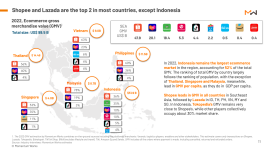
Indonesia topped online spending for Southeast Asia in 2022, accounting for more than half of the region’s purchases on digital platforms, according to a report by Singapore-based venture firm Momentum Works.

The report analysed spendings across Indonesia, Malaysia, the Philippines, Singapore, Thailand and Vietnam. Total Gross Merchandise Value (GMV) in the region, which refers to the value of goods sold via e-commerce platforms, hit US$99.5 billion, up from US$87.1 billion in 2021 and US$54.8 billion in 2020. Southeast Asia’s total GMV is projected to increase to US$175 billion in 2028.

Indonesia accounted for 52 percent of the figure in 2022, with GMV totalling US$51.9 billion.

Shopee is the most commonly used e-commerce platform in the region, with total GMV in 2022 at US$47.9 billion. TikTok, meanwhile, has been gaining ground in the region through TikTok Shop. It reportedly aims to more than triple its GMV in the region.

Going forward, online spending could be impacted by various factors such as the resumption of retail shopping, inflation, rising interest rates and the rise in commodity prices, the report states.


  • Total ecommerce platform GMV in Southeast Asia grew 1.8 times from 2020 to 2022, totalling ~ US$ 100B;
  • Shopee and Lazada are the top 2 ecommerce platforms in most countries, except Indonesia
  • Indonesia contributes 52% of the region’s GMV; while Singapore and Malaysia lead in GMV per capita;
  • Southeast Asia’s total GMV is projected to be US$175 billion in 2028, under a normal scenario with the potential of upside to US$232 billion under the best case scenario.
Southeast Asia’s ecommerce sector endured strong headwinds in 2022. Despite all these, growth and competition continue, with the total GMV of Southeast Asia’s 9 leading ecommerce platforms reaching US$ 99.5 billion in 2022, 1.8 times that of 2020 – the first year of the pandemic.

Purchase Momentum Works’ Ecommerce in Southeast Asia 2023 report for the breakdown of these numbers, and more importantly the insights connecting the dots behind.

 
To view this content we will need your consent to set third party cookies.
For more detailed information, see our cookies page.


ASEAN MILITARY BUDGET 1975 - 2022​


To view this content we will need your consent to set third party cookies.
For more detailed information, see our cookies page.


Military Expenditure As Percentage of GDP of ASEAN Countries 1970 - 2018 | ASEAN General #1​

 
Checking through some decades back

To view this content we will need your consent to set third party cookies.
For more detailed information, see our cookies page.
 

Thai, Malaysian and Indonesian currencies gain as dollar weakens​

Southeast Asia enjoys growth; political fears sink Turkish lira, Mexican peso

GENKI IKUTA, Nikkei staff writer
September 14, 2024 06:31 JST


TOKYO -- As the dollar softens on expectations of a U.S. interest rate cut, investors are moving money into emerging-market currencies, picking those most likely to benefit from a weak greenback while steering clear of political risk.

Asian currencies have performed particularly well against the dollar since the turmoil seen in global financial markets early last month. The Thai baht strengthened 6% between Aug. 1 and Sept. 12, while the Malaysian ringgit and the Indonesian rupiah each gained 5%.


How South-East Asia can weather the Trump trade typhoon​

The complacent region could use an outside jolt​


1731813831309.webp

Nov 14th 2024

In 1833 Edmund Roberts, President Andrew Jackson’s envoy, signed with the Kingdom of Siam in Bangkok a treaty of “amity and commerce”. It was America’s first in Asia, promising “commercial intercourse…as long as Heaven and Earth shall endure”. Nearly two centuries later, Thailand still feels the amity, and not just from America. “The Americans love us, the Chinese love us, we don’t have to choose sides,” boasted Pichai Naripthaphan, Thailand’s commerce minister, on November 7th. Mr Pichai thinks the America-China trade war, likely to escalate under Donald Trump, will only heat up the love-in.

 
To view this content we will need your consent to set third party cookies.
For more detailed information, see our cookies page.


New! ASEAN GDP and GDP per Capita 1980-2029 / IMF (Oct. 2024 Data)​

 
Indonesian Rupiah gets weaken, but it is manageable. It is likely good for our international trade as we see last month export is increasing


Thailand's Q3 auto sales plummet, bucking regional trend​

The Philippines on track to become Southeast Asia's third-largest market

ATSUSHI TOMIYAMA, APORNRATH PHOONPHONGPHIPHAT and NANA SHIBATA, Nikkei staff writers
November 15, 2024 11:28 JST

To view this content we will need your consent to set third party cookies.
For more detailed information, see our cookies page.


Vietnam to lead ASEAN in economic growth this year: HSBC​


By Dat Nguyen December 20, 2024 | 02:29 am PT

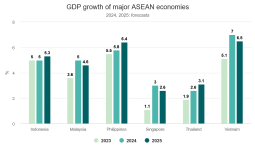
Vietnam is expected to lead ASEAN in growth this year with a GDP expansion rate of 7%, driven by manufacturing and trade, according to lender HSBC.

The forecast is grounded on strong performances in the second and third quarter with growth rates of 6.9% and 7.4% respectively, the bank said in a note.

Vietnam is expected to grow stronger than Indonesia, Malaysia, Philippines, Singapore and Thailand this year, making it once again "ASEAN’s growth star" after giving the position to the Philippines last year.
1734835886332.png

Vietnam started the year with a challenging first quarter, and the typhoon Yagi, the strongest to hit northern Vietnam in decades, added burden to the agriculture, forestry and fishery sector.

However, manufacturing raged on with the index of industrial production growing at 8.4% year-on-year in the first 11 months.

Exports surged 15.4% in the period, with electronics, textiles and footwears all posting strong expansion.

In terms of foreign direct investment, Vietnam recorded increases in property and energy, with nearly US$21.7 billion disbursed in the first 11 months, up 7.1% year-on-year.

This marks the third consecutive year in which disbursement exceeded $20 billion.

A number of large global companies have shown increasing interest in Vietnam this year.

Shunsin, a subsidiary of Apple supplier Foxconn, reportedly sought for a permit to invest $80 million to produce integrated circuits in northern Vietnam, indicative of improving production capabilities in Vietnam.

Google plans to set up an office in the country in April 2025, while chip giant Nvidia is working on building local centers to research and develop AI technologies.

The country, however, faces some challenges. Growth in the domestic sector has been recovering slower than expected, with retail sales growth remaining under pre-pandemic trend.

The Vietnamese dong has faced more fluctuation due to the volatilities before U.S.’s presidential election, China’s stimulus package and geopolitical tensions.

HSBC also warns Vietnam of food shocks next year. For instance, pork prices have been elevated as pork supply has been affected by African Swine Fever.

Whether end-demand for goods improves further will be key in determining the strength of Vietnam’s recovery, as Western markets make up close to half of Vietnam’s exports.

The possibility of the new U.S. administration, under Donald Trump, imposing higher tariffs on China and the rest of the world might affect Vietnam’s exports, as the U.S. is among its top markets.

"As result, exporters may have trouble finding alternative markets to substitute production away from the U.S. if tariffs become an issue," HSBC said.

The bank, however, still pegs Vietnam’s 2025 growth at an optimistic level of 6.5%, once again highest among the six biggest economies in ASEAN.


auto-user-sync
user-matching
 

Opinion | How South East Asia can become the next AI powerhouse.​

Young, dynamic and fast, the region has unique advantages, supported by investment in infrastructure, talent, policy support and collaboration​

Rachel Chang

Published: 8:30pm, 22 Dec 2024​


1734930697119.webp

The region is one of the world’s most economically significant, and its young and burgeoning middle class of 200 million people is the driving force behind its rapid digital transformation. Last year, Southeast Asia’s digital economy achieved US$11 billion in profits, up from US$4 billion just two years before. By 2050, Indonesia is projected to become the world’s fourth-largest economy, while Malaysia and Thailand are expected to have economies exceeding US$1 trillion each.

A report by Singapore-owned investment company Temasek Holdings, Google and global consultancy Bain & Company found that businesses in Southeast Asia can transition from idea to full-scale production in under six months, with 70 per cent of organisations achieving a return on investment within a year of implementation.

This efficiency is not unique to the region. What sets Southeast Asia apart is its focus on partnerships between regions and industries, which are key for start-ups. For instance, the Asean committee on science, technology and innovation has an AI cooperation framework to develop and collaborate on AI across the members of the Association of Southeast Asian Nations.

Despite its potential, however, Southeast Asia still faces several challenges, with talent shortages a significant hurdle. Globally, up to 70 per cent of data, security and development roles are estimated to be going unfilled. This gap is compounded by the regional’s demand for both technical expertise in building AI systems and the domain-specific knowledge needed to implement them effectively.


------------------------------

Rachel Chang is the head of Accelerator and Partnerships at Tribe and a director at The Ignition AI Accelerator, a collaboration with NVIDIA, Tribe and DISG. She drives AI and blockchain innovation by connecting global corporations, government agencies, and startup

 
SIngapore is projected by IMF to be in second position in ASEAN economy, replacing Thailand in 2025

To view this content we will need your consent to set third party cookies.
For more detailed information, see our cookies page.
 
To view this content we will need your consent to set third party cookies.
For more detailed information, see our cookies page.


Singapore, Malaysia to Launch Special Economic Hub​


To view this content we will need your consent to set third party cookies.
For more detailed information, see our cookies page.


Who Gains From Malaysia-Singapore Economic Zone | Full Episode | Insight with Haslinda Amin 1/8/2025​

 
To view this content we will need your consent to set third party cookies.
For more detailed information, see our cookies page.


RTS Link 2025 Update:- The Future of Cross Border Connectivity Malaysia & Singapore​


Users who are viewing this thread

Latest Posts

Back
Top