Bangladesh Economy

The accusations for cooking the books were always targeted towards forex reserves and GDP size. Not export figures.

At least I haven't seen anyone point to export figures.


Err, please look through the posts on this thread and you will see this.

Some BD'shis joined the Indians to bash BD as they did not like Hasina.
 
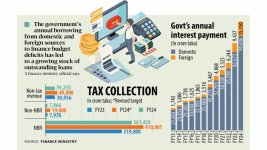
Interest payments surpass Tk 100,000cr for first time
interest-payments.jpg

The government's interest payments against loans surged 24.5 percent in fiscal year 2023-24, exceeding the Tk 100,000 crore mark for the first time in history, thanks to higher borrowing costs for loans from both domestic and foreign sources.

According to the finance ministry's fiscal report released yesterday, over Tk 114,000 crore was spent on interest payments in FY24, representing more than one-sixth of the national budget.

While spending on subsidies decreased slightly, the government missed the revenue targets set by the International Monetary Fund (IMF) for its ongoing $4.7 billion loan programme.

Initially, the government allocated Tk 94,376 crore for interest payments in FY24. However, this figure rose to over Tk 105,000 crore in the revised budget.

However, the actual figure even overshot the revised mark, indicating the government's dependence on borrowing to finance budget deficits.

Interest payments for foreign loans increased 60.53 percent to Tk 15,150 crore last year while rising 20.48 percent to Tk 99,606 crore for domestic loans.

In FY23, total interest payments amounted to Tk 92,110 crore.

A finance ministry official said the government's annual borrowing to finance budget deficits had led to a growing stock of outstanding loans.

As of March 2024, the government's total outstanding debt stood at Tk 1,697,415 crore, which is equivalent to 33.78 percent of the country's gross domestic product (GDP).

The Finance Division's Medium-Term Macroeconomic Policy Statement (MTMPS) said that interest payments would continue to rise gradually in the coming years.

The report mentioned that the proportion of external interest payments as a percentage of the national budget would rise to 2.6 percent in FY27 from 0.9 percent in FY22, reflecting the growing impact of external debt on the budget.

The report also said two major factors contributed to the increase in interest payments for foreign loans.

It further anticipated that reference rates in advanced economies, which serve as benchmarks for setting other interest rates, would remain elevated for some time.

Besides, Bangladesh's graduation from least developed country status in 2026 will gradually limit access to concessional loans from external sources, increasing borrowing pressure.

"This increase is attributed to a higher proportion of borrowing through floating and semi-concessional rates, which are more sensitive to market fluctuations compared to fixed-rate financing," said the report.

Moreover, the depreciation of the local currency taka against the US dollar has inflated the value of external debt when measured in terms of the local currency.

Regarding domestic borrowing, the banking sector has been the main source of funds. The Bangladesh Bank's recent policy rate increases have contributed to rising interest payments on domestic loans.

SUBSIDY EXPENDITURES DECLINE SLIGHTLY

The government has also been facing a new challenge due to significantly increased subsidy expenditures in recent years.

As such, the IMF has been pushing the government to reduce these expenditures by raising power and fertiliser prices.

In FY24, the government spent less on subsidies than allocated in the revised budget. In the revised budget, the total subsidy allocation was Tk 85,906 crore, but actual spending amounted to Tk 72,497 crore.

IMF TARGET MISSED AGAIN

After the IMF approved a $4.7 billion loan programme in January last year, the government struggled to meet the targets set for revenue and foreign currency reserves. In most cases, it has failed to achieve the targets.

As a result, the government had to seek a waiver for disbursal of three tranches of the loan so far.

For the fourth tranche, the IMF has set the target for tax revenue collection at around Tk 394,000 crore by June this year.

At the end of the last fiscal year, the government's tax revenue collection was Tk 369,000 crore, meaning it missed the target by Tk 25,240 crore.

BUDGET IMPLEMENTATION FALLS FLAT

Despite announcing large annual budgets, the government consistently fell short in implementation.

In the last fiscal year, the budget size was initially set at around Tk 761,000 crore before being revised to Tk 714,000 crore. However, total budget spending reached only Tk 602,000 crore.

The spending in the previous fiscal year was around Tk 574,000 crore.

Last year, the government allocated Tk 245,000 crore for the Annual Development Programme (ADP) in the revised budget but spent only Tk 188,000 crore.

In FY23, the ADP spending was Tk 192,000 crore.


@UKBengali

To view this content we will need your consent to set third party cookies.
For more detailed information, see our cookies page.


Excellent news and hopefully there is much much more to come.

We need a complete and comprehensive energy grid that covers NE India, BD, Nepal and Bhutan.
 
Regarding Nepal Hydropower that could also relate to Bangladesh

Nepal Wants Indonesia to Invest in Its Hydropower​


Jayanty Nada Shofa

September 23, 2024 | 9:31 am

Jakarta. Nepal is nudging Indonesia to invest in its hydropower sector which is already the top source of the South Asian country’s power generation.


Nepalese Foreign Affairs Minister Arzu Rana Deuba made the pitch during bilateral talks with her Indonesian counterpart Retno Marsudi in New York over the weekend. The diplomats were in the US to attend a UN General Assembly session. According to the Indonesian Foreign Affairs Ministry, the discussions dealt with cooperation in the renewable energy sector, among others.


“Nepali Foreign Minister [Deuba] extended her appreciation towards the stronger bilateral ties and hopes that both countries can further strengthen their partnership. She also called for Indonesian investment in tourism and hydropower development in Nepal,” the ministry said in its statement.


The ministry did not go into details on the scope of cooperation that Nepal was seeking. According to the Nepal Electricity Authority (NEA), as reported by Reuters last May, the country generates about 2,700 megawatts of electricity of which a large part comes from hydropower. This surpasses the country’s demand of 1,700 megawatts but only makes up less than 7 percent of its total hydro potential.

While Indonesian state-owned enterprises (SOEs) have been expanding their international presence over the years, the country still does not use much of its hydropower. Indonesia is seeking to reach net zero emission by 2060 or sooner. Last October, then-Energy Minister Arifin Tasrif revealed that the archipelagic Indonesia’s hydropower potential stood at 95 gigawatts, but its installed capacity had only reached 6.7 gigawatts. The government is planning to raise the installed hydropower capacity to exceed 10 gigawatts by 2030.


Abdul Kadir Jailani, a senior official at the Foreign Affairs Ministry, just last week revealed that the Indonesian SOEs were eyeing to increase their investments in the largely untapped markets of South Asia and Central Asia. The energy sector-related investments were among the areas of interest for these SOEs.

 
To view this content we will need your consent to set third party cookies.
For more detailed information, see our cookies page.
 
To view this content we will need your consent to set third party cookies.
For more detailed information, see our cookies page.
 

How Bangladesh repaid $1.5bn in foreign debts without tapping into reserves​


Goal is to eliminate debt within the next two months, says Dr Ahsan H Mansur.

Despite the cash crunch in the country's banks, Bangladesh is no longer facing a dollar shortage.

By curbing money laundering and reducing corruption, the supply of dollars in the interbank market has increased significantly.

This improvement has allowed Bangladesh Bank to repay $1.5 billion in foreign dues over the past two months without dipping into its reserves, sourcing the dollars from the interbank market instead.


Bangladesh Bank Governor Dr Ahsan H Mansur explained that while banks previously struggled with a dollar shortage, most now have a surplus of dollars. Though cash remains scarce, the supply of dollars is stable.

Expatriates primarily send remittances in dollars to banks, and export earnings are also deposited there first. Dollars accumulate in the banks, which then open Letters of Credit (LC) or sell the dollars to Bangladesh Bank when needed. The central bank purchases these dollars and adds them to its reserves.

Dr Mansur further clarified that while Bangladesh Bank routinely buys and sells dollars from commercial banks, it has not sold any from its reserves recently.


Well, the situation is improving steadily.

@LeonBlack08 @AbuShalehRumi @Alter_Ego @Bengal71 @Oscar
 

How Bangladesh repaid $1.5bn in foreign debts without tapping into reserves​


Goal is to eliminate debt within the next two months, says Dr Ahsan H Mansur.

Despite the cash crunch in the country's banks, Bangladesh is no longer facing a dollar shortage.

By curbing money laundering and reducing corruption, the supply of dollars in the interbank market has increased significantly.

This improvement has allowed Bangladesh Bank to repay $1.5 billion in foreign dues over the past two months without dipping into its reserves, sourcing the dollars from the interbank market instead.


Bangladesh Bank Governor Dr Ahsan H Mansur explained that while banks previously struggled with a dollar shortage, most now have a surplus of dollars. Though cash remains scarce, the supply of dollars is stable.

Expatriates primarily send remittances in dollars to banks, and export earnings are also deposited there first. Dollars accumulate in the banks, which then open Letters of Credit (LC) or sell the dollars to Bangladesh Bank when needed. The central bank purchases these dollars and adds them to its reserves.

Dr Mansur further clarified that while Bangladesh Bank routinely buys and sells dollars from commercial banks, it has not sold any from its reserves recently.


Well, the situation is improving steadily.

@LeonBlack08 @AbuShalehRumi @Alter_Ego @Bengal71 @Oscar

This is a good win for the IG to gain back some confidence. It got quite a bit of positive buzz in the social media too, which is a win for the IG and gives them some precious breathing space.
 

How Bangladesh repaid $1.5bn in foreign debts without tapping into reserves​


Goal is to eliminate debt within the next two months, says Dr Ahsan H Mansur.

Despite the cash crunch in the country's banks, Bangladesh is no longer facing a dollar shortage.

By curbing money laundering and reducing corruption, the supply of dollars in the interbank market has increased significantly.

This improvement has allowed Bangladesh Bank to repay $1.5 billion in foreign dues over the past two months without dipping into its reserves, sourcing the dollars from the interbank market instead.


Bangladesh Bank Governor Dr Ahsan H Mansur explained that while banks previously struggled with a dollar shortage, most now have a surplus of dollars. Though cash remains scarce, the supply of dollars is stable.

Expatriates primarily send remittances in dollars to banks, and export earnings are also deposited there first. Dollars accumulate in the banks, which then open Letters of Credit (LC) or sell the dollars to Bangladesh Bank when needed. The central bank purchases these dollars and adds them to its reserves.

Dr Mansur further clarified that while Bangladesh Bank routinely buys and sells dollars from commercial banks, it has not sold any from its reserves recently.


Well, the situation is improving steadily.

@LeonBlack08 @AbuShalehRumi @Alter_Ego @Bengal71 @Oscar

when you no longer have ruling party men and women offshoring money to accounts and properties in Singapore, UAE and some Western countries.
 
Last edited:
BD reserves are nearly $25b with commitments and nearly $20b without and rising daily.

I am hoping there would be no further shocks that will allow for borrowings to be further lowered.

Purchase of luxuries must still be contained but BB must relax on LC for inputs for our industries.
 

Users who are viewing this thread

Country Watch Latest

Back
Top