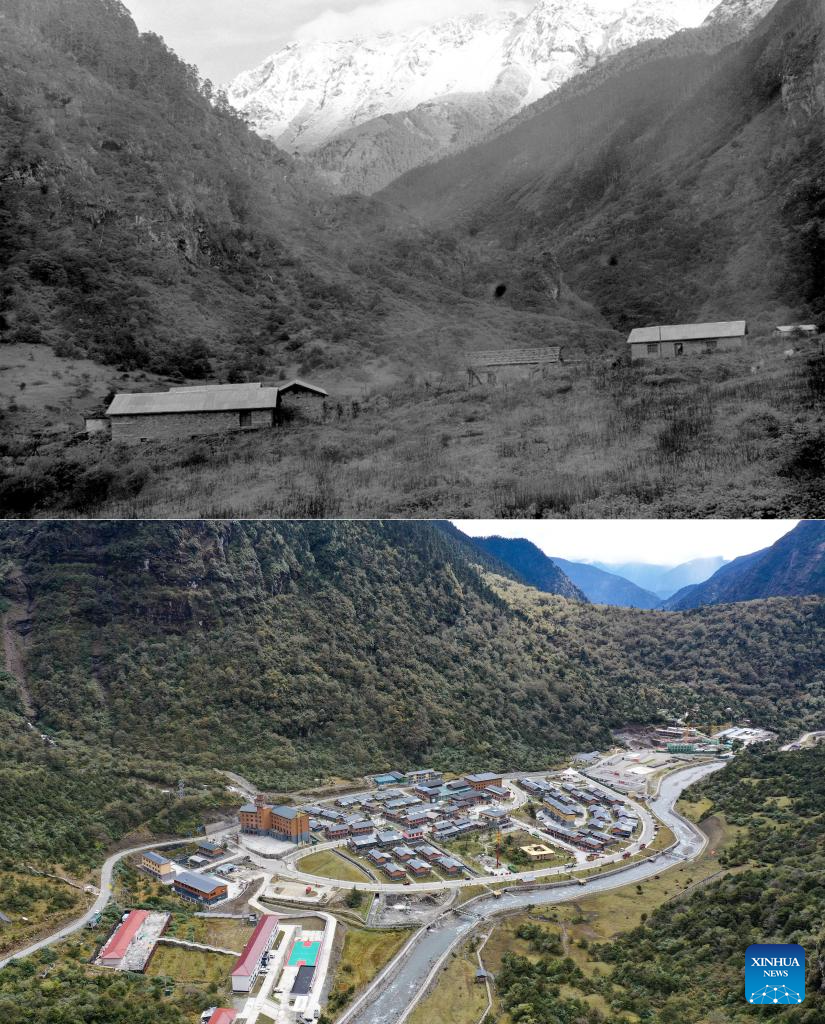
Tibet border defence village, free house and $10,000 per person a year

It has everything to do with Confucianism Yes My Korean friend told me if it were not for Confucianism Korea would become Mongolia one country where Confucianism didn't take root. Confucianism emphasizes hard work, patience, and dedication to learning All of them are the brew that creates economic miracles in the Far East! Just look at the fact all the Sino-centric countries are now rich Japan, China, Korea, Spore, and even Vietnam which spent most of the last century in war now has the fastest economy in SEA.

Now who are the poor? all are the Indian influence countries, Cambodia, Myanmar, Laos, and archipelago countries


So it took more than 2000 years for Confucian ideas to make them rich, right? You guys get minted from same factory, or what?

2000 years of poverty and in last 60 years, magical Confucian ideas did wonder.

You guys are pure comedy.
 
So it took more than 2000 years for Confucian ideas to make them rich, right? You guys get minted from same factory, or what?

2000 years of poverty and in last 60 years, magical Confucian ideas did wonder.

You guys are pure comedy.
What are you talking China was rich in the Tang Dynasty, Song Dynasty, Ming Dynasty, and early Qing Dynasty. You are the one that defies logic

Yes, the Song dynasty (960–1279) was one of the richest and most prosperous dynasties in China's history:

  • Economic growth
    The Song dynasty's economy was characterized by a combination of market forces, including specialization, industrialization, urbanization, commercialization, and monetization. The Song dynasty's national income was about three times that of 12th century Europe.
The economy of the Song dynasty (960–1279) has been characterized as the most prosperous in the world at the time.<a href="https://en.wikipedia.org/wiki/Economy_of_the_Song_dynasty#cite_note-FOOTNOTEMcDermottShiba2015435-1"><span>[</span>1<span>]</span></a> The dynasty moved away from the top-down command economy of the Tang dynasty (618–907) and made extensive use of market mechanisms as national income grew to be around three times that of 12th century Europe.<a href="https://en.wikipedia.org/wiki/Economy_of_the_Song_dynasty#cite_note-FOOTNOTELiu2015294-2"><span>[</span>2<span>]</span></a> The dynasty was beset by invasions and border pressure, lost control of North China in 1127, and fell in 1279. Yet the period saw the growth of cities, regional specialization, and a national market. There was sustained growth in population and per capita income, structural change in the economy, and increased technological innovation such as movable print, improved seeds for rice and other commercial crops, gunpowder, water-powered mechanical clocks, the use of coal as an industrial fuel, improved iron and steel production, and more efficient canal locks. China had a steel production of around 100,000 tons plus urban cities with millions of people at the time.<a href="https://en.wikipedia.org/wiki/Economy_of_the_Song_dynasty#cite_note-3"><span>[</span>3<span>]</span></a>
 
What are you talking China was rich in the Tang Dynasty, Song Dynasty, Ming Dynasty, and early Qing Dynasty. You are the one that defies logic


Bots man. I was talking about Korea. And so was India, for most of it's recorded history. Learning facts is hard.
 
  • Haha
Reactions: ety
Bots man. I was talking about Korea. And so was India, for most of it's recorded history. Learning facts is hard.
Korea too was rich in Sila, Joseon dynasty Even earlier Goguryo encompassed much of Manchuria
 
Bots man. I was talking about Korea. And so was India, for most of it's recorded history. Learning facts is hard.
When was Korea's golden age? If we are speaking figuratively, some may answer the Joseon Dynasty (1392-1910), the period most often revisited in modern K-dramas. But if we are talking literally, you need to go back much further―to the era of the Shilla.

During its 500-year duration, Joseon encouraged the entrenchment of Confucian ideals and doctrines in Korean society. Neo-Confucianism was installed as the new state's ideology. Buddhism was accordingly discouraged, and occasionally Buddhists faced persecutions. Joseon consolidated its effective rule over the Korean peninsula and saw the height of classical Korean culture, trade, literature, and science and technology. In the 1590s, the kingdom was severely weakened due to the two failed Japanese invasions of 1592 and 1598. Several decades later, Joseon was invaded by the Later Jin dynasty and the Qing dynasty in 1627 and 1636–1637 respectively, leading to an increasingly harsh isolationist policy, for which the country became known as the "hermit kingdom" in Western literature. After the end of these invasions from Manchuria, Joseon experienced a nearly 200-year period of peace and prosperity, along with cultural and technological development. What power the kingdom recovered during its isolation waned as the 18th century came to a close. Faced with internal strife, power struggles, international pressure, and rebellions at home, the kingdom declined rapidly in the late 19th century.
 
Tibetans now are so loyal to China after seeing what a abysmal life their fellow Tibetans live in the Tibetan lands under Indian administration.
 
Yup young Tibetans now consider themselves Tibetan Chinese
Considering their grandparents were either tenant farmers or slaves, now they can achieve their personal best

To view this content we will need your consent to set third party cookies.
For more detailed information, see our cookies page.
 
Yup young Tibetans now consider themselves Tibetan Chinese
Considering their grandparents were either tenant farmers or slaves, now they can achieve their personal best

To view this content we will need your consent to set third party cookies.
For more detailed information, see our cookies page.

I hope this girl can pass the test of the flight school, graduate smoothly, and become a true fighter pilot
Screenshot_20241011_090538.jpgScreenshot_20241011_090355.jpgScreenshot_20241011_090313.jpgScreenshot_20241011_090323.jpg
 
Yume 2009 and 2024

20241016153de14fd7da4bd6b2ab0974a3dd2dca_202410166ffa4d2eee024ea3957368642c2c7df4.jpg
 
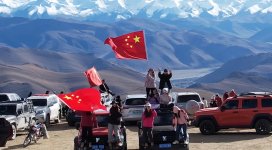
Now millions of highly motorized tourists alone can effective defend China-India border :ROFLMAO:

小姐妹无高反西藏旅游记录_5_xnmx._来自小红书网页版.jpg
 
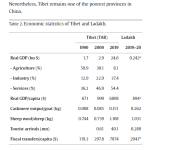
Ecomony comparison between Tibet and India controlled ethnic Tibetan Ladakh region.

微信图片_20241022165823.png

The above chart was from 2020

In 2023, the per-capita gross domestic product (GDP) of Tibet Autonomous Region in China reached around 65600 yuan ( $9,370)
 
Tibetans also get full medicare coverage and free education from kingdergarten all the way to college, so in a sense, they could have better standard of living than people from east China. Tibetans mostly drive better cars than China's average car owners.
 

Check out what cars Tibetan herders like to buy in rural pastural Tibet​

Outside a local village gathering in pastrual rural Tibet, A traveler checks out what cars Tibetan herders like to drive, he found out that Tibetan herders love Japanese large SUVs due to the local harsh terrain. Based on a survey, the highest concentration of Japanese SUV Landcruiser in China is Tibet.

To view this content we will need your consent to set third party cookies.
For more detailed information, see our cookies page.
 
Tibetan herder girl joins a friend's wedding in rural Tibet, after the wedding, on her way home, she checks out the cars the wedding guests drive to the wedding, mostly are big SUVs, she says you never see cheap small cars in Tibet.

To view this content we will need your consent to set third party cookies.
For more detailed information, see our cookies page.

240312185544-jpg.25712
 
EVs are also getting popular in Tibet due to much improved charging facilities all across Tibet in recent years.

86t6fg-jpg.28997
 

Users who are viewing this thread

Back
Top