Pakistan Constitutional Amendments:

The question is really what would happen to such a system that has like a parasite and a cancer embedded itself as these false crumbling walls of a state?

Will it be a collapse of the USSR situation when one day it was there and then a Yeltsin on the parliament attack makes it no more - Soviet Army troops simply stood confused in their bases - some celebrating others just contemplating tomorrow - but no real hoolple outside moscow?

Is it going to be a Yugoslavia-lite after a flare up of the current civil war(Im not sure what else is to be used when talking to Balochistan and KP) - perhaps a few hundred thousand displaced - a weak federated state trying to keep what it has with statelets like Syria surviving on warlords?

Technically the nuclear weapons are pretty useless in this scenario and more so a bargaining chip for the system to avoid India stepping in and keep the IMF lifelines flowing - but at the end losing territorial sovereignty seems all but inevitable now in many places
I think it's a cycle that feeds back into itself.

The obvious ethnic divide (like your Yugsoslavia example) invokes a sense of insecurity in the system causing them to react by undemocratically extending their grip on the country.

Democracy has failed in Pakistan because Pakistan isn't really an organic nation. It's made of several interest groups who often have extremely different perspectives on what their interests are. This leads to the dysfunctionality.
 
I just wanted to gauge your position here, since everyone in the thread seemed to be speaking from the perspective of PTI (a federalist patriot party).

Seems like you're speaking from an apolitical non-nationalist perspective so understandable.

Though I would say that any country in the world would have done what Pakistan did against separatist militants. In fact Pakistan probably is one of the softest states if you observe the actions of others. Don't beat yourself up over it too much.

Separatists who take up arms against the state may be seen as fair targets, as are the military installations of a force viewed as an occupier by the local population. Yet, when separatists target innocent civilians, and the armed forces resort to indiscriminate killings and abductions under the pretext of fighting separatism, both are guilty of engaging in terrorism.

The real question, however, is what drives people to the point where they feel compelled to take up arms against the state. Militant separatist movements don’t emerge in a vacuum; they are usually rooted in deep-seated resentment, born of a belief in being wronged and oppressed, and fueled by the systematic denial of any avenues to address those grievances within the existing framework.

Take the case of erstwhile East Pakistan, for example. The Bengali people did not turn against Pakistan overnight. For over 20 years, they were systematically denied their basic democratic rights, with every available avenue for redress closed off. This long-standing marginalization ultimately culminated in the state’s violent crackdown in 1971, to which the Bengalis, in turn, responded. A crucial, yet often overlooked, development was the 1954 provincial elections in East Pakistan. Originally due in 1951, the elections were delayed by the Establishment's stalling tactics—though this ultimately did little to save them. The election saw a sweeping victory for the socialists and nationalists of the United Front, which secured 228 out of 309 seats (including nine reserved for women). In stark contrast, the Muslim League, which had been in power in one form or another since 1937, won a mere 7 seats. This marked the rise of Bengali nationalism. However, just two months later, on May 30, the ministry was dismissed and direct governor’s rule was imposed.

And then, by 1957, most of the dissenters had coalesced into the left-wing, secular National Awami Party (NAP) and were confident in their prospects of winning a majority in the promised direct elections set for 1958. However, later that year, the first Martial Law was imposed in the country. Fast forward to 1970, when the first general elections were finally held, 23 years after the country's independence. Once again, the Bengalis secured a majority. Yet, the establishment denied them their rightful claim to power once again and instead launched a brutal crackdown. After exhausting all constitutional and lawful avenues, the Bengalis were left with no choice but to take up arms—and the rest, as they say, is history.

....

It seems the Pakistan Army has learned little from its past mistakes. Once again, by shutting down all legal and constitutional avenues for citizens to secure their basic rights—through rigging elections, manipulating the courts, and relying on brute force—they are driving people toward more extreme measures to claim what is rightfully theirs. And while the geopolitics of East Pakistan were different, and we may not witness a repeat of the 1971 scenario involving Indian involvement, the fundamental point remains: this growing dissatisfaction and alienation will inevitably manifest in its own unique ways, potentially threatening the very existence of what remains of Pakistan.
 

Newly formed Special Parliamentary Committee to nominate next CJP today

Nadir Guramani
October 22, 2024

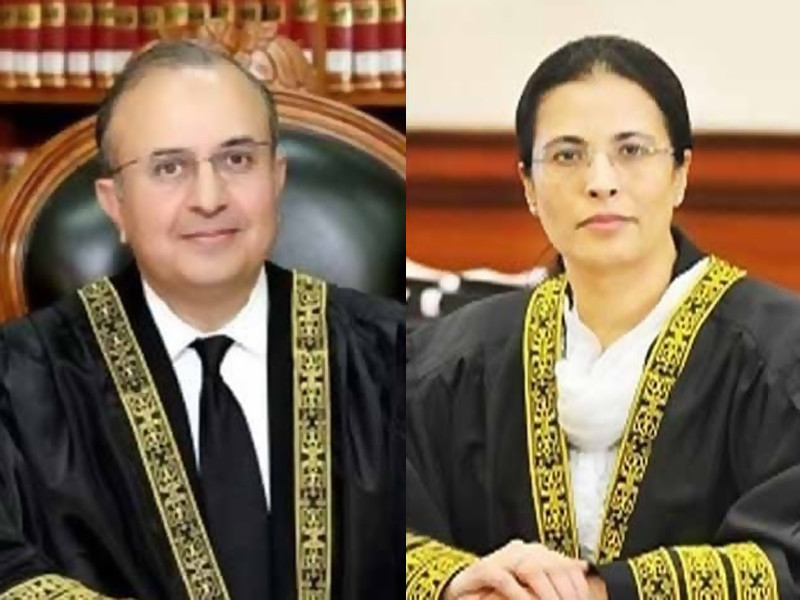
A combination photo of Justice Mansoor Ali Shah, Munib Akhtar and Yahya Afridi. — SC


A combination photo of Justice Mansoor Ali Shah, Munib Akhtar and Yahya Afridi. — SC

The newly appointed Special Parliamentary Committee (SPC) is set to nominate the next chief justice of Pakistan (CJP) today from among the three most senior Supreme Court judges after it meets at 4pm.

CJP Qazi Faez Isa is set to retire as the top judge on October 25. Senior puisne judge Justice Mansoor Ali Shah was previously set to be the next CJP under the seniority principle.

However, the newly enacted 26th Constitutional Amendment has brought numerous changes pertaining to the judiciary, among which is the process of appointing the CJP.

Under amendments to clause 3 of Article 175A, instead of the president appointing the “most senior judge of the Supreme Court” as the CJP, the top judge will now be “appointed on the recommendation of the Special Parliamentary Committee from amongst the three most senior” SC judges.
 
After Justice Shah, the next two senior apex court judges are Justices Munib Akhtar and Yahya Afridi.

Under a new clause 3C of Article 175A, the first nomination after the Amendment was in force is to be sent “within three days prior to the retirement” of the outgoing CJP.

This sets the deadline for the SPC to sent its nomination latest by tonight, as Justice Isa is to retire on October 25.

The SPC, which was formed a day ago by National Assembly Speaker Ayaz Sadiq, comprises eight MNAs and four senators nominated by their respective parliamentary leaders. Political parties have representation in the committee based on their strength in the parliament.

The committee comprises PML-N’s Khawaja Asif, Ahsan Iqbal, Shaista Pervaiz Malik and Senator Azam Nazeer Tarar; PPP’s Raja Pervez Ashraf, Naveed Qamar and Senator Farooq H. Naek; Sunni Ittehad Council’s Hamid Raza; PTI-affiliated MNA Gohar Khan and Senator Ali Zafar; Muttahida Qaumi Movement-Pakistan MNA Rana Ansar; and Jamiat Ulema-i-Islam-Fazl’s Senator Kamran Murtaza.

According to a notification issued by the NA secretariat, an in-camera meeting of the special committee will take place today at 4pm.

However, according to a post on PTI MNA Sheikh Waqas Akram’s X account, the party’s political committee decided that the PTI would not participate in the meeting.


22131936030d4f8.png
 

Who will rule the SC roost?

“The constitutional package is a bundle of confusion and no institution can function with so many contradictions,” a senior counsel says.

Nasir Iqbal
October 22, 2024

• Observers fear ambiguities in text of 26th amendment will give rise to even more litigation
• Amendment provides for situation where CJP may also become presiding judge of constitutional bench

Who wields the real authority in the new Supreme Court; is the chief justice of Pakistan or the presiding judge of the new constitutional bench?

This is one of the main questions swirling in the minds of legal practitioners, jurists and observers in Islamabad and beyond, following the early morning passage of the 26th constitutional amendment.

Whatever their political allegiances may be, most agree the Constitutional Package has created a parallel judicial system of sorts, within the very hierarchy of the apex court.

Advocate Syed Ahmad Hassan Shah described the constitutional bench as a ‘can of worms’, predicting that it would experience teething problems, since it had effectively substituted the three-judge committee formed under the Supreme Court (Practice and Procedure) Act 2023.

“The constitutional package is a bundle of confusion and no institution can function with so many contradictions,” commented another senior counsel, who wished to remain unnamed.

The manner of its operation is completely confusing, and confusion often results in more litigation, rather than keeping it in check, he feared.

For example, who will decide a tax matter; the Supreme Court or its constitutional bench? Things become especially murky when the case calls into question the very constitutionality of a particular tax law.

Now, if such a matter lands before the constitutional bench, it may chose to decide the entire case — both the vires of the law as well as the actual dispute between parties — since judges of the constitutional bench will also be sitting as judges of the apex court. This is bound to give rise to a jurisdictional debate within the judiciary.

A couple of off-the-cuff observations by SC judges during Monday’s proceedings indicated that this was no idle prediction.

During the hearing of a matter concerning the Competition Commission of Pakistan (CCP), senior puisine judge Justice Syed Mansoor Ali Shah wondered whether it would be heard by a constitutional bench now, in the same breath adding that these ‘second thoughts’ may soon become a recurring question in the Supreme Court.

During the same hearing, Justice Ayesha Malik also remarked in a lighter vein, “Good luck to your constitutional benches.”

That case was adjourned for three weeks, with Justice Shah noting that the situation may become clearer by then.

Similarly, in another hearing related to the setting up of a climate change authority, Justice Shah inquired whether the authority’s chairman had been notified. When he was told by Additional Attorney General Javed Iqbal that this had not been done so far, as the attorney general for Pakistan was otherwise “busy” with the Constitutional Package, Justice Shah observed that “now all the busy-ness must be over”.
 
CJP may also be presiding judge

“I see this enterprise destined to fail and eventually merging with the Supreme Court within a span of six or seven months,” the senior counsel commented.

He was of the view that the first case taken up by the constitutional bench may be the review petition against the July 13 reserved seats judgment, in which a majority of judges, led by Justice Syed Mansoor Ali Shah, had declared the seats to be rightfully PTI’s.

In normal course, it is the CJP who enjoys the final authority in administrative, disciplinary and financial matters of the Supreme Court.

Under Section 14(2) of the package, the most senior amongst the judges nominated by the JCP will serve as the presiding judge of the constitutional bench.

But an explanation — appended to the table outlining the fresh constitution of the JCP in the 26th amendment — hints that the CJP himself could also become the presiding judge.

This may serve to allay concerns about the formation of parallel courts within the SC, but a lack of clarity prevents most people from commenting on it.

“When there is a conflict, the one with more strength and power prevails over the weak,” he said, recalling that since no significant amendment has been done to change the complexion of the Supreme Judicial Council (SJC), which functions under Article 209 of the Constitution, the constitutional body may be used to settle “misconduct” of any judge, who may also be a member of the constitutional bench.

Besides, the CJP still has powers regarding the perks and privilege of the judges, initiation of disciplinary action against judges, sanctioning ex-Pakistan leave, approval of hospital bills or other provisions like allotment of office chambers, substitution of staff or drivers etc and can even transfer judges, to different registries in different cities.

The constitutional bench has been likened to the Shariat Appellate bench of the Supreme Court, which hears appeals against decisions by the Federal Shariat Court. But the schedule of the bench is always decided by CJP.

It also not clear whether the constitutional bench will have a separate registrar, or will it also be officiated through the same registrar’s office as the Supreme Court.

In Advocate Shah’s view, members of the constitutional bench will not necessarily be appointed in accordance with the seniority list, since the bench is to consist of judges representing all provinces.

The question will then arise, whether the judges sitting in the constitutional bench will have more seniority, or the judges of the Supreme Court.
 
One bench or more?

Some lawyers suggest that following the insertion of Article 191A into the Constitution, the constitutional bench will comprise judges of the Supreme Court, but there will be no security of tenure for members of these benches since their composition could be changed at any time.

The JCP, apparently, now has the power to constitute more than one constitutional bench, but observers say that only one bench may be formed for the time being.

Another interesting contingency that has been provided for in the amendment is that of refusal or rebellion; a substitution in clause (3) of Article 175A, which details the nomination of the CJP from amongst the three most senior judges of the Supreme Court by the Special Parliamentary Committee.

As per the amendment, in case the first nominee declines, one judge from the remaining two shall be nominated. If they too decline, the job may be offered to the third judge. And in case all three refuse, the next in the seniority line after the top three can also be brought into contention.

Published in Dawn, October 22th, 2024
 

1729597684673.png

Judicial capture: Lawyers react to ‘diluted’ 26th Constitutional Amendment Bill

The 26th Amendment has dealt a body blow to Pakistan’s democracy and its constitutional order, said Barrister Asad Rahim.

Dawn.com
October 20, 2024

Following weeks of upheaval, the coalition government on Sunday finally passed the controversial 26th Constitutional Amendment Bill in the Senate, hours after it was approved by the federal cabinet. The bill is now expected to be passed by the National Assembly to enact it into law.

The bill, dubbed the Constitutional Package, proposes a set of constitutional amendments, including but not limited to the tenure and appointment of the Chief Justice of Pakistan (CJP) and the evaluation of judges’ performances. A special parliamentary committee formed last month — which had representation of all parties, including the PTI — had been discussing various proposals after initial attempts to bulldoze it through Parliament failed.

The latest version of the bill received the nod from all political parties, including the PTI — which, however, chose not to participate in the voting process.

But what do these amendments mean for the independence of the judiciary in Pakistan. We asked lawyers for their two-cents.

Barrister Asad Rahim minced no words about the implications of the amendments on the judiciary’s independence. “The post-Musharraf consensus is officially over. The 26th Amendment is the biggest reversal for judicial independence in three decades,” he said.

“Appointments of judges have been handed back to the executive, which — as our history is witness — should have no business in such a selection.

“The method for handpicking the Chief Justice of Pakistan, among a list of three, will ensure a game of thrones every few years, thus wrecking a system that was until now immune to such intrigue,” he argued.

“Judges that were confirmed as future chief justices as late as yesterday will likely retire before ever making it, in favour of a system that will naturally prefer pliant or partisan candidates.

“Taken together, the 26th Amendment has dealt a body blow to Pakistan’s democracy and its constitutional order,” he lamented.
 

The same basic problem​

For lawyer Moiz Jaferii, the current draft being tabled “is clearly a climb down from the first attempt at steamrolling through an entirely separate apex court and leaving the Supreme Court supreme in name only.”

He added, however, that “it still suffers from the same basic problem: the idea of the executive picking a chief justice and a parliamentary committee determining which superior court judge can hear constitutional matters are both direct attacks on judicial independence.

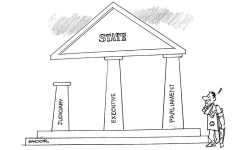
“They suffer from the same flaw that the original amendment did, in that they bring the pillar of the judiciary into a measure of subservience to the legislature and the executive.

“Where the first amendment draft spoke of the first chief justice to be appointed by the prime minister, the intervention of a parliamentary committee is now to be a continuous process. These Constitution benches and the picking of judges from within the superior courts if they are deemed worthy are a separate court in all but name. The designs behind them are little more than an attempt at bringing independent judges to heel.

“The manner in which this amendment has been attempted and today finally likely to be passed is a story of malice in itself — the threat of brute or brutal force plain for all to see.

“Championed by politicians in the name of parliamentary supremacy, it is clear to everyone where the actual interest lies.

“An election has been stolen. There is a government crowned with an illegitimate mandate. The Constitution must now pay the price lest the right to that crown be fairly adjudicated.”

According to lawyer Rida Hosain, “the fundamental problem with the previous drafts, and the current one, is the obvious aim to capture an independent judiciary.”

The CJP is to be appointed from a panel of the three senior most judges by a parliamentary committee. The government commands the majority in the parliamentary committee, and the government will have a majority say in the appointment of the CJP, she explained, adding that the government is a party before the Supreme Court. “A litigant (such as the government) cannot choose the head of the institution where it will appear as a party.”

Furthermore, she added, “a commission that includes government representatives will ‘evaluate’ the performance of superior court judges. Allowing government representatives to evaluate judicial performance is tantamount to giving the government the right to punish and reward judges. The government may render an adverse evaluation to target a judge that has given decisions against them.”

“The amendments are a huge blow for judicial independence. The professed aim of the amendments is to ‘depoliticise’ the judiciary. In fact, the amendments do the exact opposite. The government has effectively inserted itself into:

  • the process of appointment of the CJP,
  • the evaluation of performance of superior court judges, and
  • the creation of the constitutional bench.
“This is not depoliticising; this is an attempt to exert control and influence over the superior judiciary. An attack on judicial independence is an attack on fundamental rights — a judiciary that is not independent cannot dispense justice without fear or favour. This impacts all citizens,” she stressed.
 

Emasculating the judiciary​

“The proposed Constitutional Amendment betrays the government’s desire to emasculate the judiciary by giving the government’s members a majority on the judicial commission,” said lawyer Mirza Moiz Baig. “Given that the reconstituted judicial commission will now also determine the composition of the constitutional benches, the Amendment effectively seeks to control which judges will hear cases involving the government.

“Such concerns are further aggravated by the stipulation that the CJP will be selected from a panel of three by a parliamentary committee with proportionate representation.

“The government of the day would, thus, have a majority on not only the judicial commission selecting judges to the superior judiciary but also on the parliamentary committee selecting the CJP.”

According to lawyer Basil Nabi Malik, “the amendments are quite diluted when compared to the initial drafts that had been circulating.

“This draft, compared to the earlier ones, is more workable,” he said, adding however, that there still remain certain concerns which require redressal.

“Firstly, the role of the special parliamentary committee shall be controversial, especially its ability to choose a CJP from the top three judges. Secondly, the disconnect of the Constitution benches from the CJP shall cause administrative issues, and shall act as a divide in the unity of the institution.

“There shall arise several questions as to the remaining authority of the CJP, and his ability to martial his justices in times of crisis,” he said.
 

Fazl’s star rises in wake of successful amendment

JUI-F chief garners praise from political circles for "statesmanship"; among religious circles for "undoing unfair madressah regulation".

Kalbe Ali
October 22, 2024

ISLAMABAD: After remaining in relative obscurity (read opposition) since the Feb 8 elections, JUI-F chief Maulana Fazlur Rehman emerged from the shadows on the back of the 26th constitutional amendment and made his presence felt in mainstream politics, winning praises from the government as well as the opposition.

After the end of the Pakistan Democratic Movement (PDM) — a multi-party alliance that remained in power from April 2022 to Aug 2023 — Maulana Fazl found himself aligned with the PTI, particularly following the elections, as he openly chided the ruling PML-N and the PPP, as well as the establishment, over ‘rigged’ polls.

But his fortunes changed overnight after the government needed his party’s crucial votes for the passage of the 26th Amendment. On Sunday, when the amendments were passed with a two-thirds majority, Prime Minister Shehbaz Sharif rose from his desk and went to Maulana Fazl to express his gratitude. The same was the response of the PPP chairman.

JUI-F chief garners praise from political circles for ‘statesmanship’; among religious circles for ‘undoing unfair madressah regulation’

Interestingly, his ideological rivals, including Sahibzada Hamid Raza of the Sunni Ittehad Council and Senator Allama Nasir Abbas of Majlis Wahdat Muslimeen (MWM) also lauded the JUI-F chief, calling him ‘one of the best’ contemporary statesmen.

“These praises have significant importance among religious circles – as Maulana Fazlur Rehman was a close friend of Allama Sajid Naqvi, chief of the Shia Ulema Council and former Tehreek-i-Jafaria (TJP) for a long time, while Allama Nasir Abbas was the opponent of Naqvi sahib,” said a senior JUI-F official.

Hamid Raza and Nasir Abbas met the Maulana for the first time earlier this month, when they arrived at his residence along with the PTI delegation.

Some political observers believe the Maulana is an ‘anomaly’ in mainstream politics, since except for his JUI-F, the popularity of all other religio-political parties is declining.

In this vacuum, the JUI-F chief emerged as a saviour for the religious segments, with applause pouring in from all sides for his stance on interest-free economy and the Council of Islamic Ideology.

Senior clerics like Mufti Taqi Usmai and Qari Hanif Jalandhari visited Maulana’s residence on Monday with a basket of sweets, congratulating him on the success of bringing the state structures close to the shariat laws.
 
Madressah regulation

Senior journalist Sabookh Syed said the tributes to the Maulana by religious segments were not simply due to his role in negotiating the amendment.

“The key reason for the religious segments rallying behind the JUI-F were the amendments to the Societies Act — as a result, the regulation and registration of religious seminaries have been transferred back from the education ministry to the local administration,” Mr Syed said, adding that those controlling the seminaries had fears that their decades-old monopoly would eventually end with the change in the system.

According to APP, the National Assembly on Monday passed the Societies Registration (Amendment) Bill, 2024, paving the way to “register Deeni Madaris… to check their activities in appropriate manner”.

The bill’s statement of objects and reasons said that seminaries played a pivotal role in imparting religious education to every Muslim.

“At the same time, such [madressahs] are required to register under an enactment to check their activities in appropriate manner. However, certain serious issues have been noticed in the registration of [seminaries] in the absence of proper legislation.”

The changes were made by the PTI government to break the supremacy of a few madrassa boards over the seminaries’ affairs. This move was strongly opposed by the madressah boards belonging to the mainstream sects in Pakistan.

Currently, there are five education boards for religious seminaries: one each for the four mainstream schools of thought in the country — Shia, Barelvi, Deobandi, and Ahle Hadees, while the fifth board belongs to the Jamaat-i-Islami.

Despite all this success, the JUI-F does not want to capitalise on it by reaping the benefits of their support for the constitutional bill. “There is no truth that the JUI-F wants to see Fazl’s son Asad Mahmood as the KP governor or in parliament,” JUI-F spokesperson Aslam Ghauri said.
 

SC judges bring wit to court over 26th Amendment​

Justice Shah says questions of jurisdiction will rise every day

JEHANZEB ABBASI
October 22, 2024

tribune


ISLAMABAD: The recently passed 26th Constitutional Amendment echoed in the Supreme Court during hearing of multiple cases on Monday, invoking light-hearted remarks from senior puisne judge Justice Mansoor Ali Shah and Justice Ayesha Malik.

During hearing of a case, Justice Shah remarked that the question of jurisdiction would "arise every day" in the Supreme Court, whether the case would be heard by a regular bench or the constitutional bench.

Parliament passed the 26th Constitutional Amendment overnight that aimed at introducing judicial reforms, promised by the ruling coalition parties, the Pakistan Peoples Party (PPP) and the Pakistan Muslim League-Nawaz (PML-N). President Asif Zardari signed the bill on Monday to enact it.

Through the Amendment Bill, significant changes were made not only in the criteria for selecting the chief justice of Pakistan but a separate constitutional bench had been constituted in the Supreme Court and the high courts to limit the judicial activism.

It set the term of the chief justice of Pakistan to three years and established a Special Parliamentary Committee, to nominate the chief justice from amongst the three most senior judges. The committee will send the name to the prime minister who will forward it to the president for appointment.

During the hearing on a case related to the establishment of Climate Change Authority, Justice Shah had a conversation with the additional attorney general (AAG). He asked the AAG whether the notification for the appointment of Climate Change Authority had been issued.

The AAG replied in negative. On that Justice Shah asked the AAG as to where the Attorney General for Pakistan (AGP) was. The AAG replied that the AGP was busy last night therefore he did not come. Smilingly, Justice Shah quipped, saying that his work would have been done now.

The court then adjourned the hearing of the case for two weeks and asked the AGP to appear on the next date.

During the hearing on the appeal against a decision of the high court regarding the Competition Commission of Pakistan (CCP), Justice Mansoor Ali Shah mentioned the constitutional bench – a main part of the 26th Amendment.

Justice Shah enquired whether this case would now go to the constitutional bench or the current bench could hear it. It seemed now, he continued, the question would arise every day in the Supreme Court whether the case would be heard by the regular bench or the constitutional bench.

Farogh Naseem, the lawyer for the applicant in the case, said that political cases had now become the constitutional cases. On that sitting on the bench, Justice Ayesha Malik smiled and said: "Now it's up to you and your constitutional benches."

Justice Shah said that they were adjourning the hearing of the case for three weeks, by which time the situation would be clearer. Justice Malik asked the lawyer to read the new amendment as cases involving Article 199 of the Constitution could not be heard here. Justice Shah said it would take some time to understand it.
 

Users who are viewing this thread

Pakistan Defence Latest

Back
Top