BRICS Summit 2024: News & Updates

hembo

Trusted Member
Joined
Feb 6, 2009
Messages
4,135
Reaction score
4,612
Reputation
1,038.4
Country of Origin
Country of Residence
BRICS Summit 2024: Here's List Of Countries Attending Putin Hosted BRICS Summit In Kazan
By Saumya Joshi
Published: Tuesday, October 22, 2024, 11:09 [IST]

BRICS summit in Kazan, Russia, from October 22-24, 2024, is set to be a pivotal event for global politics. Leaders from key emerging economies, including Russia, China, India, and South Africa, and new members like Iran and Egypt, will gather to discuss major geopolitical and economic shifts.

This summit highlights BRICS' growing influence, particularly as it seeks to challenge the dominance of the West. With ongoing conflicts like the war in Ukraine and the unrest in the Middle East on the agenda, BRICS aims to present a united front to reshape the global order. The inclusion of countries like the UAE, Ethiopia, and Turkey further signals the group's expanding reach and ambition to push for a more multipolar world.

1729595796041.png

Here's List Of Countries Attending Putin Hosted BRICS

As the global political landscape shifts, the 2024 BRICS summit hosted by Russian President Vladimir Putin in Kazan is set to bring together a diverse coalition of countries. Here's a look at the key participants and their significance:

Russia: Hosting the summit, Russia aims to showcase its resilience amid Western sanctions and portray itself as a leader in a new global order.

China: President Xi Jinping's presence highlights China's growing influence within BRICS and its partnership with Russia, especially in countering U.S. dominance.

India: Prime Minister Narendra Modi's participation underscores India's role as a balancing power in global geopolitics, maintaining relations with both the West and BRICS nations.

South Africa: President Cyril Ramaphosa represents Africa's interests and emphasizes the continent's voice in global affairs, particularly through BRICS.

Iran: Iran's inclusion marks a closer alignment with Russia and China, especially given the geopolitical tensions in the Middle East.

Brazil: Although President Luiz Inácio Lula da Silva was initially expected to attend, his absence due to an injury highlights the unpredictable nature of leadership in BRICS.

United Arab Emirates: As a key economic player in the Middle East, the UAE's participation reflects its strategic interest in diversifying partnerships beyond the West.

Egypt: Egypt's involvement indicates its aspirations to play a more significant role in regional politics and align with emerging economies.

Ethiopia: Representing African interests, Ethiopia's presence showcases the continent's diversity within BRICS and its aim for a more equitable global order.

Turkey: President Recep Tayyip Erdogan's attendance signifies Turkey's unique position straddling the East and West, as it seeks to enhance its influence in global politics.

The Significance of the Summit

The summit is not just a gathering of leaders; it's a demonstration of a collective desire to reshape global governance and economic frameworks. With discussions likely to revolve around issues such as economic collaboration and alternative payment systems, the meeting highlights the varying interests and agendas of the attending nations.

Despite the apparent unity, underlying tensions exist within BRICS. The differing political systems and economic strategies of member states-such as India and China's historical border disputes-pose challenges to forming a cohesive message against the backdrop of Western influence.

In conclusion, the 2024 BRICS summit in Kazan serves as a critical juncture for its members, offering a platform for discussion on cooperation, economic stability, and a potential shift in the global balance of power. As these countries come together, the dynamics of international relations continue to evolve, reflecting the complexities of a multipolar world.

Published On October 22, 2024
 
To view this content we will need your consent to set third party cookies.
For more detailed information, see our cookies page.
 

16th BRICS Summit: A new era for African engagement and multilateralism

With a focus on strengthening multilateralism, the 16th BRICS Summit empowers African nations to advocate for equitable development, creating opportunities for collaboration and addressing pressing challenges within the global landscape. File Picture: Siyabulela Duda / GCIS


With a focus on strengthening multilateralism, the 16th BRICS Summit empowers African nations to advocate for equitable development, creating opportunities for collaboration and addressing pressing challenges within the global landscape. File Picture: Siyabulela Duda / GCIS
Published 48m ago

The 16th BRICS summit, taking place in Kazan from October 22 to 24, marks a crucial moment for the emerging economies group, especially with the inclusion of five new members: Egypt, Ethiopia, Iran, Saudi Arabia, and the UAE.

This expansion aims to bolster the significance of BRICS by enhancing participation from strong emerging economies.


Dr. Emmanuel Matambo, Director of the Centre for China Africa Studies at the University of Johannesburg, highlights key distinctions of this summit, notably its setting in Russia amid the ongoing conflict in Ukraine.

"This will be the first summit under Russia's chairmanship, which brings a unique backdrop to the discussions," he said.

For African countries like Ethiopia and Egypt, membership in BRICS presents significant opportunities.

Dr Berhanu Alemu, a senior economist at the Ethiopian Policy Studies Institute, emphasises that Ethiopia stands to gain through economic cooperation, networking with business leaders, and accessing new markets.

"Ethiopia can leverage its rich natural resources and cultural heritage to enhance trade and tourism," Alemu said.

Egypt, as a strategic hub, is also eager to capitalise on its BRICS membership.

Khaled Moussa, Managing Director of Muscat Media Group Sultanate of Oman asserts, "This participation allows Egypt to strengthen its economic ties and serve as a gateway for trade between Africa and other BRICS countries."

He adds that the BRICS framework offers Egypt a chance to diversify its economic partnerships, especially in light of the challenges posed by the ongoing conflicts in the region.

As for South Africa, Matambo points out that the nation is focused on advocating for peace initiatives related to the wars in Gaza and Ukraine.

"South Africa aims to spotlight the humanitarian crises arising from these conflicts and push for diplomatic resolutions," he explains.

The theme of this summit, "Strengthening Multilateralism for Equitable Global Development and Security," resonates strongly across African member states.

Alemu mentions that this theme emphasises the need for cooperative frameworks to address shared challenges, particularly around resources like the Nile River.

"The inclusion of Ethiopia and Egypt in BRICS facilitates dialogue on these critical issues, paving the way for sustainable peace in the Horn of Africa," he said.

Looking ahead, both Alemu and Moussa agree that the BRICS group may continue to expand.

Alemu states, "As Africa grows in economic potential, the desire for regional integration will likely drive further expansion of BRICS membership."

Moussa added that the group's approach to expansion will be deliberate, focusing on countries that can add value to the collective.

The outcomes of the 16th BRICS summit hold the potential to significantly influence not just the member countries but also the broader landscape of international relations, particularly for African nations seeking to enhance their global standing.
 

BRICS: South America’s Gateway to a New Economic Order

As BRICS expands its global influence, South American nations are eager to join, viewing it as a means to strengthen their economies and foster equitable international partnerships.​

Written by Huma Siddiqui
October 21, 2024 16:11 IST
Follow Us
Putin-Doval-Russian-Embassy_20241021103930.jpg


South American nations seek to join BRICS to strengthen economies and build equitable partnerships. (Image: IE)

As BRICS expands its influence on the global stage, nations across South America are increasingly looking to join the grouping. With the upcoming BRICS Summit in Kazan, Russia, the bloc continues to grow in importance as an alternative to Western-led financial and political institutions. Many South American countries see BRICS as a way to strengthen their economies, deepen international cooperation, and pursue more equitable global partnerships.

BRICS: A Growing Global Powerhouse

Russian Foreign Minister Sergey Lavrov, speaking ahead of the summit in Kazan, pointed out how BRICS has come to represent the shift in the global economy. Lavrov highlighted how new centers of economic growth have emerged, particularly in Eurasia and the Asia-Pacific, as the world’s development focus moves away from the Euro-Atlantic region. He stressed that BRICS operates differently from Western institutions like the European Union, which impose decisions that do not always align with the interests of member nations. BRICS, on the other hand, promotes collaboration without placing undue pressure on its members, making it an appealing alternative.

Lavrov underscored that BRICS has no intention of competing with or containing any country. Instead, it seeks to enhance the collective potential of its member states through cooperation in various sectors such as trade, communications, and modern technologies. This openness has sparked increasing interest, particularly from countries in South America.

Latin America’s Interest in BRICS

Latin American nations have shown growing enthusiasm for joining BRICS, with Brazil already one of the founding members. Dr. Aparajita Pandey, an expert on Latin America and the Caribbean, remarked that “more countries have shown an interest in being members of the grouping that has evolved as an alternative to the West-dominated frameworks of multilateral blocks and global economic institutions.” She noted that the appeal of BRICS to the region stems from its representation of the global majority and its potential to address economic and developmental needs without the constraints imposed by Western financial systems.

Brazil’s involvement has paved the way for other Latin American nations, and Dr Pandey explained that the presence of Brazil in BRICS “sets the tone for the rest of Latin America to view the grouping with greater faith and potential.” China and India, two key BRICS members, also hold significant influence in Latin America. China’s deep market penetration and India’s rapid economic growth, which is expected to surpass many major economies by 2030, are drawing the attention of countries like Bolivia and Colombia.

Bolivia and Colombia: Seeking Opportunities

Bolivia has expressed a strong desire to join BRICS, viewing membership as an opportunity to enhance its participation in global trade. According to Pandey, “Bolivia has worked closely with China and Russia on lithium, and this helps their bid for the grouping.” The country sees BRICS as a platform that represents 45% of the world’s population, providing vast opportunities for trade, investment, and people-to-people connections. Bolivia’s close collaboration with key BRICS members on resource development, such as lithium, highlights its alignment with the bloc’s goals of sustainable growth and equitable development.

Colombia has also demonstrated significant interest in BRICS, with Dr. Pandey noting the country’s efforts to “foster a deeper strategic partnership with India” as part of its bid. Colombia, like Bolivia, sees the New Development Bank (NDB) as a promising alternative to traditional Western financial institutions like the International Monetary Fund (IMF). Latin American nations have long been wary of Western-led financial mechanisms, particularly after the economic struggles of the 1980s, and view the NDB as a more favorable option for investment and growth.

However, Colombia’s political landscape remains a potential obstacle. She pointed out that the upcoming presidential election in two years could shift the country’s foreign policy direction, similar to what happened in Argentina after Javier Milei’s election. A right-leaning government might pull Colombia closer to Western alliances, potentially complicating its ambitions to join BRICS.

BRICS and the Global Majority

The growing interest in BRICS from South American nations reflects a broader trend among Global East and Global South countries that are seeking alternatives to Western-dominated frameworks. The bloc’s emphasis on collaboration, rather than confrontation, has resonated with countries eager to safeguard their economic systems from external pressures.

Lavrov criticized the West’s frequent use of sanctions to maintain economic dominance, a practice that has alienated many countries. He argued that the arbitrary nature of these sanctions, often imposed without regard to international principles, has driven nations to look for more reliable partners. Lavrov further pointed out that BRICS nations, alongside other international groupings like the Shanghai Cooperation Organization (SCO) and the African Union, are focused on protecting their economic systems from such external interference.

The Path Forward for BRICS

As BRICS continues to expand, it remains open to bringing in new members and exploring innovative forms of cooperation. Lavrov mentioned that around 30 countries have shown interest in building closer ties with the bloc, with some applying for full membership and others participating in the BRICS Plus/Outreach format. The upcoming summit in Kazan is expected to formalize new partner country categories, giving nations broad rights and privileges, nearly equivalent to full membership.

Turkey, a member of NATO, has also expressed interest in BRICS. Lavrov cited recent comments from Turkish Foreign Minister Hakan Fidan, who acknowledged the difficulties Turkey has faced in joining the European Union and suggested that BRICS offers a more welcoming alternative.

As BRICS expands, the grouping will continue to attract countries seeking an alternative to Western hegemony in global economic and political affairs. The inclusion of more South American nations would further strengthen the bloc’s position as a leading force in shaping the future of international cooperation.
 

China parries question on Modi-Xi meeting on margins of BRICS summit

Both Modi and Xi are attending the BRICS Summit in Kazan, Russia, which begins tomorrow​

PM Narendra Modi and Chinese President Xi Jinping at the BRICS leaders' meeting
PTI
Published: 21 Oct 2024, 5:44 PM

China's foreign ministry on Monday parried questions on a possible meeting between Prime Minister Narendra Modi and Chinese President Xi Jinping on the sidelines of the BRICS summit in Russia this week.

"We will keep you posted if anything comes up," foreign ministry spokesman Lin Jian said while replying to a question at a media briefing in Beijing.

Both Modi and Xi are attending the BRICS Summit in Kazan, Russia, which begins Tuesday and ends on Thursday.

Ahead of PM Modi's visit to Kazan, foreign secretary Vikram Misri said in New Delhi on Monday that Indian and Chinese negotiators have reached an agreement on patrolling along the Line of Actual Control (LAC) in eastern Ladakh. However, there was no reaction in Beijing to the agreement announced by Misri.

Ties between India and China nosedived following the fierce clash in the Galwan Valley in June 2020, which marked the most serious military conflict between the two nations in decades.

China last Friday announced that Xi will attend the BRICS summit in Russia, where he will work with other parties to open a new era for the Global South to seek strength through solidarity.

BRICS originally consisted of Brazil, Russia, India, China and South Africa, which is where the acronym comes from. Egypt, Ethiopia, Iran, Saudi Arabia, and the United Arab Emirates have been admitted as new members. The theme of this year's summit is 'Strengthening Multilateralism for Just Global Development and Security'.

Another Chinese ministry spokesperson, Mao Ning, said Xi will attend small-group and large-group meetings, BRICS Plus Dialogue, and deliver important addresses.

Xi will also have in-depth exchanges with other leaders on the international landscape, the BRICS practical cooperation, the development of the BRICS mechanism and important issues of mutual interest, she said.

"China stands ready to work with other parties to strive for the steady and sustained development of greater BRICS cooperation, open a new era for the Global South to seek strength through solidarity and jointly promote world peace and development," she said.
 
To view this content we will need your consent to set third party cookies.
For more detailed information, see our cookies page.
 
To view this content we will need your consent to set third party cookies.
For more detailed information, see our cookies page.
 
First thing that comes to mind?

NEW WORLD ORDER

new inductees like Iran-Egypt have added strength/charm in BRICS founder members.....
i don't think US-West can match BRICS :)

Moscow share leadership with Beijing in BRICS. Moscow is enough to see interests of India in BRICS. we find, Beijing maintains full and firm support in BRICS leadership by help of Moscow this way (y)
 

Xi, Modi and Putin discuss Ukraine war amid BRICS expansion talks

By Vladimir Soldatkin and Guy Faulconbridge
October 23, 202412:32 PM GMT+3 Updated 3 hours ago


Annual BRICS summit, in Kazan

REUTERS
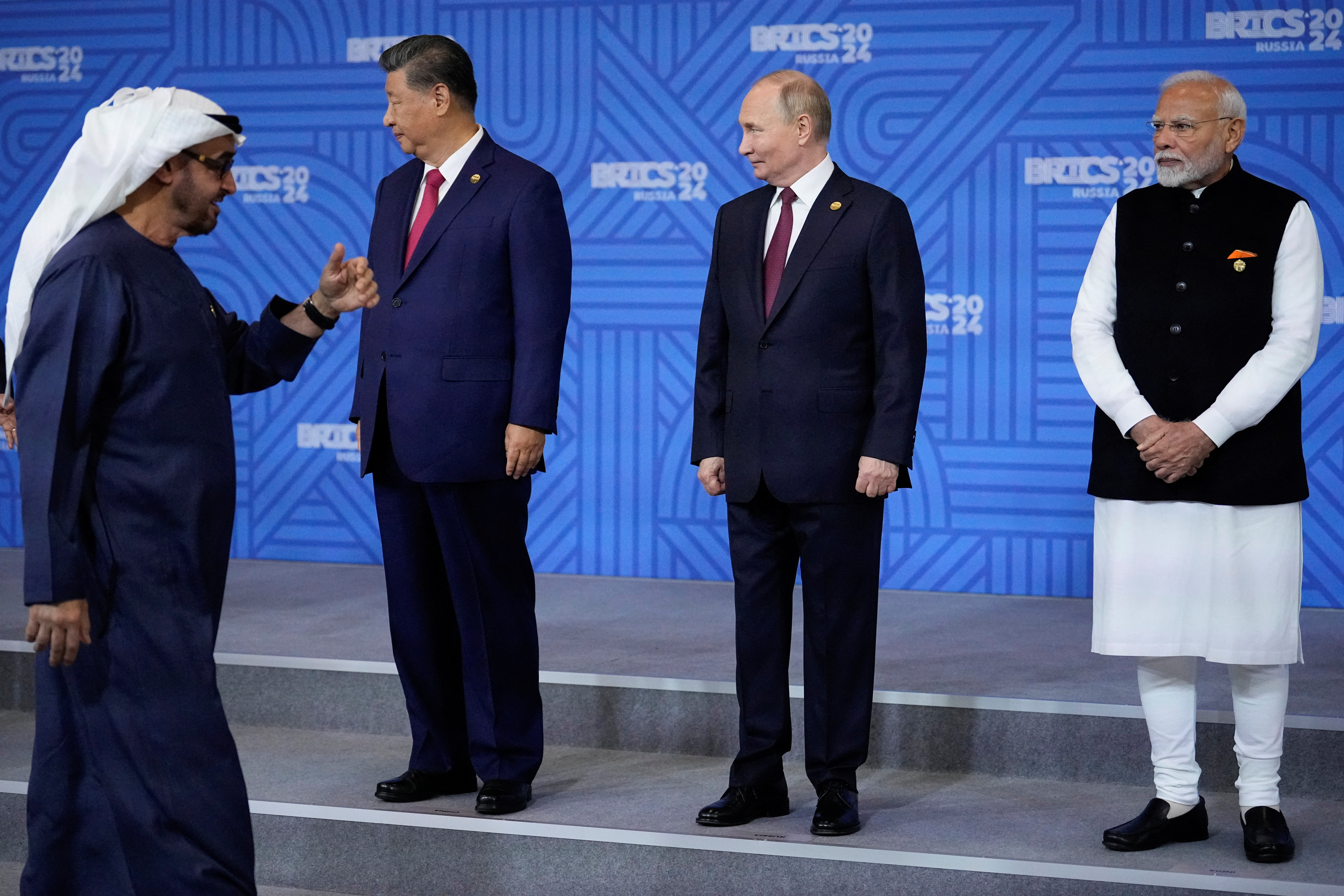
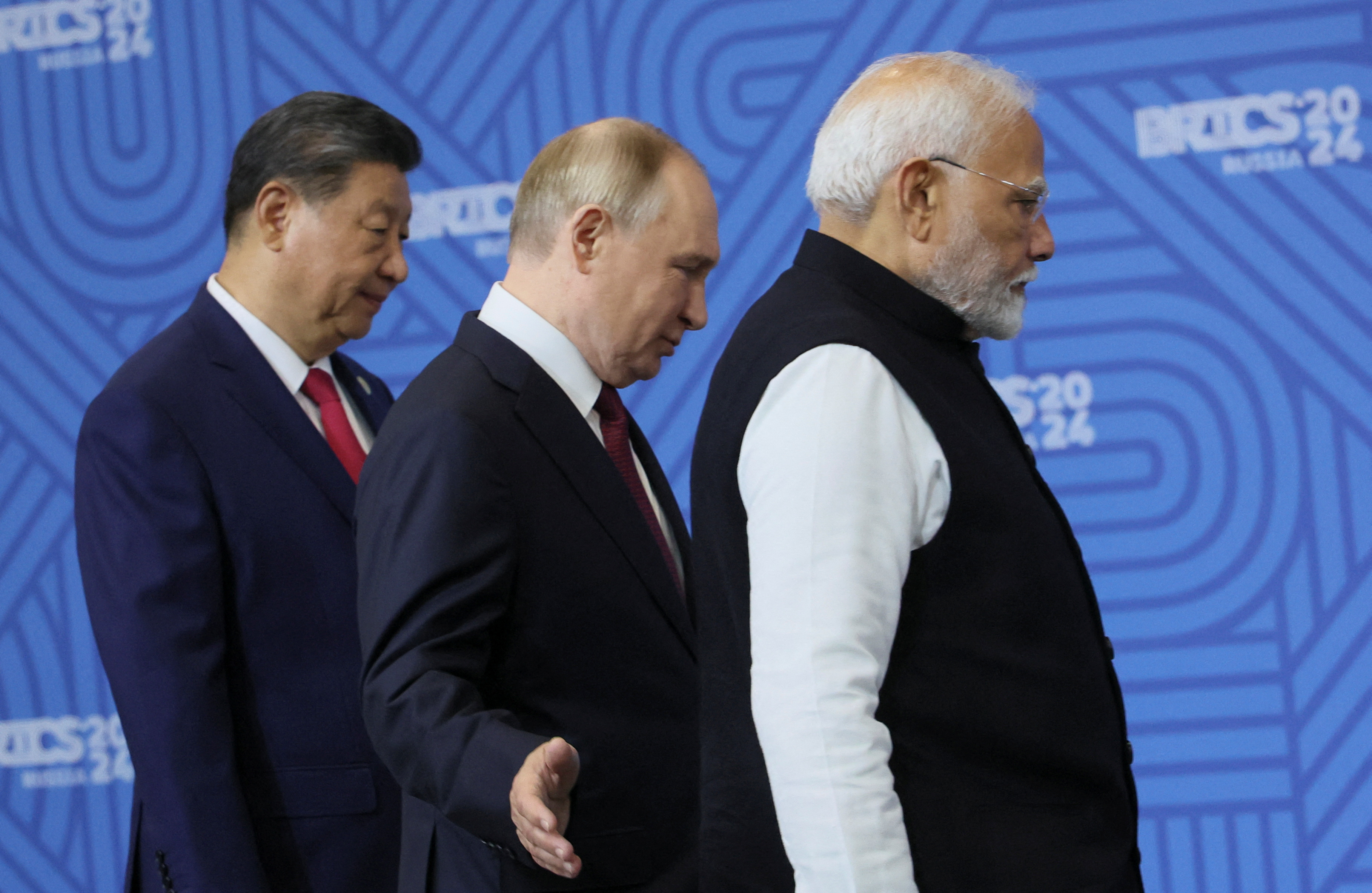
Indian Prime Minister Narendra Modi, Russian President Vladimir Putin and Chinese President Xi Jinping attend a family photo ceremony prior to the BRICS Summit plenary session in Kazan, Russia, Wednesday, Oct. 23, 2024. Alexander Zemlianichenko/Pool via REUTERS Purchase Licensing Rights, opens new tab
KAZAN, Russia, Oct 23 (Reuters) - China's Xi Jinping, India's Narendra Modi and some other BRICS leaders discussed the war in Ukraine with President Vladimir Putin as the Kremlin chief chaired a major summit aimed at showing Western attempts to isolate Russia have failed.

BRICS - an idea thought up inside Goldman Sachs two decades ago to describe the growing economic clout of China and other major emerging markets - is now a group that accounts for 45% of the world's population and 35% of the global economy.

But there are divisions and concerns even among members about how such a vast grouping can expand so swiftly while preserving some sense of geopolitical purpose and achieve any real economic results.

Putin, whose administration has dismissed war crimes allegations against him as political, opened the summit on Wednesday by saying that more than 30 states had expressed interest in joining the group but that it was important to strike a balance in any expansion.

"It would be wrong to ignore the unprecedented interest of the countries of the Global South and East in strengthening contacts with BRICS," Putin told BRICS leaders in Kazan, a Russian city on the banks of the Volga, Europe's longest river.

"At the same time, it is necessary to maintain a balance and prevent a decrease in the effectiveness of the BRICS," he said, adding that the grouping would also discuss "acute regional conflicts" - shorthand for the Middle East and Ukraine.

The BRICS summit takes place as global finance chiefs gather in Washington against the backdrop of the two conflicts, a flagging Chinese economy and worries that the U.S. presidential election could ignite new trade battles.

China and India buy about 90% of Russia's oil - Moscow's biggest foreign currency earner. Russia is the world's second largest oil exporter.

October 23, 202412:32 PM GMT+3Updated 3 hours ago
Annual BRICS summit, in Kazan

Annual BRICS summit, in Kazan

Annual BRICS summit, in Kazan


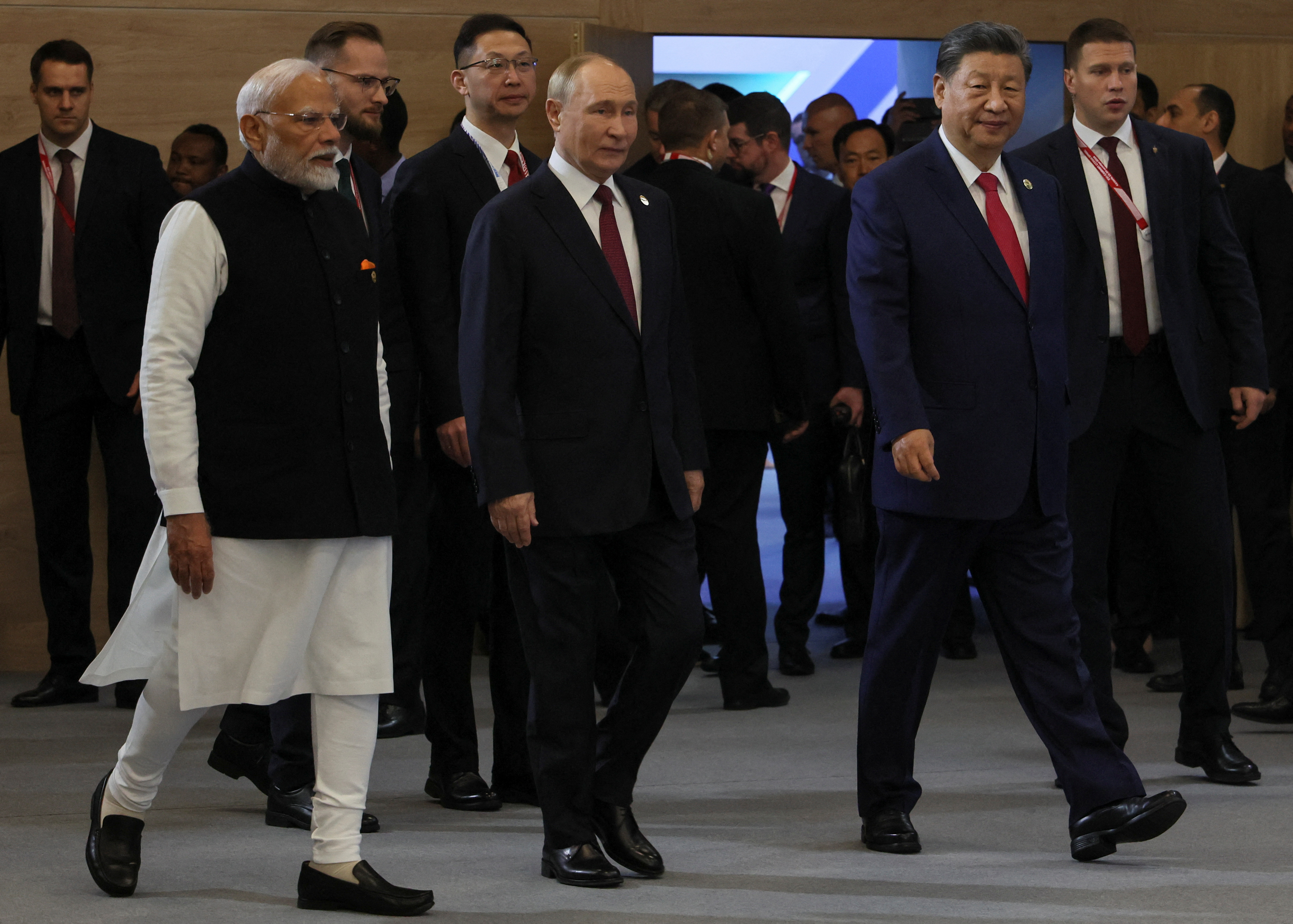
Chinese President Xi Jinping, Russian President Vladimir Putin and Indian Prime Minister Narendra Modi enter a hall for the family photo before a plenary session of the BRICS 2024 Summit in Kazan, Russia, 23 October 2024. MAXIM SHIPENKOV/Pool via REUTERS
 

Users who are viewing this thread

Latest Posts

Back
Top