China unveils HQ-19 missile to rival US THAAD, bolsters defense against ballistic threats
The system’s comparison to the US THAAD and SM-3 has drawn attention, and its reported capabilities could influence regional security dynamics.
Nov 10, 2024 01:59 PM EST
The HQ-19’s phased array radar provides early warning, enhancing coordination across multiple systems.
David Wang/Twitter
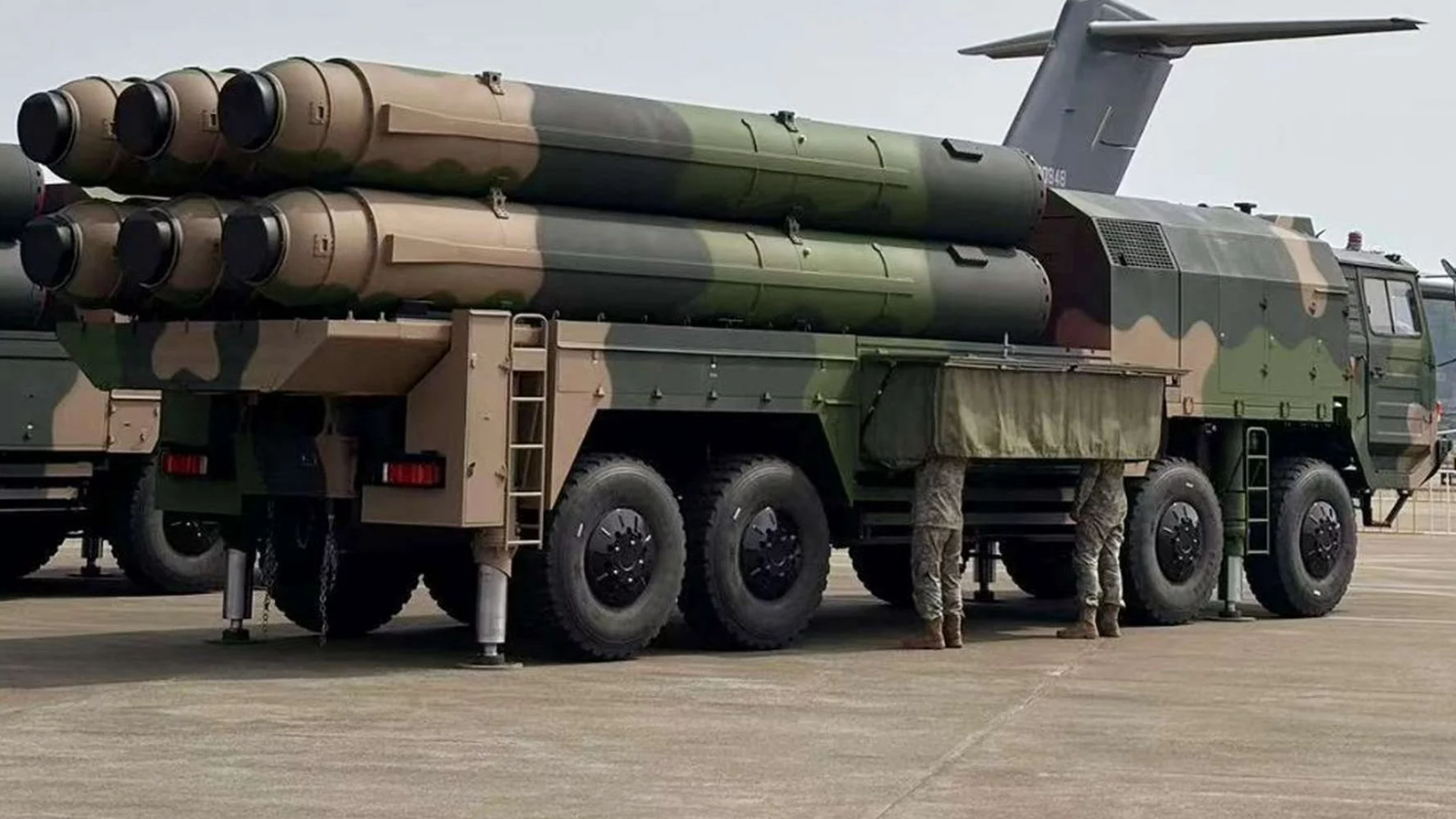
China has unveiled HQ-19 missile system to bolster defense against ballistic missile threats. The system is mounted on an 8×8 high-mobility truck and has a six-missile launcher setup.
Using a cold-launch at a steep angle, it effectively intercepts incoming ballistic missiles. Its radar, including the 610A information radar, can detect targets up to 2485 miles (4,000 kilometers) away, covering regions from northern South Asia to China’s Tibetan Plateau.
The command-and-control system integrates radar data to improve tracking and interception capabilities.
The HQ-19 was developed in the late 1990s under China’s 863 Program, which focused on high-tech defense advancements.
It uses an infrared guidance system with side windows to reduce atmospheric interference, allowing for accurate targeting at high altitudes,
Army Recognition reports.
Powered by a two-stage solid rocket engine with carbon-fiber construction and N-15B solid propellant, the missile achieves a specific impulse of 260 seconds, enabling it to maneuver effectively to intercept moving warheads.
Surface-to-air missile achieves 1864 miles intercept range
The missile’s engine has a double-pulse design, boosting its range and increasing kinetic impact during interception. Built with advanced composite materials, this design allows the missile to maneuver at forces up to 60g. The HQ-19’s intercept range is reportedly up to 1864 miles (3,000 kilometers), enabling it to target ballistic missiles, including reentry warheads, within this range.
China was an early adopter of kinetic
kill technology, reportedly completing a successful test flight in 1999, becoming the second nation after the US to develop this capability. Multiple tests have confirmed the HQ-19’s performance, including interceptions above 200 kilometers in altitude and at speeds of up to 10,000 meters per second.
In February 2021, China’s Ministry of National Defense reported that the HQ-19 met all performance expectations. Since 2010, China has conducted several tests, emphasizing their defensive purpose and clarifying that the system is not aimed at any specific country.
However, developing an advanced ground-based exo-atmospheric missile defense system could lead to future versions being deployed on Chinese navy destroyers. This would enable China to intercept missile threats in distant seas, similar to the capability the SM-3 provides for the US, Japanese, and South Korean navies.
China’s interest in wider defense export markets
The system’s comparison to the US
THAAD and SM-3 has drawn attention, and its reported capabilities could influence regional security dynamics. Furthermore, the HQ-19’s appearance at the airshow also suggests it may be available for export, with potential interest from regions like the Middle East.
China’s defense industry seeks to broaden its customer base beyond core clients like Pakistan, Saudi Arabia, and Egypt, aiming to expand its reach in emerging markets.
China’s missile defense system includes the HQ-9, HQ-19, and HQ-26, creating a layered defense approach. The HQ-26, with a multi-pulse motor, extends its range and improves its impact on various missile threats.
The HQ-19’s phased array radar provides early warning, enhancing coordination across these systems. Together, their coverage and intercept abilities offer defense against regional threats, including ballistic missiles from neighboring countries.
The HQ-19, a new surface-to-air missile system developed by China, is designed to intercept ballistic missile threats within and beyond the atmosphere.

interestingengineering.com







 armyrecognition.com