Protesters Regret 'From the River to the Sea' Chant Upon Learning Meaning

The whole issue is here legitimacy of the State of Israel in the first place. It was established (by the European colonialists) by force, it has existed by force and it continues to expand by force.

The problem is: which laws that you want to refer to say that Israel state is illegitimate?

Because UN has issued resolution for Partition Plan 1947, means Israel state should be legal and majority of UN members acknowledge Israel state.

Also saying Israel state was established by European colonialist by force is not only inaccurate but also wrong, because they didn't declare independence by toppling another government/state.

To say they continue to expand by force is also inaccurate, because the occupation on Arab territories was the result of aggression by Arab league themself, and Israel has returned most of it as part of peace negotiation.


If the Arabs had the money and weapons, they could declare Israel illegal and get the UN to rubber stamp the deed.


Saying the money and weapons as the legal basis to say Israel legal/illegal is also incorrect.

First, UN charter guarantees the aspirations of people to be independent and establish a state on a stateless territory.

Second, if the money and weapons as the legal rootcause then Russia and China can help to oppose UN charter and resolutions by veto right or political stand even by weapons. The fact is both Russia and China officially recognize the existence of the State of Israel. Diplomatic relations exist between these countries and Israel
 
The Israeli claim to legitimacy is based on the fact that they are descended from the ancient Hebrews. I showed that the Hebrews were only one of a series of ancient conquerers and, if we use genetics, modern Lebanese have a greater DNA connection to the Canaanites. This demolishes the Jewish claim to exclusivity even if we accept that ancient genetics grants land ownership by default.

They claim legitimacy both on UN resolution PP 1947 and historical connection.

As explained before the genetics alone cannot address complex questions of identity, cultural continuity, or historical rights. The Israeli-Palestinian conflict involves not only historical and genetic aspects but also contemporary geopolitical, social, and human rights dimensions.

The combination of international recognition through UN resolutions and historical claims has been central to the legitimacy of the State of Israel.

Why pick 1947? This is the % of Jews in Palestine according to the Jewish Virtual Library

EraYear
Jews
(core population)
Non-Jews
Total Population
% Jewish
Ottoman Empire1517
5,000​
295,000​
~300,000​
1.7%​
1533-395,000151,000157,0003.2%
1882
24,000​
276,000​
300,000​
8.0%​
World War I191494,000595,000689,00013.6%
1918
60,000​
600,000​
660,000​
8.1%​
British Mandate192283,794673,388757,18211%
1931
174,610​
861,211​
1,035,821​
16.9%​
1936
384,078​
982,614​
1,366,692​
28.1%​
1939449,000
1946
543,000​
1,267,037​
1,810,037​
30.0%​
1947630,0001,324,0001,970,00032.0%
State of Israel1948
716,700​
156,000^​
872,700​
82.1%​


At the time of the Balfour Declaration, when colonialist Britain unilaterally decided to gift the land to Jews, it was 8%.

Then why pick only from 1533 AD? why not pick from before 70AD when the jews was majority there and there were Judah and Israel kingdom there while there had never been Palestine kingdom over the territory?
 
They claim legitimacy both on UN resolution PP 1947 and historical connection.

As explained before the genetics alone cannot address complex questions of identity, cultural continuity, or historical rights. The Israeli-Palestinian conflict involves not only historical and genetic aspects but also contemporary geopolitical, social, and human rights dimensions.

The combination of international recognition through UN resolutions and historical claims has been central to the legitimacy of the State of Israel.

My point was the UN resolutions are worthless since they are dictated by the major powers - major military powers -- of the day. At the end of the day, it's all about who had the military power.

Then why pick only from 1533 AD? why not pick from before 70AD when the jews was majority there and there were Judah and Israel kingdom there while there had never been Palestine kingdom over the territory?

I wasn't picking 1533; this was the earliest date in the Jewish Virtual Library table. The only date that matters is 1917 when the British colonialists issued the Balfour Declaration gifting the land to Jews who comprised 8% of the population.
 
My point was the UN resolutions are worthless since they are dictated by the major powers - major military powers -- of the day. At the end of the day, it's all about who had the military power.

The major power who has political interest with Israel existence in middle east was only US, or + west european at the most.

Russia and China didn't. They could have used their veto right from the beginning in 1947 if UN resolution PP 1947 had been indeed illegitimate.

I wasn't picking 1533; this was the earliest date in the Jewish Virtual Library table. The only date that matters is 1917 when the British colonialists issued the Balfour Declaration gifting the land to Jews who comprised 8% of the population.

The date that matter is the date when Israel declared independence in 1948.
Thats the date to justify whether the independence was supported by enough population or not.
In year 1947 there were 33% jews in the whole Palestine territory therefore the 33% will be justifiable to declare independence on partial land (55% of the stateless territory by UN PP1947)
 
The problem is: which laws that you want to refer to say that Israel state is illegitimate?

Because UN has issued resolution for Partition Plan 1947, means Israel state should be legal and majority of UN members acknowledge Israel state.

Also saying Israel state was established by European colonialist by force is not only inaccurate but also wrong, because they didn't declare independence by toppling another government/state.

To say they continue to expand by force is also inaccurate, because the occupation on Arab territories was the result of aggression by Arab league themself, and Israel has returned most of it as part of peace negotiation.

As I explained in previous posts, the State of Israel was promised (Balfour Declaration, 1917) and then created solely with the help of Western military might. Initially, it was Czechoslovakia then other European countries and the USA.

It is a lingering remnant of the European colonialist era and populated by imported people.

Saying the money and weapons as the legal basis to say Israel legal/illegal is also incorrect.

First, UN charter guarantees the aspirations of people to be independent and establish a state on a stateless territory.

Stateless territory by whose definition? The British colonialists had no right to gift that land to anyone, especially by evicting the people who were already living there.

Once again we come to the UN and, once again, I repeat that the UN is a rubber stamping body for the major powers.

Second, if the money and weapons as the legal rootcause then Russia and China can help to oppose UN charter and resolutions by veto right or political stand even by weapons. The fact is both Russia and China officially recognize the existence of the State of Israel. Diplomatic relations exist between these countries and Israel

Why should Russia or China intervene on an issue which is not their core interest. USSR/Russia had a lot of Jews who migrated to Israel so they have close ties to Israel anyway. As for China, they are not a Muslim country. They can sympathize but their priority is Taiwan and other issues, not Palestine. Also, they know how strong the pro-Israel lobby is in the West so why should they damage their relations with the West for Palestine's sake?

This is a failure of the Muslim countries; there is no point looking at others to do the hard word that Muslim countries themselves can not, or will not, do.
 
The major power who has political interest with Israel existence in middle east was only US, or + west european at the most.

Russia and China didn't. They could have used their veto right from the beginning in 1947 if UN resolution PP 1947 had been indeed illegitimate.

I already explained why this is not a Russia/China problem.

The date that matter is the date when Israel declared independence in 1948.
Thats the date to justify whether the independence was supported by enough population or not.
In year 1947 there were 33% jews in the whole Palestine territory therefore the 33% will be justifiable to declare independence on partial land (55% of the stateless territory by UN PP1947)

he important date is 1917 (8% Jewish population) because that when Britain gave Zionists the guarantee of a Jewish State and Jewish migration to Palestine picked up steam. From 1917 to 1948, the Zionists, rich and well established in the West, had moved hundreds of thousands of Jews into Palestine.
 
As I explained in previous posts, the State of Israel was promised (Balfour Declaration, 1917) and then created solely with the help of Western military might. Initially, it was Czechoslovakia then other European countries and the USA. It is a lingering remnant of the European colonialist era and populated by imported people.

But you say they are illegitimate.
Claim for Illegitimate case must be based on underlaying laws, can't be based on opinion/ perception/ complaint/ etc. Means before 1948 the territory was stateless.


Stateless territory by whose definition? The British colonialists had no right to gift that land to anyone, especially by evicting the people who were already living there.

By any available definition.

The fact says Israel is the first state in the territory in 1948, then come Palestine declared as state in 1988.


Once again we come to the UN and, once again, I repeat that the UN is a rubber stamping body for the major powers.

If you said UN PP1947 were against law then first of all you need to show which laws that the resolution was against?

Without this all you said above is groundless.

Why should Russia or China intervene on an issue which is not their core interest. USSR/Russia had a lot of Jews who migrated to Israel so they have close ties to Israel anyway. As for China, they are not a Muslim country. They can sympathize but their priority is Taiwan and other issues, not Palestine. Also, they know how strong the pro-Israel lobby is in the West so why should they damage their relations with the West for Palestine's sake?

This is a failure of the Muslim countries; there is no point looking at others to do the hard word that Muslim countries themselves can not, or will not, do.

Because you said it was illegitimate or against law.

There were so many other countries that support UN PP 1947 other than major powers, if you say only Muslim countries that stated UN PP 1947 illegitimate then it seems the laws you are referring is Muslim laws which is only applied for Moslem people within Moslem countries, not international laws.
 
Last edited:
I already explained why this is not a Russia/China problem.

It should be all countries problem, because you said UN resolution PP 1947 it is illegitimate.

he important date is 1917 (8% Jewish population) because that when Britain gave Zionists the guarantee of a Jewish State and Jewish migration to Palestine picked up steam. From 1917 to 1948, the Zionists, rich and well established in the West, had moved hundreds of thousands of Jews into Palestine.

No, it is not about Britain guarantees, but it is about international laws and UN Charter as justification for the establishment of Israel state.

UN Resolution on PP 1947 was not based on British Guarantee, but based on UN Charter, justice and humanity.
 
Last edited:
But you say they are illegitimate.
Claim for Illegitimate case must be based on underlaying laws, can't be based on opinion/ perception/ complaint/ etc. Means before 1948 the territory was stateless.

We are going in circles: I am saying the 'legitimacy' granted by the UN was by force of weapons.

You keep saying 'UN' and I am saying the UN is a rubber stamping body to legitimize whatever the major military powers want.

P.S. You know before the UN there was something called the League of Nations. Tomorrow, we can disband the UN and create another body to rubber stamp anything we want as long as we have enough military and economic power.
 
We are going in circles: I am saying the 'legitimacy' granted by the UN was by force of weapons.

You keep saying 'UN' and I am saying the UN is a rubber stamping body to legitimize whatever the major military powers want.

You haven't answered me at all.

I keep asking and still waiting the laws you refer to claim UN Partition Plan 1947 was illegitimate.

Without it all of your claim is groundless.

I have also refuted your claim that the legitimacy of PP 57 is by force / weapons as there was no such think during the issue of resolution, as it was issued by General Assembly of UN.
 
You haven't answered me at all.

I keep asking and still waiting the laws you refer to claim UN Partition Plan 1947 was illegitimate.

Without it all of your claim is groundless.

I have also refuted your claim that the legitimacy of PP 57 is by force / weapons as there was no such think during the issue of resolution, as it was issued by General Assembly of UN.

You haven't refuted anything since I am questioning the legitimacy of the UN itself. As I stated, the UN was created to sugar coat and legitimize the wishes of the major powers.

What on Earth do you think the veto power means in the UN? On what basis can you even consider a body legitimate where a handful of countries can dictate the outcome just because they had military power in 1945?
 
You haven't refuted anything since I am questioning the legitimacy of the UN itself. As I stated, the UN was created to sugar coat and legitimize the wishes of the major powers.

What on Earth do you think the veto power means in the UN? On what basis can you even consider a body legitimate where a handful of countries can dictate the outcome just because they had military power in 1945?

You can't deny legitimacy of UN when you are a member of UN.

The legitimacy of the United Nations (UN) as an international organization is derived from its founding principles, its charter, and the recognition and participation of its member states.

Several key elements contribute to the legitimacy of the UN:
  1. Charter and Founding Principles: The UN was established on October 24, 1945, with the signing of the UN Charter. The Charter outlines the purposes and principles of the UN, emphasizing international cooperation, peace, security, development, and the protection of human rights. Member states voluntarily agree to abide by the principles set forth in the Charter.
  2. Universal Membership: The UN is a universal organization, meaning that nearly all recognized sovereign states are eligible for membership. As of my last knowledge update in January 2022, the UN has 193 member states, making it a comprehensive representation of the international community.
  3. International Recognition: The UN is widely recognized as the preeminent international organization, serving as a forum for member states to engage in diplomacy, negotiations, and cooperation on global issues. Its diverse membership and inclusive nature contribute to its legitimacy.
  4. Peacekeeping and Conflict Resolution: The UN has been involved in peacekeeping and conflict resolution efforts worldwide. Its role in mediating conflicts, providing humanitarian assistance, and fostering diplomatic solutions enhances its legitimacy as a force for international peace and security.
  5. Human Rights and Development Agenda: The UN is committed to promoting and protecting human rights and facilitating global development. Initiatives such as the Universal Declaration of Human Rights and the Sustainable Development Goals (SDGs) underscore its commitment to addressing pressing global challenges.
Almost all countries in the surface of earth are members of UN and give legitimation on UN.
 
You can't deny legitimacy of UN when you are a member of UN.

The legitimacy of the United Nations (UN) as an international organization is derived from its founding principles, its charter, and the recognition and participation of its member states.

Several key elements contribute to the legitimacy of the UN:
  1. Charter and Founding Principles: The UN was established on October 24, 1945, with the signing of the UN Charter. The Charter outlines the purposes and principles of the UN, emphasizing international cooperation, peace, security, development, and the protection of human rights. Member states voluntarily agree to abide by the principles set forth in the Charter.
  2. Universal Membership: The UN is a universal organization, meaning that nearly all recognized sovereign states are eligible for membership. As of my last knowledge update in January 2022, the UN has 193 member states, making it a comprehensive representation of the international community.
  3. International Recognition: The UN is widely recognized as the preeminent international organization, serving as a forum for member states to engage in diplomacy, negotiations, and cooperation on global issues. Its diverse membership and inclusive nature contribute to its legitimacy.
  4. Peacekeeping and Conflict Resolution: The UN has been involved in peacekeeping and conflict resolution efforts worldwide. Its role in mediating conflicts, providing humanitarian assistance, and fostering diplomatic solutions enhances its legitimacy as a force for international peace and security.
  5. Human Rights and Development Agenda: The UN is committed to promoting and protecting human rights and facilitating global development. Initiatives such as the Universal Declaration of Human Rights and the Sustainable Development Goals (SDGs) underscore its commitment to addressing pressing global challenges.
Almost all countries in the surface of earth are members of UN and give legitimation on UN.

Everything the UN does is hostage to veto power. By what rights does a pipsqueak country like France have veto power where Germany and Japan do not?

Already there is talk to reform the UNSC. If, tomorrow, some country develops a super weapon and forms a new body to replace the UN, as the UN replaced the League of Nations, then they can have a new Security Council which can declare Israel illegal.

At the end of the day, it's all about who has the military power. Even economic power is secondary to military power. We have not gone very far from the jungle.
 

Protesters Regret 'From the River to the Sea' Chant Upon Learning Meaning


"From the river to the sea" is a battle cry chanted by pro-Palestinian groups across college campuses and major cities.
The phrase, which refers to the Jordan River and Mediterranean Sea, is often seen by pro-Palestinian voices as a call for dignity and freedom. The call for action looks to restore Palestinians' land and political rights. However, to Israel and its supporters, it takes on a different meaning, often seen as a call to exterminate Israel as a Jewish state and the millions of Jewish people living in it.

A new survey found many potential protesters couldn't explain the meaning behind the controversial phrase. UC Berkeley professor Ron Hassner hired a survey firm to poll 250 college students from across the country, and a majority, or roughly 86 percent, said they supported the phrase, a common protest chant to express support for Palestinians in the ongoing conflict against Israel.
Still, only 47 percent could name the Jordan River and Mediterranean Sea, which historically encompassed Palestine and today includes both Israel and Israeli-occupied Palestinian territories.
Palestine protest

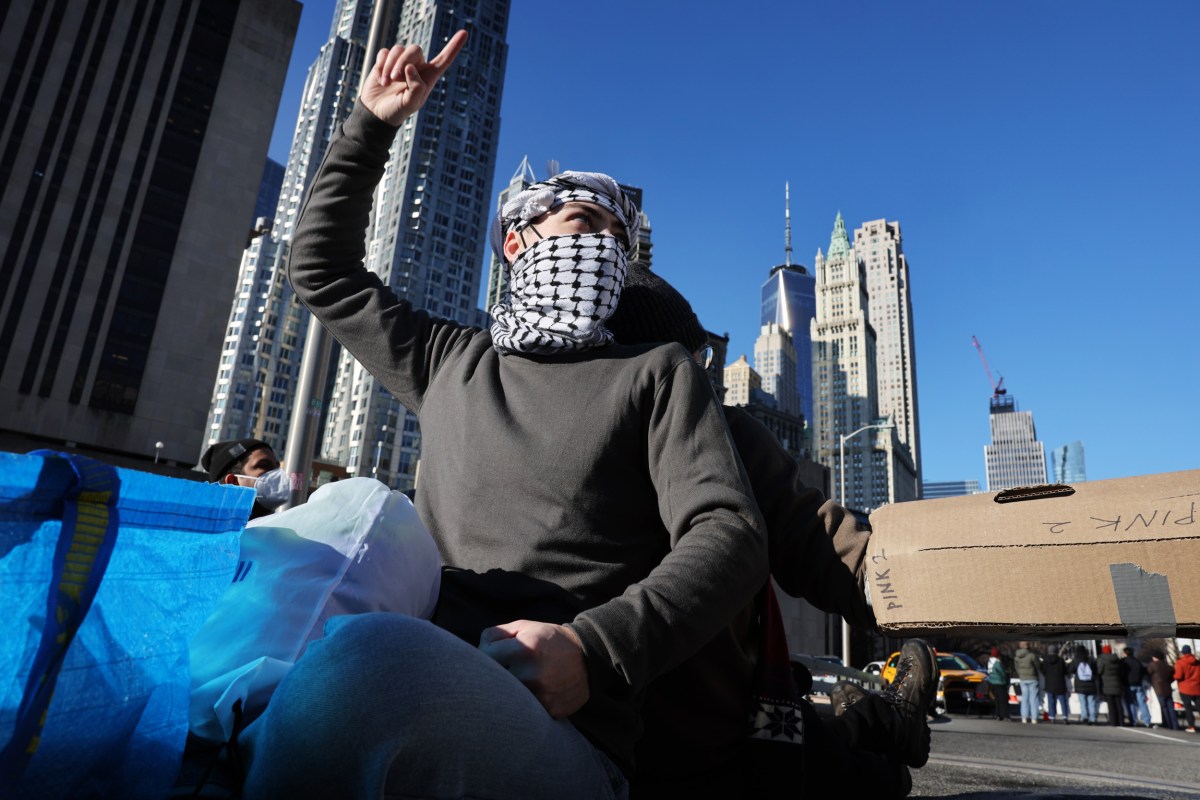
Pro-Palestinian demonstrators close down the Brooklyn Bridge on Monday morning in New York City. The divisive phrase "from the river to the sea" is often chanted by pro-Palestinian groups as a call for equality, but Israelis and their supporters hear it as a push for Israel's demise. A new survey found many potential protesters couldn't explain the battle cry's meaning.SPENCER PLATT/GETTY IMAGES
And even more surprising, once students learned more about the region, 67.8 percent of those surveyed no longer agreed with the sentiment.

Israel and Hamas have been in a violent conflict since October 7, 2023, when the Palestinian militant group launched a surprise attack on Israel, killing roughly 1,200 people, according to the Associated Press, while subsequent Israeli military strikes in Gaza have led to the deaths of at least 20,000 people.
In response, many groups have demonstrated while chanting "from the river to the sea." According to the survey, many students believed the sentiment was expressing support for the idea of Palestinians and Israel living peacefully side by side.

Even among students who said the chant called for Palestinians to force Israel out of Gaza and agreed with it, 60 percent changed their minds when learning it would cause 7 million Jewish and 2 million Arab Israelis "subjugation, expulsion or annihilation," Hassner said.
"There's no shame in being ignorant, unless one is screaming for the extermination of millions," Hassner wrote in a Wall Street Journal piece describing his study.
Sign up for Newsweek’s daily headlines
"An art student from a liberal arts college in New England 'probably' supported the slogan because 'Palestinians and Israelis should live together in one state,'" Hassner said in the article. "But when informed of recent polls in which most Palestinians and Israelis rejected the one-state solution, this student lost his enthusiasm. So did 41% of students in that group."

So why are so many students supporting a stance on an issue they know little about, or even going to protest on campus or in city streets?
Psychologist Thomas Plant said that for many, being a part of a cause or group is about developing an identity.
"In our current age of social media, people think about issues in terms of tweets or bumper sticker slogans," Plant told Newsweek. "Like so many other issues of the day, the Middle East conflict is extremely complicated at so many levels. People don't necessarily have the time or interest to educate themselves about these complexities, preferring to stick with slogans and feel the support of a group that helps to create community and an identity."

According to Adam Swart, CEO and founder of Crowds on Demand, a firm that helps organizations advocate for important causes and settle disputes, protest organizers have been linking their events to broader movements like "Black Lives Matter" through a shared narrative of struggle and solidarity.
Succinct slogans, like "from the river to the sea" or "defund the police" often demand others' attention, and they are especially popular to younger audiences like college students.
"In a digital age marked by extensive social media engagement, many individuals feel a sense of urgency to participate in these discussions," Swart told Newsweek. "This phenomenon is partly driven by FOMO [fear of missing out], a prevailing belief in some groups that remaining silent on these issues could be interpreted as complicity."

There's also a desire by many people, especially students, to be involved in the "hot" social media issue of the day and "not so much due to a true genuine desire to either make a difference or have a positive, meaningful impact made," William Hall, political science professor at Webster University, told Newsweek.
Hall said that historically, protesters devote the time to become informed about the key issues and stances they represent. But more modern-day protests, including those over the Middle East conflict, mark a deviation from the historical norm that might be amplified by today's social media.

Enduring Ignorance of Middle Eastern Conflict​

Ignorance around the Middle East has been present in the United States for a long time, according to Joseph Richard Guthein, a Texas-based attorney at Gutheinz Law Firm.

Around 45 years ago, Guthein was earning his Ph.D. in sociology at the University of California, Davis, and he got to observe a group of students demonstrating in favor of Palestinians against Israel.
"When I interviewed those college students, I was floored by the large number of students I interviewed that had no idea what countries bordered Israel or any basic facts about the history of Israel or Palestine," Guthein told Newsweek.
He added students knew very little about any terrorist attacks against Israel, including the Munich Olympics massacre that ended in the murders of 11 Israeli Olympic team athletes.

"When I offered examples of savage terrorist attacks against Jewish people, the students either didn't care or didn't believe it," Guthein said.
Still, Guthein has noted a stark difference in pro-Palestinian protesters today.
"The biggest change I have seen over 40 years is now many demonstrators know of the atrocities and are glad they happened," Guthein said.


@MCK @Cryptonian @spammmmer @Hamartia Antidote @Truth @TruthSeeker @Sharma Ji @Get Ya Wig Split @dbc @F-22Raptor
Ironically same wording is also on official ruling Likud party's manifesto. But no one in the zionist controlled msm in the west will ever accuse Israelis calling for the mass murder of Palestinians, especially now since they've been one of the biggest enablers of the ongoing genocide in Gaza.
 
Everything the UN does is hostage to veto power. By what rights does a pipsqueak country like France have veto power where Germany and Japan do not?

Veto had nothing to do with UN Resolution for PP 1947, as no major power vetoed it.


Already there is talk to reform the UNSC. If, tomorrow, some country develops a super weapon and forms a new body to replace the UN, as the UN replaced the League of Nations, then they can have a new Security Council which can declare Israel illegal. At the end of the day, it's all about who has the military power. Even economic power is secondary to military power. We have not gone very far from the jungle.

UN Resolution on PP 1947 is not based on who has the strongest military power, but by the vote of the majority of UN members. Even if there was no UNSC members at all or are all UN members were members of UNSC, the result would have been the same.

The United Nations General Assembly Resolution 181, often referred to as the UN Partition Plan for Palestine, was adopted on November 29, 1947. The resolution recommended the partition of British Mandate Palestine into separate Jewish and Arab states, with Jerusalem designated as an international city.

The vote on Resolution 181 was as follows:

In Favor (33):

  1. Australia
  2. Belgium
  3. Bolivia
  4. Brazil
  5. Byelorussian SSR
  6. Canada
  7. Costa Rica
  8. Czechoslovakia
  9. Denmark
  10. Dominican Republic
  11. Ecuador
  12. France
  13. Guatemala
  14. Haiti
  15. Iceland
  16. Liberia
  17. Luxembourg
  18. Netherlands
  19. New Zealand
  20. Nicaragua
  21. Norway
  22. Panama
  23. Paraguay
  24. Peru
  25. Philippines
  26. Poland
  27. Sweden
  28. Ukrainian SSR
  29. Union of South Africa
  30. United States
  31. Uruguay
  32. Venezuela
Against (13):

  1. Afghanistan
  2. Cuba
  3. Egypt
  4. Greece
  5. India
  6. Iran
  7. Iraq
  8. Lebanon
  9. Pakistan
  10. Saudi Arabia
  11. Syria
  12. Turkey
  13. Yemen
Abstentions (10):

  1. Argentina
  2. Chile
  3. China
  4. Colombia
  5. El Salvador
  6. Ethiopia
  7. Honduras
  8. Mexico
  9. United Kingdom
  10. Yugoslavia
The Soviet Union, initially in favor, ended up abstaining after attempting to delay the vote.
 
Last edited:

Users who are viewing this thread

Back
Top