Türkiye and the Balkans | News & Discussion

MMM-E

Elite Member
Joined
Jul 6, 2017
Messages
17,140
Reaction score
17,278
Reputation
4,314.8
Country of Origin
Country of Residence
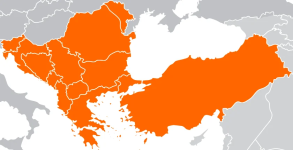
The Balkans is a priority for Türkiye not only from the political, economical and geographical perspectives, but also due to its historical, cultural and human ties with the region.


Being itself a Balkan country, Türkiye attaches great importance to its bilateral relations with the Balkan countries and maintains good relations with all of them. Our bilateral relations with these countries are based on the principles of respect for independence, sovereignty and territorial integrity and non-intervention into internal affairs and further developed on the basis of our historical ties and the principle of good neighborliness.

Etymology​

The origin of the word Balkan is obscure; it may be related to Turkish bālk 'mud' (from Proto-Turkic *bal 'mud, clay; thick or gluey substance', cf. also Turkic bal 'honey'), and the Turkish suffix -an 'swampy forest' . It was used mainly during the time of the Ottoman Empire. In both Ottoman Turkish and modern Turkish, balkan means 'chain of wooded mountains

1732390767654.png

POPULATION
Turkiye : 85,3 million

Balkan Countries : Total of 70 million
Romania : 19 million
Greece : 10,3 million
Hungary : 9,6 million
Serbia : 6,6 million
Bulgaria : 6,4 million
Croatia : 3,8 million
Bosnia and Herzegovina : 3,2 million
Albania : 2,7 million
Moldavia : 2,5 million
Slovenia : 2,1 million
North Macedonia : 1,8 million
Kosovo : 1,5 million
Montenegro : 616,177


ECONOMY ( GDP Nominal )
Turkiye : $1,344 trillion

Balkan Countries : Total of $1,318 trillion
Romania : $380 billion
Greece : $252 billion
Hungary : $228 billion
Bulgaria : $108 billion
Croatia : $89 billion
Serbia : $82 billion
Slovenia : $73 billion
Bosnia and Herzegovina : $29 billion
Albania : $25 billion
Moldavia : $18 billion
North Macedonia : $15 billion
Kosovo : $11 billion
Montenegro : $8 billion


Turkiye's influence in the Western Balkans
Priority countries: Albania, Kosovo , Bosnia and Herzegovina

Turkiye's influence in the Western Balkans remains mainly based on
cultural and educational programmes offered to those countries with a large Muslim community and steadily developing trade.
 
Last edited by a moderator:
Turkish soft power
The region continues to be deeply rooted in Turkiye’s historical memory (including the Ottoman legacy, the cultivated identity of the descendants of individuals displaced from the Balkans).

President ERDOGAN in Novi Bazaar / Serbia
To view this content we will need your consent to set third party cookies.
For more detailed information, see our cookies page.


President ERDOGAN in Kosovo
To view this content we will need your consent to set third party cookies.
For more detailed information, see our cookies page.


President ERDOGAN in Sarajevo / Bosnia and Herzegovina
To view this content we will need your consent to set third party cookies.
For more detailed information, see our cookies page.


SKOPJE - President Erdogan's election success enthusiastically celebrated in North Macedonia
To view this content we will need your consent to set third party cookies.
For more detailed information, see our cookies page.
 
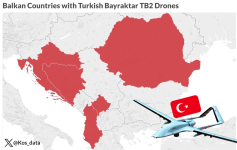
Turkish Drones dominate the BALKAN Region


Romania
Kosovo
Albania
Bosnia and Herzigovina
Croatia

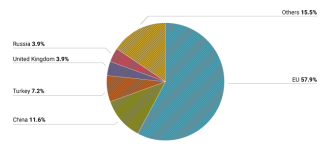
1732391391461.png
 
Turkey should support countries like Albania, Kosovo, and Bosnia
 
Turkey should support countries like Albania, Kosovo, and Bosnia

Turkiye always support Muslims in the Balkans
Turkiye has historical and cultural ties to the region


KOSOVO
-- Türkiye pledges full support for Kosovo's international recognition

-- Post-war, Turkiye has assisted Kosovo regarding stability and security through OSCE, UNMIK and KFOR missions deploying 780 troops

( The mission comprises over 4,500 military personnel from 27 nations, including 21 NATO member states . Türkiye contributes the second-largest contingent with at least 780 soldiers )


ALBANIA
-- Turkiye remains for Albania an important military ally
Through its military personnel, Turkiye trains Albania's armed forces and provides assistance for Albanian military logistical and modernising endeavours.

-- The Albanian-Turkish military cooperation agreement was signed in 1992 and encompassed rebuilding Albania's Pasha Liman Base by Turkiye alongside granted access for Turkish use


Turkiye’s infrastructure and developmental investments are not limited to Albania. Turkiye opened a highway between Belgrade and Bosnia-Herzegovina that will connect Bosnia-Herzegovina to the other Balkan states.

Turkiye is the third-largest investor in Kosovo, and the TIKA is restoring and rebuilding the cultural heritage of the Ottoman era in different parts of the region


Turkiye has signed free trade agreements with all Balkan states
1732396928353.png
 
Ethnic Turks in the Balkans


During centuries of Ottoman rule over the Balkans, many Turkish tribes from Asia Minor, Central Asia, the Caucuses and the Black Sea region were settled in the region as part of the Sultans’ Turkification and Islamisation efforts.

As a result, the Turkish population grew to significant numbers in what later became Greece, Bulgaria, North Macedonia, Kosovo and elsewhere.


Ethnic Turks comprise 8% of Bulgaria’s total population — totalling some 600,000 people — while many Bulgarian Turks live in Turkiye too.

According to Turkiye’s foreign ministry, around 150,000 ethnic Turks live in mainland Greece and another 25,000 live on Greek islands.

Ethnic Turks account for 4% of North Macedonia’s population of 2.1 million.

In Kosovo, they account for nearly 2% of the country’s 1.9 million people. Turks are represented by one of the six stars on Kosovo’s flag signifying the country’s multi-ethnic population.


1732399479731.png
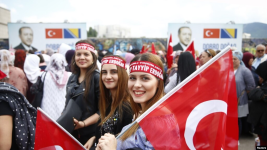
FILE - Supporters of Turkish President Recep Tayyip Erdogan gather before a pre-election rally in Sarajevo, Bosnia and Herzegovina, May 20, 2018.

 
Destruction of Muslim heritage in the Balkans


Muslim heritage was extensively targeted during the persecutions. During their long rule the Ottomans had built numerous mosques, madrasas, caravanserais, bath-houses and other types of building. According to current research, around 20,000 buildings of all sizes have been documented in official Ottoman registers.

However very little survives of this Ottoman heritage in most Balkan countries.

Most of the Ottoman era mosques of the Balkans have been destroyed; the ones still standing often had their minarets destroyed.

Before the Habsburg conquest, Osijek had 8–10 mosques, none of which remain today. During the Balkan wars there were cases of desecration, destruction of mosques and Muslim cemeteries.

Of the 166 madrasas in the Ottoman Balkans in the 17th century, only 8 remain and 5 of them are near Edirne. It is estimated that 95–98% were destroyed.

The same is also valid for other types of buildings, such as markethalls, caravanserais and baths. From a chain of caravanserais across the Balkans only one is preserved while there are vague ruins of four others.

There were in the area of Negroponte in 1521: 34 large and small mosques, six hamams, ten schools, and 6 dervish convents. Today only the ruin of one hamam remains

 
According to Turkiye’s foreign ministry, around 150,000 ethnic Turks live in mainland Greece and another 25,000 live on Greek islands.
The Greek government however refrains from referring to the Muslim minority by a specific ethnic background, such as Turkish, since it is a multi-ethnic minority that includes ethnic Greek Muslims, Pomaks and Roma Muslims as well.

The "Panhellenic Pomak Association" and the "Cultural Association of Pomaks of Xanthi", have stated that Greece's Pomaks and Romas do not accept the Turkish government's characterization as "Turkish" for them, since they are self-identifying as ethnic groups distinct from the Turks; the latter also asserted that they have Greek national consciousness.

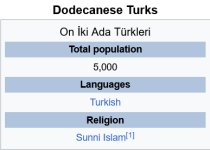
Screenshot 2024-11-24 at 00-36-54 Turks of the Dodecanese - Wikipedia.png
 
Death toll


According to historian Justin McCarthy, between 1821 and 1922, from the beginning of the Greek War of Independence to the end of the Ottoman Empire, 5 million Muslims were driven from their lands and another 5,5 million died, some of them killed in wars and others perishing as refugees from starvation or disease.

Karl Kaser also gives similar estimates, with around five million Muslims dead and five million Muslims displaced in the 19th and early 20th centuries


Roger Owen and Şevket Pamuk estimate that during the last decade of the Ottoman Empire (1912–1922), when the Balkan Wars, the First World War and the War of Independence took place in areas that were later to become part of Turkiye, the "total casualties, military and civilian, of Muslims during this decade are estimated as close to 2 million.

The historian Mark Biondich estimates that, in the 19th and early 20th centuries, more than 3 million Muslims from the Balkan area died, and around 2 million Muslims were displaced.

 
Turkish Presence in Greece


Currently, about 150.000 ethnic Turks live in Western Thrace, Greece.
This population constitutes the Turkish Minority of Western Thrace whose status was established by the Lausanne Peace Treaty of 1923 and whose rights are guaranteed by several bilateral and multilateral agreements.


The members of the Turkish Minority of Western Thrace, however, cannot enjoy their minority rights due to Greek obstruction. The main problems faced by the Turkish Minority are the following

-- Denial of ethnic identity
-- Problems in the field of education
-- Lack of bilingual kindergartens
-- Closing down and merging Minority elementary schools
-- Lack of adequate number of Minority secondary-high schools
-- Lack of sufficient number of qualified teachers
-- Restrictions in the field of freedom of religion
-- Problems regarding land and acquisition of immovable properties
-- Problems regarding minority foundations
-- Deprivation of Greek citizenship
-- Political representation of the Minority


Official Source


Currently, about 150.000 ethnic Turks live in Western Thrace, Greece.
This population constitutes the Turkish Minority of Western Thrace whose status was established by the Lausanne Peace Treaty of 1923 and whose rights are guaranteed by several bilateral and multilateral agreements.
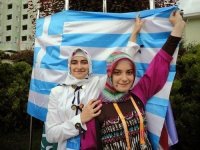
150,000 is an assumption. Turks love to count the Pomaks and other Muslims of Thrace in their "Turkish Minority". Pomaks despise that and protest against Turkey on that.

5cf3ef9b2500001107dbdff9.jpeg

Pomaks are proud to be Muslims and Greek citizens.
 
Quite a Diverse region of Balkans interesting thread to read about these nations, often in context of Europe the Balkan Regions are not talked about in a way which focuses on them. The focus is mainly on Western European Bloc

However I do admit I do enjoy Greek food specially the Salad

The Balkan Nations could even have their own Mini Economic Zone in an idealistic world

Romanians and Bulgarians have unique features face etc resemble certain sections of Pakistan's demographics, Dark hair , Dark eyes
 
To view this content we will need your consent to set third party cookies.
For more detailed information, see our cookies page.
 
To view this content we will need your consent to set third party cookies.
For more detailed information, see our cookies page.


Users who are viewing this thread

Back
Top