Thinking
Registered Member

i would say i have also read that story..... its India
by mistake he reached America
Either he was not looking for India since it didn't exist pre-British or he was looking for Pakistan..So I am told.
Follow along with the video below to see how to install our site as a web app on your home screen.
Note: This feature may not be available in some browsers.
i would say i have also read that story..... its India
by mistake he reached America

Either he was not looking for India since it didn't exist pre-British or he was looking for Pakistan..So I am told.

Non-cooperation movement (1919–1922)
The non-cooperation movement was a political campaign launched on 4 September 1920 by Mahatma Gandhi to have Indians revoke their cooperation from the British government, with the aim of persuading them to grant self-governance.
This came as result of the Indian National Congress (INC) withdrawing its support for British reforms following the Rowlatt Act of 18 March 1919 – which suspended the rights of political prisoners in sedition trials, and was seen as a "political awakening" by Indians and as a "threat" by the British which led to the Jallianwala Bagh massacre of 13 April 1919.
The movement was one of Gandhi's first organized acts of large-scale satyagraha. Gandhi's planning of the non-cooperation movement included persuading all Indians to withdraw their labour from any activity that "sustained the British government and also economy in India," including British industries and educational institutions.Through non-violent means, or ahimsa, protesters would refuse to buy British goods, adopt the use of local handicrafts, and picket liquor shops. In addition to promoting "self-reliance" by spinning khadi, buying Indian-made goods only, and boycotting British goods,
The non-cooperation movement was among the broader movement for Indian independence from British rule and ended, as Nehru described in his autobiography, "suddenly" on 4 February 1922 after the Chauri Chaura incident. Subsequent independence movements were the Civil Disobedience Movement and the Quit India Movement.
.
Non-cooperation movement (1919–1922) - Wikipedia
en.wikipedia.org
=>
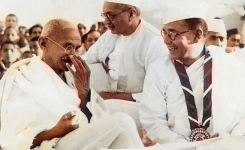
Neta Ji Subhash Chandra Bose became the President of the Congress Party in 1938. In 1919, Bose headed to London to give the Indian Civil Services (ICS) examination and he was selected. Bose, however, resigned from Civil Services as he believed he could not side with the British.

[Solved] Subhash Chandra Bose became the President of the Congress Pa
The correct answer is 1938. Key Points Subhash Chandra Bose became the President of the Congress Party in 1938. In 1919, Bose headed to London to givetestbook.com

.China stretches lead over Greece as world’s largest shipowning nation
Sam Chambers
December 16, 2024
CSSC
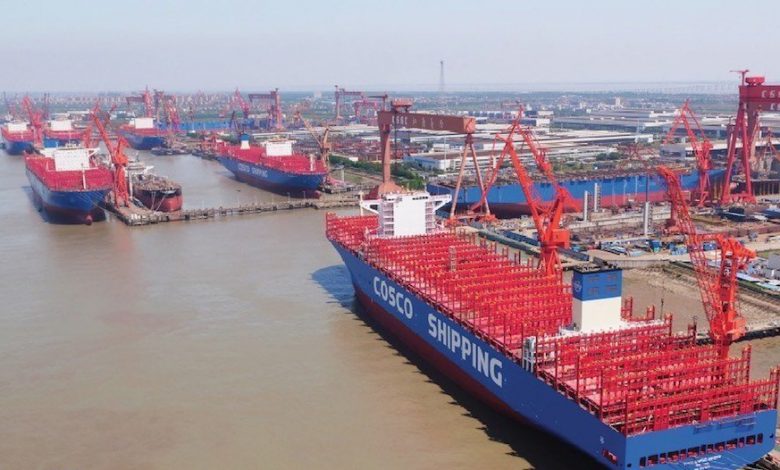
China is building a commanding lead over Greece as the world’s largest shipowning nation, its lead now stretching to close to 30m gt, according to the latest data from Clarksons Research.
It was in August last year that China surpassed Greece as the nation with world’s largest merchant fleet in gross tonnage (gt) terms, and since then shipowners in the People’s Republic have topped the charts in vessel acquisitions, while also being major clients of shipyards.
The Chinese commercial fleet now stands at 282.9m gt according to Clarksons, with Greece in second place on 254m gt. Moreover, Chinese owners have a larger combined orderbook – 46.7m gt – than their Greek counterparts on 35.4m gt.
In the year to date, Chinese owners have bought 496 secondhand ships, far more than Greece’s total of 2006.
From around one-twentieth of the world total in the early 2000s, the China-owned merchant ship fleet now comprises more than one-seventh, following remarkable growth over two decades. During the past decade the capacity of the China-owned merchant ship fleet has more than doubled.
It is not just shipowning where China leads the world in shipping. Its shipbuilders have outmuscled South Korea into top spot, its port operators now have a massive global footprint while the People’s Republic has become a vital source of ship financing over the past decade.

.It's impressive that Greece plays that large of a role considering its small size.
sometimes I wish we had data on specific regions too - like which part of china, which part of India or france, gemany, italy weren't a single country for a good chunk of human history, Russia was much smaller back than
that'd be complicated for economist/historians to figure out
but cool at the same

.
List of princely states of British India (by region)
View attachment 66956
Before the Partition of India in 1947, about 584 princely states, also called "native states", existed in India.<a href="https://en.wikipedia.org/wiki/List_of_princely_states_of_British_India_(by_region)#cite_note-1" target="_blank">[1]</a> These were not part of British India, the parts of the Indian subcontinent which were under direct British administration, but rather under indirect rule, subject to subsidiary alliances.
Things moved quickly after the partition of British India in 1947. By the end of 1949, all of the states had chosen to accede to one of the newly independent states of India or Pakistan or else had been conquered and annexed.
List of princely states of British India (by region) - Wikipedia
Western countries 'lie' about their economic data. We find USA missing top 10 economies if it's GDP is measured accurately, similar to IndiaMost think tanks have been suggesting for two decades that this century 21st will see Asia rose again and overtake the west as economic dominance
Not sure it will happen as they say but yes the brics nations and others are growing much faster now
Everybody expected china to overtake USA and in the last five years the gap has widened again in favour of USA again so we just don't know for sure
How the hell did old India get enslaved by tiny Britain and before that the mughals etc when they were so rich in gdp
sometimes I wish we had data on specific regions too - like which part of china, which part of India or france, gemany, italy weren't a single country for a good chunk of human history, Russia was much smaller back than
that'd be complicated for economist/historians to figure out
but cool at the same

....thereby leading to the expression Red Pakistanis.Either he was not looking for India since it didn't exist pre-British or he was looking for Pakistan..So I am told.

Either he was not looking for India since it didn't exist pre-British or he was looking for Pakistan..So I am told.
I think - I may be wrong - that our friend was being heavily sarcastic.He was looking for a shortcut to "the Indies" not "specifically" India.
It's like the term "Middle East". It's not referring to a country but a region.
For instance he would have mistakenly called the people he saw in the New World "Middle Easterners" but in his case he called them "the Indians".
with Mughal, Sikh empire was also worth noticing, who also surrendered to British Empire by 1849
.
=>
The Sikh Empire was a regional power based in the Punjab region of South Asia.[8] It existed from 1799, when Maharaja Ranjit Singh captured Lahore, to 1849, when it was defeated and conquered by the British East India Company in the Second Anglo-Sikh War. It was forged on the foundations of the Khalsa from a collection of autonomous misls.[1][9] At its peak in the 19th century, the empire extended from Gilgit and Tibet in the north to the deserts of Sindh in the south and from the Khyber Pass in the west to the Sutlej in the east as far as Oudh.[10][11] It was divided into four provinces: Lahore, which became the Sikh capital; Multan; Peshawar; and Kashmir from 1799 to 1849. Religiously diverse, with an estimated population of 4.5 million in 1831 (making it the 19th most populous country at the time),[12] it was the last major region of the Indian subcontinent to be annexed by the British Empire. Some of the notable Commander-in-Chief of the Sikh Empire were Misr Diwan Chand, Hari Singh Nalwa and Diwan Mokham Chand.

Sikh Empire - Wikipedia
en.wikipedia.org
=> Sikh Empire, the map of India at 1839:
View attachment 205
 ), was continuously higher than other countries since 1st century till early 20th century, the first few posts of references of 'The Atlanta' and 'The Economics' and 'Wikipedia/ post#13 & #27'
@Fatman17The thing is that Bharat was never a name for a State. But a name for a region. Just like Africa is the modern name of a region, and not a united African realm.
Even during the Mughal high tide, there was never a united Subcontinent. The brits actually managed something unique in that regard; uniting all of south asia into a single polity.