Again, you are confusing two different things. Trade deficit and economic growth are NOT same thing and are very losely related to each other.
Take example of Singapore. From 65-84 Singapore experienced massive growth while its Current account balance was in negative and MASSIVELY negative.
GDP Growth:
View attachment 80985
Current account balance
View attachment 80984
There's actually economic logic to why Singapore has large current account deficit back then. We needed huge investments to grow but we had insufficient savings, so we had to run a current account deficit to finance our investments.
5.3 Why does Singapore have a current account surplus?
The current account should be understood in the context of the evolution of national saving and domestic investment. Long-term trends in Singapore’s saving and investment rates are well explained by the shifting stages of Singapore’s development, its demographics, as well as the fact that as a small country, risk diversification dictates that it invests a portion of its saving abroad.
Charts 5.2 and 5.3 show Singapore’s saving-investment gap, as well as its constituent series, scaled by Gross National Disposable Income (GNDI).
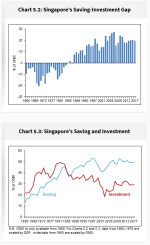
In the early stages of development after independence in 1965, Singapore had a young population and a rapidly growing economy. As domestic investment needs could not be met with national saving alone, foreign capital was sought to finance this investment. Singapore ran a current account deficit until the mid-1980s, which enabled the rapid build-up of capital stock in the economy and the catch-up of labour productivity and incomes to near-developed economy levels. (Chart 5.3)
Subsequently, Singapore switched to a current account surplus, as saving rose while the need for domestic investment moderated.
As the economy matured, the rate of investment in fixed capital declined, as signalled by a fall in the returns to capital. At the same time, national saving has grown in line with rising incomes and as Singaporeans stepped up saving for old age. Singapore has a fully-funded, defined contribution pension scheme called the Central Provident Fund (CPF) in which Singaporeans save for retirement and medical needs.
In addition, the government had deemed it prudent from the beginning that Singapore diversify some of its saving abroad. Singapore is a small economy, and cannot diversify its risk domestically, unlike a large country. As an economy with no natural resources, there is also a need to preserve Singapore’s international purchasing power during crises, since a large proportion of domestic consumption is imported.
Thus, Singapore’s economic development and the shift in demographics over the years resulted in it having a current account surplus since the mid-1980s, which gradually rose to a peak of 27% of GNDI in 2007 before trending down to an average of around 20% of GNDI in recent years.
Over the last decade, the trend growth rate of the maturing Singapore economy has slowed, while expenditure to provide for an ageing population has grown. This demographic-driven trajectory of the current account surplus has been broadly as predicted.
Singapore’s current account trajectory is thus the outcome of shifting saving and investment behaviours in the domestic economy.