Syrian Civil War and The future of Syria after liberation

Assad’s final hours in Syria: Deception, despair and flight

Reuters
December 14, 2024

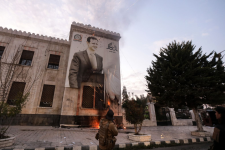
A shoe rests on top of a bust of former Syrian president Hafez al-Assad, as fighters of the ruling Syrian body inspect the damage at a military site, in the aftermath of an Israeli strike according to Syrian Observatory for Human Rights, after fighters of the ruling Syrian body ousted Syria’s Bashar al-Assad, in Damascus, Syria on December 14. — Reuters


A shoe rests on top of a bust of former Syrian president Hafez al-Assad, as fighters of the ruling Syrian body inspect the damage at a military site, in the aftermath of an Israeli strike according to Syrian Observatory for Human Rights, after fighters of the ruling Syrian body ousted Syria’s Bashar al-Assad, in Damascus, Syria on December 14. — Reuters

Bashar al-Assad confided in almost no one about his plans to flee Syria as his reign collapsed. Instead, aides, officials and even relatives were deceived or kept in the dark, more than a dozen people with knowledge of the events told Reuters.

Hours before he escaped for Moscow, Assad assured a meeting of about 30 army and security chiefs at the defence ministry on Saturday that Russian military support was on its way and urged ground forces to hold out, according to a commander who was present and requested anonymity to speak about the briefing.

Civilian staff were none the wiser, too.

Assad told his presidential office manager on Saturday when he finished work he was going home but instead headed to the airport, according to an aide in his inner circle.

He also called his media adviser, Buthaina Shaaban, and asked her to come to his home to write him a speech, the aide said. She arrived to find no one was there.

“Assad didn’t even make a last stand. He didn’t even rally his own troops,” said Nadim Houri, executive director of the Arab Reform Initiative regional think-tank. “He let his supporters face their own fate.”

Reuters was unable to contact Assad in Moscow, where he has been granted political asylum. Interviews with 14 people familiar with his final days and hours in power paint a picture of a leader casting around for outside help to extend his 24-year rule before leaning on deception and stealth to plot his exit from Syria in the early hours of Sunday.

Most of the sources, who include aides in the former president’s inner circle, regional diplomats and security sources and senior Iranian officials, asked for their names to be withheld to freely discuss sensitive matters.
 
Assad didn’t even inform his younger brother, Maher, commander of the Army’s elite 4th Armoured Division, about his exit plan, according to three aides. Maher flew a helicopter to Iraq and then to Russia, one of the people said.

Assad’s maternal cousins, Ehab and Eyad Makhlouf, were similarly left behind as Damascus fell to the rebels, according to a Syrian aide and Lebanese security official.

The pair tried to flee by car to Lebanon but were ambushed on the way by rebels who shot Ehab dead and wounded Eyad, they said. There was no official confirmation of the death and Reuters was unable to independently verify the incident.

Assad himself fled Damascus by plane on Sunday, Dec 8, flying under the radar with the aircraft’s transponder switched off, two regional diplomats said, escaping the clutches of rebels storming the capital. The dramatic exit ended his 24 years of rule and his family’s half a century of unbroken power, and brought the 13-year civil war to an abrupt halt.

He flew to Russia’s Hmeimim airbase in the Syrian coastal city of Latakia, and from there onwards towards Moscow.

Assad’s immediate family, wife Asma and their three children, were already waiting for him in the Russian capital, according to three former close aides and a senior regional official.

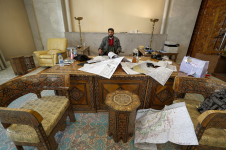
Videos of Assad’s home, taken by rebels and citizens who thronged the presidential complex following his flight and posted on social media, suggest he made a hasty exit, showing cooked food left on the stove and several personal belongings left behind, such as family photo albums.
 

Russia and Iran: No military rescue​

Dawn

There would be no military rescue from Russia, whose intervention in 2015 had helped turn the tide of the civil war in favour of Assad, or from his other staunch ally Iran.

This had been made clear to the Syrian leader in the days leading up to his exit, when he sought aid from various quarters in a desperate race to cling to power and secure his safety, according to the people interviewed by Reuters.

Assad visited Moscow on Nov 28, a day after Syrian rebel forces attacked the northern province of Aleppo and lightning drive across the country, but his pleas for military intervention fell on deaf ears in the Kremlin which was unwilling to intervene, three regional diplomats said.

Hadi al-Bahra, the head of Syria’s main opposition abroad, said that Assad didn’t convey the reality of the situation to aides back home, citing a source within Assad’s close circle and a regional official.

“He told his commanders and associates after his Moscow trip that military support was coming,” Bahra added. “He was lying to them. The message he received from Moscow was negative.”

Kremlin spokesman Dmitry Peskov told reporters on Wednesday that Russia had spent a lot of effort in helping stabilise Syria in the past but its priority now was the conflict in Ukraine.

Four days after that trip, on Dec 2, Iranian Foreign Minister Abbas Araqchi met with Assad in Damascus. By that time, the rebels from the Hayat Tahrir al-Sham (HTS) Islamist group had taken control of Syria’s second-largest city Aleppo and were sweeping southwards as government forces crumbled.

Assad was visibly distressed during the meeting, and conceded that his army was too weakened to mount an effective resistance, a senior Iranian diplomat told Reuters.

Assad never requested that Tehran deploy forces in Syria though, according to two senior Iranian officials who said he understood that Israel could use any such intervention as a reason to target Iranian forces in Syria or even Iran itself.

The Kremlin and Russian foreign ministry declined to comment for this article, while the Iranian foreign ministry was not immediately available to comment.
 

Assad confronts own downfall​


Dawn

After exhausting his options, Assad finally accepted the inevitability of his downfall and resolved to leave the country, ending his family’s dynastic rule which dates back to 1971.

Three members of Assad’s inner circle said he initially wanted to seek refuge in the United Arab Emirates, as rebels seized Aleppo and Homs and were advancing towards Damascus.

They said he was rebuffed by the Emiratis who feared an international backlash for harbouring a figure subject to US and European sanctions for allegedly using chemical weapons in a crackdown on insurgents, accusations that Assad has rejected as a fabrication.

The UAE government didn’t immediately respond to a request for comment.

Yet Moscow, while unwilling to intervene militarily, was not prepared to abandon Assad, according to a Russian diplomatic source who spoke on condition of anonymity.

Russia’s Foreign Minister Sergei Lavrov, attending the Doha forum in Qatar on Saturday and Sunday, spearheaded the diplomatic effort to secure the safety of Assad, engaging Turkey and Qatar to leverage their connections to HTS to secure Assad’s safe exit to Russia, two regional officials said.

One Western security source said that Lavrov did “whatever he could” to secure Assad’s safe departure.

Qatar and Turkey made arrangements with HTS to facilitate Assad’s exit, three of the sources said, despite official claim by both countries that they had no contacts with HTS, which is designated by the US and the UN as a terrorist organisation.

Moscow also coordinated with neighbouring states to ensure that a Russian plane leaving Syrian airspace with Assad on board would not be intercepted or targeted, three of the sources said.
 
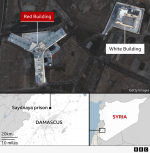
"Everything was banned. You're just allowed to eat and drink and sleep and die," says Qasem.

BBC

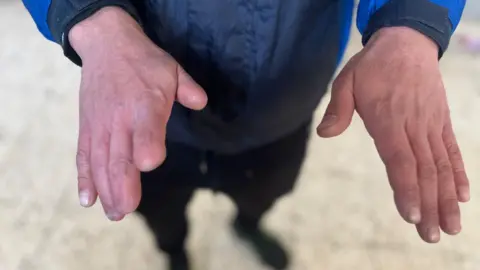
The guide holds out his hands showing a shortened and grown over thumb, index and middle finger on his right hand


The BBC's guide says his fingers were chopped off as torture
Punishments at Saydnaya were frequent and brutal.

All of the people we spoke to described being beaten with different implements - metal staffs, cables, electric sticks.

"They would enter the room and start to beat us all over our bodies. I would stay still, watching and waiting for my turn," Adnan, who was arrested in 2019 on accusations of kidnapping and killing a regime soldier, recalls.

"Every night, we would thank God that we were still alive. Every morning, we would pray to God, please take our souls so we can die in peace."

Adnan and two of the other newly released inmates said they were sometimes forced to sit with their knees towards their foreheads and a vehicle tyre placed over their bodies with a stick wedged inside so they couldn't move, before beatings were administered.

Forms of punishment were varied.

Qasem says he was held upside down by two prison officers in a barrel of water until he thought he was going to "choke and die".

"I saw death with my own eyes," he says. "They would do this if you woke up in the night, or we spoke in a loud voice, or if we had a problem with any of the other prisoners."
 

What lies ahead for Assad and his family?​

19 hours ago
Sam Hancock
BBC News

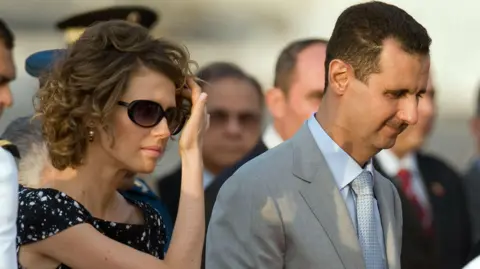
Getty Images Asma al-Assad, who has short curly hair and is wearing sunglasses and a black outfit, touches her hair. Her husband Bashar is wearing a light grey suit and tie. This is a stock photo from 2010.


Deposed Syrian president Bashar al-Assad and his wife Asma are currently in Russia (file photo)

When Bashar al-Assad was toppled on Sunday, it turned the page on not only his 24-year presidency but on more than 50 years of his family ruling Syria.

Before Assad took office in 2000, his late father Hafez was president for three decades.

Now, with rebels led by the Islamist militant group Hayat Tahrir-al Sham (HTS) forming a transitional government, the future of the deposed president, his wife and their three children is uncertain.

They are now in Russia, where they have been offered asylum, but what lies ahead for them?

Why did Assad flee to Russia?​

Russia was a staunch ally of Assad during Syria's civil war and has two key military bases in the Middle Eastern country.

In 2015, Russia launched an air campaign in support of Assad that turned the tide of the war in the government's favour.

A UK-based monitoring group reported that more than more than 21,000 people, including 8,700 civilians, were killed in Russian military operations over the following nine years.

However, distracted by its war in Ukraine, Russia was either unwilling or unable to help Assad's government stop the rebel's lightning offensive after it began in late November.

Hours after rebel forces seized control of Damascus, it was reported by Russian state media that Assad and his family had arrived in Moscow and that they would be granted asylum on "humanitarian grounds".

But when Kremlin spokesman Dmitry Peskov was asked about Assad's whereabouts and asylum claim by reporters on Monday, he said: "I have nothing to tell you... right now. Of course, such a decision [on granting asylum] cannot be made without the head of state. It is his decision."

The Assads' ties to Russia, specifically Moscow, are well-documented.

A 2019 investigation by the Financial Times found that Assad's extended family had purchased at least 18 luxury apartments in the Russian capital, in a bid to keep tens of millions of dollars out of Syria during the civil war.

Meanwhile, Assad's eldest son, Hafez, is a PhD student in the city - with a local newspaper reporting just last week about the 22-year-old's doctoral dissertation.

Amid the chaos at the weekend, Russian state TV reported that officials in Moscow were in talks with "the Syrian armed opposition" to secure Russia's bases and diplomatic missions.
 
His "job" was never to fire a single bullet at the entity as he was in no position to go to war with it.

And who was this 'employer' of this 'job' of his? What were the Russians doing there? They certainly did not engage Israeli jets that violated Syrian airspace and defend Syria's territory.

The moment I read that the Russians and the Israelis had some 'understanding', that was when I realized that the Syrians in general are in for a lot of trouble. Big trouble. That was the point where the most damage was inflicted on Syria's sovereignty. We are seeing the results now. This is bad omen.

The fact that Hamas did not like him is telling.

Allowing supply to Hezbollah was more than any other Arab state was doing.

And this will weaken the Zionists, how? You know that is insufficient to weaken the Zionist regime.

I have no idea why people do not think at any more than a surface level when it comes to what Assad could realistically do.

You asked for 'concrete evidence', and it was presented here here in some form or another from credible sources from way back since 2010's.

There are challenges up ahead, yes. And they will have to take their chances. But one thing's for certain is that they will be better off without the Assad family in charge. This is why rulers who see their own nation as personal property never work in the long run.
 

Why Israel captured Syria’s tallest mountain just hours after Assad fell​


By Mick Krever, CNN
December 14, 2024

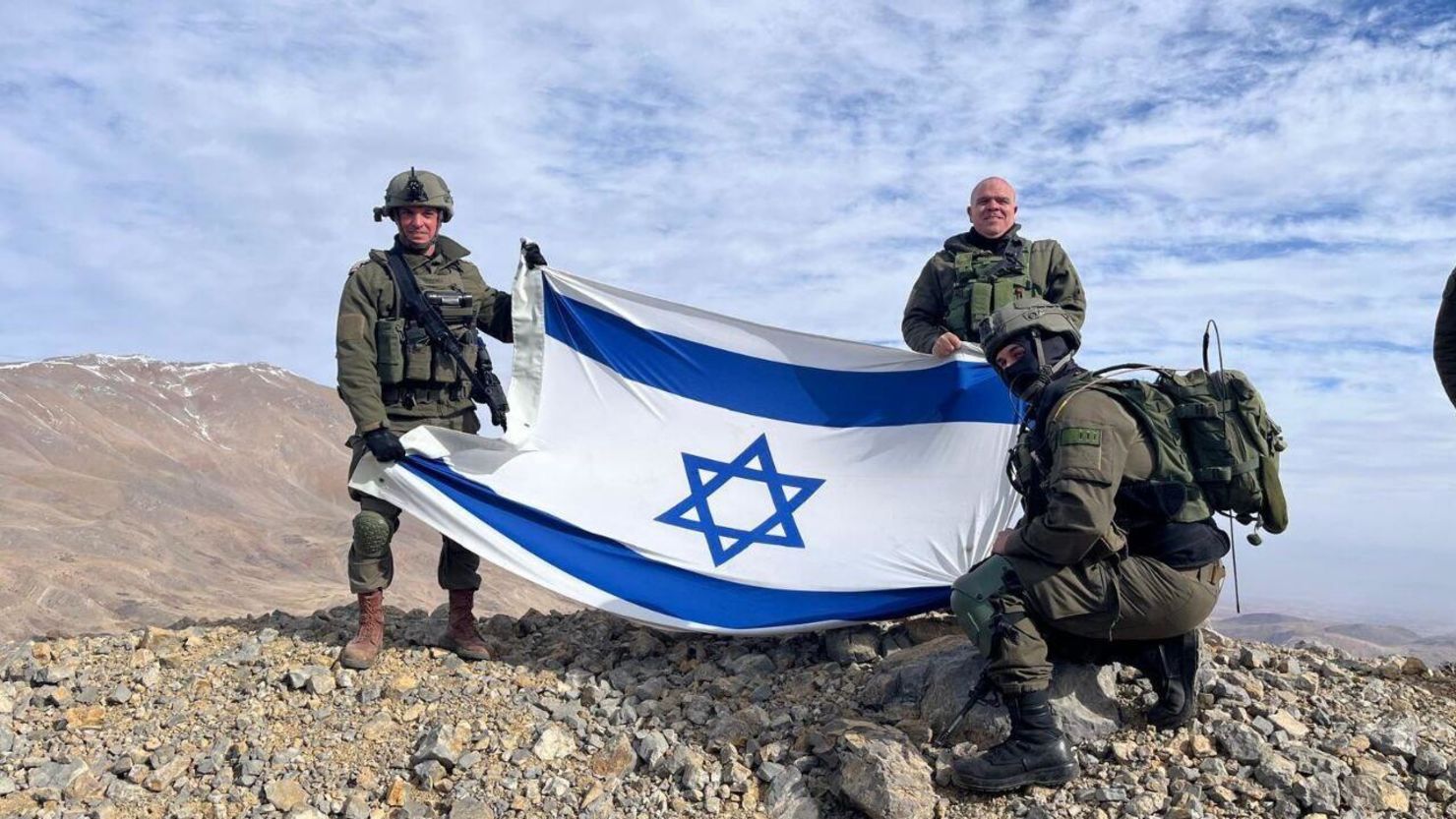
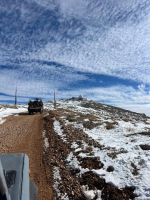
Israeli soldiers stand on Mount Hermon, in Syria, after Prime Minister Benjamin Netanyahu ordered the military to retake a demilitarized zone.


Israeli soldiers stand on Mount Hermon, in Syria, after Prime Minister Benjamin Netanyahu ordered the military to retake a demilitarized zone.
Social Media
CNN —
Israel wasted no time after Bashar al-Assad’s fall to bomb all the Syrian military assets it wanted to keep out of the rebels’ hands – striking nearly 500 targets, destroying the navy, and taking out, it claims, 90% of Syria’s known surface-to-air missiles.

But it is Israel’s capture of Syria’s highest peak, the Mount Hermon summit, that may prove among the most lasting prizes – though officials have insisted that its occupation is temporary.

“This is the highest place in the region, looking upon Lebanon, upon Syria, Israel,” said Efraim Inbar, director of the Jerusalem Institute for Strategy and Security (JISS). “It’s strategically extremely important. There is no substitute for mountains.”

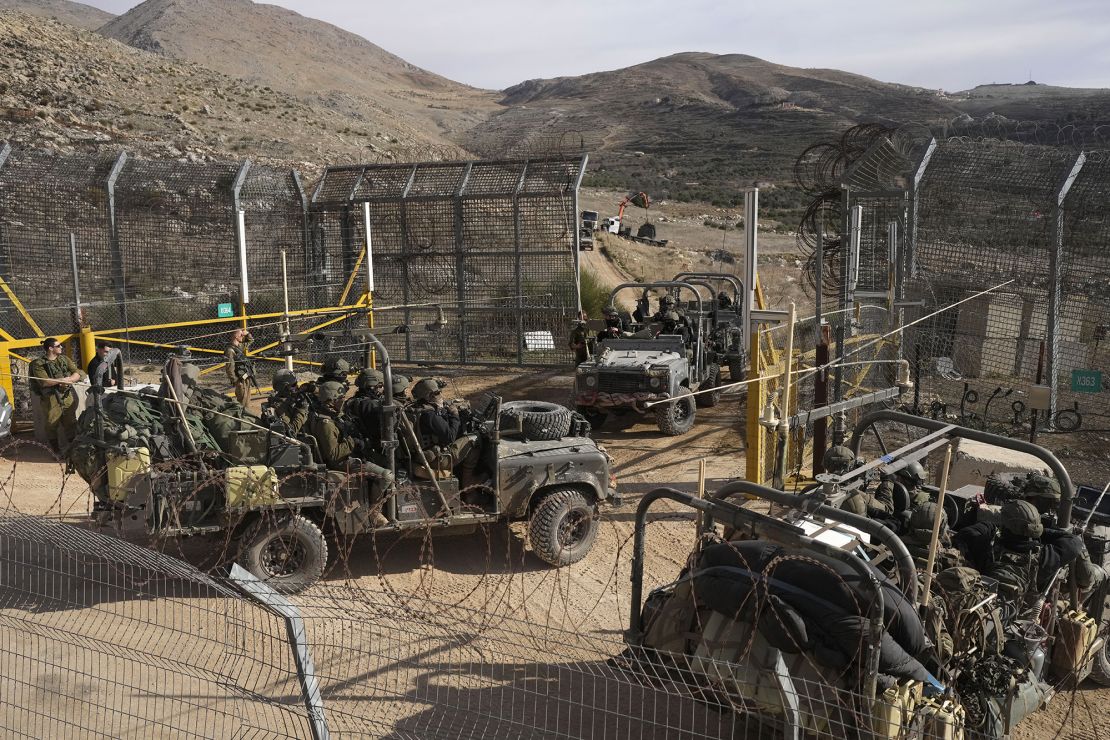
Israeli armored vehicles at the demilitarized buffer zone in the Golan Heights.


Israeli armored vehicles at the demilitarized buffer zone in the Golan Heights.
Matias Delacroix/AP

The summit of Mount Hermon lies in Syria, in a buffer zone that separated Israeli and Syrian forces for fifty years until last weekend, when Israeli troops took control of it. Until Sunday, the summit was demilitarized and patrolled by UN peacekeepers – their highest permanent position in the world.

Israel’s defense minister, Israel Katz, on Friday ordered the military to prepare for the harsh conditions of winter deployment. “Due to developments in Syria, it is of immense security importance to maintain our control over the summit of Mount Hermon,” he said in a statement.

The Israel Defense Forces (IDF) has advanced beyond the summit, as far as Beqaasem, about 25 kilometers (15.5 miles) from the Syrian capital, according to Voice of the Capital, a Syrian activist group. CNN could not independently confirm that claim. An Israeli military spokesperson this week denied that forces were “advancing toward” Damascus.

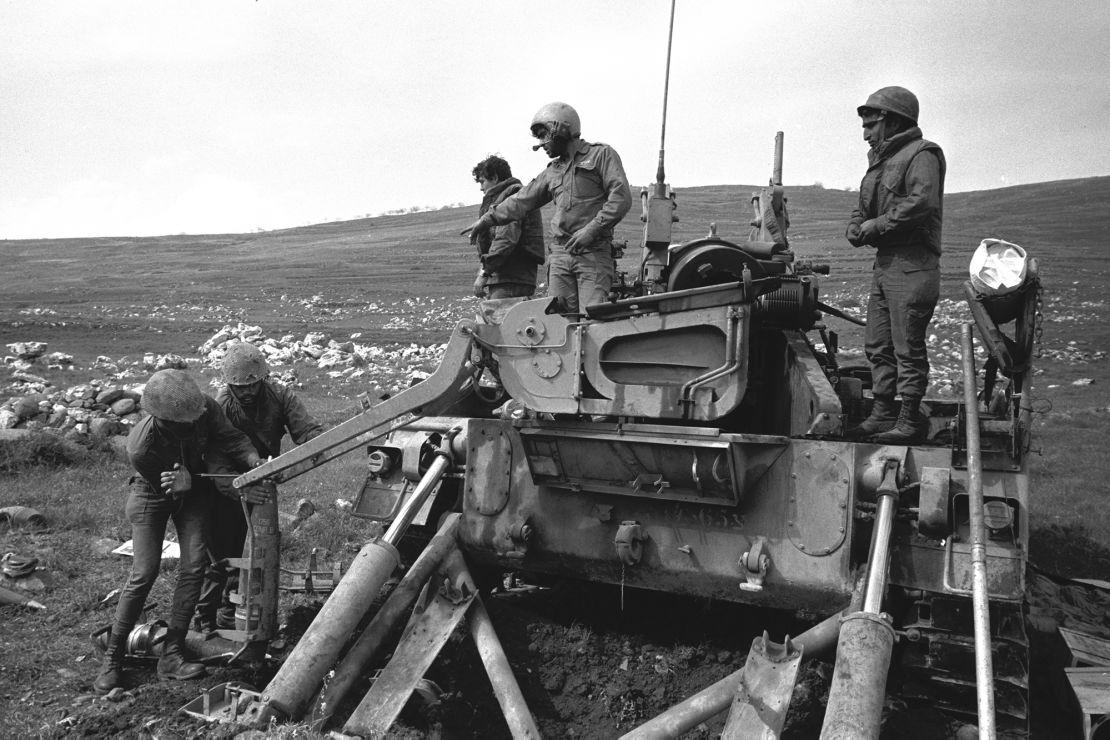
Israeli artillery on Mount Hermon in 1974.


Israeli artillery on Mount Hermon in 1974.
Alain Dejean/Sygma/Getty Images

Israel captured the Golan Heights, a strategic plateau in southwestern Syria that abuts Mount Hermon, in the 1967 war and has occupied it since. Syria attempted to retake the territory in a surprise attack in 1973, but failed, and Israel annexed it in 1981. The occupation is illegal under international law, but the United States recognized Israel’s claim on the Golan during the Trump administration.

Israel has for decades held some lower slopes of Mount Hermon, and even operates a ski resort there, but the peak remained in Syria proper.
 
1734188204959.png
Israeli military forces on Mount Hermon on Sunday.

The peak is just over 35 kilometers (about 22 miles) from Damascus, which means that control of its Syrian foothills – also now in IDF hands – put the Syrian capital within range for artillery cannons.

The Israeli prime minister has said his “hand is extended” to the new government in Syria. But in the post-October 7 world, he and other national security heavyweights have made clear they are not going to take any chances.

“Mostly, it’s a comfort for us,” retired Brigadier General Israel Ziv said of Israel’s operations in Syria. “We have learned what happened in other countries when you have a terror organization that captures military equipment.”

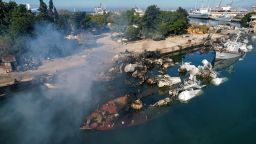
Syrian naval ships destroyed in an overnight Israeli attack on the port city of Latakia. Israel's defense minister hailed the operation as a great success.


Netanyahu has also insisted that the occupation is temporary. “Israel will not permit jihadi groups to fill that vacuum and threaten Israeli communities on the Golan Heights with October 7 style attacks,” he said. His criteria for withdrawing, he said, was a Syrian force “that is committed to the 1974 agreement can be established and security on our border can be guaranteed.”

It is unclear when that may be achieved.

Whether the military withdraws “is a political decision,” Inbar said. “The military would love to stay there.”

Mike Schwartz and Tim Lister contributed to this report.
 
I think your English is not good enough for this forum or you are trolling here by misrepresenting my posts on purpose.
This is not competition in literacy and i am aware of my english language limitations, beside that i think that i am clear more then enough in my opinions and statements.
How so i am misrepresenting your opinion, are you not advocating for assad regime staying regardless it's diabolic and twisted nature for the sake of AoR, that is my friend clear ill intention towards syrians as collective.
 
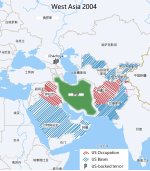
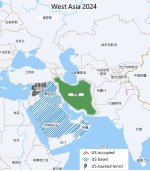
People who are worried about the fall of Syria, should remember what West and Central Asia looked like in 2004, when Russia and China were far weaker. Iran is now much safer than it was back then, when it was literally encircled. Now it's facing a one-front war.
1734188891490.jpeg
1734188908718.jpeg
 

Users who are viewing this thread

Pakistan Defence Latest

Latest Posts

Back
Top