HOW CHINA’S RISE HAS TRIGGERED A DECISIVE SHIFT IN GLOBAL TECHNOLOGY-RESEARCH LEADERSHIP FROM WEST TO EAST
November 4, 2024
 By Alexander Jones, International Banker
“China and the United States have effectively switched places as the overwhelming leader in research in just two decades.” That’s the brutally honest assessment delivered by the Australian Strategic Policy Institute (ASPI) shortly after publishing its Critical Technology Tracker on August 28—an assessment that highlights just how far the pendulum has swung from West to East in recent years on the technology front. And despite the tech war between the world’s two leading superpowers having intensified significantly during this period, the Tracker’s results suggest that this is a war that the US may have already lost.
Before even examining the Tracker’s findings, however, it is worth highlighting from the outset that perhaps the most astonishing revelation of all is the source of those findings. An Australian think tank, ASPI is renowned for its frequently hawkish positions towards China, thanks in no small part to the backing it receives from the United States Department of State (DOS), the Australian Department of Defence and some of the biggest US weapons manufacturers. And yet, despite this support, ASPI’s Critical Technology Tracker has recorded a resounding shift in research leadership towards the Asia-Pacific, with China strongly leading those gains.
ASPI defines critical technologies as current or emerging technologies “that have the potential to enhance or threaten our societies, economies and national security”, most of which have applications across a broad range of important sectors, including defence, space, energy, the environment, artificial intelligence (AI), biotechnology, robotics, cyber, computing, advanced materials and key quantum-technology areas. The Critical Technology Tracker covers a hefty 64 of such technologies that “are foundational for our economies, societies, national security, defence, energy production, health and climate security”, focusing specifically on technologies that are early in the science and technology (S&T) lifecycle rather than those already in existence and fielded.
The most recent Tracker also focuses on the highest 10 percent of the most highly cited research publications between 2003 and 2023—a massive expansion from the five-year timeframe covered by last year’s edition of the Tracker (2018-22)—with this year’s results gathered from insights into the countries and institutions—including universities, national labs, companies and government agencies—that are publishing “the greatest share of innovative and high-impact research”.
Having led in just three technologies during the 2003–07 period, this year’s findings reveal that China now leads in a whopping 57 of 64 critical technologies. This is also a sizeable gain from the 52 technologies that China led at the start of 2023, as confirmed by last year’s Critical Technology Tracker—strongly suggesting that the world’s nominally second-biggest economy is only further extending its lead in global technology research at present.
The Tracker credits China’s rapid growth mainly to the gains it has made since the late 2000s, during which Beijing commenced its “Made in China 2025” plan, which saw substantial state financing announced in 2015 for research and development (R&D) in key technologies. On April 30, the
South China Morning Post published an article on the findings of its own investigation into Made in China 2025, revealing that “a large proportion” of the initiative’s 10-year targets had been achieved.
The Hong Kong-based news publication had compiled more than 260 goals previously proposed under the plan, covering 10 key areas involving many highly specialised and complex technologies. It reported that more than 86 percent of those goals had been achieved, with several more on course to be completed later this year or next, while other targets, such as those concerning electric vehicles (EVs) and renewable-energy production, were achieved well ahead of schedule.
“As a direct result of the persistence and advancement of the Made in China 2025 plan, there have been profound changes in Chinese society,” the
Post also confirmed. “The number of EVs bought by Chinese consumers has now surpassed that of fossil fuel vehicles, with the most popular being local brands; the Chinese-made passenger plane C919 has begun serving some of the busiest routes; the widespread adoption of 5G technology allows railway passengers in China to enjoy high-speed internet even when passing through tunnels; China has more smart factories and automated terminals than any other country; high-end phones using domestic chips and operating systems have become bestsellers; and the production capacity of Chinese shipyards has surpassed that of the United States by over 200 times, among others.”
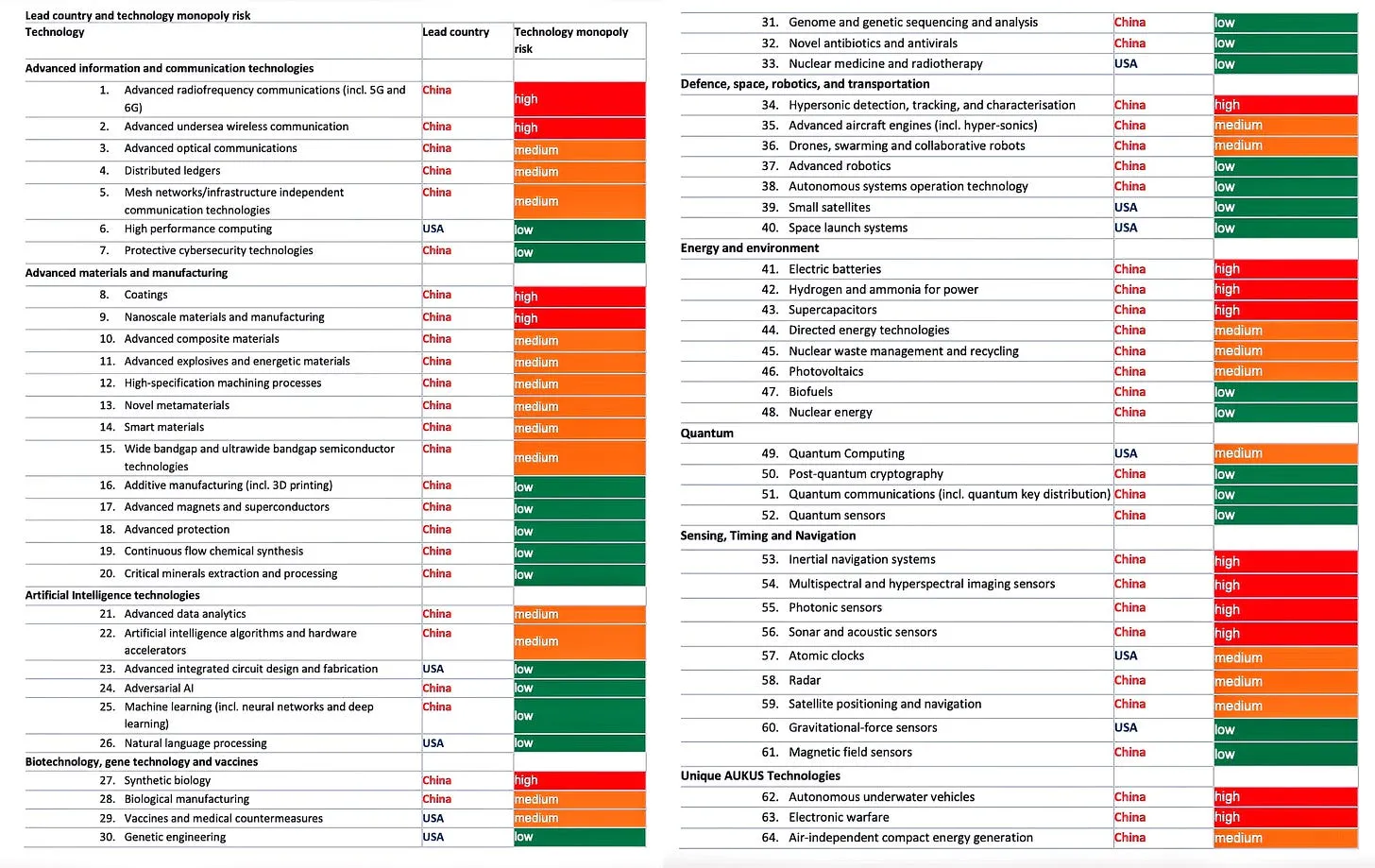
And it is that indisputable surpassing of the US that perhaps most clearly illuminates just how advanced China’s technology credentials are today. As the Critical Technology Tracker stated, the last 21 years of data show that the US has been unable to hold its research advantage. Although it was easily the dominant research power in the mid-2000s—it led in research for 60 out of the 64 technologies between 2003 and 2007—the last couple of decades have seen that lead almost entirely evaporate, such that it now leads in just seven technologies, with quantum computing and vaccine and medical countermeasures still earning the US the top position globally.
Signs of China’s emerging dominance have been growing for some time. A report published in August 2023 by Japan’s Ministry of Education, Culture, Sports, Science and Technology (MEXT), for example, found that in the three years to 2021, not only did China produce 24.6 percent of all scientific-research papers published globally—and 8.5 percent more than the US—it also produced nearly 30 percent of the top 10 percent and top 1 percent most-cited publications. As such, China is now leading in both the quantity and quality of scientific-research material.
It should also be highlighted that the West-to-East shift in technology research does not just stop at the boundaries of the China-US rivalry. Indeed, some of the most significant results from the 2024 Critical Technology Tracker can be found in India’s impressive growth over the 21-year data range, with the burgeoning South Asian economy now ranking in the top 5 countries for 45 of 64 technologies—8 more than last year’s count of 37. Given that the 2003–07 period saw it place in the top 5 countries for just four technologies, it is clear that India has also made stellar gains over the last couple of decades. Although it has not assumed global leadership in any single critical technology thus far—only China and the US do so at present—it has shown strength across a range of technologies, ASPI noted, especially in biofuels and high-specification machining processes.
The West’s waning influence can also be observed in the declining position of the United Kingdom, which has rapidly fallen from ranking in the top 5 countries globally in 44 technologies last year to just 36 countries in 2024. The UK also ranked in the top 5 for 47 technologies between 2003 and 2007. “The technologies in which the UK has fallen out of the top 5 rankings are spread across a range of areas, but are mostly technologies related to advanced materials, sensing and space. For example, the 2003 to 2007 snapshot shows the UK placing 2nd in satellite positioning and navigation and small satellites and 3rd in space launch systems,” the 2024 Critical Technology Tracker noted. “However, recent performance shows the UK placed 6th, 8th and 9th in these technologies, respectively. There have been some gains as well, particularly in defence-related technologies such as electronic warfare and directed energy technologies.”
The Tracker also measured the risk that any country could hold a monopoly in a technology capability in the future, based on the share of high-impact research output and the number of leading institutions in the dominant country. It found that the number of technologies classified as “high risk” in this regard jumped to 24 technologies this year from 14 technologies in 2023. All those 24 technologies, moreover, categorised with this high-risk label specified monopolisation by China.
Nonetheless, China’s dominant position within the global tech-research community is being further cemented with every passing year, a testament in part to Beijing’s long-term planning and unwavering commitment to achieving its goals in this field. “Our results serve as a reminder to governments around the world that building technological capability takes a sustained investment in, and accumulation of, knowledge, innovative skill, talent and high-performing institutions—none of which can be acquired through only short-term investments,” the 2024 Critical Technology Tracker concluded. “In a range of essential sectors, democratic nations risk losing hard-won, long-term advantages in cutting-edge science and research—the crucial ingredient that underpins much of the development and progress of the world’s most important technologies.”